
Written by: Anish Rao, Head of Growth, Listen Labs | Last updated: July 3, 2026
Key Takeaways
- AI-moderated interviews deliver one-on-one depth at quantitative scale by adapting questions in real time for each participant.
- Traditional qualitative research is slow, expensive, fragmented across vendors, and often polluted by professional survey-takers, which turns research teams into bottlenecks.
- A seven-step workflow – study design, sourcing, AI moderation, quality control, emotional signal capture, automated analysis, and instant deliverables – compresses a six-week research cycle into under 24 hours.
- Listen Labs improves participant quality through non-commodity panels, real-time Quality Guard monitoring, strict frequency caps, and a reputation scoring system that strengthens with every study.
- Enterprises like Microsoft, Anthropic, and P&G already use Listen Labs to run qual-at-scale with full traceability and stakeholder-ready outputs in a single day.
Why Traditional Qualitative Research Slows Decisions
Traditional focus groups cost $4,000–$12,000 per 90-minute session and take three to five weeks to complete. In large enterprises, internal prioritization, budget approvals, and research backlogs often stretch that timeline to six months. By the time a report arrives, product decisions have usually been made on instinct.
Beyond speed, the process is fragmented across disconnected vendors, with separate partners for recruitment, scheduling, transcription, and analysis. Each handoff adds delay and increases the risk of quality loss. Commodity panels make the problem worse by admitting professional survey-takers who chase incentives instead of giving honest answers. Even when data arrives clean, qualitative methods still lack speed and sample size, so research leaders must choose between depth and scale instead of getting both.
These compounding inefficiencies create a predictable outcome. Research teams become internal bottlenecks, backlogs grow faster than capacity, and many requests never get fulfilled.
See how to compress your research cycle to under 24 hours with Listen Labs.
How to Run AI Moderated Interviews: 7-Step Workflow
Step 1: Study Design With AI Co-Design
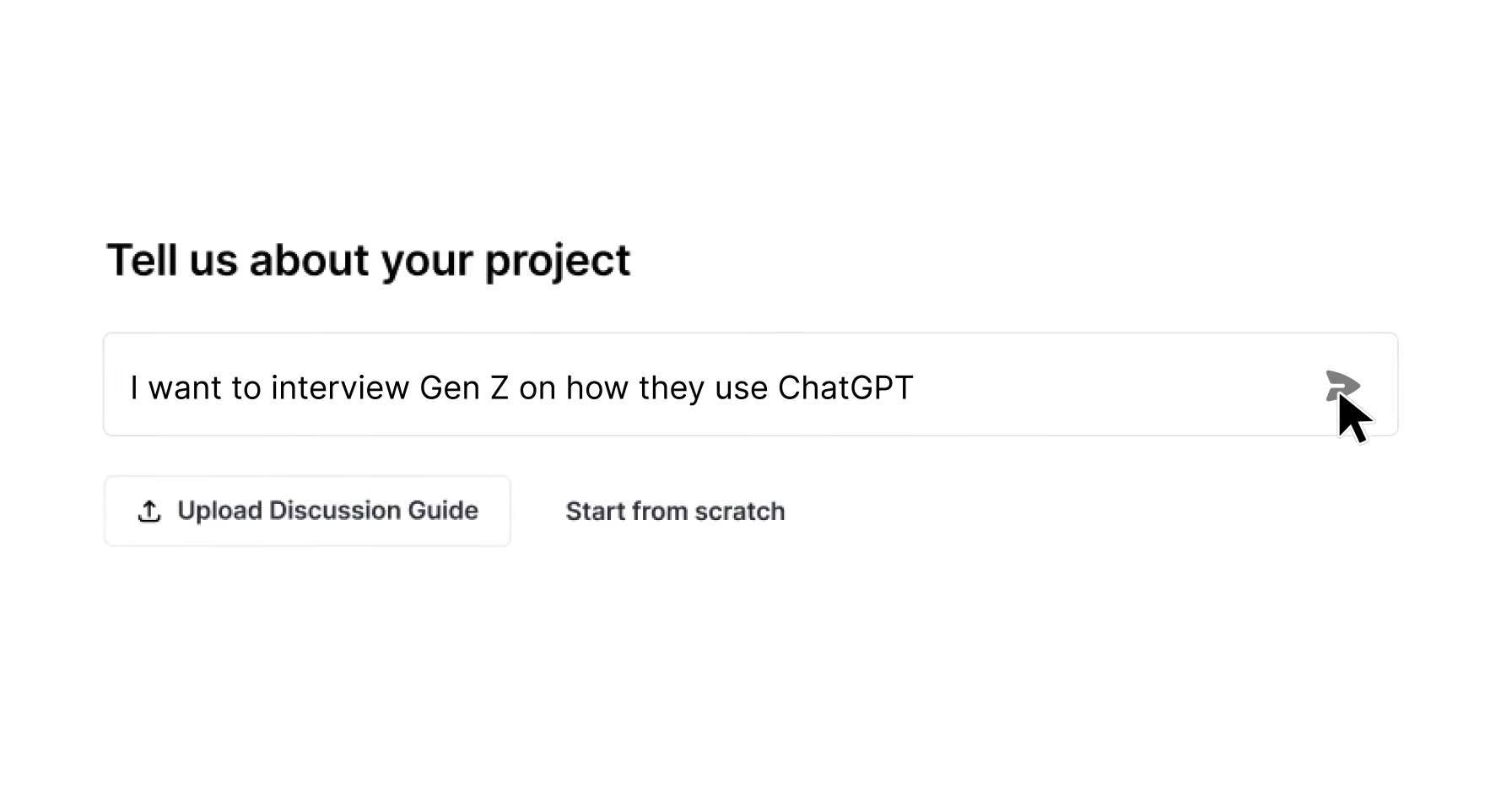
Teams describe research objectives in natural language, then Listen Labs’ AI co-design layer turns that input into structured goals, interview questions, and probing context in seconds. The system draws on proprietary data from tens of thousands of completed studies to suggest proven patterns. Auto-QA flags issues in the guide before launch. Advanced logic such as branching, skip logic, quotas, monadic randomization, and rich stimuli including images, video, PDFs, and live URLs all live in the same interface.
Step 2: Participant Sourcing Across Global Panels
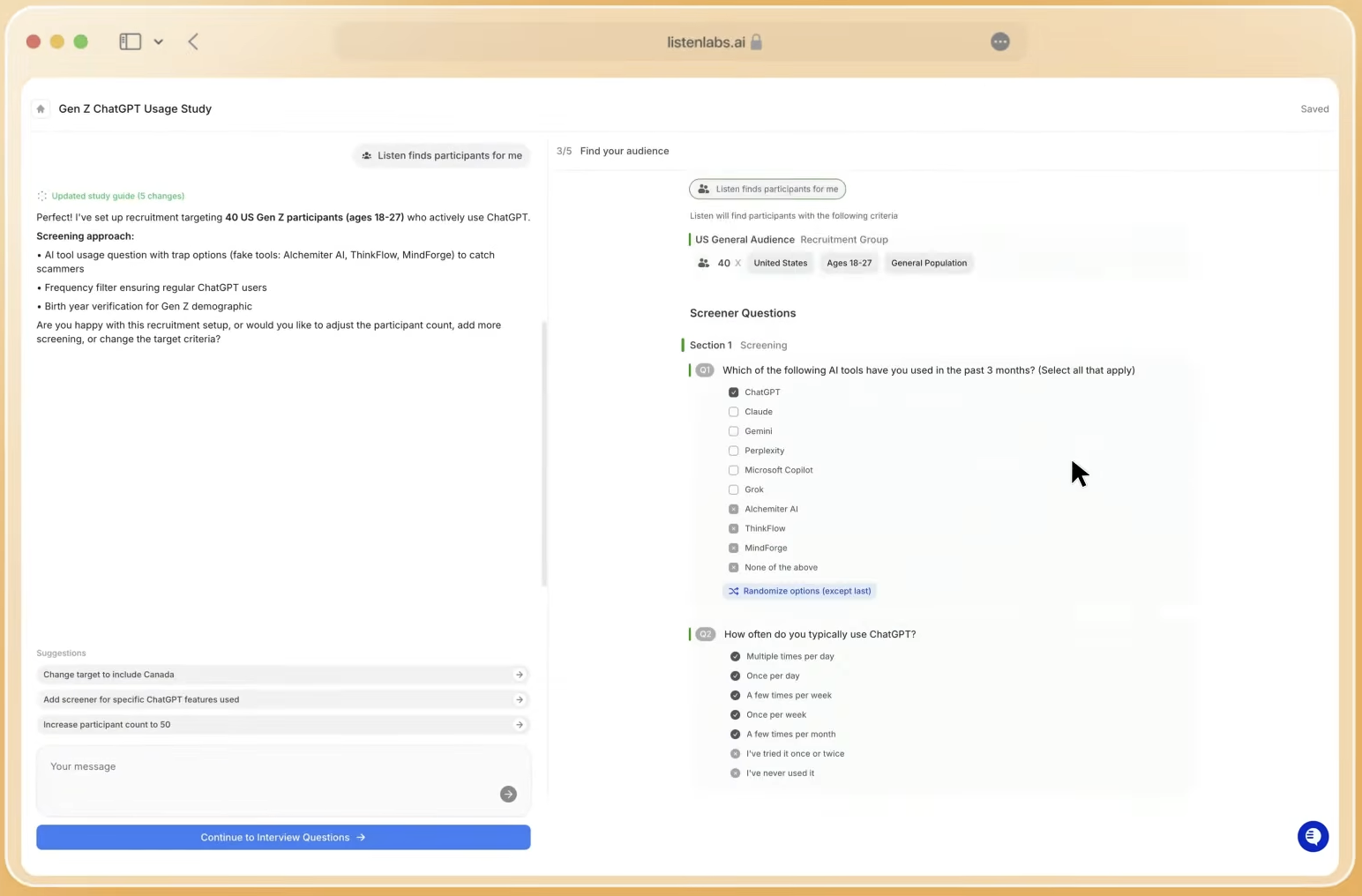
Listen Atlas, the platform’s AI orchestration layer, matches and bids across a global network of 30M verified respondents spanning 45+ countries and 100+ languages. For niche segments such as enterprise decision-makers, healthcare workers, or consumers below 1% incidence, a dedicated recruitment ops team taps specialized networks. Organizations can also bring their own participants at reduced cost while keeping the same workflow.
Step 3: AI-Moderated Interviews in Mixed Formats
AI schedules and runs the interviews, then turns conversations into structured data without requiring a human moderator. The AI probes deeper on short or interesting answers, mirroring how a trained researcher would follow up, while capturing video, audio, text, and screen recordings at the same time. Mixed-method formats such as Likert scales, NPS, and MaxDiff run alongside open-ended questions within a single session.
Step 4: Real-Time Quality Control With Quality Guard
Quality Guard monitors every interview live and flags fraud, low-effort responses, AI-generated scripts, and mismatched profiles. It checks video, voice, content, and device signals together to catch subtle inconsistencies. Participant frequency limits cap involvement at three studies per month, which blocks professional survey-takers before they can distort results.
Step 5: Emotional Signal Capture During Sessions
Emotional Intelligence analyzes three signals: tone of voice, word choice, and subconscious micro expressions to surface emotions that transcripts alone miss. It is built on Ekman’s universal emotions framework and quantifies emotions per question and concept. Each label supports verification through full traceability rather than relying on opaque outputs.
Step 6: Automated Analysis With Research Agent
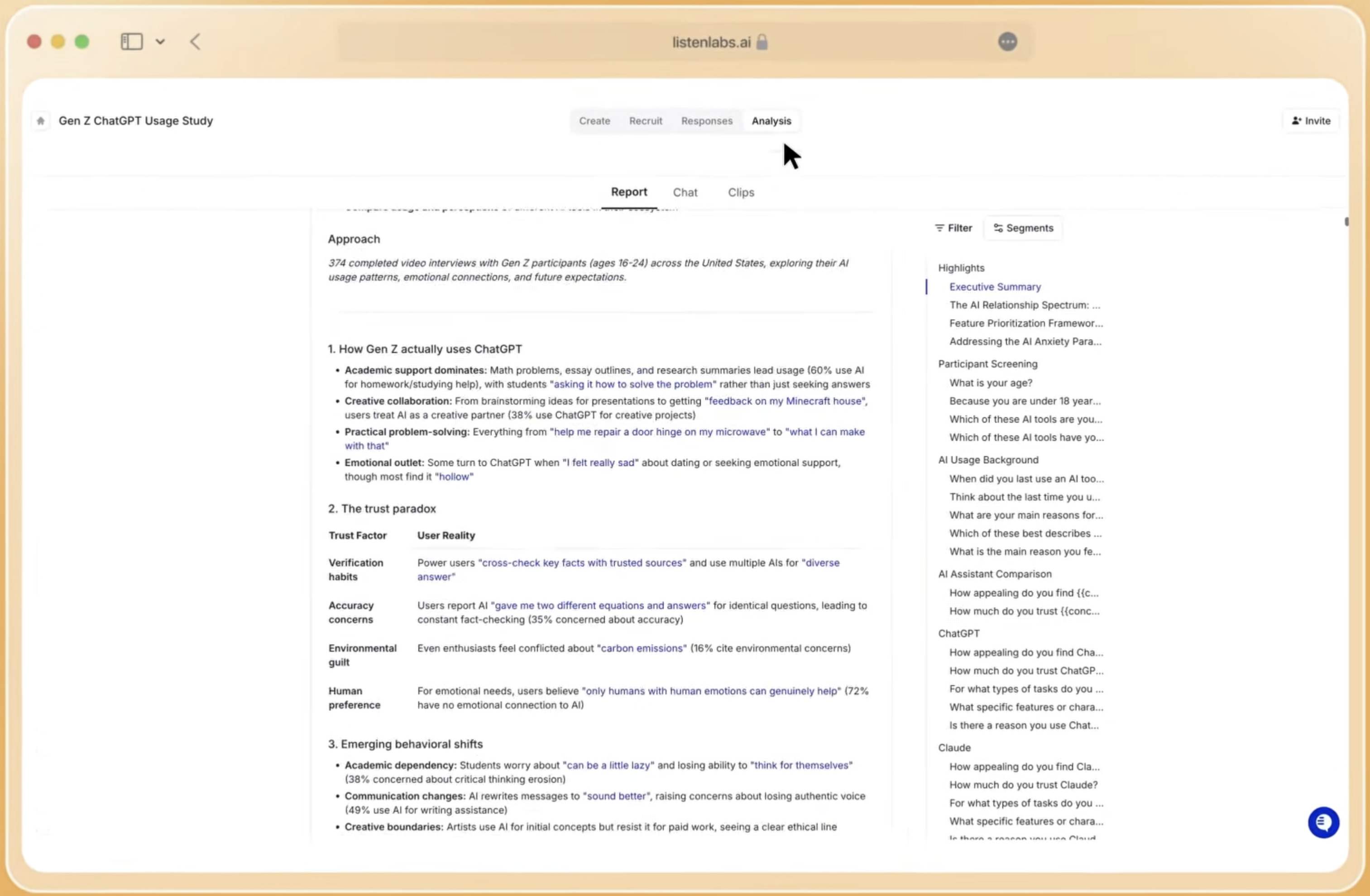
With AI-moderated interviews, talking to users at scale is no longer the hard part, understanding them is. Research Agent processes all interview data objectively and identifies patterns and themes across hundreds of responses. It supports natural-language queries for segmentation, statistical comparisons, and cross-study synthesis, so teams can move directly from questions to evidence-backed answers.
Step 7: Instant Deliverables for Stakeholders
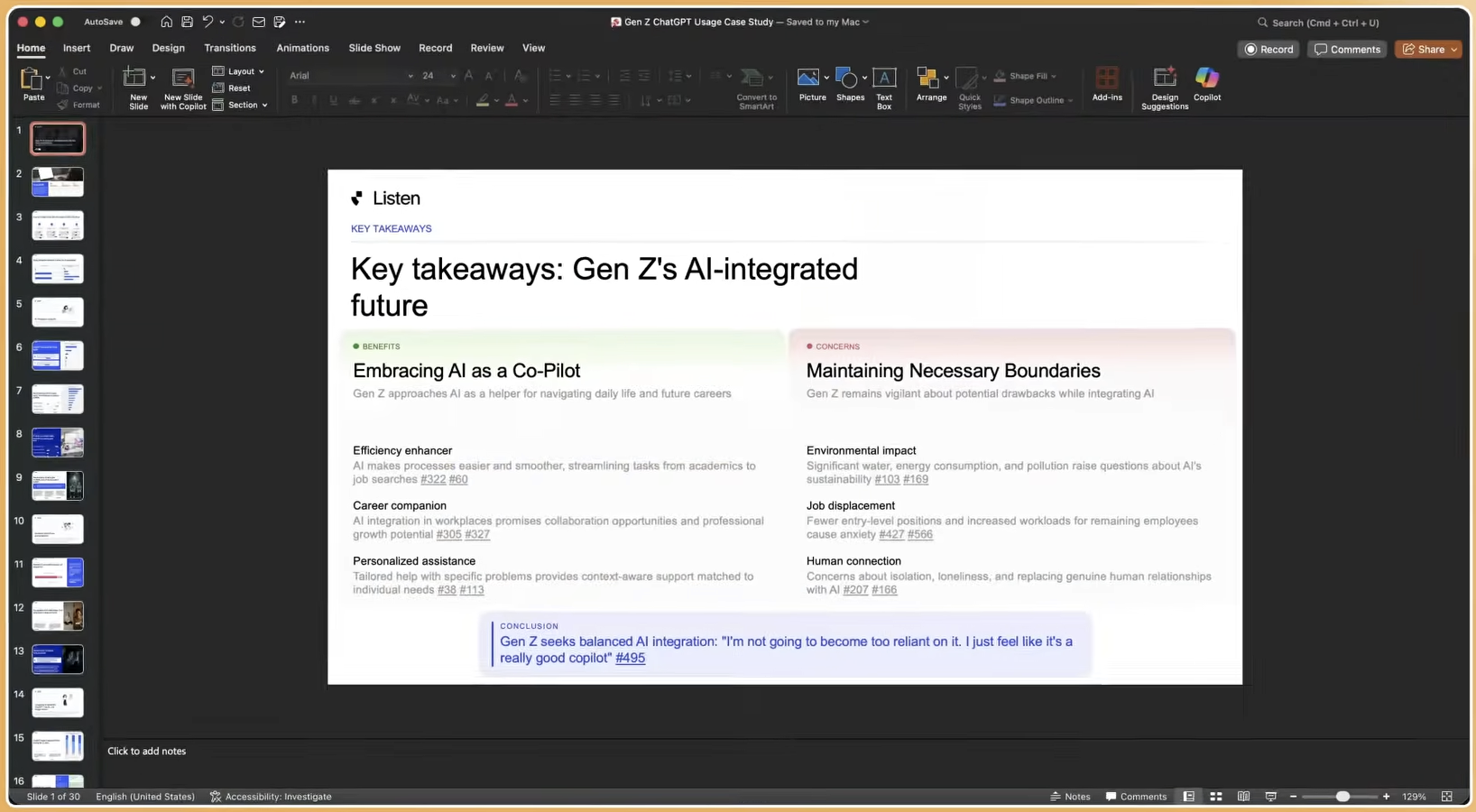
Research Agent generates a slide deck in a company’s branded template and a downloadable report in under a minute. It also produces video highlight reels, memos, charts, and statistical tests. Every output links back to the underlying response data, which gives stakeholders full traceability from insight to verbatim.
How Listen Labs Blocks Professional Survey-Takers
Participant fraud is the most common objection to AI-moderated interviews at scale, and commodity platforms struggle most on this point. Listen Labs addresses the risk through three compounding layers that work together.
First, Listen Labs does not source from commodity quantitative panels. Listen Atlas works only with high-quality, non-commodity panel partners, including NewtonX for B2B segments, alongside a proprietary database. Second, Quality Guard applies real-time behavioral matching based on intent and past actions instead of self-reported demographics, then flags anomalies across video, voice, content, and device signals. Third, a dedicated recruitment ops team adds human review for hard-to-reach segments, and the three-studies-per-month frequency cap prevents panel fatigue and incentive-driven behavior.
Quality Guard also builds a reputation score for every participant across all interviews on the platform. As more studies run, audience quality improves, creating a compounding flywheel that competitors without similar data volume cannot match.
Capturing Emotional Signals Beyond Transcripts
Two concepts can earn the same positive rating while triggering very different emotional reactions. A transcript records what a participant says. It does not capture the frown before an answer, the hesitation before a positive rating, or the widened pupils during a product reveal.
Listen Labs’ Emotional Intelligence layer quantifies emotions per question and concept with full traceability to support verification. The framework tracks anger, anticipation, disgust, fear, joy, sadness, trust, and surprise, the same taxonomy used in clinical psychology and UX research. Enterprise teams apply it to creative testing, concept comparison, usability testing, and brand research across 50+ languages. Results flow directly into Research Agent for natural-language queries, charts, and highlight reels of the most emotionally significant moments.
Experience Emotional Intelligence on your next concept test and see how it transforms creative evaluation.
Enterprise Results From 24-Hour Research Cycles
Listen Labs has run over 1 million AI-powered customer interviews for companies including Microsoft, Perplexity, and Sweetgreen. These enterprise outcomes show what that scale delivers in practice.
At Microsoft, a Director of Data Science needed global customer stories for the company’s 50th anniversary within a day. Listen Labs delivered those user video stories in that timeframe. The leadership team was “very thrilled at both the speed and the scale that Listen Labs enabled,” and the director can now reach hundreds of users at one third of the previous cost.
At Anthropic, the team needed to understand why Claude users cancel subscriptions. Listen Labs surfaced churn drivers through 300+ user interviews in 48 hours, five times faster than previous methods, and delivered a prioritized list of ten must-fix items. The Director of Product Strategy noted that Listen Labs provides clarity and speed on user churn that the team had never experienced before.
At P&G, more than 250 interviews with quantified themes and verbatim proof shaped product and brand strategy in hours, revealing where claims felt exaggerated before launch. At Skims, thousands of premium consumers were identified and qualified overnight to de-risk a global campaign and secure board-level buy-in. At Robinhood, qual interviews showed that users who view prediction markets as entertainment drive 2.4x higher weekly re-engagement, and integration flows boosted uptake 30–40%, with insights delivered five times faster than prior research cycles.
Addressing Common Objections to AI-Moderated Interviews
On AI versus human interview quality: 92% of participants report top comfort levels in both human and AI moderated sessions, and 32% explicitly state they feel less judged with AI moderation. That comfort advantage matters for sensitive topics such as personal finances, health, and brand perception. Listen Labs’ in-house research team, with 50+ years of combined experience, continuously refines the methodology framework.
On fraud risk: Quality Guard’s real-time monitoring across video, voice, content, and device signals, combined with frequency limits and non-commodity panel sourcing, addresses fraud at every stage of the participant lifecycle. Protection extends beyond recruitment and continues through each interview.
On replacing research teams: Listen Labs acts as a force multiplier, not a replacement. By removing the depth-versus-scale trade-off described earlier, existing researchers can focus on strategic analysis and stakeholder influence instead of logistics and moderation scheduling.
Readiness Checklist and Common Pitfalls
Research leaders should confirm enterprise readiness across six dimensions before deploying AI-moderated interviews at scale.
Research quality should be the first checkpoint. Confirm that the platform uses adaptive follow-up questions instead of static surveys dressed as interviews, and verify that the moderation engine probes on unexpected answers. Once the methodology passes that bar, evaluate speed by looking at end-to-end turnaround from study brief to final deliverable, not just interview completion time.
That speed only creates value when paired with cost efficiency. Account for the full vendor stack being replaced, including recruitment, moderation, transcription, analysis, and report writing. These three factors, quality, speed, and cost, must hold up at scale. Confirm that the platform can run hundreds of simultaneous sessions across multiple markets and languages without degrading quality.
At enterprise scale, governance becomes critical. Require documentation of participant frequency limits, fraud detection methodology, and panel sourcing standards. Finally, data security forms the procurement foundation. Require SOC 2 Type II, GDPR, ISO 27001, ISO 27701, and ISO 42001 certifications as a baseline. Listen Labs holds all five, uses 256-bit encryption, and never uses customer data for AI model training.
The most common pitfall is evaluating platforms on interview volume alone. High participant counts mean little if Quality Guard equivalents are missing, emotional signal capture is absent, or deliverables still require extra analyst hours before they are ready for stakeholders.
Conclusion: Selecting a Platform for AI Moderated Interviews
The evaluation framework for AI moderated interviews at enterprise scale maps directly to six criteria. Research quality, speed, cost, scalability, governance, and data security together determine whether a platform can replace the fragmented vendor stack that created today’s backlogs.
Listen Labs addresses the six evaluation criteria outlined earlier through a single end-to-end platform. It combines AI-assisted study design, a 30M verified panel with Quality Guard fraud controls, adaptive AI moderation with Emotional Intelligence, Research Agent deliverables in under a minute, Mission Control for cross-study institutional knowledge, and enterprise-grade security certifications. Alfred Wahlforss, CEO of Listen Labs, summarizes the capability directly: “Companies use it for all kinds of large decisions. This AI interviewer means that you can have hundreds of one-on-one interviews run at scale.”
Recommended next steps for enterprise research leaders are straightforward. Start with a current-state audit of research cycle time and backlog volume, then run a scoped pilot study on an active research question. Both steps can begin with a single conversation.
Run your first AI-moderated study and get results in 24 hours with Listen Labs.
Frequently Asked Questions
What is the difference between AI-moderated interviews and traditional online surveys?
Traditional online surveys deliver pre-set questions with no ability to follow up, probe, or adapt based on what a participant says. Every respondent receives the same question sequence regardless of their answers, which makes unexpected insights structurally impossible to surface. AI-moderated interviews conduct real conversations. The moderator listens to each response and generates contextually relevant follow-up questions in real time, the same way a trained human researcher would. This approach produces qualitative depth such as verbatim reasoning, emotional context, and unprompted themes that surveys cannot capture, while still running at the scale and speed of quantitative methods. Listen Labs combines both formats in a single session, so Likert scales, NPS, and MaxDiff questions run alongside open-ended conversational probes.
How does Listen Labs prevent professional survey-takers and fraudulent respondents from contaminating results?
Listen Labs applies three compounding layers of protection. First, the platform does not source from commodity quantitative panels where professional survey-takers concentrate. Listen Atlas orchestrates recruitment across high-quality, vetted panel partners and Listen Labs’ proprietary database. Second, Quality Guard monitors every interview in real time across video, voice, content, and device signals, then flags and removes low-effort responses, AI-generated scripts, mismatched profiles, and behavioral anomalies before they enter the dataset. Third, a hard frequency limit of three studies per month per participant structurally prevents panel fatigue and incentive-driven participation. A dedicated recruitment ops team adds a human review layer for niche or hard-to-reach segments. The result is a reputation scoring system that compounds in quality with every study run on the platform.
Can Listen Labs capture emotional responses, and how are those findings made actionable?
Yes. The Emotional Intelligence layer analyzes three simultaneous signal streams, tone of voice, word choice, and subconscious micro expressions, to detect emotions that transcripts alone miss. It is built on Ekman’s universal emotions framework, the same standard used in clinical psychology, and tracks eight emotions: anger, anticipation, disgust, fear, joy, sadness, trust, and surprise. Every emotional label is quantified per question and concept, and every label is traceable to the exact timestamp, verbatim quote, and AI reasoning that produced it, so teams can verify findings rather than accept black-box outputs. Emotional Intelligence integrates directly with Research Agent, enabling natural-language queries such as “which concept triggered the most confusion among 35–44-year-old women” and returning charts, segmentation breakdowns, and video highlight reels of the most emotionally significant moments. It is available across 50+ languages.
What deliverables does Listen Labs produce, and how long do they take to generate?
Research Agent generates a full suite of stakeholder-ready outputs. These include automated key findings and theme analysis, consultant-quality PowerPoint slide decks in a company’s branded template, memo-style reports, video highlight reels of significant interview moments, statistical charts and comparisons, segmentation breakdowns by demographics or custom cohorts, and custom reports based on any natural-language question. All outputs are generated in under a minute from completed interview data. Every insight links back to the underlying response data, so stakeholders can drill into the verbatim evidence behind any finding. For most enterprise studies, the full research cycle from study brief to final deliverable completes in under 24 hours.
Is Listen Labs suitable for multi-market and multilingual research programs?
Yes. Listen Labs supports interview moderation in 100+ languages with automatic translation and transcription, and its panel network spans 45+ countries across the Americas, Europe, APAC, and MEA. Emotional Intelligence is available across 50+ languages. Study designs can include market-specific quotas, branching logic, and stimuli localization within a single study, which enables simultaneous fielding across regions without separate vendor relationships or manual coordination. Mission Control aggregates findings across all markets into a single source of truth, allowing cross-market trend tracking and institutional knowledge building over time.