
Written by: Anish Rao, Head of Growth, Listen Labs | Last updated: July 28, 2026
Key Takeaways
- AI can compress a traditional 4–6-week qualitative research cycle into less than 24 hours when a complete, repeatable workflow is in place.
- The six-step workflow covers study design, verified participant recruitment, AI-moderated interviews, automated transcription and coding, human-led bias review, and instant deliverable generation.
- Human researchers retain control of interpretation, cultural context, and bias auditing while AI handles high-volume, repeatable tasks.
- Listen Labs combines all six steps in a single enterprise-grade platform trusted by Microsoft, Google, P&G, and Anthropic.
- Teams ready to run more studies at one-third the cost can see how the workflow applies to their next project.
Why This AI Workflow Changes Qualitative Research
The business case for AI-augmented qualitative research is now well-supported by 2025–2026 data. For a standard qualitative project, manual transcription requires substantial hours of work while AI speech-to-text models reduce the same task to minutes. AI coding can cut first-pass coding time dramatically, compressing manual work into far less time even with human review. Teams using AI-driven synthesis report expanding sample sizes from the manual ceiling of 8–15 interviews to 50 or 200 interviews, with one researcher still able to meaningfully analyze the larger set.
The compounding effect is significant. Perspective AI’s 2026 AI Research Productivity Report found that AI research tools cut median time-to-insight by 84% for a standard 30-interview qualitative study, and high-performing organizations saw substantial increases in studies per researcher per quarter at constant headcount. For consumer-insights directors and UX-research leads already managing a growing backlog, that multiplier is the difference between keeping pace with the business and falling behind it.
See how Listen Labs delivers these gains in a single platform.
Step 1: AI-Assisted Study Design That Starts With Plain Language
Action: Describe research goals in natural language. Listen Labs’ AI drafts structured objectives, discussion guides, probing context, and logic in seconds.
Required inputs: A plain-language brief covering the business question, target audience, and any stimuli such as images, video, prototypes, or URLs.
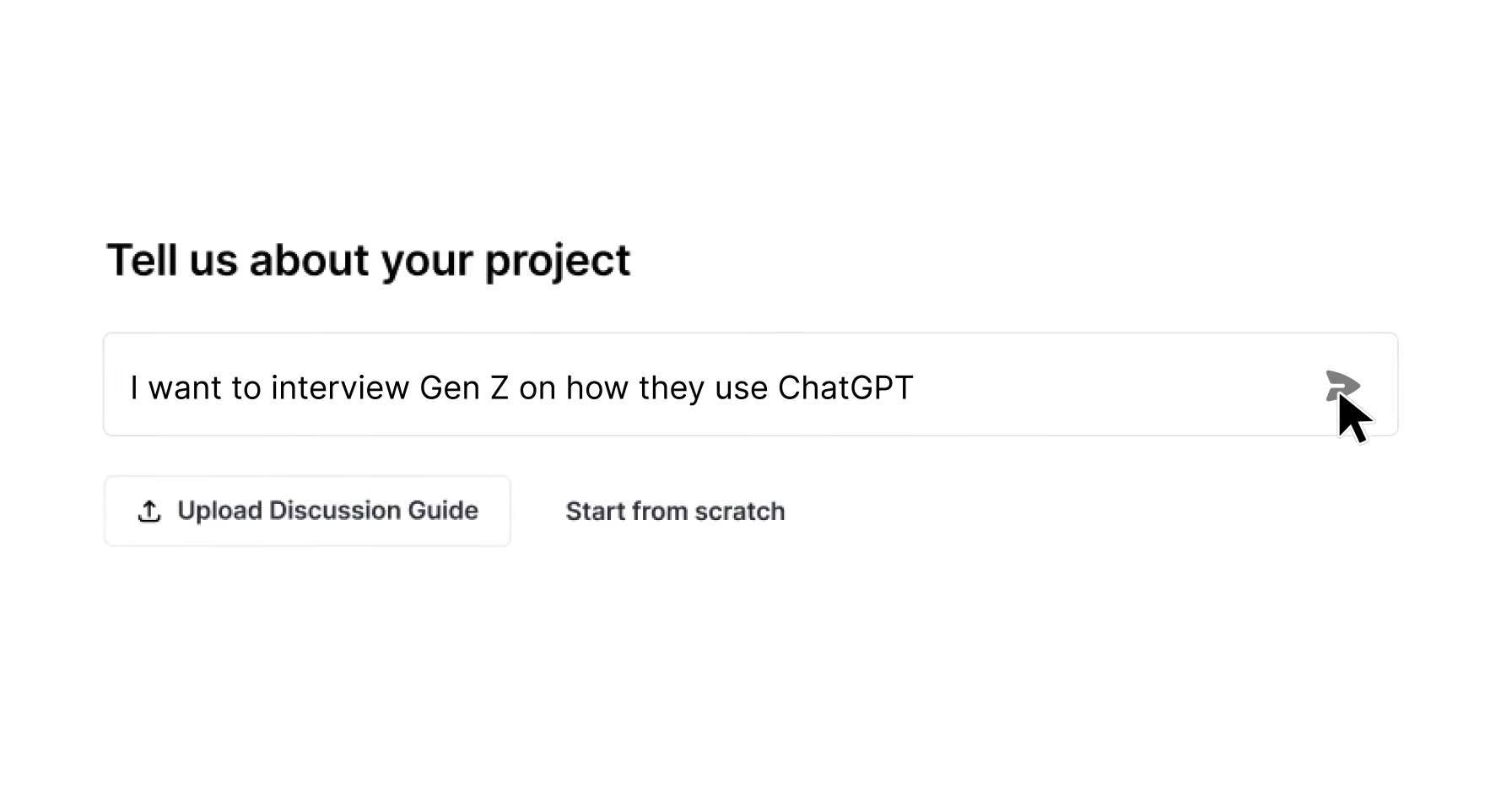
Key decision points: The human researcher reviews and approves the guide, then configures the study mechanics including branching logic, quotas, randomization, and format selection (IDI, diary, ethnography, or task-based UX test). Before launch, Auto-QA flags configuration issues so the study design is complete and internally consistent.
Typical timeline: Under two hours from brief to approved guide, versus one to two weeks manually.
Watch the study design interface in action.
Step 2: Participant Sourcing and Quality Screening at Scale
Action: Listen Atlas, the platform’s AI orchestration layer, automatically matches and recruits participants from a global network of 30M verified respondents across 45+ countries and 100+ languages.
Required inputs: Screening criteria, quotas, and incidence-rate estimates. Organizations can also self-recruit from their own user base at reduced cost.
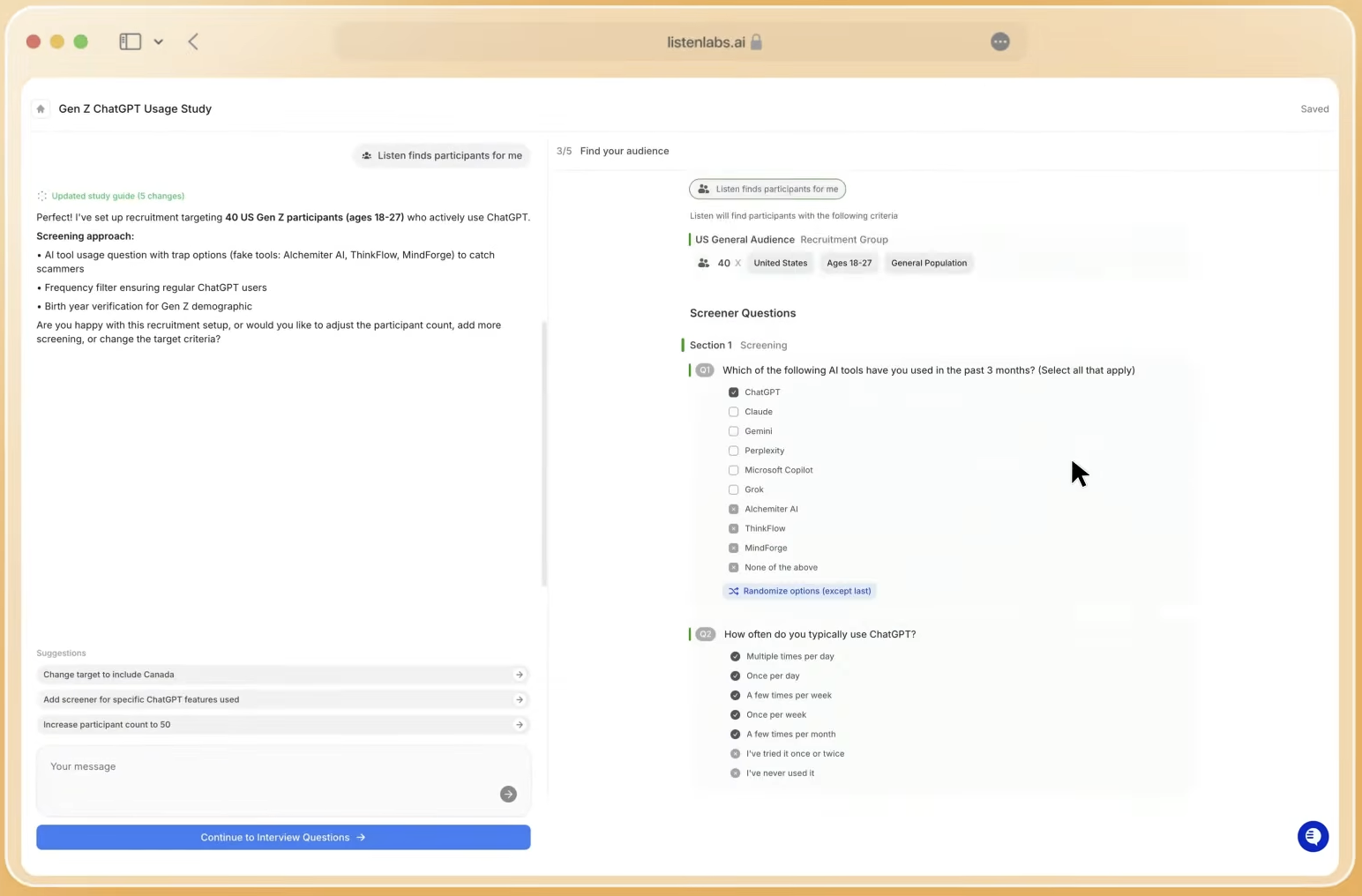
Key decision points: Quality Guard monitors every recruitment signal in real time, including video, voice, content, and device, to detect fraud, low-effort responses, and mismatched profiles. To prevent panel fatigue and professional survey-takers from gaming these automated checks, participants are capped at three studies per month. For audiences that require specialized sourcing beyond automated matching, such as enterprise decision-makers, healthcare workers, and segments below 1% incidence rate, a dedicated recruitment ops team adds a human review layer.
Typical timeline: Recruitment completes in 24–72 hours for most audiences, versus two to three weeks for traditional panel sourcing.
Step 3: AI-Moderated Conversational Interviews Without Scheduling Bottlenecks
Action: Listen Labs conducts AI-led video interviews with dynamic follow-up questions, capturing video, audio, text, and screen recordings simultaneously.
Required inputs: Approved discussion guide, stimuli, and any mixed-method components such as Likert scales, NPS, or MaxDiff.
Key decision points: The AI probes deeper on short or interesting answers in the same way a trained human interviewer would. Platforms like Listen Labs layer on auto-recruiting, transcription, sentiment tagging, and insight summarization so teams jump from question to findings in hours, not weeks. Human researchers review flagged sessions and outliers after fielding. Many enterprises use a 70/30 split, with AI handling volume and humans moderating a targeted subset for sensitive topics or executive participants.
Typical timeline: Hundreds of interviews can complete in 24–48 hours because sessions run asynchronously with no scheduling bottleneck.
Explore AI moderation at scale.
Step 4: Automated Transcription, Translation, and First-Pass Coding
Action: Every completed interview is transcribed, translated where needed, and coded automatically across all 100+ supported languages.
Required inputs: Completed interview recordings. No manual setup required.
Key decision points: Human researchers spot-check transcripts for proper nouns, product names, and specialist vocabulary before quoting. AI coding offers high self-consistency across a full dataset and identifies relevant segments. Researchers audit the codebook for missing codes, over-merged codes, and AI training biases before proceeding.
Typical timeline: A 10,000-word transcript that takes 4–6 hours for manual first-pass coding can be coded in 8–15 minutes with AI.
Step 5: Human-Led Interpretation and Bias Review
Action: Human researchers review AI-generated codes and themes, audit for bias, investigate outliers, and connect findings to business and cultural context.
Required inputs: AI-generated codebook, flagged sessions, and raw transcripts for a representative sample.
Key decision points: This step is non-negotiable. Without human researchers actively questioning results, bias can be amplified rather than corrected. Researchers verify quote accuracy and check that AI outputs represent the full participant sample rather than majority segments. They also identify emergent categories the AI may have missed. Human analysts in a large-scale NAP7 study identified an emergent “ambiguous” sentiment category for responses containing mixed or unclear emotional valence, a distinction current commercial AI tools could not replicate.
Typical timeline: One to two days of focused human review, versus two to four weeks of manual analysis for a comparable study.
Step 6: Instant Synthesis into Decision-Ready Deliverables
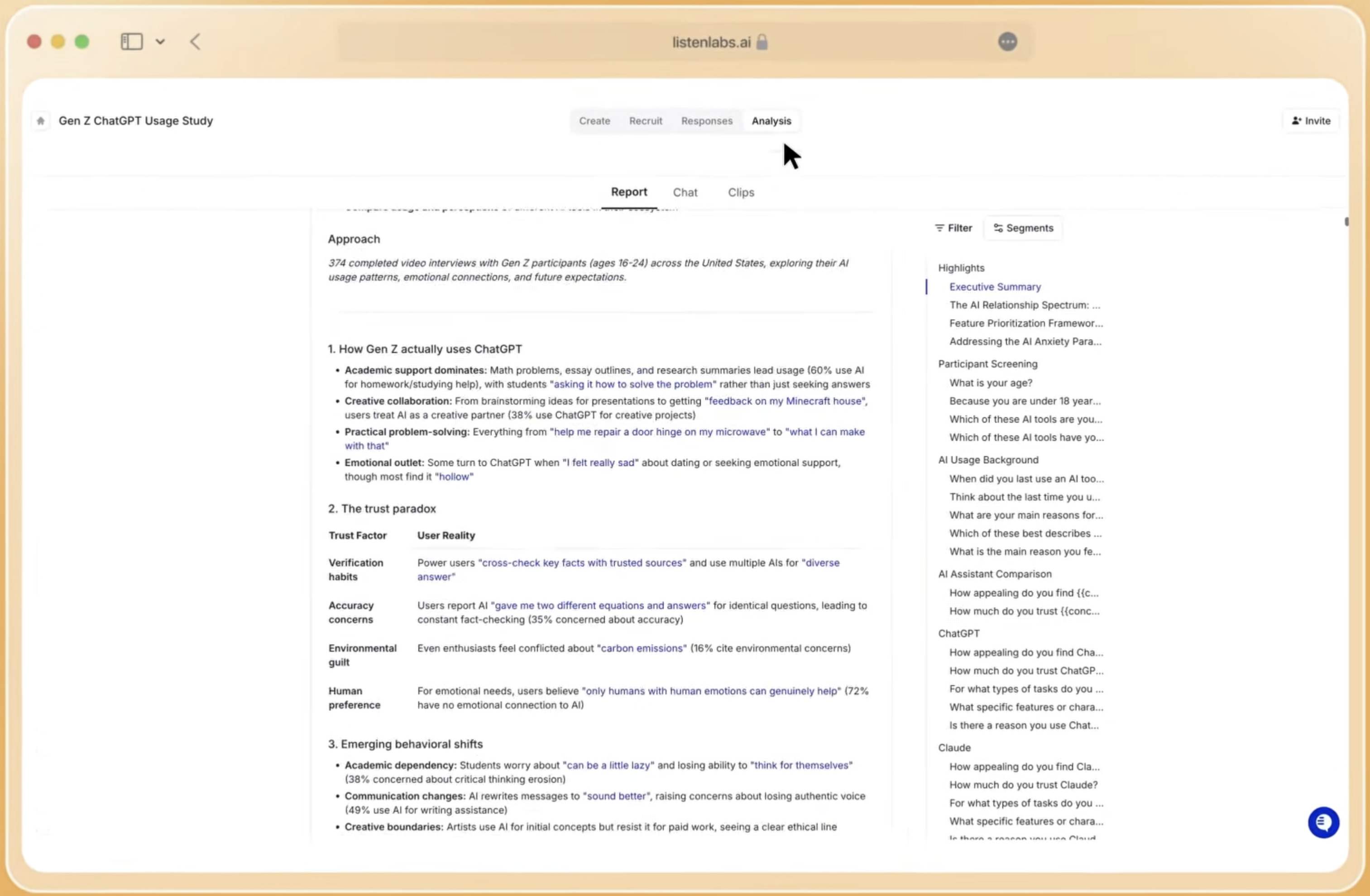
Action: Listen Labs’ Research Agent generates consultant-quality deliverables from verified findings, including slide decks, memos, video highlight reels, statistical charts, segmentation breakdowns, and custom reports.
Required inputs: Reviewed and approved thematic analysis from Step 5.
Key decision points: Every insight links directly to the underlying response data, so stakeholders can drill into verbatim quotes and timestamps rather than accepting summary claims. Researchers use natural-language queries to run segment comparisons, significance tests, and highlight-reel generation, and one researcher ran a full buying intent analysis across three user segments in under a minute.
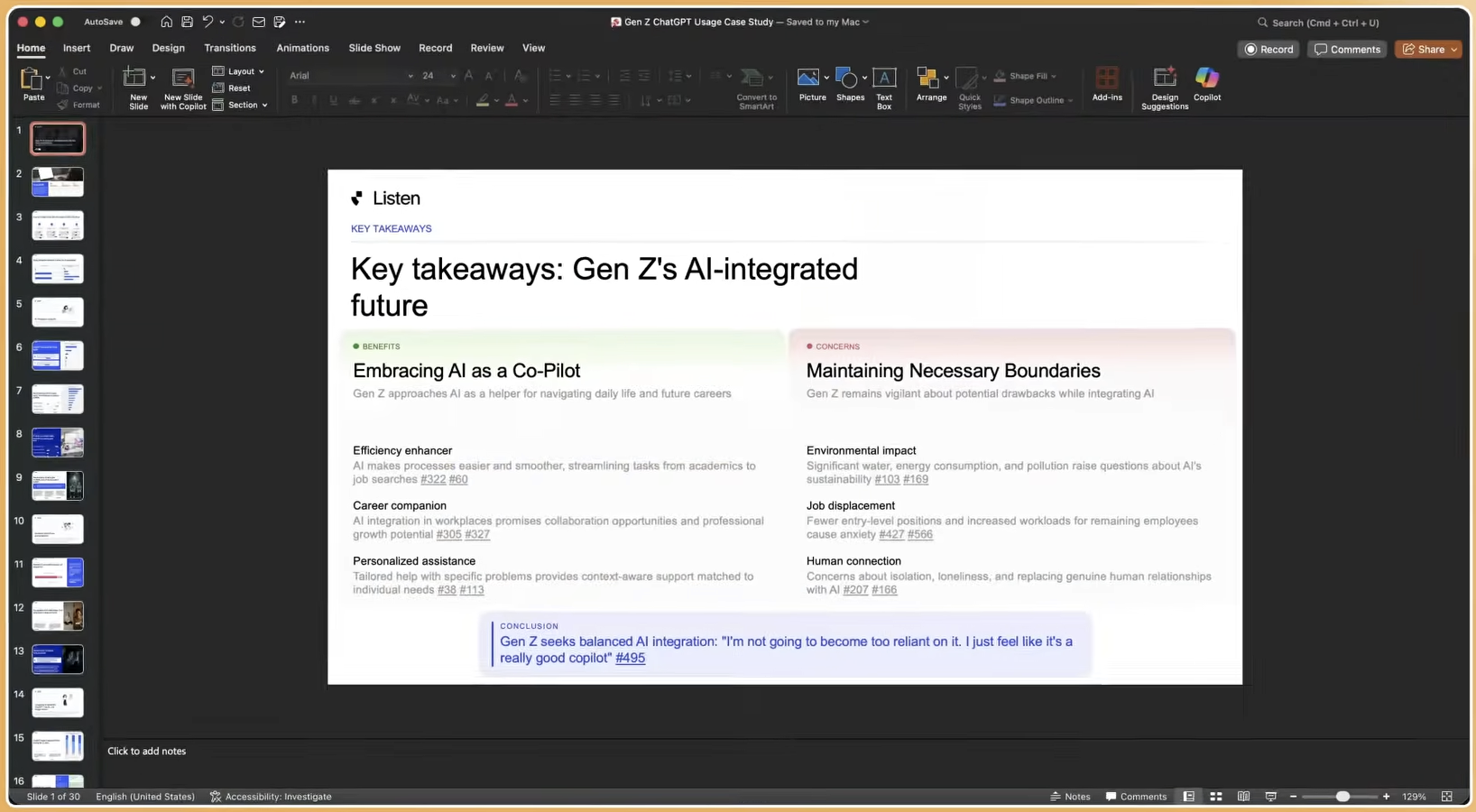
Typical timeline: Deliverables generate in under a minute. The full six-step cycle completes in less than 24 hours.
See the Research Agent produce deliverables live.
How Listen Labs Splits AI and Human Responsibilities
Listen Labs divides responsibilities so AI handles high-volume, repeatable tasks while human researchers retain ownership of contextual judgment, cultural knowledge, and interpretive depth. The platform enables teams to run more studies with the same headcount, which frees researchers to focus on strategic analysis and stakeholder storytelling that AI cannot replicate.
Map this workflow to your team’s current process.
Transcription and Translation Acceleration for Global Studies
Transcription has historically been one of the most time-intensive steps in qualitative research. Manual transcription for qualitative projects requires significant time while AI speech-to-text models reduce the same task to minutes of processing. AI transcription tools can operate faster than human transcription, and cost savings are substantial when teams switch to an AI tool for qualitative interviews.
Listen Labs extends this acceleration to translation across 100+ languages, enabling global multi-market studies without separate localization vendors. Human researchers retain responsibility for verifying register signals such as hedging, politeness conventions, and culturally specific phrasing before quoting translated material.
Conversational AI Scaling Beyond Moderator Limits
The traditional constraint on qualitative research sample size has been moderator time, not participant availability. A single skilled human researcher can realistically conduct about 8–15 interviews per week, so completing 20 interviews typically requires two to three weeks. AI moderation removes this bottleneck by conducting interviews asynchronously.
With qual-at-scale, the old trade-off between depth and scale is no longer a barrier. This automation enabled Chubbies to capture hundreds of candid, one-to-one conversations overnight, a volume impossible under the traditional moderator-time constraint. AI-moderated interviews achieve participant-satisfaction rates around 98% and often increase disclosure on sensitive topics because participants face no social pressure to please a human interviewer.
First-Pass Thematic Analysis With Human Codebook Governance
AI coding delivers speed and consistency gains that compound at scale. AI-assisted coding can substantially reduce the hours required for a qualitative study, including human review time. Consistency is also measurably higher because AI maintains uniform coding logic across the full dataset.
The human researcher’s role in this step is codebook governance, not mechanical coding. This governance involves auditing the AI-generated codebook for structural flaws such as missing codes that leave themes uncaptured, over-merged codes that collapse distinct concepts, and majority-segment bias that drowns out minority voices. These checks ensure the AI’s pattern detection serves the research question rather than obscuring the minority voices that represent the highest-value signal in most qualitative studies.
Review how Listen Labs handles first-pass coding at enterprise scale.
Multimodal Emotional Intelligence for Deeper Signal
Transcripts capture what participants say, but they do not capture how participants feel. Two concepts can both receive positive verbal ratings while triggering entirely different emotional responses, and only multimodal signal analysis can surface that difference.
Listen Labs’ Emotional Intelligence analyzes three layers of signal: tone of voice, word choice, and subconscious micro expressions. It is built on Ekman’s universal emotions framework, the same standard used in clinical psychology and UX research, tracking anger, anticipation, disgust, fear, joy or happiness, sadness, trust, and surprise. Every emotion is quantified per question and concept, with every label traceable to the exact timestamp, verbatim quote, and AI reasoning behind it.
This capability is available across 50+ languages and integrates directly with the Research Agent for natural-language queries, charts, and highlight reels of the most emotionally significant moments. Use cases include creative testing, concept comparison, usability testing, and brand research.
Why AI Will Not Replace Qualitative Researchers
No. The evidence from 2025–2026 research consistently points to a hybrid model in which AI handles high-volume, repeatable tasks while human researchers retain ownership of the work that requires contextual judgment, cultural knowledge, and interpretive depth.
Dimitris Raidos of Ipsos UK frames the issue directly: “The question is not: ‘How will AI replace us?’ but rather ‘How can we work with AI safely and effectively?’” Kane Callaghan, VP of Research at GetWhy, states: “AI makes qualitative research faster and cheaper, but it can’t automate the full process.”
A hybrid human-AI research workflow enables UX teams to run 3–4 times the study volume without compromising interpretive quality, by reallocating researcher time from scheduling, notetaking, and first-pass coding toward study design, anomaly investigation, and strategic synthesis. McKinsey research found that teams using AI research tools spend 45% more time on strategic planning and only 20% on execution, versus 30% strategy and 60% execution for traditional teams.
Listen Labs is designed as a force multiplier for existing research teams. The platform enables those teams to run more studies with the same headcount, which frees researchers to focus on the strategic analysis and stakeholder storytelling that AI cannot replicate.
See how the workflow redistributes researcher time.
Using ChatGPT Versus a Purpose-Built Qual Platform
General-purpose large language models including ChatGPT can assist with discrete tasks in qualitative analysis, such as drafting a discussion guide, summarizing a transcript, or suggesting initial codes. The limitations become significant at the workflow level.
A 2025 PLOS One study testing Microsoft Copilot for thematic analysis found minimal overlap with human themes, frequent fabricated quotes, and a tendency to draw themes from early parts of the dataset rather than the whole. The real risk with general-purpose models is that they average toward the middle, so the unusual answer that would have changed your mind gets coded as “other” and disappears.
General-purpose LLMs also lack the proprietary data that makes a purpose-built platform effective. Listen Labs is trained on tens of thousands of completed studies, giving it deep understanding of which question types lead to better analysis, which methodologies work for which objectives, and how to separate signal from noise. Critically, ChatGPT does not handle recruitment, moderation, fraud prevention, or deliverable generation. It addresses one step in a six-step workflow, while Listen Labs addresses all six.
Compare the full-workflow approach against point-solution alternatives.
Ensuring Participant Quality at Scale
Participant quality is the most consequential variable in qualitative research at scale, and it requires multiple overlapping controls rather than a single mechanism.
Listen Labs operates three layers of protection. First, the platform works exclusively with high-quality, non-commodity panel sources, avoiding professional survey-takers from incentive-driven commodity panels. Second, Quality Guard applies real-time AI monitoring across video, voice, content, and device signals to detect fraud, low-effort responses, AI-generated scripts, and mismatched profiles. Participants are limited to three studies per month, which eliminates panel fatigue and repeat-respondent bias. Third, a dedicated recruitment ops team adds a human review layer and sources hard-to-reach segments such as enterprise decision-makers, healthcare workers, engineers, and audiences below 1% incidence rate through niche communities, micro-creators, and specialized networks.
The system compounds over time. Quality Guard builds a reputation score across every interview conducted on the platform. The more studies Listen Labs runs, the stronger the audience quality becomes, creating a flywheel that point-solution recruitment platforms cannot replicate.
Review the Quality Guard methodology for your target audience.
Frequently Asked Questions
How long does a typical end-to-end study take on Listen Labs?
The full six-step cycle of study design, recruitment, fielding, transcription, analysis, and deliverables completes in less than 24 hours for most standard studies. Hard-to-reach audiences requiring dedicated recruitment ops may extend the recruitment phase by 24–48 hours. This compares to a traditional cycle of 4–6 weeks, and up to 6 months in enterprise environments with internal prioritization backlogs.
What does a Listen Labs study cost compared to traditional qualitative research?
Listen Labs uses a subscription model. Enterprises pay for platform access, which includes a set number of studies and credits, and then spend credits per participant recruited. Credit cost varies by audience difficulty, so general population studies cost fewer credits than niche segments. Across comparable study types, enterprises run more studies at approximately one-third the cost of the traditional approach, which bundles separate fees for recruitment vendors, moderators, transcription services, analysts, and report writers.
How does Listen Labs handle data privacy and security?
Listen Labs maintains enterprise-grade security with 256-bit encryption. Customer data is never used for AI model training. The platform holds SOC 2 Type II, GDPR, ISO 27001, ISO 27701, and ISO 42001 certifications. Enterprise SSO is supported. Before any AI-assisted processing step, data is handled in accordance with these certifications, and the platform supports full documentation of AI tool usage at each research stage for transparency and auditability.
Can Listen Labs reach niche or hard-to-find audiences?
Yes. The dedicated recruitment ops team partners with niche communities, micro-creators, and specialized networks to source audiences below 1% incidence rate, including enterprise decision-makers, engineers, healthcare workers, and highly specialized consumer segments. Listen Atlas, the AI orchestration layer, also matches across behavioral and intent data rather than self-reported demographics alone, which improves screening accuracy for low-incidence populations. Organizations can additionally self-recruit from their own user base at reduced cost.
Can we bring our own participants to Listen Labs?
Yes. Listen Labs supports self-recruitment, allowing organizations to study their own customers or users at a reduced credit cost. You can also bring your own panel provider. This approach is common for UX research teams that want to test with existing product users, or for brand teams running studies with known customer segments from a CRM or loyalty database.
When should a team rerun a study rather than query past data in Mission Control?
Mission Control, Listen Labs’ cross-study knowledge base, enables teams to query findings from past research in seconds without re-fielding. A rerun is warranted when the business context has materially changed, such as new product features, a market entry, a competitive shift, or a significant time gap since the original study. It is also appropriate when the original sample does not cover a new target segment, or when a hypothesis surfaced in past data requires validation at a larger sample size. For trend tracking and longitudinal programs, Listen Labs supports recurring study cadences that build institutional knowledge over time.
Conclusion: A Repeatable System for Qual-at-Scale
The six-step workflow of AI-assisted study design, participant sourcing with Quality Guard, AI-moderated interviews, automated transcription and first-pass coding, human-led interpretation and bias review, and instant synthesis into deliverables resolves the core tension in enterprise qualitative research. Teams no longer choose between depth and scale, or between speed and rigor.
AI can schedule and conduct the interview for you, analyze the transcripts for themes, and even generate quantitative insights from those interviews, but the workflow only delivers reliable, decision-grade insight when human researchers retain ownership of interpretation, bias review, and stakeholder synthesis. That division of labor is built into every step of the Listen Labs platform.
Consumer-insights directors, UX-research leads, product managers, and marketing leaders running five times the studies this quarter without adding headcount have a repeatable system to do it. Map the workflow to your next project.