
Written by: Anish Rao, Head of Growth, Listen Labs | Last updated: July 26, 2026
Key Takeaways
- Enterprise teams are re-evaluating research platforms as AI-moderated interviews mature and traditional methods become too expensive and slow.
- Listen Labs is the only production-grade platform that covers the full research lifecycle, from study design through deliverables, in a single workflow.
- AI-augmented workflows cut median time-to-insight by 84% compared to traditional methods, and Listen Labs compresses the full cycle to under 24 hours.
- Listen Labs delivers adaptive AI-moderated interviews with emotional intelligence analysis across three signal layers, so teams no longer trade depth for scale.
- Teams seeking to replace fragmented research stacks and deliver insights in hours instead of weeks should see Listen Labs in action.
Evaluation Criteria for AI Interview Platforms in 2026
Enterprise teams evaluating platforms in 2026 should apply a consistent set of criteria across every category. Working researchers prioritize methodological defensibility, depth per response, scale without headcount, and time-to-insight as the four primary dimensions. A complete evaluation framework for enterprise procurement also includes the following: research speed and turnaround, depth of insight and emotional intelligence, sample quality and fraud prevention, participant sourcing infrastructure, methodological flexibility, global reach, language support, analysis effort and automation, reporting transparency and evidence traceability, governance and security compliance, scalability across concurrent studies, and total operational burden including vendor coordination and internal headcount requirements.
See how Listen Labs performs against every criterion in a live environment.
The following sections apply this framework across six core dimensions, starting with research speed, which most directly affects product velocity and competitive positioning.
Research Speed and Turnaround Across Platform Types
Research speed directly affects product decisions, launch timing, and competitive advantage. When insights arrive slowly, teams either move ahead without data or delay releases while they wait.
Traditional agencies require 4–6 weeks from study brief to final deliverable across setup, recruitment, moderation, transcription, analysis, and report writing phases. A traditional qualitative study typically requires several weeks of turnaround time across all phases, and in enterprise settings with internal prioritization queues, that timeline can extend to six months.
Quantitative survey tools reduce fielding time but not analysis time. Panel and recruitment platforms accelerate sourcing but hand off to separate moderation and analysis vendors, which reintroduces delays at every handoff. Analysis repositories such as Dovetail organize completed research but conduct none, so they add no speed advantage to the production cycle. Human-moderated testing platforms depend on scheduling human moderators, which caps throughput and extends timelines. General-purpose LLMs can assist with drafting discussion guides but cannot recruit participants, conduct interviews, or produce verified findings.
AI-augmented workflows cut median time-to-insight by 84% between 2024 and 2026 production baselines for a 30-interview qualitative study, reducing the median from 31.4 working days to 9.2 working days. Stage-specific reductions include a 91% reduction in analysis time and an 81% reduction in interviewing time. Listen Labs compresses the full cycle further, moving from study brief to deliverables in under 24 hours by running hundreds of parallel AI-moderated interviews with automated analysis and one-click report generation via the Research Agent.
Insight Depth and Emotional Intelligence Across Tools
Depth of insight determines whether teams uncover surface-level opinions or the motivations and emotions that drive real behavior. Emotional intelligence in research workflows strengthens product, brand, and UX decisions.
Traditional agencies deliver nuanced insight through experienced human moderators, but quality varies by moderator, sessions cannot run in parallel, and the process does not scale repeatably. Quantitative surveys capture stated preferences through pre-set questions with no adaptive follow-up, which structurally blocks discovery of unexpected findings. Panel platforms, analysis repositories, and recruitment tools do not conduct interviews and therefore add nothing to insight depth.
Human-moderated testing platforms provide conversational depth but are limited by moderator availability and scheduling constraints. General-purpose LLMs can summarize text but cannot conduct live interviews with real participants, capture emotional signals, or produce findings traceable to verified human responses. Synthetic users generated by LLMs cannot produce novel reactions to novel stimuli and instead regress toward the centroid of their training data, which makes them unsuitable for genuine customer insight work.
Listen Labs conducts adaptive AI-moderated interviews that probe deeper on short or vague answers, similar to a trained human interviewer. The platform’s Emotional Intelligence feature analyzes three simultaneous signal layers, tone of voice, word choice, and subconscious micro-expressions, to surface emotions that transcripts alone miss. Built on Ekman’s universal emotions framework, the same standard used in clinical psychology and UX research, every emotion is quantified per question and concept, with every label traceable to the exact timestamp, verbatim quote, and AI reasoning behind it. With qual-at-scale, the old trade-off between depth and scale no longer blocks enterprise research programs.
Sample Quality, Participant Sourcing, and Fraud Prevention
Sample quality and fraud prevention directly affect whether findings are trustworthy. Poor sourcing and weak controls create biased data, wasted budget, and false confidence in decisions.
Traditional agency-led qualitative research costs $1,500–$3,000 per interview all-in, including recruitment, moderation, transcription, and analysis. Despite that investment, commodity panels carry documented risks: professional survey-takers, fraudulent profiles, and incentive-driven responses that undermine data integrity. Panel and recruitment platforms solve sourcing logistics but apply inconsistent quality controls and do not monitor interview behavior in real time.
Quantitative survey tools rely on self-reported screening with limited behavioral verification. Analysis repositories and general-purpose LLMs have no participant sourcing infrastructure at all. Human-moderated platforms typically rely on third-party panel vendors, inheriting the same fraud risks without an added mitigation layer.
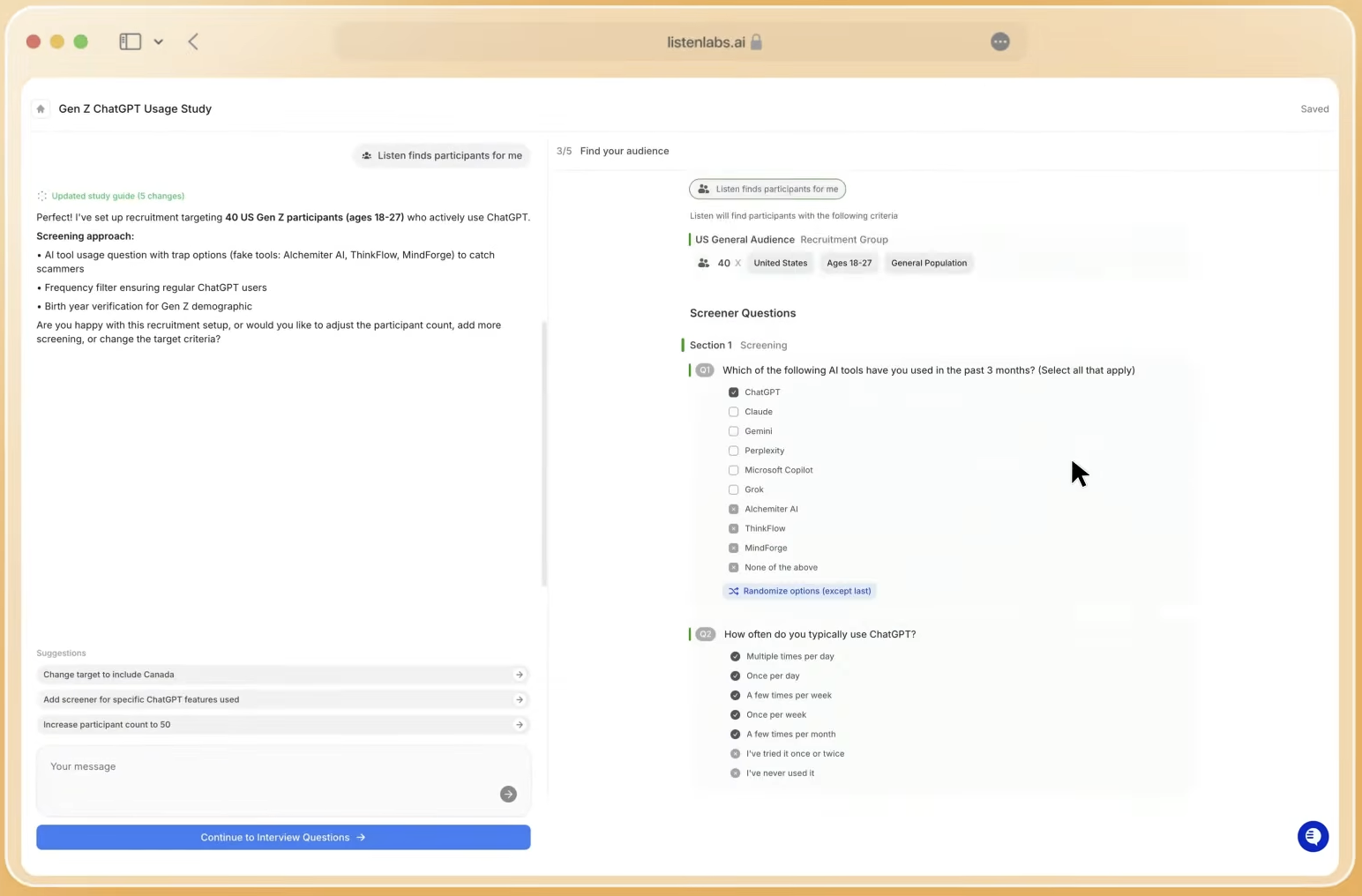
Listen Labs operates three independent quality layers. Listen Atlas, the platform’s AI orchestration layer, matches participants across behavioral and intent data from a 30M+ verified respondent network spanning 45+ countries, not just self-reported demographics. Quality Guard monitors every interview in real time across video, voice, content, and device signals to detect fraud, low-effort responses, AI-generated scripts, and mismatched profiles. Participants are limited to three studies per month, which removes professional survey-takers. A dedicated recruitment operations team adds human review for hard-to-reach segments including enterprise decision-makers, healthcare workers, and audiences below 1% incidence rate.
Method Flexibility, Global Reach, and Language Coverage
Methodological flexibility and global coverage determine whether a platform can support real-world research roadmaps across markets and study types.
Traditional agencies support a wide range of study types but require separate engagements, vendors, and timelines for each methodology. Quantitative survey tools support structured questionnaires but not conversational formats. Panel platforms are methodology-agnostic but provide no moderation. Analysis repositories accept any input format but generate no new research. Human-moderated platforms support usability testing and moderated sessions but are constrained by moderator language skills and geographic availability.
General-purpose LLMs support text generation in many languages but cannot conduct live interviews, recruit participants, or operate within a governed research workflow. Researchers increasingly adopt AI embedded in specialized research platforms, reflecting a shift toward purpose-built solutions.
Listen Labs supports in-depth interviews, semi-structured interviews, survey-style questionnaires, diaries, ethnography, task-based UX testing with screen sharing, concept and prototype testing, creative testing, brand perception studies, and multi-market segmentation studies. The platform covers 45+ countries across the Americas, Europe, APAC, and MEA, with interview moderation in 100+ languages and automatic translation and transcription across all supported languages. AI-led one-on-one interviews deliver faster, more reliable, and unbiased insights without the logistical overhead of organizing group sessions.
Analysis Workflow, Reporting Transparency, and Knowledge Management
Analysis workflow and reporting transparency shape how quickly teams move from raw data to decisions, while knowledge management determines whether insights compound over time.
Traditional agencies produce consultant-quality reports but require 40–80+ hours of manual transcript coding and thematic synthesis per study. Quantitative survey tools generate charts and cross-tabs but cannot synthesize open-ended qualitative responses at depth. Panel platforms deliver raw data with no analysis layer. Analysis repositories organize and tag existing research but require manual input and do not generate new findings automatically.
Human-moderated platforms produce session recordings and notes but rely on researchers to conduct thematic analysis manually. General-purpose LLMs can summarize text inputs but lack proprietary research data, cannot access verified participant responses, and produce outputs with no traceability to source material.
Listen Labs’ Research Agent handles the full analysis workflow from raw interview data to final output. It generates automated key findings, themes, and personas, supports chat-based analysis in natural language, and produces slide decks in branded templates, memo-style reports, video highlight reels, statistical charts, and segmentation breakdowns. Every insight links back to the underlying response data. Mission Control serves as the organization’s cross-study source of truth, enabling teams to query findings from past research in seconds and track customer sentiment over time without re-running studies.
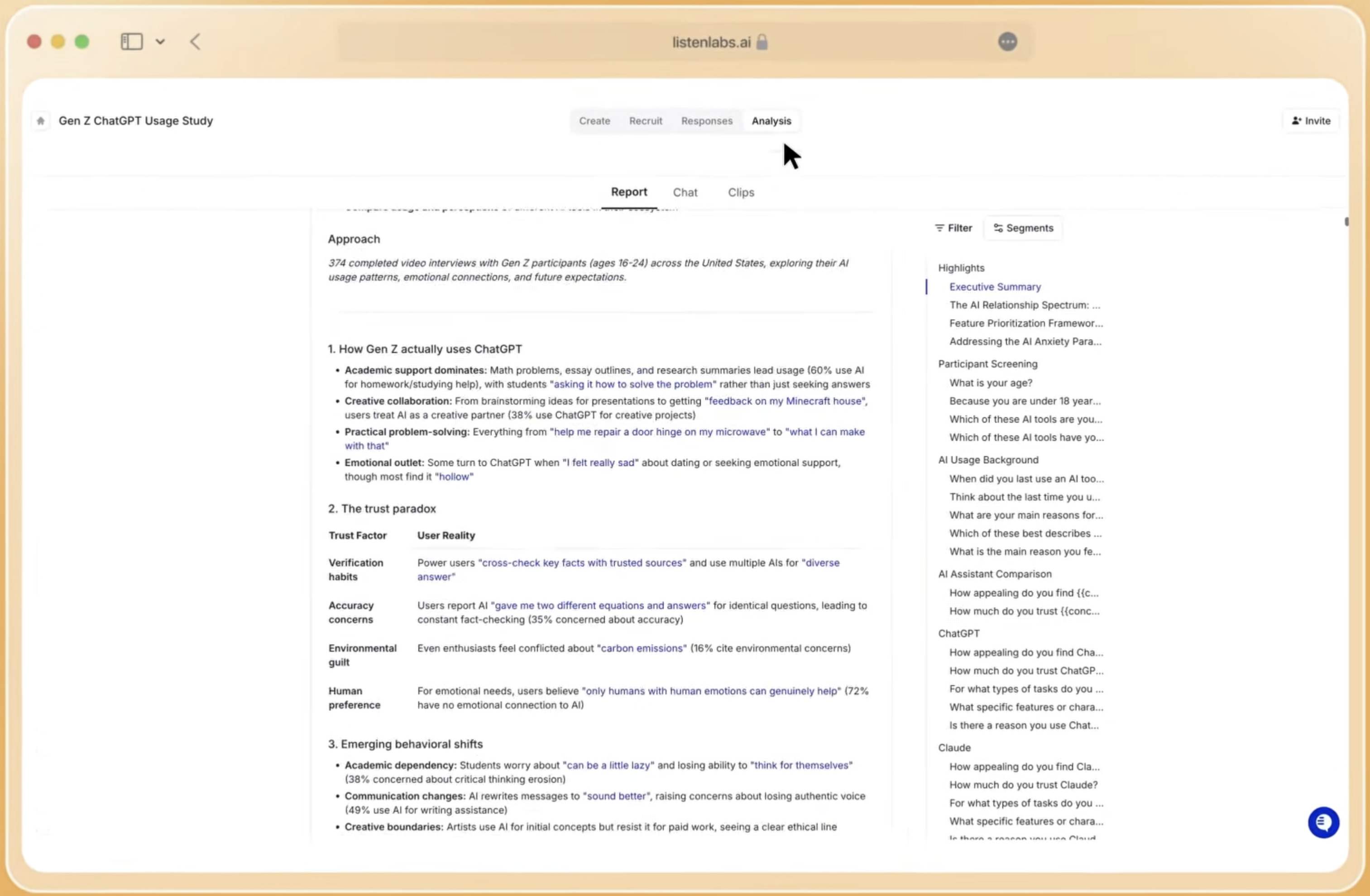
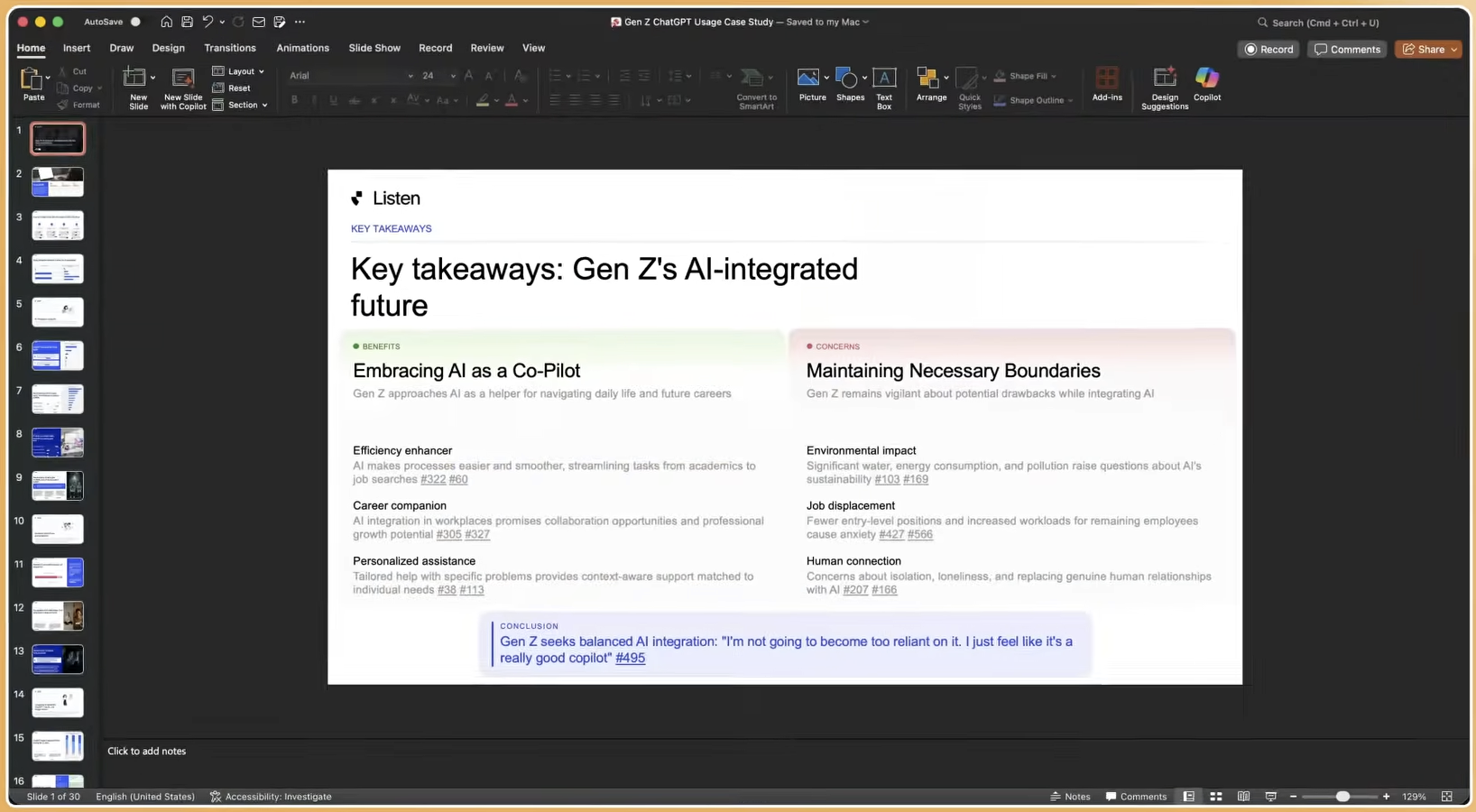
Watch the Research Agent generate a full deliverable in under a minute.
Best-Fit Use Cases for Different Research Teams
Best-fit use cases help teams connect the evaluation criteria to their day-to-day reality and choose platforms that match real constraints.
Enterprise consumer insights teams managing high-volume research backlogs use Listen Labs to multiply study output without adding headcount. Microsoft used the platform to collect global customer stories for its 50th anniversary celebration within a day, with a Director of Data Science noting the ability to reach hundreds of users at one third of the cost. Anthropic’s Claude Code team ran 300+ user interviews in 48 hours to surface churn drivers 5x faster than previous methods.
UX research leads at mid-to-large product companies use Listen Labs to run usability studies with 50–100+ participants instead of 5–10, with screen sharing and mobile screen recording on iOS, which compresses two-week testing cycles into 48 hours. Product managers and brand managers without dedicated research teams use the platform’s AI-assisted study co-design to describe research goals in natural language and receive structured objectives, questions, and participant recruitment automatically. Agencies and consultancies use Listen Labs to meet client timelines measured in days, reaching niche audiences including enterprise decision-makers and healthcare workers that commodity panels cannot reliably source.
Operational and Long-Term Platform Considerations
Operational and long-term factors determine whether a platform can survive security review, scale across teams, and support knowledge over years, not just a single project.
Adopting any new research platform requires stakeholder alignment across insights, IT, legal, and procurement. Listen Labs holds SOC 2 Type II, GDPR, ISO 27001, ISO 27701, and ISO 42001 certifications, which satisfy enterprise security and privacy requirements in most procurement processes. Customer data is never used for AI model training, and the platform uses 256-bit encryption throughout.
Internal expertise requirements are lower than for fragmented stacks because study design, recruitment, moderation, analysis, and deliverable generation operate within a single interface. This consolidation shifts the primary change management challenge from learning multiple tools to reorienting research teams from logistics management toward strategic interpretation, a transition the platform’s in-house research team supports directly with 50+ years of combined expertise. That same consolidation also solves a longer-term problem, because Mission Control’s cross-study query capability and trend tracking eliminate the institutional knowledge loss that occurs when findings are scattered across disconnected tools and vendor relationships.
Risks, Limitations, and Common Misconceptions
Risks and misconceptions around AI research platforms often stem from workflow design and sourcing choices rather than the core technology.
Rigid survey-style question sets produce shallow data regardless of the platform delivering them, which shows that tooling alone cannot fix flawed methodology. Teams that bolt AI tools onto 2019 workflows achieve only 28–35% time savings versus the benchmark mentioned earlier, far below what becomes possible when teams restructure around parallel AI interviewing and synthesis QA loops. Even with proper workflow restructuring, speed gains do not automatically produce better research, so methodological rigor in study design remains the researcher’s responsibility.
Hidden recruitment complexity often goes unnoticed during evaluation. Platforms that provide moderation without integrated sourcing transfer the recruitment burden back to the research team. Fraud and low-quality respondents remain a structural risk in any platform relying on commodity panels without real-time behavioral monitoring. General-purpose LLMs do not replace purpose-built research platforms, because they lack verified participant networks, real-time quality controls, proprietary research methodology data, and the end-to-end workflow required for decision-grade consumer insights work. Using ChatGPT or Claude to analyze customer interviews without a governed recruitment and moderation layer produces outputs with no chain of custody from participant to finding.
Decision Framework: Matching Platforms to Your Research Goals
A clear decision framework links team constraints to platform types, so buyers can map needs to the right mix of tools.
Teams with a primary constraint of speed and a need for qualitative depth across large samples should evaluate purpose-built AI interview platforms first. Teams whose primary output is structured quantitative tracking with no need for adaptive follow-up may find survey tools sufficient for that specific use case, though they will still require separate solutions for qualitative work. Teams whose constraint is analysis of existing research archives rather than new data collection may find repository tools useful as a complement, not a replacement, for a production research platform.
Teams operating globally across multiple languages and markets require a platform with native multilingual moderation, not post-hoc translation of English-language instruments. Teams with enterprise governance requirements, including SOC 2, GDPR, and ISO certifications, must verify compliance before procurement, not after. Teams evaluating total operational burden should account for vendor coordination costs, internal researcher time, and the compounding cost of research backlogs when comparing platform options against traditional agency or fragmented-stack models.
Frequently Asked Questions
How quickly can Listen Labs deliver research results?
Listen Labs compresses the full research cycle, from study design through participant recruitment, AI-moderated interviews, analysis, and deliverable generation, to under 24 hours. This timeline applies to studies ranging from concept tests to multi-market qualitative programs. Traditional agency-led qualitative research for a comparable study typically requires the multi-week timeline described earlier, and enterprise backlogs can extend that to six months.
How does Listen Labs source and verify participants?
Listen Labs operates Listen Atlas, an AI orchestration layer that matches and recruits from a global network of 30M+ verified respondents across 45+ countries. Matching uses behavioral and intent data, not just self-reported demographics. For hard-to-reach segments, including enterprise decision-makers, healthcare workers, and audiences below 1% incidence rate, a dedicated recruitment operations team sources participants through niche communities, micro-creators, and specialized networks. Organizations can also bring their own participants or panel providers.
What prevents fraud and low-quality responses?
The three-layer quality system described earlier addresses this through multiple mechanisms. At the sourcing level, Listen Labs works exclusively with high-quality, non-commodity panel sources, excluding professional survey-takers from the outset. Quality Guard monitors every interview in real time across video, voice, content, and device signals, detecting fraud, low-effort responses, AI-generated scripts, and mismatched profiles. Participants are limited to three studies per month to prevent panel fatigue and incentive-driven behavior. The reputation scoring system compounds across every interview conducted on the platform, creating a quality flywheel that strengthens over time.
Can Listen Labs support research in multiple languages and markets simultaneously?
Yes. The platform supports interview moderation in 100+ languages with automatic translation and transcription across all supported languages. Studies can run concurrently across 45+ countries in the Americas, Europe, APAC, and MEA. Emotional Intelligence is available across 50+ languages, which enables consistent emotional signal capture across markets without separate localization workflows.
What security and compliance certifications does Listen Labs hold?
Listen Labs holds SOC 2 Type II, GDPR, ISO 27001, ISO 27701, and ISO 42001 certifications. The platform uses 256-bit encryption, and customer data is never used for AI model training. Enterprise SSO is supported. These certifications satisfy standard enterprise procurement requirements across most regulated industries and geographies.
Conclusion: Choosing the Platform That Matches Enterprise Requirements
The 13 evaluation criteria outlined in this guide, research speed, depth of insight, emotional intelligence, sample quality, participant sourcing, fraud prevention, methodological flexibility, global reach, language support, analysis automation, reporting transparency, governance, and total operational burden, reveal a consistent pattern. Traditional agencies, quantitative survey tools, panel platforms, analysis repositories, human-moderated testing platforms, and general-purpose LLMs each address one or two criteria while leaving the rest unresolved. The result is fragmented stacks, slow cycles, shallow data, and research backlogs that grow faster than teams can clear them.
Listen Labs has conducted over 1 million AI-powered customer interviews for enterprises including Microsoft, Google, SKIMS, and Nestlé, and raised $69 million in Series B funding at a valuation of $500 million. The platform is a production-grade, end-to-end AI research solution that collapses multi-week research cycles to under 24 hours while delivering qualitative depth at scale, emotional intelligence traceable to individual timestamps, and enterprise-grade quality controls, without requiring additional headcount.
Replace fragmented stacks and see how Listen Labs delivers insights in hours.