
Written by: Anish Rao, Head of Growth, Listen Labs | Last updated: July 16, 2026
Key Takeaways for Enterprise Insights Leaders
- Enterprise teams evaluating AI research assistants must weigh nine criteria: speed, depth versus scale, participant quality, global reach, emotional signal capture, analysis objectivity, deliverable speed, security, and operational burden.
- General web assistants, academic literature tools, and quantitative survey platforms each cover only narrow slices of the research lifecycle and cannot replace end-to-end qualitative customer research platforms.
- Enterprise customer-research platforms like Listen Labs deliver AI-moderated interviews at scale with verified global panels, real-time fraud controls, emotional intelligence layers, and one-click deliverables in under 24 hours.
- AI-moderated research now serves as the default discovery method for 81% of research teams, driven by faster decision velocity and the removal of the traditional depth-versus-scale trade-off.
- Listen Labs provides the only fully integrated solution meeting enterprise requirements for speed, compliance, and emotional signal capture, and you can see the integrated platform in action.
Nine Criteria for Evaluating AI Research Assistants
Research speed determines whether insights arrive in time to influence decisions. Greenbook’s GRIT reports show that AI-moderated studies can significantly reduce the time from question to decision, so turnaround becomes a primary differentiator.
Depth versus scale asks whether a platform can run adaptive, probing conversations at sample sizes large enough to be statistically meaningful. The old trade-off between depth and scale is no longer a structural barrier for platforms built around AI moderation.
Participant quality and fraud controls directly affect the reliability of findings. A significant portion of online survey data is compromised by bots, duplicate respondents, or professional survey-takers, and these risks persist in AI-moderated research without multi-layer prevention.
Global and multilingual reach is now a standard requirement. ESOMAR’s Global Market Research Reports show a rising share of insights professionals at multinationals running multilingual qualitative studies.
Emotional signal capture determines whether a platform records only what participants say or also how they feel. Tone, micro-expressions, and word choice carry signal that transcripts alone cannot surface.
Analysis objectivity focuses on whether findings reflect the data rather than the analyst’s prior assumptions. AI analysis removes interviewer drift and confirmation bias, while introducing auditable model-level variability that must remain traceable to source transcripts.
Deliverable speed and transparency cover how quickly stakeholder-ready outputs such as slide decks, memos, and highlight reels appear, and whether every claim links back to a verifiable participant response.
Security and compliance posture is non-negotiable for enterprise procurement. SOC 2 Type II, ISO 27001, ISO 27701, ISO 42001, and GDPR certifications form the baseline for global programs handling consumer data.
Total operational burden measures the number of vendors, handoffs, and coordination steps required to complete a study. Fragmented stacks introduce delay, cost, and quality loss at every seam.
With these evaluation criteria in place, you can now compare how each category of AI research assistant performs, starting with the most general-purpose tools.
General Web and Research Assistants for Background Work
Study setup: Tools such as Perplexity, ChatGPT Deep Research, and Gemini Deep Research accept natural-language prompts and return synthesized responses within seconds. Fast answer engines provide quick web maps with citations but suffer from weak source hierarchy, and synthesis engines generate readable narrative briefs where fluency can obscure uncertainty.
Recruitment: General web assistants have no participant sourcing capability. They cannot recruit, screen, or verify human respondents for primary consumer interviews.
Moderation approach: These tools do not conduct interviews with external participants. Any “interview” is a conversation between the user and the AI, not between the AI and a recruited consumer or customer.
Data quality: A Columbia Journalism Review Tow Center test found that eight generative search tools collectively answered more than 60% of article-identification queries incorrectly, with Perplexity answering 37% incorrectly. Output quality depends entirely on the quality of indexed web sources, with no fraud controls or participant verification.
Analysis workflow: Users can paste transcripts or documents into these tools for thematic summarization. The process remains manual, non-standardized, and lacks traceability back to verified participant responses.
Reporting: Outputs appear as prose responses or exported text. There are no automated slide decks, highlight reels, or structured deliverables tied to a research repository.
General web assistants work well for competitive landscape scans, background research, and study guide drafting. They are not designed for primary consumer interviews, participant sourcing, emotional signal capture, or enterprise compliance requirements.
Academic Literature Assistants for Evidence Synthesis
Study setup: Platforms such as Elicit, Consensus, ResearchRabbit, and SciSpace center on academic databases. Elicit supports systematic reviews and meta-analyses by enabling semantic search across 138 million academic papers and 545,000 clinical trials, automatically generating customizable extraction tables.
Recruitment: Academic literature tools have no consumer or B2B panel infrastructure. They retrieve published research, not live human participants.
Moderation approach: These platforms do not moderate interviews. Their interaction model is document retrieval and synthesis, not adaptive conversation with recruited respondents.
Data quality: All major academic AI research assistants are trained on academic databases rather than general web data, and their outputs must still be manually verified before use to avoid ethical issues. Source coverage is limited to published literature, excluding proprietary consumer data, behavioral signals, and real-time customer feedback.
Analysis workflow: Literature synthesis sits at the core. Consensus delivers quick, evidence-based answers from 200M+ peer-reviewed papers and includes a Consensus Meter showing agreement levels across studies. This workflow has no analog in consumer interview analysis.
Reporting: Outputs include literature summaries, citation lists, and extraction tables. There are no consumer-facing deliverables, video highlight reels, or segmentation breakdowns.
Academic literature tools serve researchers conducting systematic reviews, meta-analyses, and evidence synthesis. They do not address participant sourcing, emotional intelligence, or the operational requirements of enterprise consumer interview programs.
Quantitative Survey Platforms for Structured Measurement
Study setup: Platforms such as Qualtrics and SurveyMonkey offer structured questionnaire builders with branching logic, quotas, and panel integrations. Setup is fast for closed-ended instruments but constrained by the static nature of pre-set questions.
Recruitment: Survey platforms connect to panel networks for respondent sourcing, but panel quality varies. Commodity panels carry elevated risk of professional survey-takers and incentive-driven responses.
Moderation approach: Surveys do not moderate. Every respondent receives the same fixed question sequence with no adaptive probing, follow-up, or dynamic branching based on individual responses. AI-moderated interviews capture about 39% more words (and 36% more unique themes) per respondent than open-text fields in static surveys.
Data quality: Completion rates on AI-moderated interviews exceed 85% compared to 22% for long-form surveys. Email-based survey response rates have also declined, creating a hidden reach-budget inefficiency. Many survey respondents now use LLMs to help answer open-ended questions, which causes data homogenization where responses reflect AI-approved patterns rather than authentic human thinking.
Analysis workflow: Survey platforms generate dashboards and cross-tabulations from structured data. Open-text analysis requires separate tools or manual coding, and thematic synthesis across hundreds of verbatim responses is not automated within the core platform.
Reporting: Outputs include charts, dashboards, and data exports. Narrative synthesis, video evidence, and consultant-quality deliverables require additional analyst time and tooling.
Survey platforms remain appropriate for regulatory tracking, syndicated benchmarks, and statistically projectable population work. Most teams still run at least one survey study in the trailing twelve months, although surveys now play a narrower role focused on structured measurement rather than exploratory consumer understanding.
Enterprise Customer-Research Platforms for End-to-End Qual
Study setup: Enterprise customer-research platforms manage the full research lifecycle within a single environment. AI-assisted study co-design translates natural-language research goals into structured discussion guides, objectives, and probing context. Advanced stimulus support for images, video, audio, PDFs, prototypes, and live URLs enables concept testing, creative testing, and usability research within the same workflow.
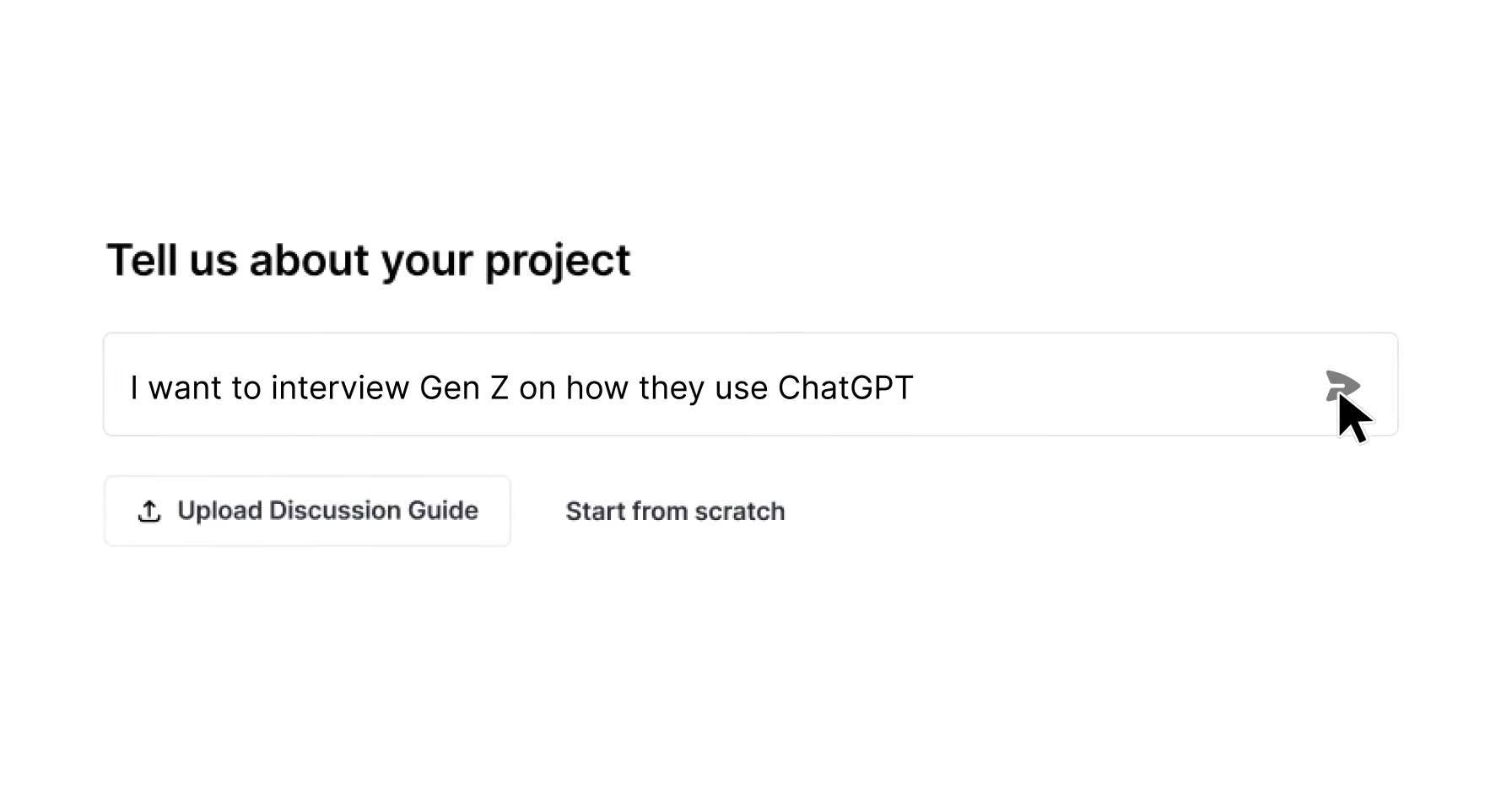
Recruitment: Listen Labs operates a global panel of 30 million verified respondents across 45+ countries and 100+ languages. An AI orchestration layer, Listen Atlas, automatically matches and bids across multiple consumer and B2B panel partners alongside Listen Labs’ proprietary database. A dedicated recruitment operations team handles hard-to-reach segments including enterprise decision-makers, healthcare workers, and audiences below 1% incidence rate. Organizations can also self-recruit from their own user base at reduced cost.
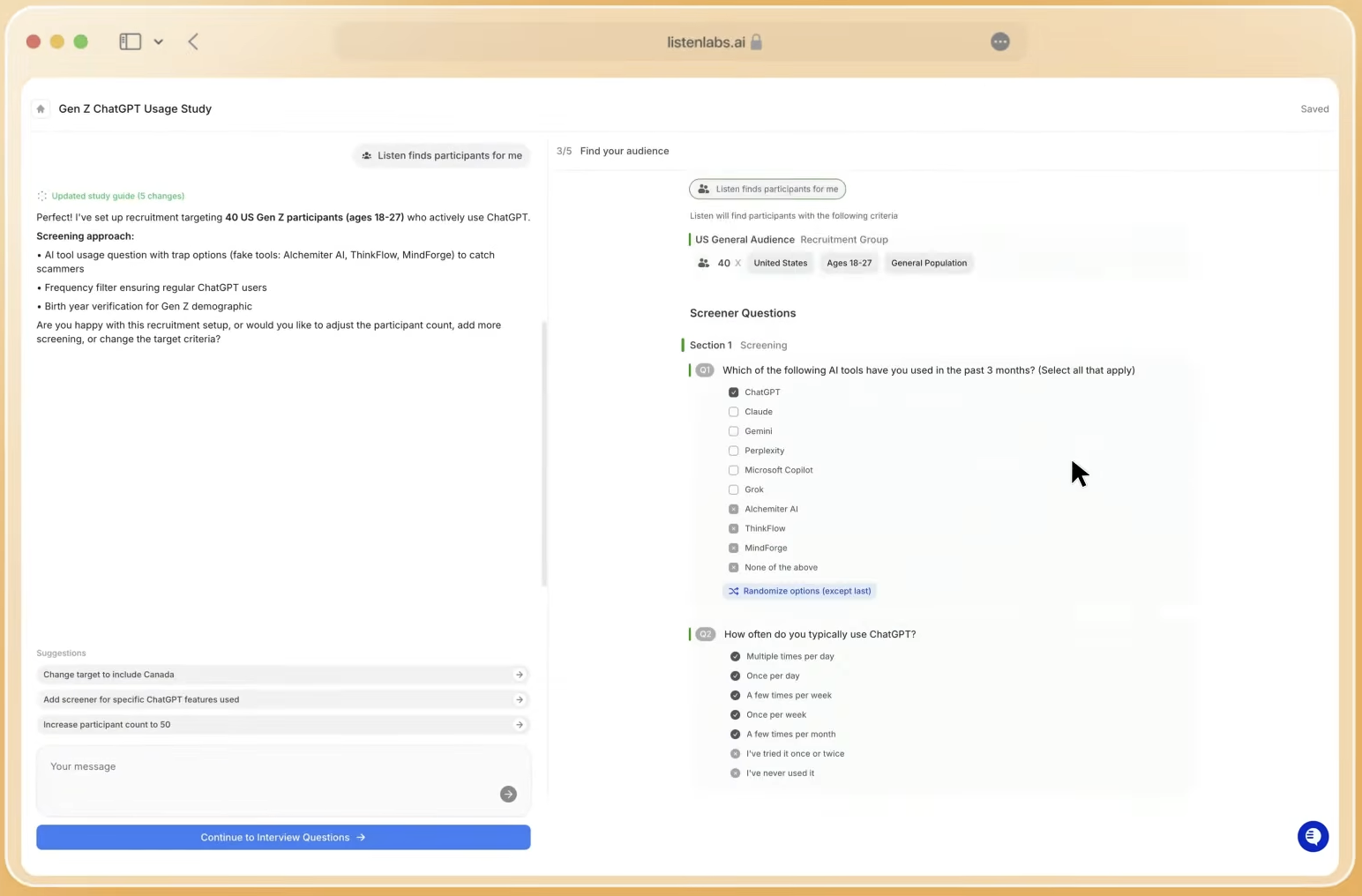
Moderation approach: AI-moderated video interviews conduct personalized, adaptive conversations with dynamic follow-up questions. Listen Labs has run over 1 million AI-powered customer interviews for companies including Microsoft, Perplexity, and Sweetgreen. Alfred Wahlforss, CEO of Listen Labs, notes that companies use the platform for large decisions and can run hundreds of one-on-one interviews at scale. Platforms like Listen Labs layer on auto-recruiting, transcription, sentiment tagging, and insight summarization so teams jump from question to findings in hours, not weeks.
Data quality: Quality Guard monitors every interview in real time for fraud, low-effort responses, AI-generated scripts, and mismatched profiles across video, voice, content, and device signals. Participants are limited to three studies per month, which removes professional survey-takers. Behavioral matching operates on intent and past actions, not only self-reported demographics. Listen Labs’ Emotional Intelligence layer analyzes tone of voice, word choice, and subconscious micro-expressions to surface emotions that transcripts alone miss, built on Ekman’s universal emotions framework and available across 50+ languages.
Analysis workflow: The Research Agent processes all interview data objectively, identifying patterns, themes, and insights across hundreds of responses. Chat-based natural-language querying, segmentation by demographics and cohorts, statistical testing, and cross-study queries through Mission Control all sit inside the platform. Every emotional label is traceable to the exact timestamp, verbatim quote, and reasoning behind it.
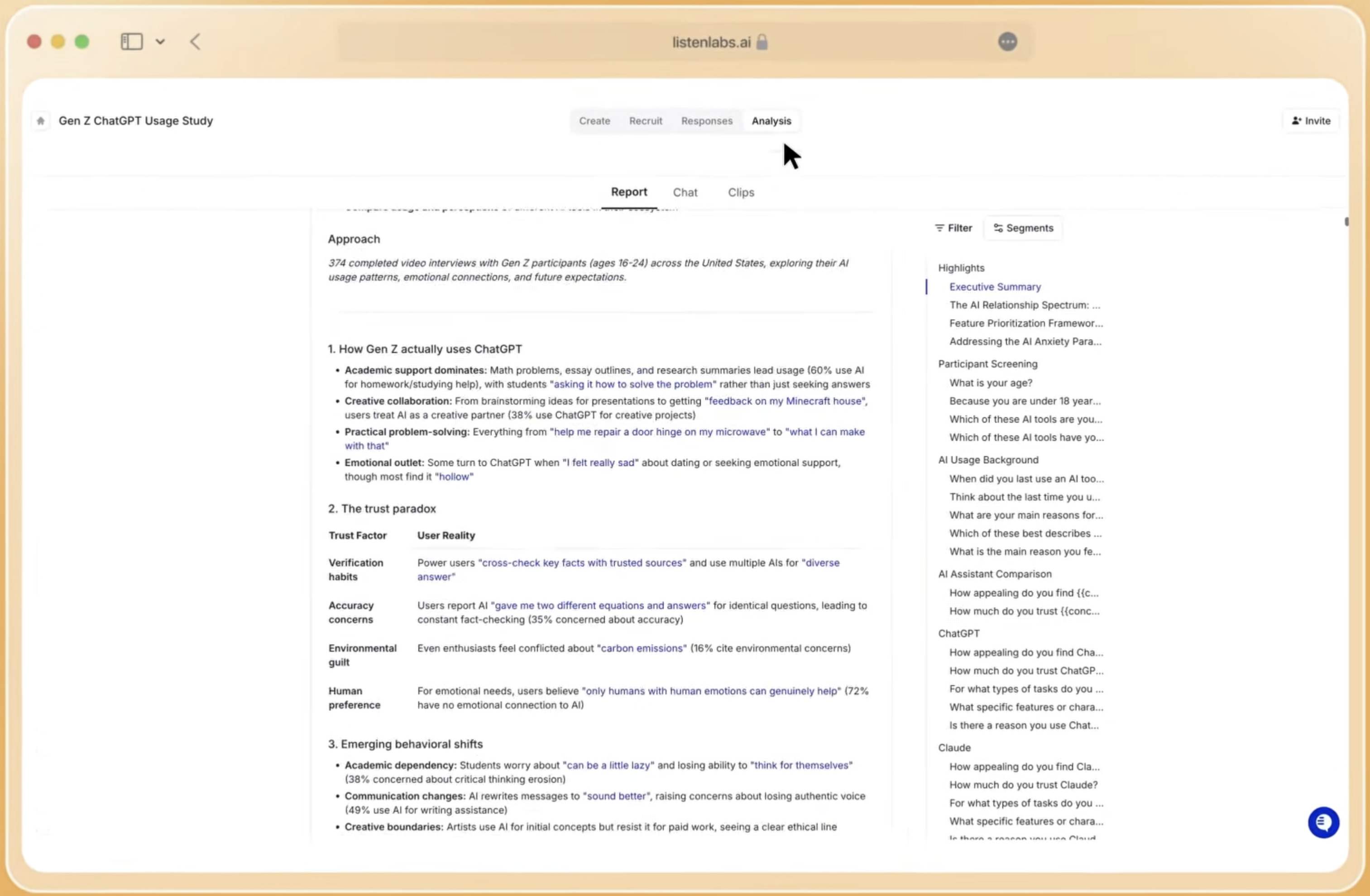
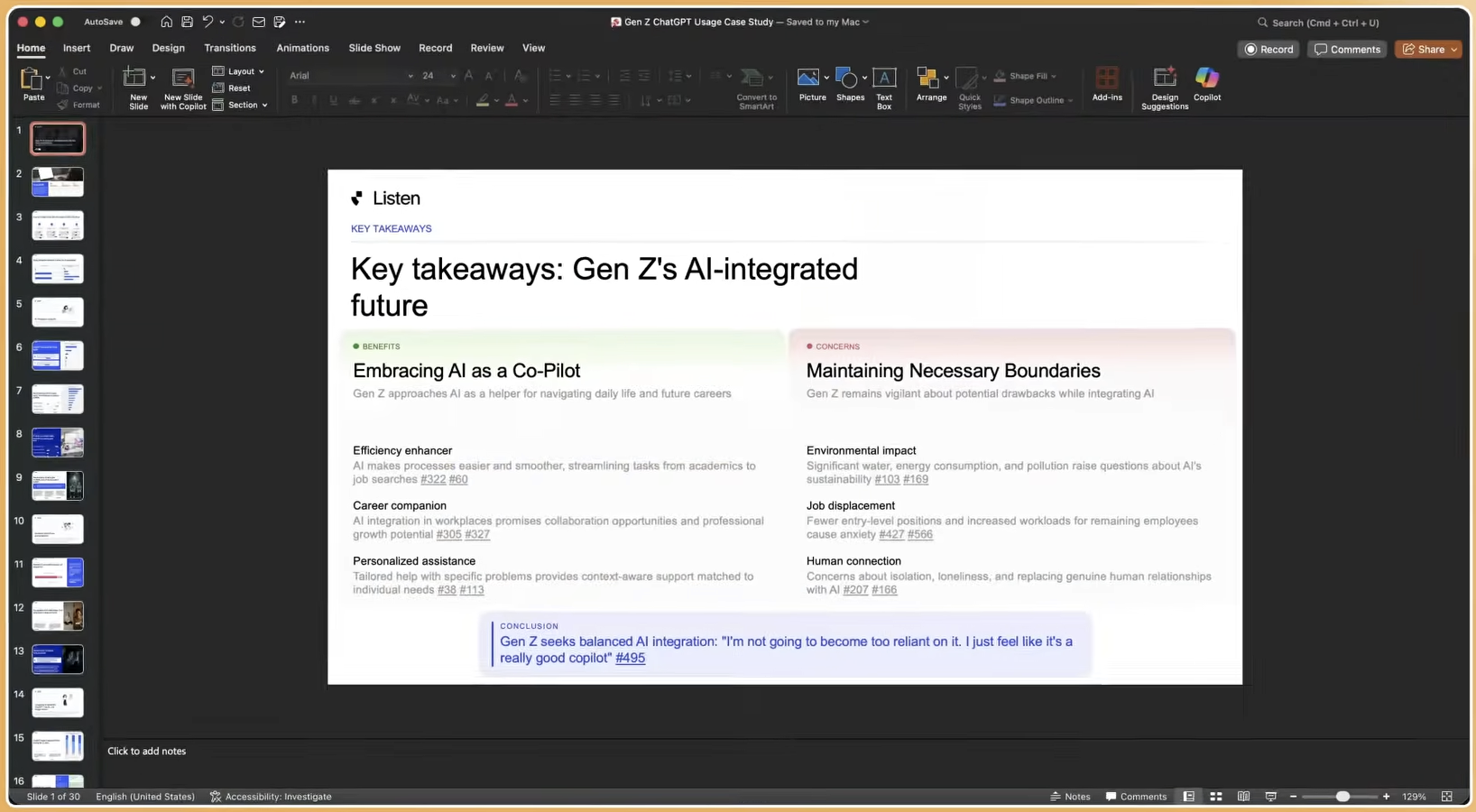
Reporting: One-click deliverables include consultant-quality slide decks, memo-style reports, video highlight reels, and statistical charts generated in under a minute. Microsoft used Listen Labs to collect global customer stories for its 50th anniversary celebration within a day. Anthropic’s Claude team surfaced churn drivers across 300+ user interviews in 48 hours, 5x faster than traditional approaches. P&G delivered 250+ interviews with quantified themes that directly shaped product and brand strategy in hours. Skims validated campaign direction with thousands of high-income buyers overnight. Robinhood received insights 5x faster with integration flows boosting uptake 30–40%.
Listen Labs holds SOC 2 Type II, GDPR, ISO 27001, ISO 27701, and ISO 42001 certifications, providing the full enterprise compliance stack for global programs. Listen Labs raised $69 million in a Series B funding round led by Ribbit Capital, with participation from Sequoia Capital, Conviction, and Pear VC, reaching a valuation over $500 million as of January 2026.
See how the end-to-end platform handles your research use case.
Best-Fit Use Cases by Team Type
Enterprise consumer insights teams running continuous customer intelligence programs, multi-market segmentation studies, and concept testing at scale benefit most from enterprise customer-research platforms. The combination of global panel access, AI moderation at volume, and automated deliverables addresses the core problem of a growing research backlog against fixed headcount. This adoption rate reflects a structural shift away from one-off agency engagements toward continuous research programs.
UX research leads at mid-to-large product companies need faster feedback loops that match sprint cycles. UX team adoption of AI customer research reached 73% in 2026, driven by screen-share and prototype-share capabilities inside AI interviews. Enterprise platforms with usability testing, mobile screen recording, and mixed-method support reduce the logistics overhead of recruiting, scheduling, and moderating sessions that currently bottleneck product development.
Non-research product and marketing leaders without dedicated research teams or methodology expertise gain access to primary research through platforms that translate natural-language research goals into structured studies, handle recruitment and moderation automatically, and return analysis without manual coding. Self-serve access and AI-assisted study design lower the barrier to primary consumer data for teams that previously relied on gut instinct or infrequent survey data.
Consultancies and agencies operating under client timelines measured in days rather than weeks require speed, global reach, and the ability to recruit niche audiences. Enterprise platforms that combine a large verified panel with dedicated recruitment operations for hard-to-find segments such as enterprise decision-makers, healthcare workers, and specialized consumer cohorts directly address the cost and resource intensity of bespoke research per engagement.
Operational Risks and Adoption Considerations
Change management is the most underestimated barrier to AI research adoption. Insights teams should measure decision velocity, the speed from business question to confident answer, alongside operational metrics including turnaround time, deliverable quality, and active usage rates when evaluating platforms. Measurement reveals whether the platform works, yet teams that bolt AI tools onto existing workflows without restructuring around parallel moderation and executable research briefs achieve only incremental gains because the old process architecture limits the impact of new technology.
Internal expertise requirements differ by platform category. General-purpose AI tools require manual orchestration for every research task. Enterprise platforms with AI-assisted study design, automated recruitment, and one-click deliverables reduce the expertise threshold for non-researchers while preserving methodological rigor for research professionals.
Global repeatability depends on native-language moderation rather than translation of English guides. AI moderators run native-quality interviews in up to 50+ languages, which makes multilingual consumer research economically practical at scale for the first time.
Fraud risk remains a persistent operational hazard. Platforms relying on commodity panels without real-time behavioral monitoring introduce data quality problems that undermine the entire research investment. Multi-layer fraud prevention that includes behavioral matching, real-time AI monitoring, participant frequency limits, and human review now represents the operational standard for enterprise-grade qualitative work.
Shallow data risk appears when teams prioritize speed over probing depth. Moderator quality is the most important evaluation dimension, and platforms should be benchmarked on whether the AI achieves 5–7 levels of emotional laddering in 30+ minute conversations rather than repetitive scripted follow-ups or sessions averaging 8–12 minutes.
The misconception that faster tools automatically produce better insights remains common among teams new to AI-moderated research. Speed comes from automation, while insight quality depends on moderation depth, participant quality, and analysis rigor. These variables operate independently, and only platforms that improve all three at once truly remove the depth-versus-scale trade-off.
Decision Framework and Practical Checklist
The following checklist maps research goals, timelines, budgets, and audience needs to the appropriate tool category.
- Background research, competitive scans, or study guide drafting with no participant recruitment needed: General web and research assistants such as Perplexity and ChatGPT Deep Research are appropriate for this scope.
- Systematic literature review, meta-analysis, or evidence synthesis from published academic sources: Academic literature tools such as Elicit, Consensus, and SciSpace are purpose-built for this workflow.
- Structured measurement, regulatory tracking, syndicated benchmarks, or statistically projectable population data: Quantitative survey platforms such as Qualtrics and SurveyMonkey remain the appropriate choice for closed-ended, large-sample measurement.
- Primary consumer interviews, concept testing, creative testing, usability research, brand perception, or churn analysis requiring adaptive probing, emotional signal capture, global reach, and deliverables in under 24 hours: Enterprise customer-research platforms with end-to-end AI moderation, verified panel access, and automated analysis fit this requirement.
- Ongoing continuous customer intelligence programs requiring cross-study querying, trend tracking, and institutional knowledge building: Platforms with a persistent research repository and retrieval-augmented synthesis across all historical studies address this need.
- Studies requiring SOC 2 Type II, ISO 27001, ISO 27701, ISO 42001, and GDPR compliance for enterprise procurement: Teams should verify certifications before piloting any platform at scale.
- Hard-to-reach audiences below 1% incidence rate: Confirm whether the platform has dedicated recruitment operations beyond automated panel matching.
- Emotional signal capture for creative testing, concept comparison, or usability research: Confirm whether the platform analyzes tone, micro-expressions, and word choice with timestamp-level traceability, not only sentiment tags.
Frequently Asked Questions
Will an AI research assistant replace my insights team?
AI research assistants act as force multipliers for existing research teams, not replacements. The platform handles logistics such as recruitment, moderation, transcription, initial analysis, and deliverable generation, which frees researchers to focus on strategic synthesis, stakeholder communication, and study design. Teams using AI-native platforms report running significantly more studies per quarter at constant headcount, with time savings reallocated to higher-value work rather than eliminated positions. The in-house research expertise required to design rigorous studies, interpret unexpected findings, and advise business stakeholders remains a human function that AI augments rather than replaces.
How do enterprise platforms ensure participant quality and prevent fraud in customer interviews?
Enterprise-grade platforms apply multiple independent layers of quality control. The first layer is panel sourcing, which means working exclusively with high-quality, non-commodity panel sources and excluding professional survey-takers through participant frequency limits. The second layer is real-time behavioral monitoring, where AI systems analyze video, voice, content, and device signals during each interview to detect fraud, low-effort responses, AI-generated scripts, and mismatched profiles. The third layer is human review, with dedicated recruitment operations teams manually verifying sourcing for hard-to-reach segments and applying behavioral matching on intent and past actions rather than self-reported demographics alone. Platforms with all three layers in place provide a materially different quality guarantee than those relying on panel access alone.
How does AI moderation compare to human moderation for emotional intelligence and depth?
AI moderation matches or exceeds human moderation on consistency, scale, and synthesis throughput for most semi-structured consumer research. AI moderators apply discussion guides with perfect consistency across every interview, which removes interviewer drift, leading questions, tone bias, and energy variation that human moderators introduce. For emotionally sensitive topics such as trauma, grief, clinical vulnerability, or high-stakes executive interviews requiring peer credibility, human moderation remains the appropriate default. For the majority of enterprise use cases including concept testing, brand research, churn analysis, usability testing, and competitive positioning, AI moderation delivers comparable depth at much greater speed and scale. Platforms that add a dedicated Emotional Intelligence layer, analyzing tone of voice, micro-expressions, and word choice with timestamp-level traceability, extend AI moderation’s capability beyond what transcripts alone can surface.
What pricing and self-recruitment options exist for enterprise qualitative research?
Enterprise customer-research platforms typically use a subscription model that combines platform access with per-participant credits. Credit cost varies by audience difficulty, so general population studies require fewer credits than niche or hard-to-reach segments. Organizations can reduce per-participant costs by self-recruiting from their own user base, bringing their own panel provider, or using the platform’s global panel. Compared to traditional agency models, where a 20-interview in-depth interview program can cost $100,000–$150,000 and take 6–8 weeks, AI-moderated platforms deliver equivalent or greater depth at a fraction of the cost. Enterprises with more than 100 employees typically go through a demo and pilot process before committing to a subscription, while smaller organizations may access self-serve tiers directly.
How do these platforms handle data security and compliance for global consumer research?
Enterprise-grade platforms maintain certifications that satisfy procurement requirements across major global markets. The relevant certifications for consumer research at enterprise scale include SOC 2 Type II for security controls, ISO 27001 for information security management, ISO 27701 for privacy information management, ISO 42001 for AI management systems, and GDPR compliance for European data subjects. Beyond certifications, enterprise platforms should provide 256-bit encryption, a clear policy that customer data is never used for AI model training, enterprise SSO, workspace data segregation, and permissions and approval workflows for multi-team environments. Verifying the full certification stack, not only SOC 2, sets the appropriate standard for global programs handling consumer data across multiple jurisdictions.
Conclusion: Choosing the Right AI Research Assistant for Enterprise Qual
The four categories of AI research assistants serve distinct purposes. General web and research assistants support background research and content synthesis. Academic literature tools support systematic review and evidence synthesis from published sources. Quantitative survey platforms handle structured measurement at scale. Enterprise customer-research platforms cover the full research lifecycle for primary consumer interviews, from study design and participant sourcing through AI-moderated conversations, emotional signal capture, automated analysis, and stakeholder-ready deliverables.
The competitive gap in the market does not sit between these categories on any single dimension. It appears between platforms that cover the full research lifecycle end-to-end and those that address only one or two stages. Qual-at-scale platforms eliminate the structural barrier mentioned earlier, enabling teams to achieve both depth and scale simultaneously.
Listen Labs combines the speed described above, with hundreds of interviews completed and analyzed overnight, with a 30-million-person verified panel across 45+ countries and 100+ languages and automated deliverables that include slide decks, memos, video highlight reels, and statistical analysis. Switching to Listen Labs AI-moderated interviews lets enterprise teams capture hundreds of candid, one-to-one conversations overnight at roughly a third of the cost of traditional research approaches.
For enterprise insights leaders, UX research heads, and product and marketing stakeholders replacing 4–6 week research cycles and fragmented vendor stacks, Listen Labs stands out as the only end-to-end platform that meets the full set of requirements for speed, depth, participant quality, global reach, emotional intelligence, and compliance in a single solution.
See how Listen Labs can transform your qualitative research program.