
Written by: Anish Rao, Head of Growth, Listen Labs
Key Takeaways
-
AI rapid data analysis collapses the traditional 4–6 week qualitative research cycle into under 24 hours by automating recruitment, adaptive interviews, multimodal analysis, and deliverable generation.
-
Listen Labs removes the depth-versus-scale trade-off, enabling hundreds of emotionally intelligent interviews with verified participants across 45+ countries and 100+ languages.
-
Multimodal Emotional Intelligence captures tone, word choice, and micro-expressions to surface nuanced participant sentiment that transcripts alone miss.
-
Research Agent automates analysis and produces branded slide decks, reports, and video highlight reels in under a minute while maintaining full traceability to source data.
The Skill Gap Most Insights Teams Still Face
Most enterprise research teams still treat qualitative research as a linear project: define objectives, recruit participants, schedule sessions, moderate interviews, transcribe recordings, analyze transcripts, and write a report. Each stage waits for the previous one to finish. The result is a multi-week cycle that, inside large organizations with internal prioritization queues and budget approval processes, can stretch to six months.
Researchers spend the bulk of their time in analysis: finding patterns, quantifying insights, testing significance, adding macro context, and formatting results for stakeholders who each need something different. That time cost compounds across every study in the backlog. Product and brand teams file requests and wait. Many requests never get fulfilled. Cross-functional trust erodes because the insights function cannot keep pace with the speed of decisions being made around it.
The linear-project mindset also forces a depth-versus-scale trade-off that is no longer technically necessary. With qual-at-scale, the old trade-off between depth and scale is no longer a barrier. The five-step workflow below converts research from a sequential project into an always-on intelligence capability.
Step 1: Turn Business Questions into a Structured Study Guide
Inputs: Business decision to be made, stakeholder hypotheses, prior research in the repository.
Stakeholders: Insights lead, product or brand owner, legal or compliance reviewer.
Decision points: Research methodology (IDI, diary, concept test), target audience definition, success criteria.
Timeline: Two to four hours.
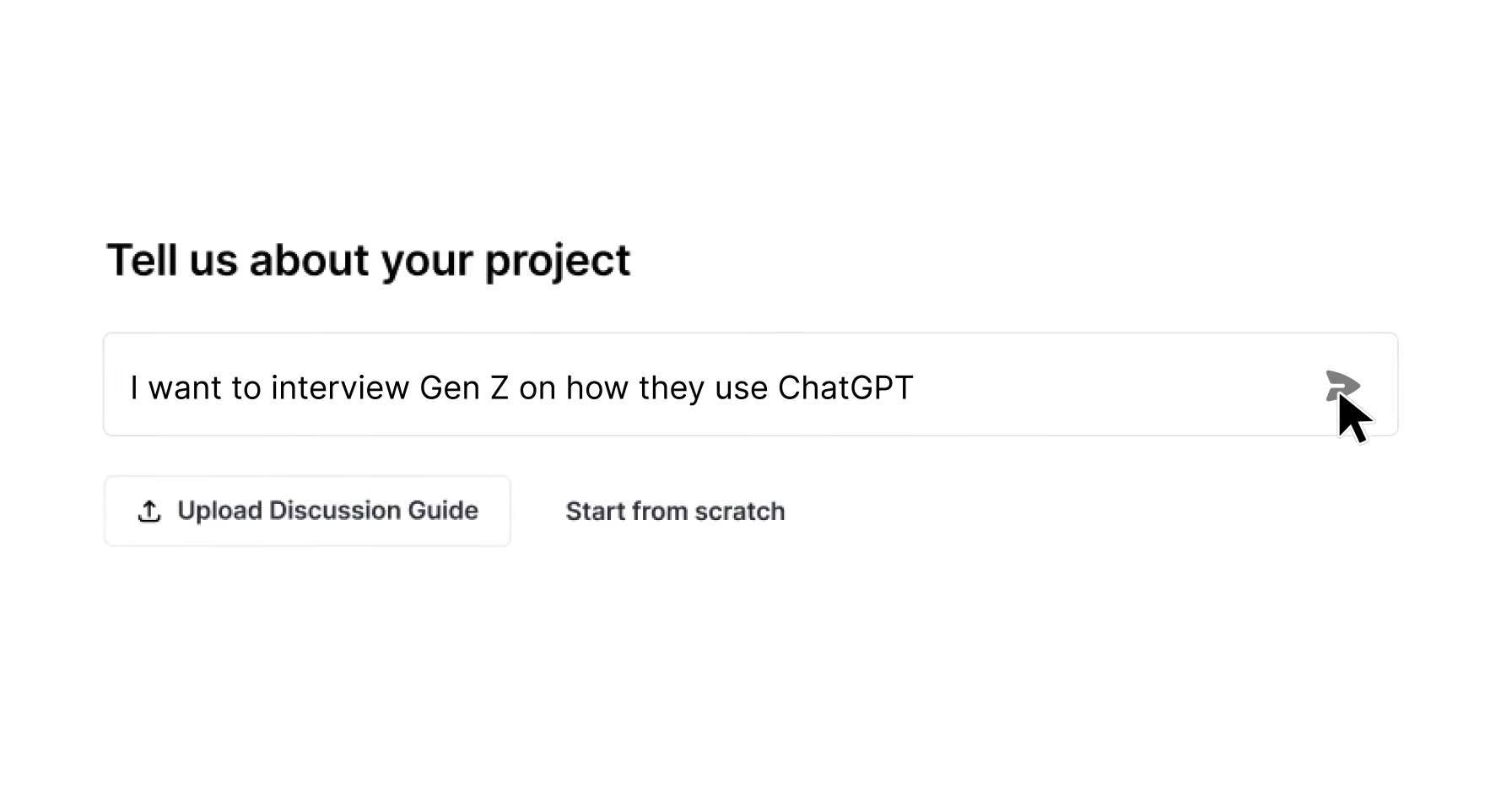
The study guide is the foundation of every downstream output. AI-assisted co-design lets researchers describe goals in natural language and receive a structured set of objectives, questions, and probing context within seconds. Auto-QA flags ambiguous or leading questions before launch, reducing iteration cycles that typically consume days in traditional workflows. Cloning past studies from Mission Control, Listen Labs’ cross-study knowledge base, removes redundant setup for recurring research programs.
Step 2: Source and Screen Participants at Scale
Inputs: Audience definition, incidence rate estimate, quota requirements.
Stakeholders: Insights lead, recruitment operations team.
Decision points: Panel source (managed network, self-recruited, or hybrid), screening criteria, sample size.
Timeline: Two to six hours for general population; up to 24 hours for niche segments.
AI market research tools have made participant sourcing the fastest stage of the research lifecycle rather than the slowest. Listen Labs’ Listen Atlas layer automatically matches and bids across a global network of 30 million verified respondents spanning 45-plus countries and 100-plus languages. Behavioral and intent data drive matching, not just self-reported demographics, which improves screening accuracy before a single interview begins.
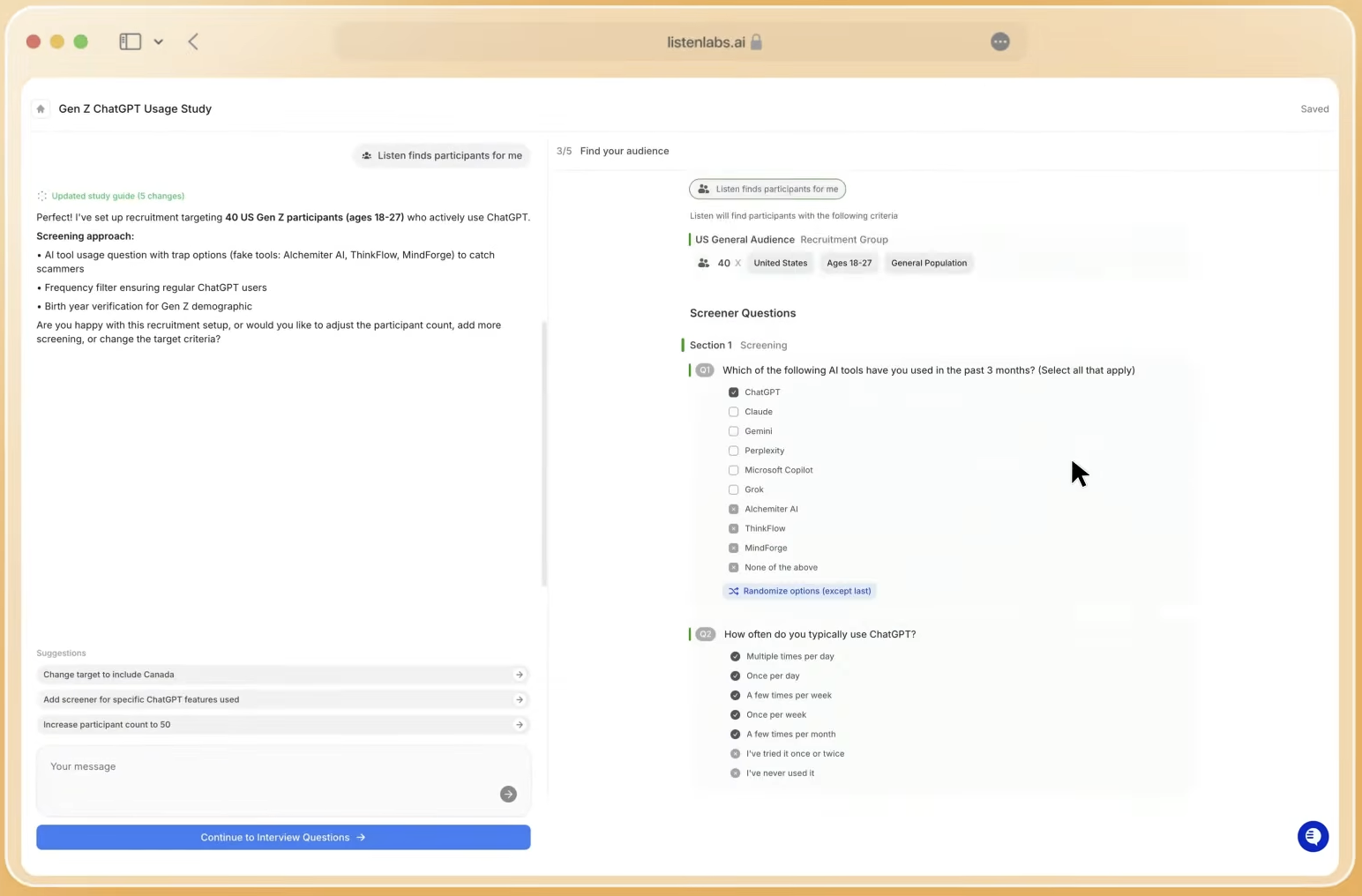
Organizations can also self-recruit from their own user base, reducing cost per participant while maintaining the same quality controls. For audiences that fall outside the automated panel network, such as segments below one percent incidence rate including enterprise decision-makers, healthcare workers, and highly specialized consumer profiles, a dedicated recruitment operations team steps in to source participants through niche communities and specialized networks.
Step 3: Conduct Adaptive AI-Moderated Interviews
Inputs: Finalized study guide, recruited participant pool, any stimuli (images, video, prototypes, live URLs).
Stakeholders: Insights lead, UX or brand team providing stimuli.
Decision points: Interview format (video, audio, text), mixed-method components (NPS, Likert, MaxDiff), language and localization settings.
Timeline: Two to eight hours to complete hundreds of parallel sessions.
AI for qualitative data analysis begins at the interview stage, not after it. AI-moderated interviews conduct personalized, adaptive conversations with dynamic follow-up questions, probing deeper on short or unexpected answers the same way a trained human moderator would. Platforms like Listen Labs layer on auto-recruiting, transcription, sentiment tagging, and insight summarization so teams jump from question to findings in hours, not weeks.
Participant comfort in AI-moderated sessions matches human-moderated sessions. For sensitive topics including personal finances, politics, and health, AI moderation produces more candid responses because participants perceive less social judgment. Switching to AI-moderated interviews let Chubbies capture hundreds of candid, one-to-one conversations overnight.
Step 4: Run Multimodal Analysis Including Emotional Signals
Inputs: Completed interview recordings, transcripts, quantitative responses.
Stakeholders: Insights lead, Research Agent.
Decision points: Segmentation cuts, emotional signal depth, cross-study comparisons.
Timeline: Under one hour for hundreds of interviews.
Transcript analysis alone captures what participants say. It does not capture what they feel. The key insight is that emotional signals often contradict stated preferences and reveal friction points that predict downstream rejection. For example, a participant may rate a concept positively while displaying micro expressions of confusion or hesitation.
This capability is grounded in established science. Emotional Intelligence is built on Ekman’s universal six emotions framework, the same standard used in clinical psychology and UX research: anger, disgust, fear, happiness, sadness, and surprise.
Independent research supports the validity of vocal biomarker analysis. A 2026 study published in Frontiers in Psychology examined metacognitive monitoring and calibration in the vocal emotion recognition task. Every emotion is quantified per question and concept, with every label traceable to the exact timestamp, verbatim quote, and AI reasoning behind it.
Teams can ask the Research Agent which concept triggered the most confusion and receive a side-by-side emotional breakdown across stimuli, segments, and markets in natural language. Apply Emotional Intelligence to your next concept test or creative review and schedule a walkthrough.
Step 5: Turn Analysis into Shareable Deliverables
Inputs: Analyzed interview data, emotional signal outputs, stakeholder reporting requirements.
Stakeholders: Insights lead, product, brand, executive sponsors.
Decision points: Deliverable format (slide deck, memo, highlight reel, statistical chart), distribution channels.
Timeline: Under one minute per deliverable format.
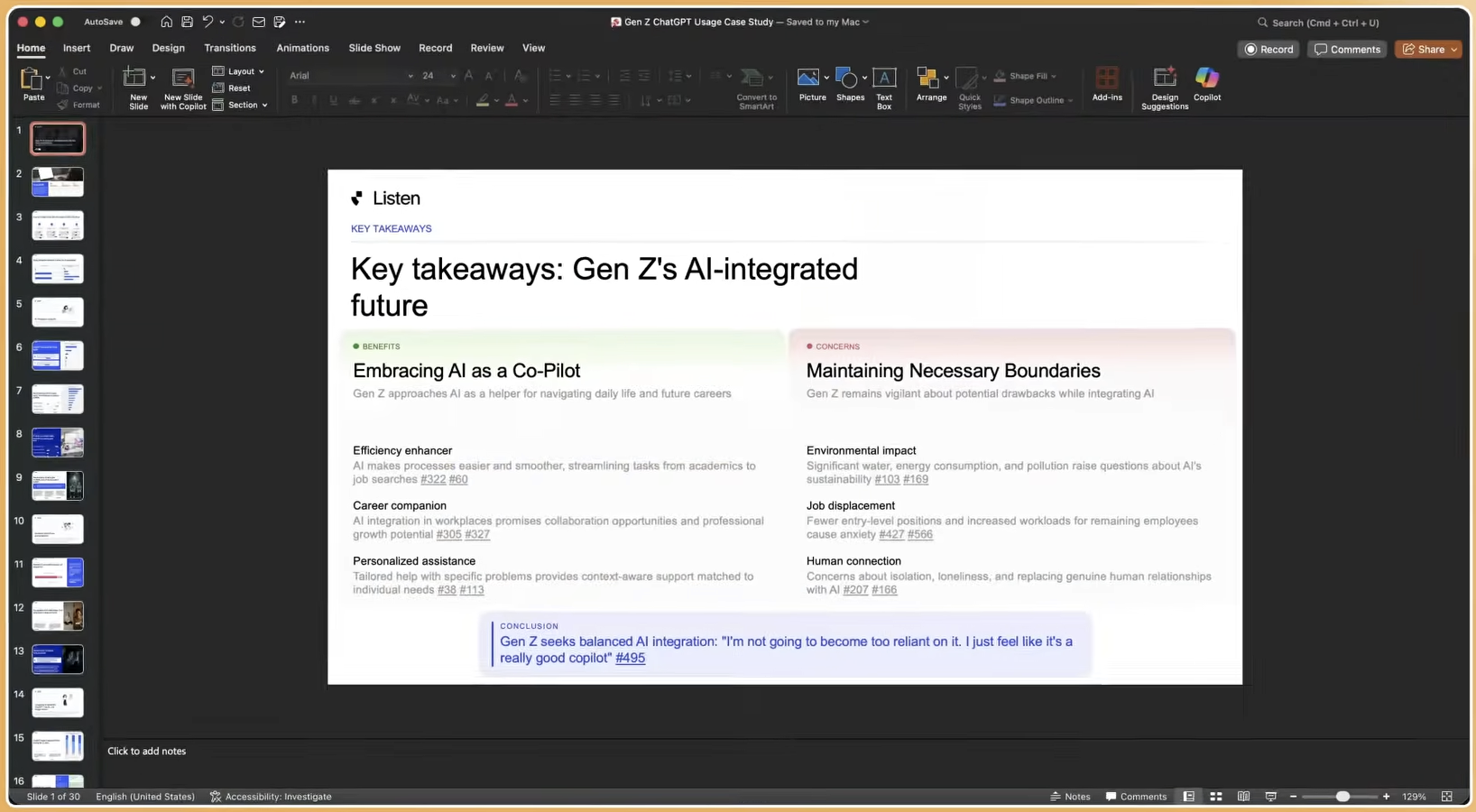
Research Agent handles the full analysis workflow from raw data to final output. One researcher can run a full buying intent analysis across three user segments in under a minute. Research Agent generates a slide deck in a company’s branded template and a downloadable report.
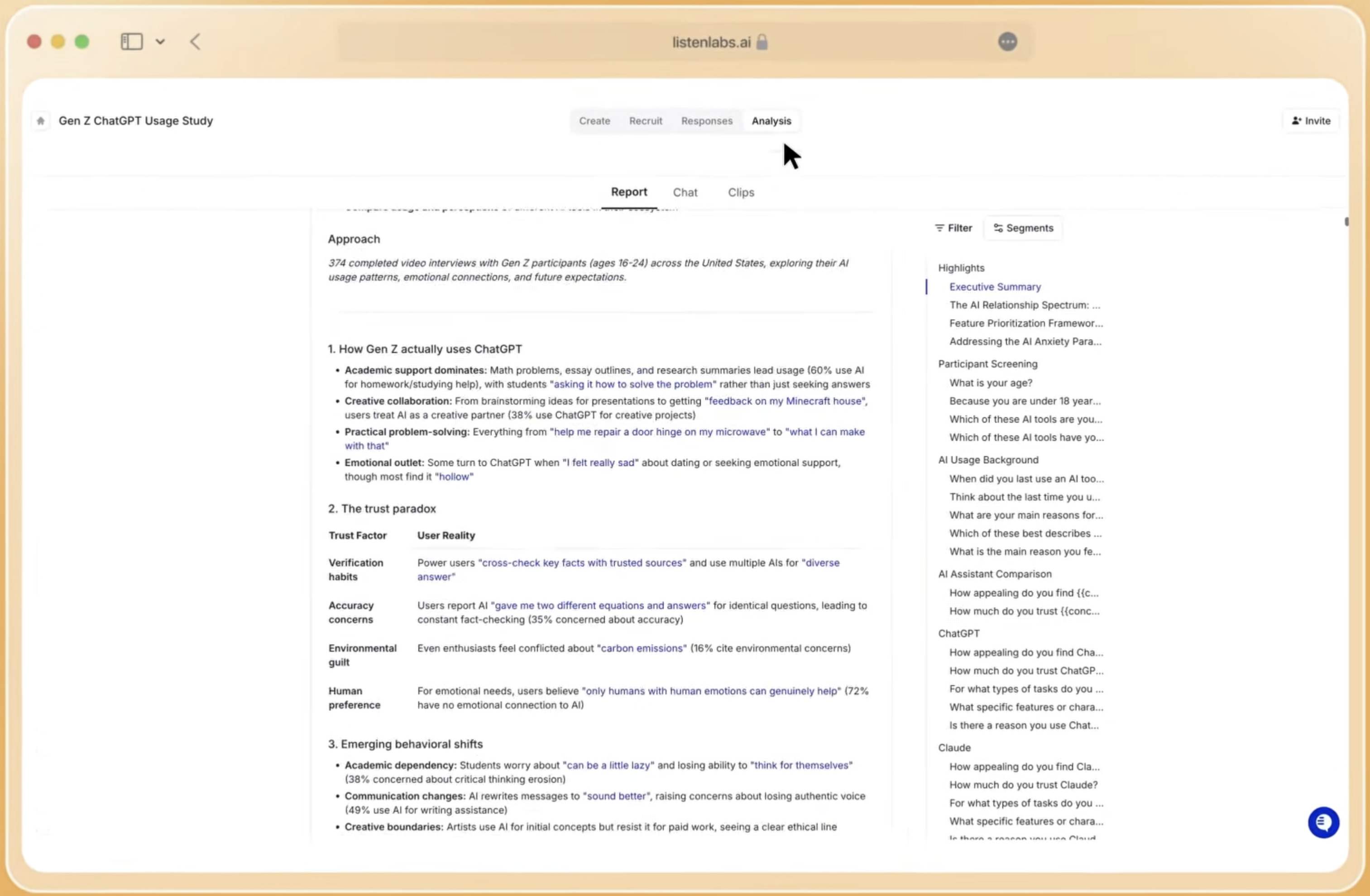
Video highlight reels surface the most emotionally significant moments from hundreds of interviews, giving executives direct access to the voice of the customer without reading a 40-page report. Every insight links directly to the underlying response data, so stakeholders can drill into any finding rather than accepting a summary at face value. This traceability converts research outputs from slide decks into decision-making infrastructure.
Enterprise-Grade Fraud Prevention Layers
Data quality depends on participant authenticity. Even the most sophisticated analysis pipeline produces misleading insights if the underlying interview data comes from fraudulent respondents. Participant fraud is a structural problem in online research.
An estimated 30–40% of online survey responses are fraudulent or unusable, based on CloudResearch analysis of billions of surveys and third-party research. The threat has evolved.
Listen Labs addresses this through three independent layers. First, the platform works exclusively with high-quality, non-commodity panel sources, with no professional survey-takers. Second, Quality Guard monitors every interview in real time across video, voice, content, and device signals to detect fraudulent responses, AI-generated scripts, and mismatched profiles. Participants are limited to three studies per month, which reduces panel fatigue and incentive-driven behavior.
Third, a dedicated recruitment operations team adds human review for complex or high-stakes studies. According to a 2025 Alloy survey, 99% of organizations already use AI as part of their fraud prevention system, a multi-layer approach that mirrors Listen Labs’ own architecture.
Quantified Time and Cost Savings (2025–2026 Benchmarks)
Traditional focus groups cost $4,000–$12,000 per 90-minute session and take 3–5 weeks to complete. Listen Labs compresses the full research lifecycle to the same sub-24-hour window. Enterprises running the platform report costs at approximately one third of the traditional research approach for equivalent sample sizes.
Listen Labs has run over one million AI-powered customer interviews for companies including Microsoft, Perplexity, and Sweetgreen. Microsoft’s team collected global customer video stories for the company’s 50th anniversary within a single day. Anthropic’s Claude Code team completed 300-plus user interviews in 48 hours, surfacing churn drivers five times faster than prior methods. Robinhood’s research delivered insights five times faster and revealed integration flows that boosted feature uptake by 30–40%.
Listen Labs raised $69 million in a Series B funding round led by Ribbit Capital, with participation from Sequoia Capital, Conviction, and Pear VC, at a valuation over $500 million as of January 2026, which signals the level of enterprise-grade infrastructure investment behind the platform.
Frequently Asked Questions
How long does it actually take to go from study brief to final deliverables?
The full cycle, study design, participant recruitment, AI-moderated interviews, multimodal analysis, and deliverable generation, completes in under 24 hours for most studies. General population studies with standard sample sizes typically finish faster. Studies targeting niche audiences below one percent incidence rate may require up to 24 hours for recruitment alone, with analysis and deliverables completing within the same timeframe.
What privacy and security certifications does the platform hold?
Listen Labs maintains SOC 2 Type II, GDPR, ISO 27001, ISO 27701, and ISO 42001 certifications. All data is encrypted at 256-bit, and customer data is never used to train AI models. Enterprise SSO is supported. These certifications cover both data security and AI governance, which is relevant for organizations operating under sector-specific compliance requirements in financial services, healthcare, and consumer goods.
Can the platform reach hard-to-find or niche audiences?
Yes. The Listen Atlas recruitment layer draws from a global network of 30 million verified respondents across 45-plus countries and 100-plus languages. For audiences below one percent incidence rate, including enterprise decision-makers, engineers, healthcare workers, and highly specialized consumer segments, a dedicated recruitment operations team partners with niche communities, micro-creators, and specialized networks to source the right participants. Organizations can also self-recruit from their own user base at reduced cost.
Can we bring our own participants instead of using the managed panel?
Yes. Listen Labs supports self-recruitment, allowing organizations to direct their own customers or users into studies. This option reduces the credit cost per participant and is commonly used for customer advisory panels, loyalty program members, and product beta testers. Self-recruited participants move through the same Quality Guard monitoring as panel-sourced participants, maintaining consistent data integrity.
When should a study be expanded versus retired?
A study should be expanded when early interview data reveals unexpected segments or contradictory findings across demographic cuts, or when stakeholders request statistical significance across a subgroup that was underrepresented in the original sample.
Mission Control enables cross-study queries, so teams can check whether a finding replicates across prior studies before commissioning additional interviews. A study should be retired when thematic saturation is reached, meaning new interviews are no longer producing new themes, or when the business decision it was designed to inform has already been made and the data is no longer actionable.
Conclusion
Treating qualitative research as a linear, weeks-long project is a structural choice, not a technical constraint. AI rapid data analysis market research removes every bottleneck in that linear chain. Study design, participant recruitment, interview moderation, multimodal analysis including emotional signals, and deliverable generation all run in parallel or in rapid sequence, compressing the traditional multi-week process to a single day.
AI can schedule and conduct interviews, analyze transcripts for themes, and generate quantitative insights from qualitative data at a scale and speed that makes always-on research infrastructure operationally viable for the first time. The depth-versus-scale trade-off that has constrained insights teams for decades is now a solved problem. The remaining decision is whether your organization’s research infrastructure is built to take advantage of it.