
Written by: Anish Rao, Head of Growth, Listen Labs
Key Takeaways for Research Leaders
-
AI-moderated interviews compress traditional 4–6 week research cycles into under 24 hours by integrating study design, recruitment, moderation, and analysis in a single workflow.
-
AI moderation delivers consistent probing depth and higher participant candor on sensitive topics, while human moderation remains stronger for studies that depend on deep empathic rapport.
-
Listen Labs’ Quality Guard and Emotional Intelligence tools maintain enterprise-grade data quality and capture emotional nuance through multimodal analysis of voice, text, and micro-expressions.
-
Automated analysis via Research Agent and Mission Control removes manual coding, supports natural-language queries, and builds a reusable cross-study knowledge base for research teams.
-
See how Listen Labs can multiply your team’s research output without adding headcount by scheduling a tailored platform walkthrough.
Study Setup and Recruitment for AI vs Human Moderation
Human-moderated research typically requires coordinating across multiple vendors, with separate partners for recruitment, scheduling, moderation, and analysis. Traditional qualitative research run through agencies or manual workflows typically takes six to twelve weeks from brief to final report, with recruitment and scheduling consuming most of that time.
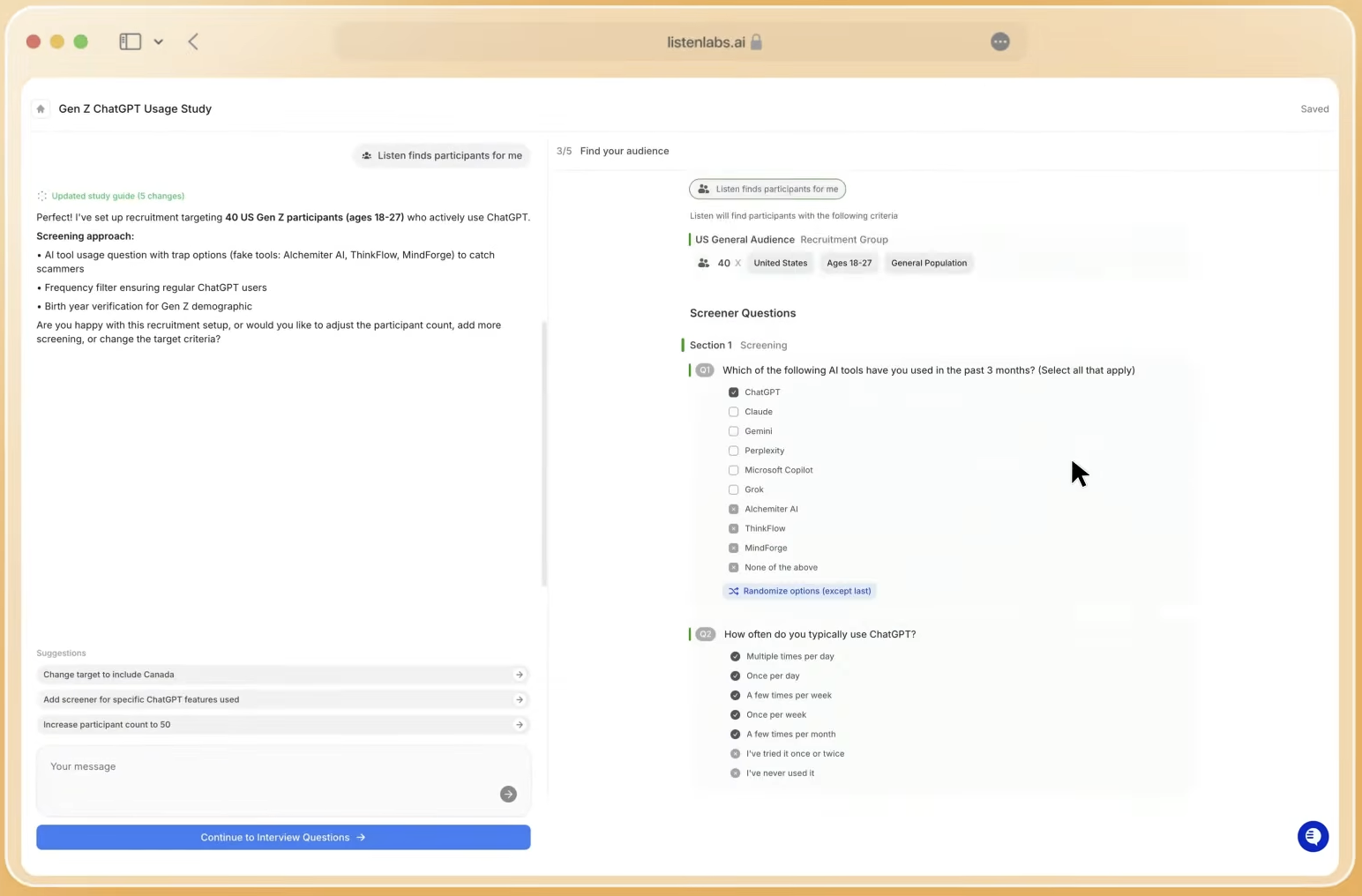
Listen Labs removes that fragmentation. AI-assisted study co-design drafts structured objectives and interview questions from a plain-language brief in seconds. Recruitment draws from Listen Atlas, a global panel of 30M verified respondents across 45+ countries and 100+ languages, with an AI orchestration layer that matches participants on behavioral and intent signals rather than self-reported demographics alone. A dedicated recruitment ops team handles hard-to-reach segments such as enterprise decision-makers, healthcare workers, and audiences below 1% incidence rate that commodity panels rarely reach reliably.
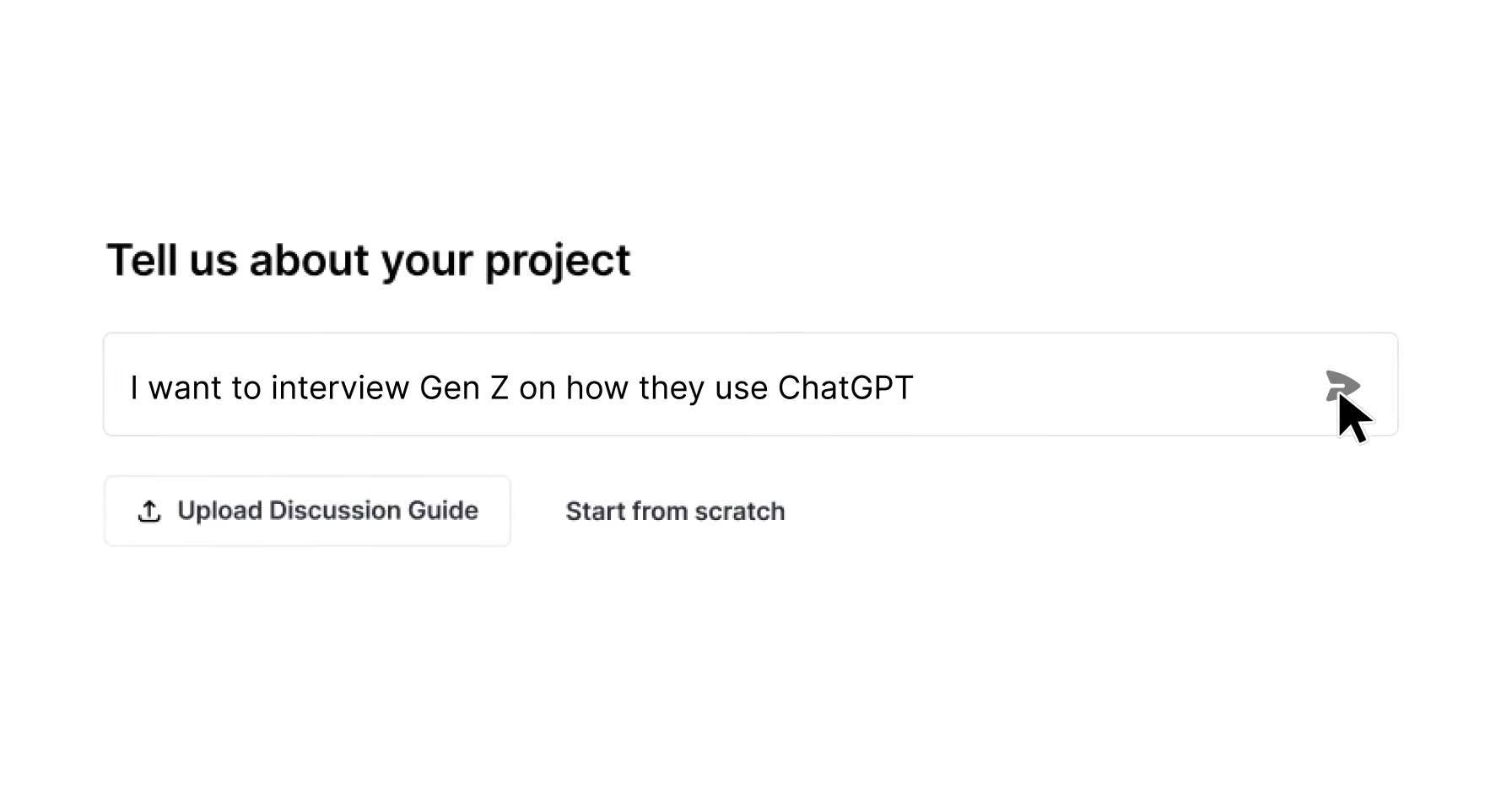
This integrated workflow eliminates the vendor coordination overhead that consumes most of the traditional timeline. Human-moderated workflows cannot match this speed at equivalent sample sizes because each phase runs sequentially instead of in parallel.
Moderation Style and Participant Experience with AI
AI-moderated interviews run personalized, adaptive conversations with dynamic follow-up questions. When a participant gives a short or unexpected answer, the AI probes deeper with targeted prompts. That behavior mirrors a trained human interviewer and applies consistently across every session, regardless of volume or time of day.
Where AI Moderation Fits in the Research Workflow
AI moderation does not replace the strategic judgment of a senior researcher. It replaces the logistics-heavy execution layer that consumes most of a research team’s time. Automation shifts the researcher’s role from managing logistics and sitting through moderation sessions to focusing on study design, interpreting nuance in findings, and translating insights into strategic recommendations. For exploratory research, concept testing, and large-sample studies, AI moderation performs at or above the level of human execution. For highly sensitive topics that depend on live relationship-building, such as complex medical discussions or grief research, human moderation retains a meaningful advantage.
How AI Captures Emotional Nuance
92% of participants report top comfort levels in both human and AI moderation sessions, which shows that AI-moderated interviews deliver a comparable experience for most research contexts. Within that group, 58% of participants preferred AI moderation for discussing political and religious views, and 32% explicitly stated they feel less judged with AI moderation. Many describe AI sessions as “easier than interacting with an actual person” because they can go at their own pace without worrying about perception from the interviewer.
Data Quality Controls and Fraud Prevention Infrastructure
While participant comfort drives candor, that candor only matters when participants are legitimate and engaged. Human-moderated research often relies on manual screening, recruiter judgment, and post-hoc quality checks, which are inconsistent and time-intensive. Listen Labs applies three layers of automated quality control through Quality Guard: real-time behavioral monitoring across video, voice, content, and device signals; reputation scoring that compounds across every interview conducted on the platform; and a hard limit of three studies per month per participant, which removes professional survey-takers. No commodity quantitative panels are used. A dedicated ops team adds a human review layer for studies that require niche audiences.
This architecture addresses a structural weakness in traditional research. Platforms like Listen Labs layer on auto-recruiting, transcription, sentiment tagging, and insight summarization so teams move from question to findings in hours, not weeks, while maintaining the quality controls that enterprise research demands.
Emotional Intelligence, Qualitative Depth, and Quant Support
The assumption that AI moderation produces shallower data than human moderation breaks down when emotional intelligence tools are integrated. Listen Labs’ Emotional Intelligence feature analyzes three signal layers simultaneously: tone of voice, word choice, and subconscious micro-expressions. Built on Ekman’s universal emotions framework, the same standard used in clinical psychology, it tracks anger, anticipation, disgust, fear, joy, sadness, trust, and surprise. Every emotion is quantified per question and concept, and every label is traceable to the exact timestamp, verbatim quote, and reasoning behind it.
Combining voice tone analysis with text content can reduce sentiment misclassification compared to text-only methods. Modern deep learning models for facial expression recognition also achieve strong performance on benchmark datasets. Listen Labs’ multimodal approach captures what transcripts alone miss, such as hesitation before a negative answer, a micro-expression of confusion during a concept test, or flat affect behind a nominally positive rating.
Mixed-methods support extends this depth. Likert scales, NPS, sliders, grids, and MaxDiff can be embedded directly into AI-moderated interview flows, which delivers quantitative confidence alongside qualitative richness in a single study.
Analysis, Deliverables, and Knowledge Management at Scale
Researchers spend the bulk of their time in analysis: finding patterns, quantifying insights, testing significance, adding macro context, and formatting results for stakeholders who each need something different. Human-moderated research compounds this burden because analysis begins only after all sessions are complete.
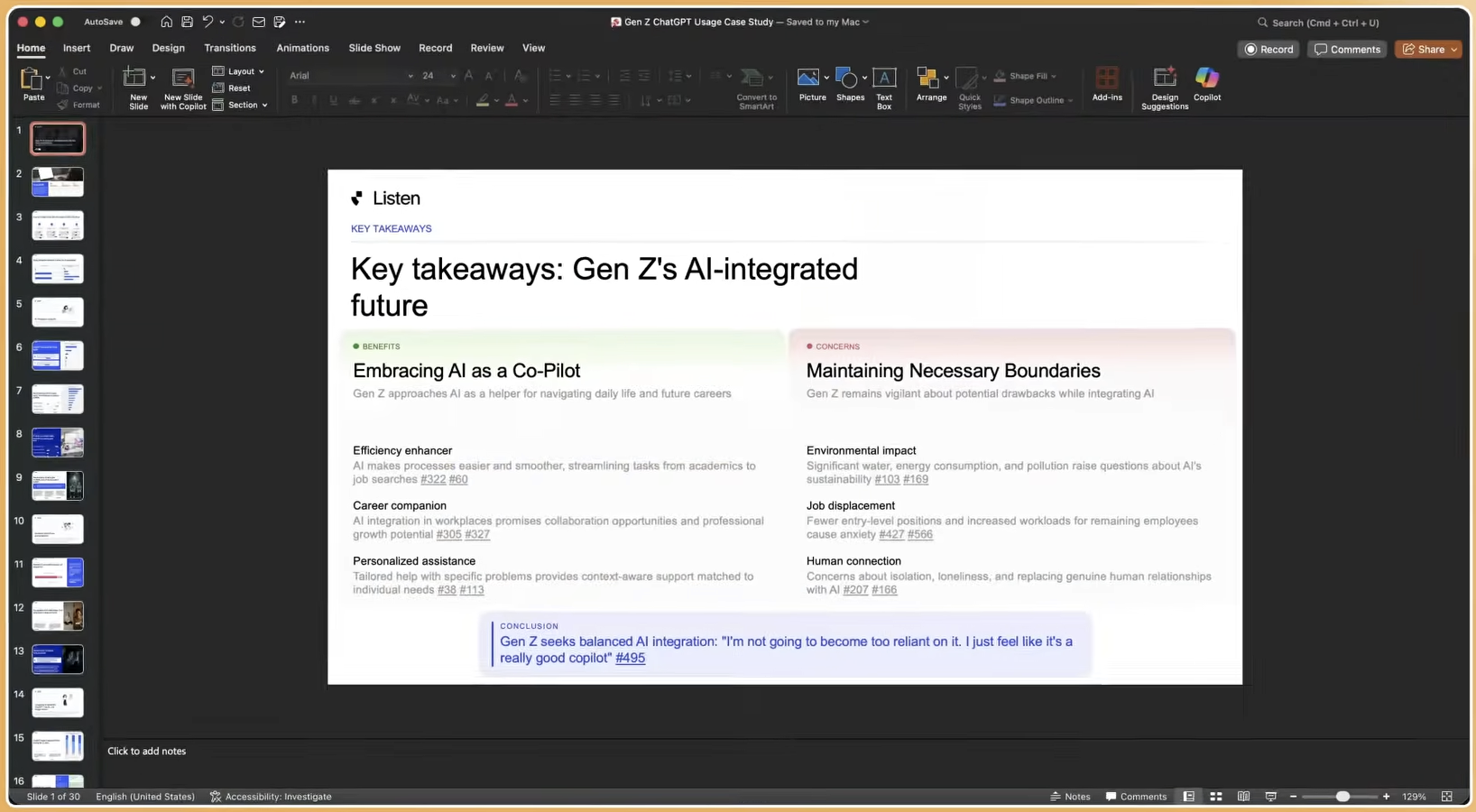
Listen Labs’ Research Agent automates this workflow. With AI-moderated interviews, talking to users at scale is no longer the hard part, and the challenge becomes understanding what they mean. Research Agent addresses that challenge through chat-based natural-language queries, automated theme identification, statistical significance testing, segmentation breakdowns, and one-click generation of slide decks, memos, video highlight reels, and custom reports, all in under a minute.
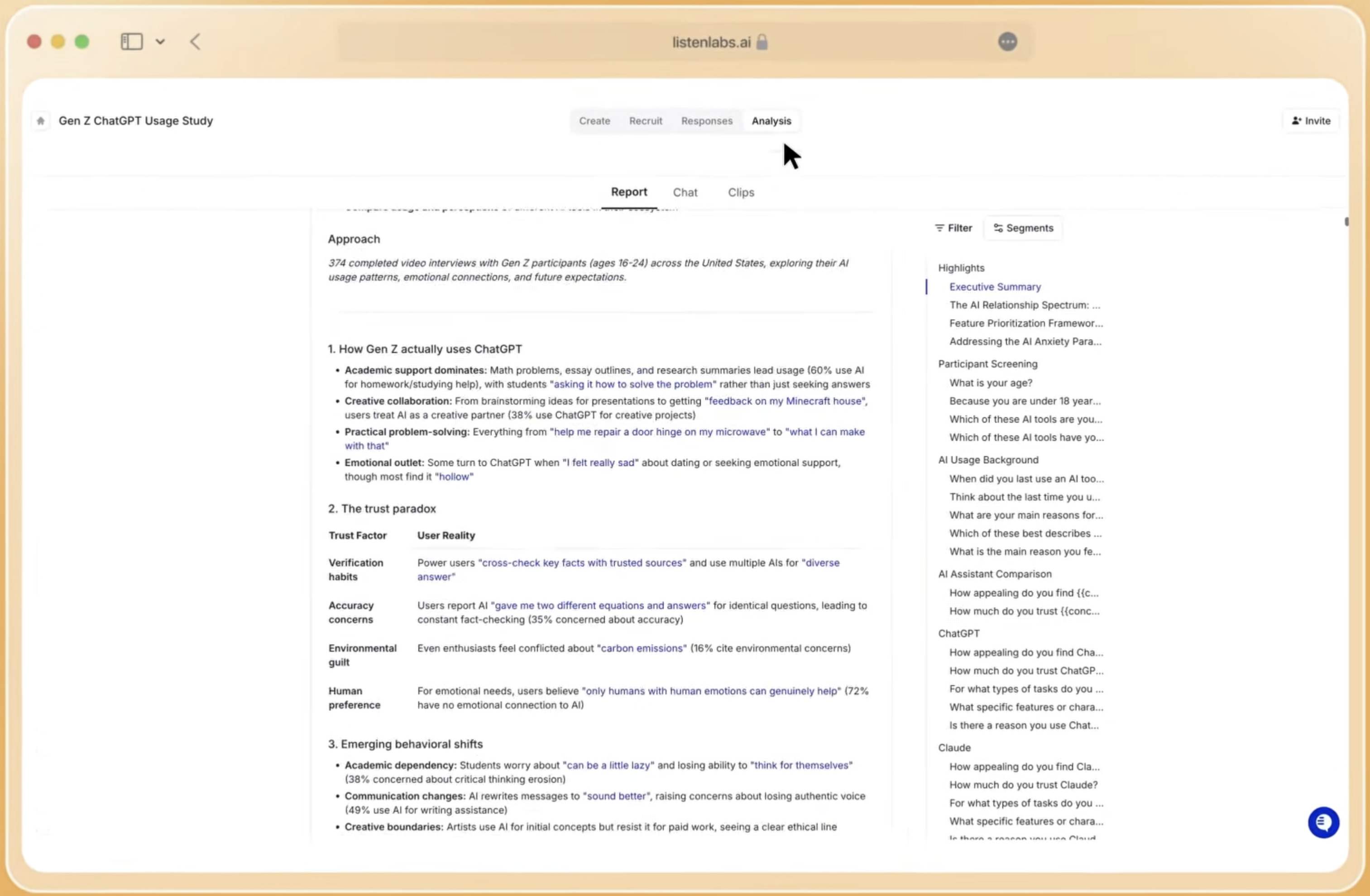
Mission Control extends this advantage across time. Every completed study feeds an organizational knowledge base that supports cross-study queries, trend tracking, and institutional memory. Research leaders can retrieve answers from past studies in seconds instead of re-commissioning work that already exists.
When AI Moderation Works Best for Different Teams
Consumer Insights Leaders at Fortune 500 enterprises with growing research backlogs gain the most from AI moderation for concept testing, segmentation studies, multi-market brand research, and any study requiring 50+ interviews. The under-24-hour speed-to-insight directly addresses backlog pressure without adding headcount.
UX Research Leads gain the ability to test with 50–100+ users per sprint cycle instead of 5–10, with screen-sharing and mobile screen recording built into the moderation flow. AI moderation removes the scheduling and no-show burden that makes keeping pace with product development cycles structurally difficult.
Product and Marketing Leaders without dedicated research teams can describe goals in natural language and receive study design, recruitment, moderation, and analysis handled end-to-end. This removes the methodology expertise barrier that previously made self-serve qualitative research impractical.
Agencies and consultancies facing client timelines measured in days rather than weeks can use Listen Labs to reach niche audiences globally and deliver findings within 24–48 hours of study launch.
Discuss which study types in your current backlog are best suited for AI moderation by scheduling a consultation with the Listen Labs research team.
Operational, Compliance, and Global Program Considerations
Enterprise adoption of AI moderation requires more than platform capability. It also requires compliance infrastructure that meets procurement and legal standards. Enterprise teams in healthcare, pharmaceutical, and financial services typically require SOC 2 Type II, GDPR, HIPAA, and ISO certifications as table stakes for AI qualitative research platforms. Listen Labs holds SOC 2 Type II, GDPR, ISO 27001, ISO 27701, and ISO 42001 certifications, with 256-bit encryption and a policy of never using customer data for AI model training.
Repeatability is a structural advantage of AI moderation that human-moderated research cannot match. Every session follows the same guide with the same probing logic, which removes moderator variance as a source of inconsistency across waves or markets. For global programs running across multiple languages simultaneously, Listen Labs supports 100+ languages with automatic translation and transcription. This enables true cross-market comparability without the coordination overhead of managing multilingual human moderator teams.
Risks, Limitations, and Where Humans Still Lead
AI moderation is not universally superior. Studies requiring deep empathic rapport, such as bereavement research, complex chronic illness experiences, or topics where the relationship between moderator and participant is methodologically significant, benefit from human moderation. Mental health discussions showed a 40% preference for AI versus 32% for human moderators, but the remaining participants who prefer human moderation in sensitive contexts represent a real segment whose preferences affect data quality.
Speed alone does not guarantee better research. A poorly designed study guide executed in 24 hours still produces low-quality findings. Listen Labs’ Auto-QA flags issues in the study guide before launch, and the in-house research team, with 50+ years of combined expertise, provides methodology support. The quality of inputs, however, continues to determine the quality of outputs.
Overestimating automation also creates risk. AI moderation handles execution, while strategic interpretation, stakeholder communication, and business decision-making remain human responsibilities. Research leaders who position Listen Labs as a replacement for their team’s judgment rather than a force multiplier for their team’s capacity will underuse the platform.
Fraud risk in AI-moderated research is real but addressable. Platforms without dedicated quality infrastructure, such as frequency limits, behavioral monitoring, and non-commodity panel sourcing, produce unreliable data regardless of moderation quality. Quality Guard’s architecture directly addresses this risk.
Practical Decision Framework for Research Leaders
AI moderation is the stronger choice when operational and program constraints favor automation. Sample sizes above 30 participants make manual moderation time-intensive, timelines under one week strain human coordination, and geographic or linguistic breadth multiplies the complexity of managing moderator teams. Studies that will be repeated across waves also benefit from AI’s consistency and repeatability.
Human moderation retains an advantage when the research topic involves grief, complex medical experiences, or contexts where participant trust in a specific person is methodologically necessary. Studies with fewer than 10 participants, where the depth of a single extended conversation is the primary deliverable, also align better with human-led approaches.
For most enterprise research programs, including concept testing, segmentation, brand tracking, UX validation, creative testing, and multi-market studies, AI moderation with Listen Labs delivers comparable or superior results to human moderation at a fraction of the time and cost. The decision does not need to be binary, because Listen Labs supports mixed-methods designs and can integrate with human moderation workflows for studies that genuinely require both.
Frequently Asked Questions
How fast is turnaround time with AI-moderated interviews?
As noted earlier, Listen Labs compresses the full research cycle to under 24 hours by running key phases in parallel. Study design, recruitment, moderation, and analysis happen simultaneously instead of sequentially. Parallel AI moderation, integrated recruitment from a 30M-respondent network, and automated analysis through Research Agent combine to deliver this speed, even for large samples.
How does Listen Labs ensure participant sourcing and sample quality?
Listen Labs uses three layers of quality control. First, Listen Atlas sources participants from a 30M verified respondent network across 45+ countries, using an AI orchestration layer that matches on behavioral and intent data rather than self-reported demographics. Second, Quality Guard monitors every interview in real time across video, voice, content, and device signals to detect fraud, low-effort responses, and mismatched profiles. Third, a dedicated recruitment ops team adds human review for hard-to-reach segments, and participants are limited to three studies per month to prevent panel fatigue. Organizations can also bring their own participants or panel providers.
What are the key differences in moderation between AI and human researchers?
AI moderation delivers consistent probing logic across every session, with the same follow-up depth applied to every participant regardless of volume or time of day. Human moderation introduces moderator variance, because skill level, fatigue, and unconscious bias affect session quality in ways that are difficult to audit or control at scale. AI moderation also produces higher candor on sensitive topics, with participants reporting less judgment and greater willingness to share honestly. Human moderation remains stronger in contexts that require live empathic rapport, complex emotional support, or research where the moderator-participant relationship forms part of the methodology.
How much analysis effort is required after AI-moderated interviews?
Research Agent automates the full analysis workflow. After interviews complete, the platform generates automated key findings, theme analysis, segmentation breakdowns, statistical significance tests, video highlight reels, slide decks, memos, and custom reports in under a minute. Researchers interact with the data through natural-language chat queries instead of manual coding. Mission Control stores all findings in a cross-study knowledge base, so institutional knowledge compounds over time rather than being lost between projects.
Can Listen Labs handle multilingual research at enterprise scale?
Yes. Listen Labs supports 100+ languages for interview moderation, with automatic translation and transcription across all supported languages. The platform covers 45+ countries across the Americas, Europe, APAC, and MEA. Emotional Intelligence analysis is available across 50+ languages. This capability enables true cross-market research programs, with simultaneous studies in multiple languages and comparable data structures, without the coordination overhead of managing multilingual human moderator teams across time zones.
What security and privacy certifications does Listen Labs maintain?
Listen Labs holds SOC 2 Type II, GDPR, ISO 27001 (information security management), ISO 27701 (privacy information management), and ISO 42001 (AI management systems) certifications. The platform uses 256-bit encryption and does not use customer data for AI model training. Enterprise SSO is supported. These certifications meet the compliance requirements of procurement and legal teams in regulated industries including financial services, healthcare, and technology.
Conclusion: Choosing the Right Moderation Approach for 2026
The depth-versus-scale trade-off that defined qualitative research for decades no longer needs to constrain enterprise teams. With qual-at-scale, the old trade-off between depth and scale is no longer a barrier. Listen Labs functions as a force multiplier for enterprise research teams. The same headcount can run more studies, reach broader audiences, and deliver findings in hours rather than weeks, while preserving the qualitative depth that drives real business decisions.
Microsoft collected global customer stories for its 50th anniversary within a day. Anthropic surfaced churn drivers from 300+ user interviews in 48 hours. P&G shaped product and brand strategy from 250+ interviews delivered in hours. Across these enterprise deployments, AI moderation paired with strong quality infrastructure produces results that research leaders trust and act on.
Your decision is not about AI versus humans in the abstract. The decision is whether your current research infrastructure delivers the speed, scale, and consistency your organization now requires. For most enterprise research programs in 2026, AI moderation with Listen Labs raises that bar significantly.
Schedule a demo to see Listen Labs in action and explore how it fits your team’s research workflow.