
Written by: Anish Rao, Head of Growth, Listen Labs | Last updated: August 7, 2026
Key Takeaways for Enterprise Research Leaders
- AI-moderated interviews deliver hundreds of sessions in under 24 hours at $5–$20 each, compared to 4–6 week timelines and tens of thousands of dollars for human-moderated studies.
- Human moderators still shine in emotionally complex or therapeutic contexts, while AI moderation provides consistent depth and removes fatigue-driven bias across large sample sizes.
- Listen Labs combines adaptive AI moderation, Emotional Intelligence signal capture, and Quality Guard fraud controls to deliver statistically robust, emotionally rich insights at scale.
- Enterprise teams at Microsoft, Anthropic, P&G, Skims, and Robinhood have used Listen Labs to run hundreds of interviews in 24–48 hours, achieving 3–5× faster feedback cycles than traditional methods.
- See how Listen Labs can multiply your research output without increasing headcount or budget by booking a tailored demo for your team.
Evaluation Criteria for Comparing AI and Human Moderation
A rigorous comparison between AI-moderated and human interviews requires evaluating multiple dimensions. The following criteria represent the key decision factors enterprise teams consider, and while not every dimension receives its own section, each shapes the analysis throughout this guide:
- Research speed
- Depth of insight
- Sample quality
- Participant sourcing
- Methodological flexibility
- Global reach
- Language support
- Analysis effort
- Reporting transparency
- Governance
- Security
- Scalability
- Total operational burden
Side-by-Side Comparison of AI-Moderated and Human Interviews
The gap between AI and human moderation on speed and cost is substantial. AI-moderated sessions run $5–$20 each while human-moderated sessions cost substantially more once recruiting, incentives, moderator time, and analysis are included, putting a 100-interview study at a few thousand dollars instead of tens of thousands. Completion rates for AI-moderated conversations run about 2.5× higher than human-led video studies on the same recruit pool (87% vs 34%) because participants respond asynchronously without scheduling friction. A 2024 comparative study found AI-moderated interviews delivered significantly more words per response than traditional surveys, with most transcripts rated higher quality.
On depth, human moderators retain advantages in specific contexts. Skilled human moderators notice hesitation, tone changes, or a flicker of discomfort that participants do not verbalize and turn those subtle cues into discovery moments. The Curtin University biometric study found participants reported 26% stronger emotional connection with human interviewers and showed nearly 3× more joy in facial expression analysis with humans. Well-designed AI moderation still achieves high participant satisfaction and effective probing depth per topic, with measurably less variance between sessions than skilled human moderators. Listen Labs’ Emotional Intelligence feature addresses the non-verbal gap directly by analyzing tone of voice, word choice, and subconscious micro-expressions across 50+ languages, capturing signals that transcripts alone miss.
These high-level differences show up differently across the research lifecycle. The next sections walk through the operational categories where the choice between AI and human moderation has the greatest impact for enterprise teams.
Category-by-Category Analysis Across the Research Lifecycle
Study Setup and Guide Design
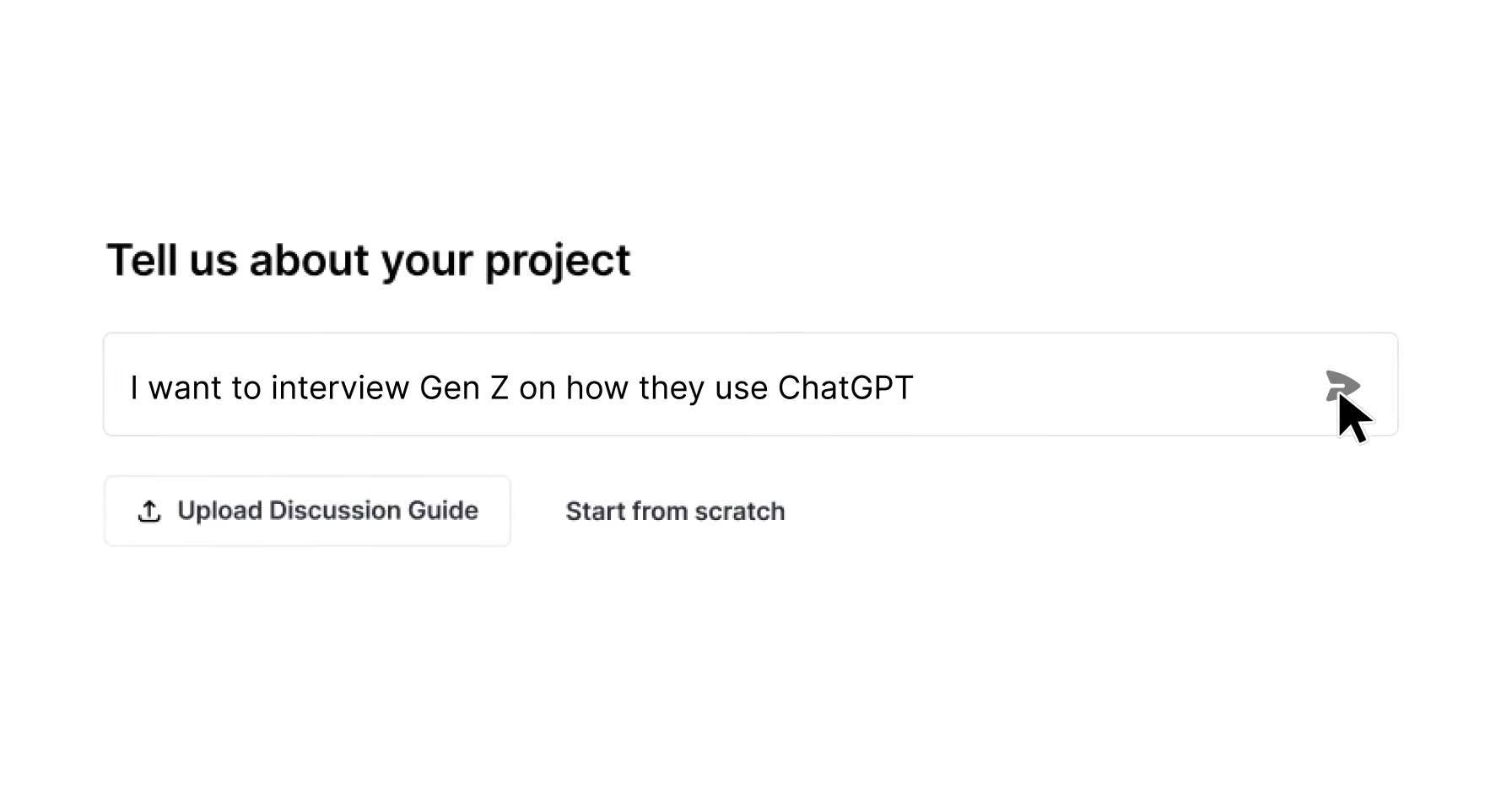
Human-moderated studies require discussion guide development, internal review cycles, and moderator briefing before a single interview begins. Listen Labs’ AI-assisted study co-design accepts research goals in natural language and drafts structured objectives, questions, and probing context in seconds. Auto-QA then flags guide issues before launch so teams avoid rework after fieldwork starts.
Recruitment and Sampling at Scale
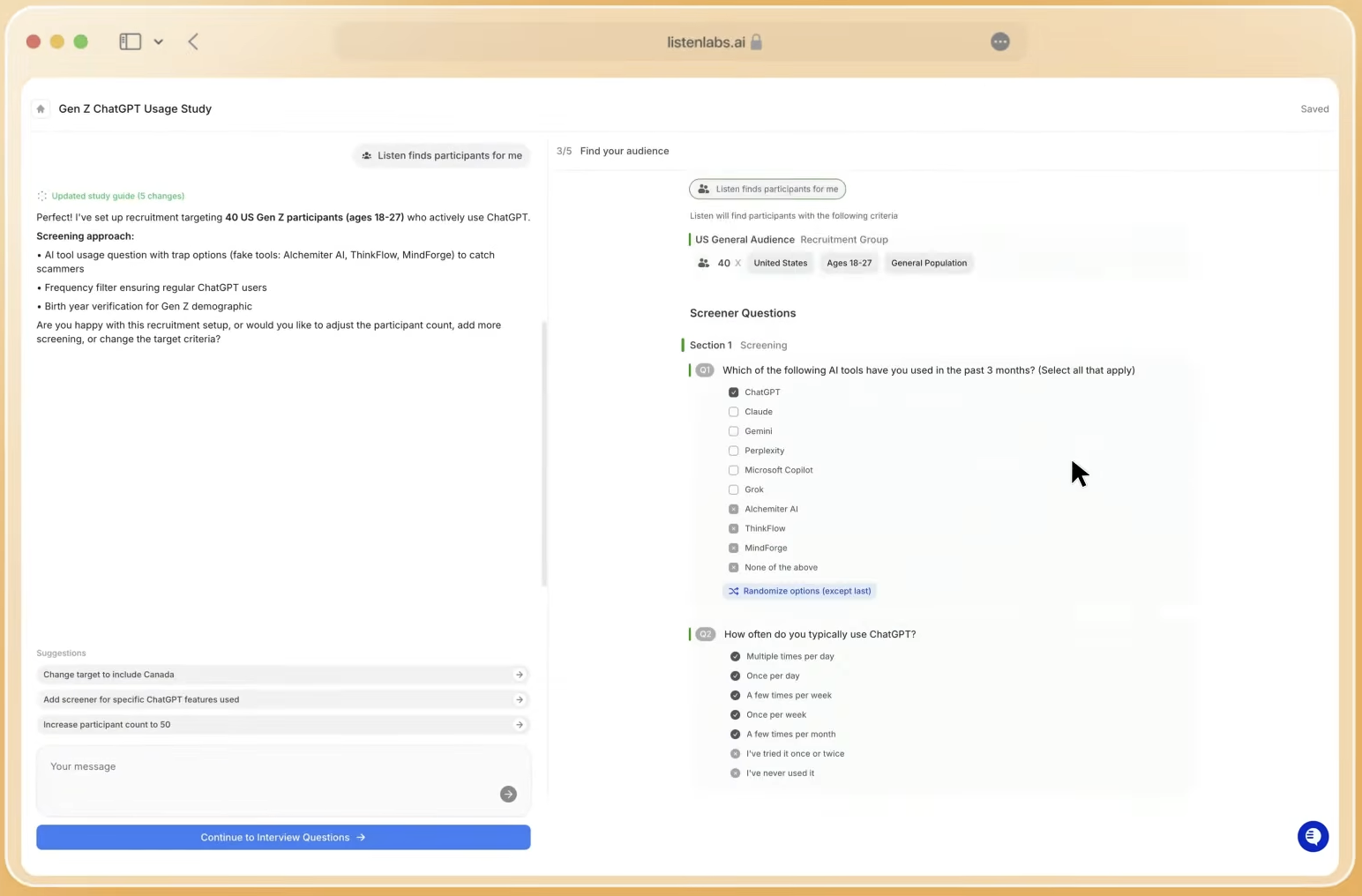
Human-moderated studies typically use 5–15 participants per study, while AI-moderated interviews support 50–500+ participants, enabling segment-level analysis across personas, geographies, and cohorts. Listen Labs’ Listen Atlas panel covers 30M verified respondents across 45+ countries and 100+ languages, with a dedicated recruitment ops team for audiences below 1% incidence rate.
Moderation Consistency and Participant Comfort
Human moderators fatigue after four to six interviews in a day and start leading the witness or asking questions that confirm a pet theory. AI moderation maintains identical probing quality from the first to the 200th interview in a study, eliminating the cognitive fatigue that degrades human moderator performance across multiple sessions. For sensitive topics, 58% of participants preferred AI moderation for discussing political and religious views, and mental health discussions showed a 40% preference for AI versus 32% for human moderators.
Data Quality Controls and Bias Management
AI-moderated interviews remove human biases such as interviewer drift, leading questions, and tone bias while introducing model behavior and prompt-design biases that can be tested and audited. Listen Labs’ Quality Guard monitors every interview in real time across video, voice, content, and device signals. Participants are capped at three studies per month, which eliminates professional survey-takers. Poorly designed AI interviews can exhibit affirmation bias, and Quality Guard’s behavioral matching and real-time monitoring are built to prevent that pattern.
Qualitative Depth by Objective Type
Human-moderated interviews remain the gold standard for emotionally fraught topics, founder-level customer development, and discovery in genuinely novel domains where the researcher’s own pattern-matching is the instrument. For the majority of enterprise research objectives such as concept testing, churn analysis, journey mapping, and brand perception, AI-moderated interviews deliver equal or superior results to human moderation.
Analysis Workflow and Deliverable Creation
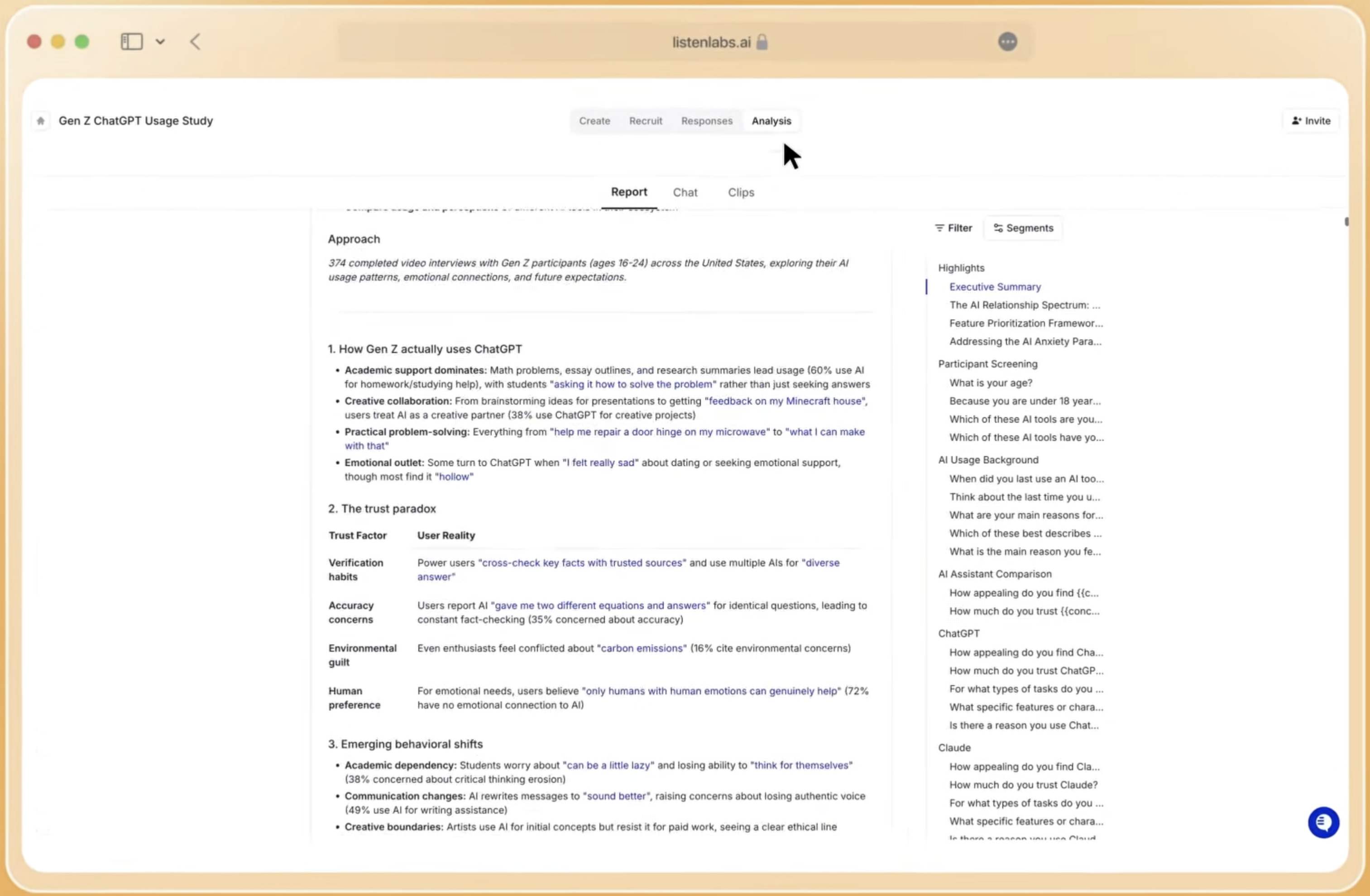
Teams switching from manual coding to AI-assisted clustering and auto-tagging report saving 20+ hours per project on transcript analysis. Listen Labs’ Research Agent generates automated key findings, themes, and personas from interview data, with one-click output of slide decks, memos, video highlight reels, and statistical charts. A 2026 JMIR Med Inform study highlighted the value of LLMs as structured, human-supervised analytic assistants, a model Listen Labs operationalizes through its hybrid oversight layer.
Cross-Study Knowledge Management and Reuse
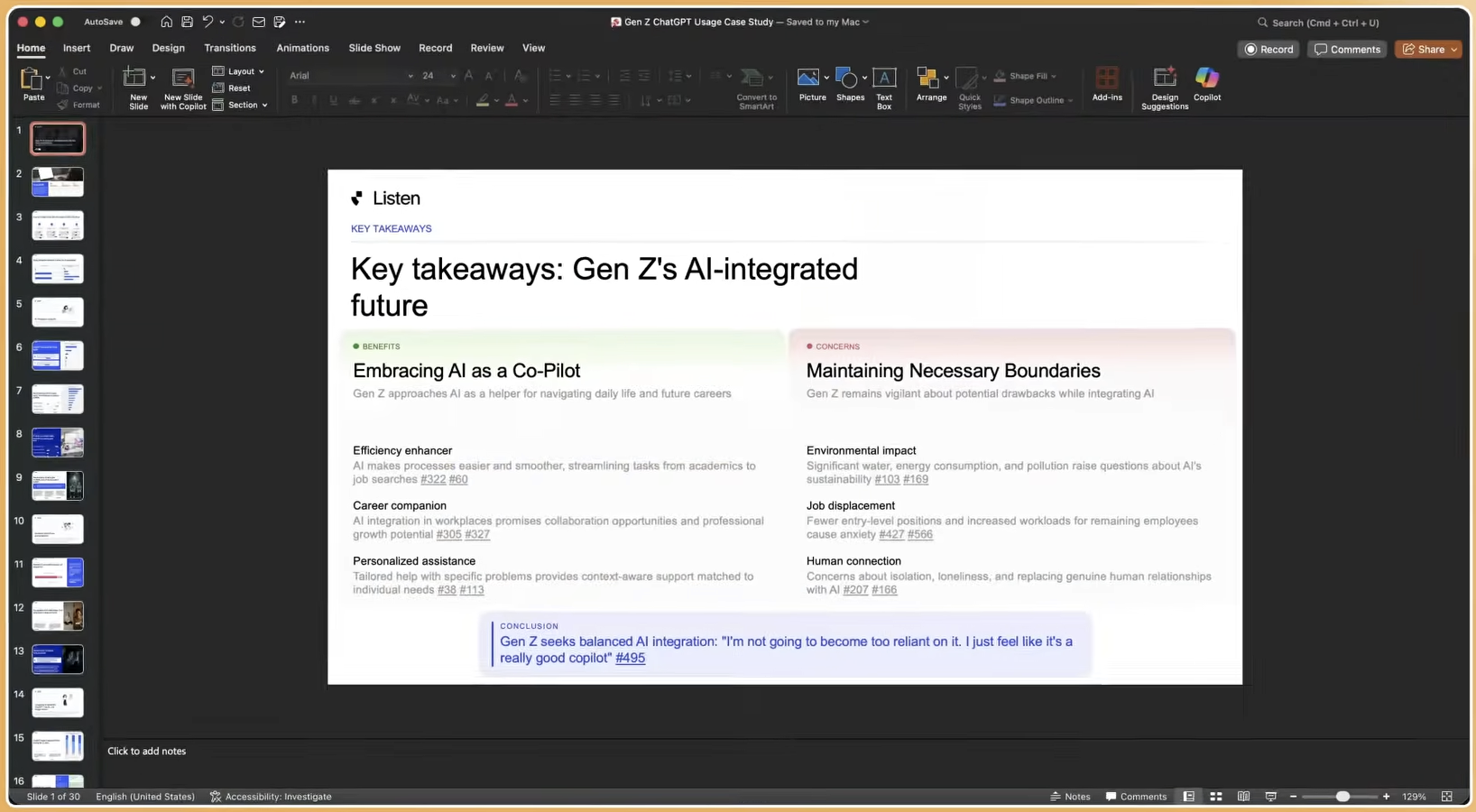
Traditional research produces siloed reports that are rarely revisited. Listen Labs’ Mission Control serves as an organizational source of truth across all studies, enabling cross-study queries, trend tracking, and institutional knowledge building so teams answer questions from past research in seconds rather than re-running studies.
Best-Fit Use Cases by Team Type
Understanding the operational differences is only half the picture. The choice between AI and human moderation ultimately depends on your team’s specific research objectives and constraints.
Enterprise consumer insights teams benefit most from AI moderation at volume. Microsoft used Listen Labs to collect global customer stories for its 50th anniversary celebration within a single day, a timeline impossible with traditional human-moderated methods. A Director of Data Science at Microsoft noted: “I can reach out to hundreds of users at one third of the cost.”
Product and UX research teams gain faster feedback loops for sprint cycles. Anthropic ran 300+ user interviews in 48 hours to surface Claude subscription churn drivers 5× faster than previous methods, identifying where former users migrate and delivering a prioritized list of must-fix items. A Director of Product Strategy at Anthropic stated: “Listen Labs lets us understand user churn with a level of clarity and speed we’ve never had before.”
Brand and marketing teams use AI moderation for concept and creative validation at scale. P&G ran 250+ interviews to evaluate how men respond to new product claims before market launch, surfacing where claims felt exaggerated and confirming that comfort and reliability matter more than novelty. Skims validated campaign direction with thousands of high-income buyers overnight, enabling board-level buy-in before a global launch.
Product teams without dedicated researchers use Listen Labs’ self-serve study design to run concept tests, usability studies, and post-launch feedback collection without research methodology expertise. Robinhood used the platform to assess whether prediction markets feel on-brand, revealing that users who view the product as entertainment drive 2.4× higher weekly re-engagement.
Ready to explore which configuration fits your team’s research objectives? Book a demo to walk through your specific requirements.
Operational Considerations for Enterprise Rollout
Once you have identified the right use cases, enterprise adoption requires addressing three operational layers: stakeholder alignment, compliance verification, and process repeatability. A 2024 Greenbook GRIT study found that 72% of insights professionals are using or evaluating generative AI.
Listen Labs holds SOC 2 Type II, GDPR, ISO 27001, ISO 27701, and ISO 42001 certifications, covering the full research lifecycle from participant data through analysis outputs. These certifications address the compliance requirements most enterprise procurement teams evaluate first. Beyond certification, Listen Labs enforces a strict data usage policy: customer data is never used for AI model training, and enterprise SSO is supported for organizations requiring centralized access control. For global programs, the platform’s 100+ language support with automatic translation and transcription eliminates the need for separate localization vendors across the 45+ countries covered, reducing both compliance surface area and operational complexity.
Hybrid human-AI workflows let research teams run 3–4× the study volume without compromising interpretive quality by having AI handle high-volume repeatable tasks while humans retain strategy, judgment-heavy decisions, and quality review. Listen Labs supports this model through its hybrid oversight option for sensitive topics.
Risks and Limitations of AI-Moderated Interviews
AI-moderated interviews carry documented risks that enterprise teams must evaluate honestly.
- Shallow data risk: Nielsen Norman Group’s 2026 evaluation noted challenges with rapport building that may lead participants to share less with an AI interviewer. Listen Labs’ Emotional Intelligence layer and hybrid human oversight option mitigate this for sensitive study types.
- Prompt-design bias: Poorly designed AI interviews can exhibit affirmation bias. Listen Labs’ in-house research team, with 50+ years of combined expertise, reviews study design and probing logic before launch.
- Fraud and panel quality: Commodity panels introduce professional survey-takers and low-effort responses. Quality Guard’s real-time monitoring and participant frequency limits address this structurally.
- Genuinely novel or therapeutic domains: Sensitive or therapeutic contexts such as bereavement research, mental health discovery, and trauma-adjacent topics still require trained human moderators because the empathy bar is too high for AI. Listen Labs supports hybrid workflows for these cases.
- Overestimating automation: A 2026 JMIR Med Inform study highlighted that LLMs are best used as structured, human-supervised analytic assistants rather than replacements for qualitative researchers. Listen Labs positions AI as a force multiplier for research teams, not a replacement.
Decision Framework for Choosing AI vs Human Moderation
The choice between AI-moderated and human interviews is determined by four variables: study volume, topic sensitivity, timeline, and budget.
When volume is high (50+ participants), timelines are tight (under one week), budgets are constrained, and topics are non-therapeutic, AI moderation is the appropriate primary method. This pattern covers the majority of enterprise consumer insights work such as concept testing, brand perception, churn analysis, product feedback, and multi-market segmentation.
When topics involve bereavement, trauma, or clinical health contexts, or when the research objective is genuinely exploratory in a novel domain with no prior framework, human moderation remains necessary. A hybrid approach, with AI moderation for volume sessions and human moderation for a targeted strategic subset, fits programs that require both depth and scale. Many teams apply an 80/20 or 85/15 split, with AI handling the majority of routine volume and humans reviewing ambiguous cases.
When timeline is the binding constraint and quality must be maintained, Listen Labs’ end-to-end platform, covering study design, recruitment, moderation, analysis, and deliverables, removes the operational overhead that makes human-moderated research slow regardless of moderation quality.
Frequently Asked Questions
How long does an AI-moderated study take from brief to results?
Listen Labs compresses the full research cycle, including study design, participant recruitment, interview moderation, analysis, and deliverable generation, to under 24 hours for most studies. Traditional human-moderated qualitative research takes 4–6 weeks end-to-end, and in large enterprises with internal prioritization queues, timelines can stretch to six months. The 24-hour cycle applies to standard consumer studies, while niche audiences with very low incidence rates may require additional recruitment time, which the dedicated recruitment ops team manages.
How does Listen Labs ensure participant quality and prevent fraud?
Quality Guard operates across three layers. First, Listen Labs works exclusively with high-quality, non-commodity panel sources, so professional survey-takers are excluded. Second, Quality Guard uses real-time AI monitoring across video, voice, content, and device signals to detect fraud, low-effort responses, AI-generated scripts, and mismatched profiles during every interview. Third, participants are capped at three studies per month to eliminate panel fatigue and incentive-driven behavior. A dedicated recruitment ops team adds a human review layer for hard-to-reach segments, including enterprise decision-makers, healthcare workers, and audiences below 1% incidence rate.
Can AI moderation match the depth of a skilled human interviewer?
For the majority of enterprise research objectives such as concept testing, churn analysis, brand perception, journey mapping, and product feedback, AI moderation delivers comparable or superior results to human moderation. Listen Labs’ AI probes multiple levels deep per topic, equivalent to a skilled human interviewer, and maintains that consistency from the first to the 200th interview without the fatigue-driven drift that affects human moderators at scale. For emotionally complex or therapeutic topics such as bereavement or trauma-adjacent research, human moderation remains the appropriate choice. Listen Labs supports hybrid oversight for these cases.
What languages and geographies does Listen Labs support?
Listen Labs supports 100+ languages for interview moderation, with automatic translation and transcription across all supported languages. The platform covers 45+ countries across the Americas, Europe, APAC, and MEA through its Listen Atlas panel of 30M verified respondents. Emotional Intelligence is available across 50+ languages. Multi-market studies can run simultaneously across geographies without separate localization vendors.
What security and compliance certifications does Listen Labs hold?
Listen Labs holds SOC 2 Type II, GDPR, ISO 27001, ISO 27701, and ISO 42001 certifications. All data is protected with 256-bit encryption. Customer data is never used for AI model training. Enterprise SSO is supported for large organizations. These certifications cover the full research lifecycle, including participant data, interview recordings, transcripts, and analysis outputs.
Conclusion: Moving from Trade-Offs to Qual-at-Scale
The traditional trade-off between qualitative depth and quantitative scale is a product of human moderation’s structural constraints, not an inherent property of qualitative research. With qual-at-scale, the old trade-off between depth and scale is no longer a barrier. Listen Labs removes that barrier through adaptive AI moderation, Emotional Intelligence signal capture, Quality Guard fraud controls, and a 30M-respondent global panel, delivering statistically robust, emotionally rich consumer insights at the speed and cost outlined above. Enterprise teams at Microsoft, Anthropic, P&G, Skims, and Robinhood have validated this model at scale.
Book a demo to see how Listen Labs can deliver the research volume your team needs within existing budget and staffing constraints.