
Written by: Anish Rao, Head of Growth, Listen Labs | Last updated: June 25, 2026
Why Emotional Intelligence Belongs in Your 2026 Research Stack
- AI emotional intelligence goes beyond sentiment analysis by detecting nuanced emotions through multimodal signals such as tone of voice, word choice, and facial micro-expressions during qualitative interviews.
- Listen Labs applies Paul Ekman’s universal emotions framework to deliver timestamp-traceable emotional labels tied directly to verbatim quotes and AI reasoning for every interview.
- Enterprise applications span creative testing, concept comparison, usability, and brand perception, so researchers can pinpoint exactly when and why participants feel confusion, delight, or distrust.
- A hybrid AI-plus-human Quality Guard and support for 50+ languages maintain cultural accuracy, compliance, and methodological rigor across global research programs.
- Ready to capture what participants feel, not just what they say? See how emotional intelligence works in your research.
From Sentiment Analysis to Multimodal Emotion Detection
Early voice-of-customer programs relied on keyword scoring and net sentiment to summarize what participants said. That approach captures surface polarity but misses the emotional texture underneath a response, such as the hesitation before a compliment, the flat affect behind a five-star rating, or the micro-expression of disgust that contradicts a verbally positive answer.
To capture this emotional texture, the field has moved toward multimodal fusion, which analyzes voice tone, facial expressions, and word choice at the same time instead of relying on text alone. This convergence of signals is now the baseline expectation for enterprise-grade emotion detection, and market investment reflects that shift.
The global Emotion AI market is projected to grow substantially through 2034, with multimodal emotion recognition that combines facial analysis, voice tone, and textual sentiment cited as a primary driver of improved enterprise accuracy. The enterprise and SME segment accounts for a substantial share of the emotion AI market, driven by deployments across customer experience, workforce analytics, and CRM integration. The AI-powered Emotion Analytics Platform Market is expected to reach USD 34.70 billion by 2033, growing at a CAGR of 18.83% from 2026-2033, fueled by rising use in customer experience management and digital marketing.
For consumer insights leaders, transcript-only research leaves a measurable gap between what participants report and what they actually feel. Closing that gap requires a three-signal architecture.
The Three-Signal Architecture Built on Ekman's Universal Emotions
Listen Labs' Emotional Intelligence analyzes three layers of signal at the same time: tone of voice, word choice, and subconscious micro-expressions. Each layer contributes distinct information that the others cannot fully replicate.
Tone of voice captures prosodic features such as pitch, pace, energy, and pauses that signal emotional arousal independently of the words spoken. A participant who says “I think it's fine” in a flat, low-energy tone communicates something different from the same phrase delivered with rising intonation and increased pace. Word choice analysis examines the semantic and syntactic patterns in transcribed speech, identifying hedging language, intensifiers, and vocabulary associated with specific emotional states. Micro-expression analysis applies computer-vision models to video frames, detecting brief, involuntary facial movements that precede or contradict conscious verbal responses.
Listen Labs built Emotional Intelligence on Ekman's universal six emotions framework, which covers anger, disgust, fear, happiness, sadness, and surprise, the same standard used in clinical psychology and UX research. The framework extends to include anticipation, trust, and a neutral state for comprehensive coverage across research contexts.
The critical differentiator is traceability. Every emotion is quantified per question and concept, with every label traceable to the exact timestamp, verbatim quote, and AI reasoning behind it. A research leader reviewing a concept test can jump directly to the 47-second mark of a specific interview, read the verbatim quote that triggered a “disgust” classification, and examine the reasoning the model applied. That chain of evidence turns emotional data from a black-box score into an auditable research artifact that meets enterprise methodological standards.
Emotional Intelligence integrates directly with Listen Labs' Research Agent. Teams can ask natural-language queries such as “which concept triggered the most confusion among women 35–54?” and receive side-by-side emotional breakdowns, charts, and highlight reels of the most emotionally significant moments, without manual data wrangling.
See timestamp-traceable emotional insights in action.
Where Emotional Intelligence Delivers Value in Enterprise Research
Emotional intelligence data reframes each major use case from “what did participants say about this stimulus?” to “what did participants feel, and exactly when did they feel it?”
Creative Testing. When Skims needed to validate a global campaign direction with thousands of high-income buyers overnight, the team used Listen Labs to identify and qualify premium consumers, test campaign creative before launch, and deliver qualitative clarity that secured board-level buy-in. This approach eliminated weeks of recruiting and panel sourcing. Emotional Intelligence surfaces the precise moments in a video ad where viewers light up, disengage, or register confusion, giving creative teams frame-level feedback instead of only aggregate ratings.
Concept Comparison. When Procter & Gamble evaluated how men respond to new product claims, Listen Labs delivered more than 250 interviews with quantified themes and verbatim proof. The work surfaced where claims felt exaggerated or unclear before market launch and showed that comfort, safety, and reliability mattered far more than novelty. Emotional Intelligence adds a layer to that analysis, so researchers can query which claim triggered the highest disgust or lowest trust scores, with traceable evidence for each finding.
Usability Testing. Emotional Intelligence catches the moments of hesitation and frustration that participants do not verbalize. A participant who navigates past a broken flow without commenting may still register a micro-expression of confusion or a prosodic signal of stress. Those signals, timestamped and linked to the screen recording, give UX teams actionable friction maps that transcripts alone cannot produce.
Brand Perception. When Anthropic needed to understand why Claude users cancel their subscriptions, Listen Labs delivered more than 300 user interviews in 48 hours, surfacing churn drivers five times faster and identifying where former users migrate and what triggers switching. Emotional Intelligence extends brand research by quantifying the emotional valence of competitor comparisons, distinguishing, for example, between participants who express mild preference for an alternative and those who register strong negative affect toward the current brand.
Beyond competitive analysis, emotional intelligence also enriches brand storytelling initiatives. Microsoft used Listen Labs to collect global customer stories for its 50th anniversary celebration within a single day, reaching hundreds of users at one-third of the cost of traditional methods. Emotional Intelligence enables that same scale of data collection to carry emotional depth alongside narrative content.
Limitations of Emotion AI and the Hybrid AI-Plus-Human Safeguard
AI emotion detection operates within documented constraints that enterprise research programs must address. Cultural and contextual complexity is a core limitation: emotional signals do not transfer uniformly across populations or situations, and true emotional comprehension and intuition remains uniquely human, as Clarke, Garcia-Garcia, and Joffe document in their 2026 Cambridge University Press chapter. Sarcasm, irony, and culturally specific emotional display rules exemplify this challenge, because models trained on one population may misclassify expressions in another. Ethical concerns around empathy, bias, and emotional data privacy are tied directly to the fact that emotion interpretation is not context-free.
Listen Labs addresses these limitations through a three-layer Quality Guard. The first layer applies behavioral matching on intent and past actions rather than self-reported demographics, so the participant pool reflects the target population. The second layer uses real-time AI monitoring across video, voice, content, and device signals to detect fraud, low-effort responses, and mismatched profiles during the interview itself. The third layer adds human review by a dedicated recruitment operations team with more than 50 years of combined research expertise, who validate methodology, flag edge cases, and ensure that emotional findings are interpreted within appropriate cultural and contextual frames.
Listen Labs' Emotional Intelligence is available across 50+ languages, and the platform supports interview moderation in more than 100 languages with automatic translation and transcription. That coverage is a structural requirement for any enterprise running multi-market research programs where emotional display norms vary by region.
Five-Step Framework for Rolling Out Emotional Intelligence
Enterprise research teams that integrate AI emotional intelligence most effectively follow a repeatable process that begins before a single interview runs.
The first step is study design with emotional hypotheses defined in advance. Before launching a concept test or usability study, the research team specifies which emotions are expected, which would be problematic, and at which points in the stimulus or task flow emotional signals are most diagnostic. Listen Labs' AI-assisted study co-design translates research objectives stated in natural language into structured guides with probing context, which reduces setup time from days to minutes.
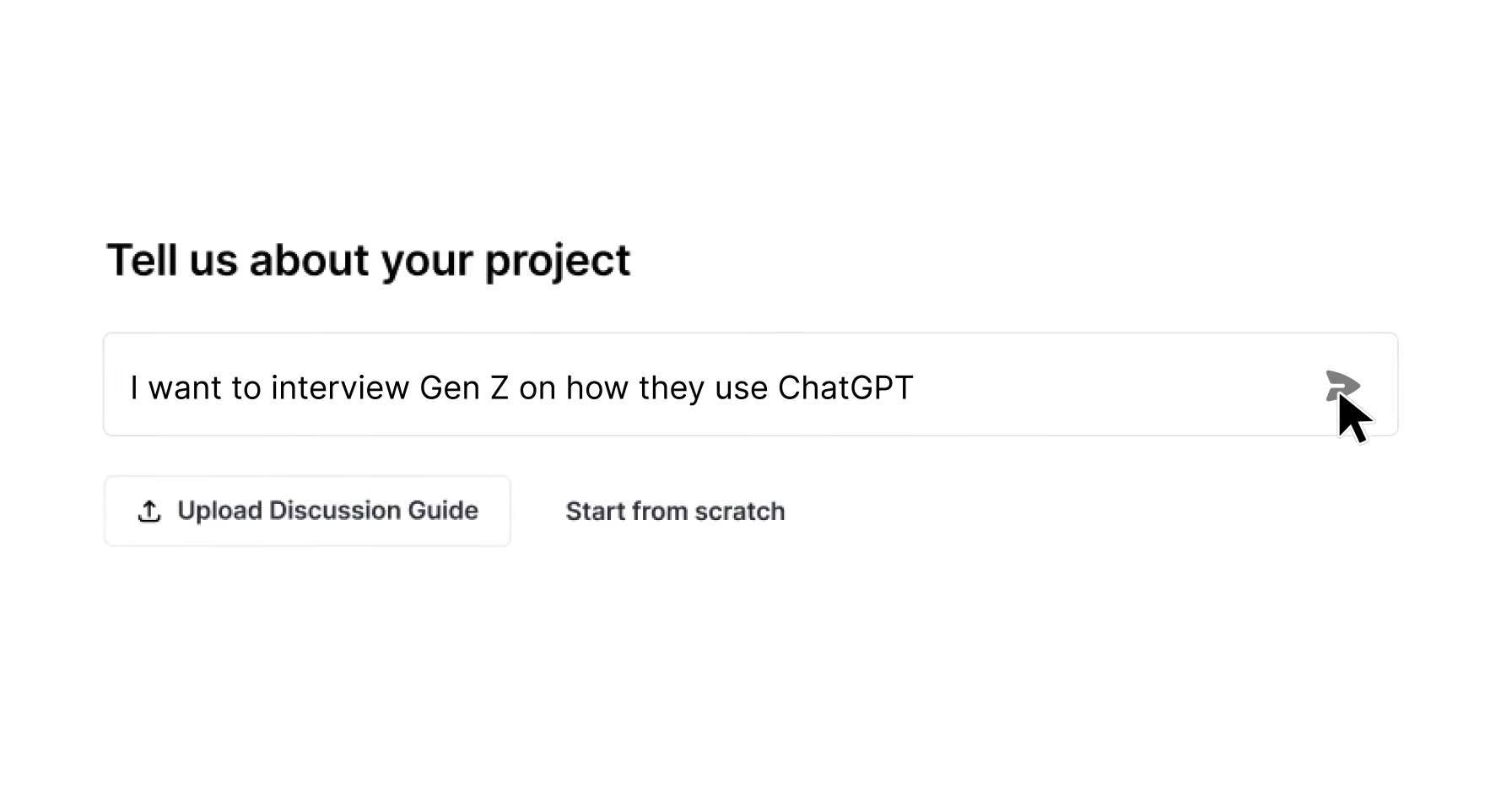
The second step is participant recruitment against verified behavioral criteria. Emotional data is only as valid as the sample it comes from. Listen Labs' Listen Atlas matches participants across behavioral and intent signals using a global network of 30 million verified respondents across more than 45 countries, with a dedicated recruitment operations team handling segments below 1% incidence rate.
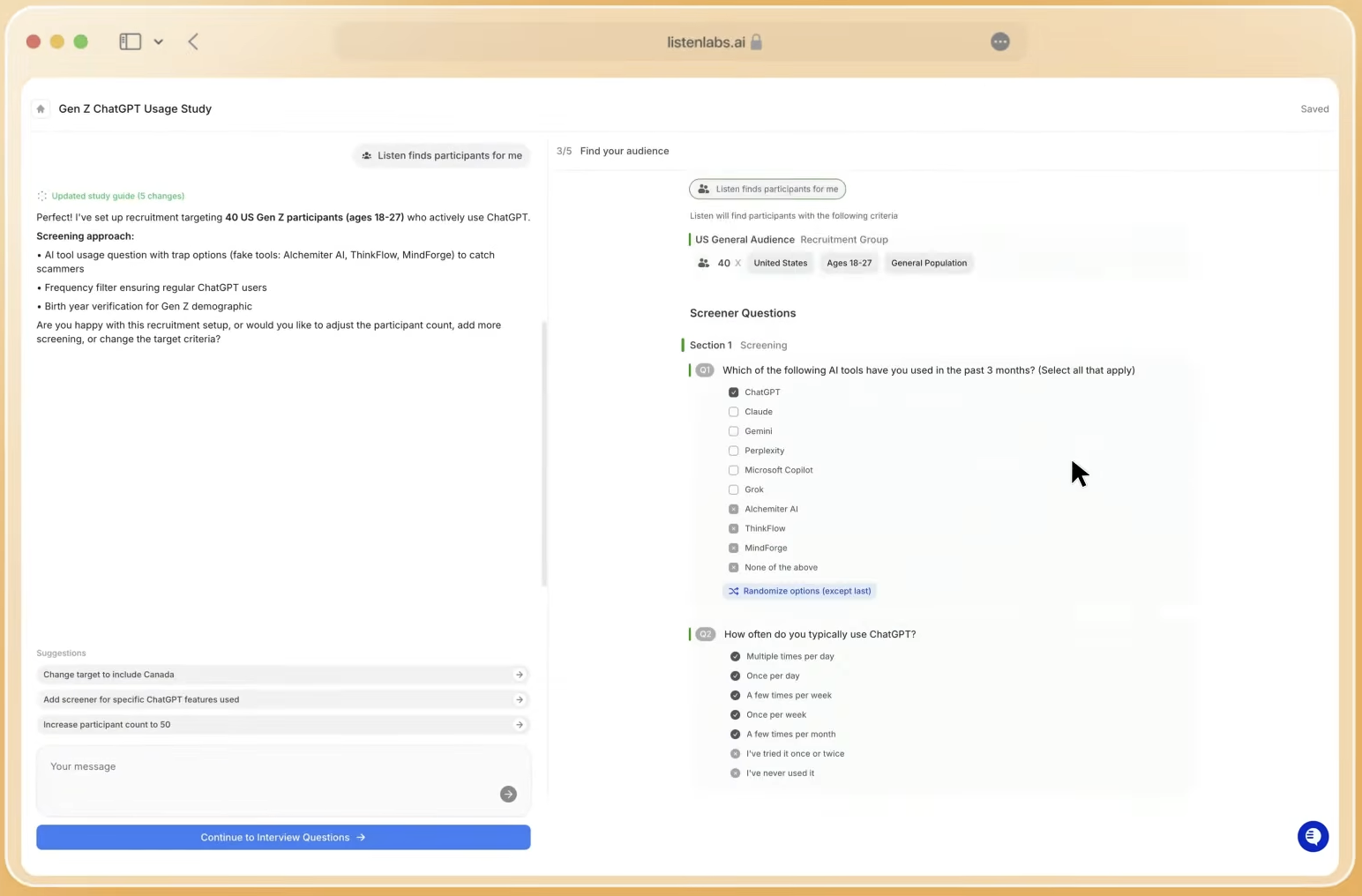
The third step is AI-moderated interview execution with multimodal capture enabled. Listen Labs conducts video interviews with dynamic follow-up questions, capturing video, audio, text, and screen recordings at the same time. Emotional Intelligence processes all three signal layers, including tone, word choice, and micro-expressions, in parallel with the interview, producing timestamped emotional labels without adding to the participant's experience or the moderator's workload.
The fourth step is emotional analysis integrated with thematic synthesis. The Research Agent generates automated key findings, theme clusters, and persona profiles from interview data. Emotional Intelligence layers quantified emotion scores per question and concept onto that thematic structure, so researchers can query findings in natural language and receive charts, segmentations, and highlight reels of emotionally significant moments.
The fifth step is delivery of traceable emotional deliverables to stakeholders. Listen Labs generates consultant-quality slide decks, memo-style reports, and video highlight reels in under a minute. Every emotional claim in those deliverables links back to the timestamp, verbatim quote, and AI reasoning that produced it, which gives stakeholders the evidence chain needed to act on emotional findings with confidence.
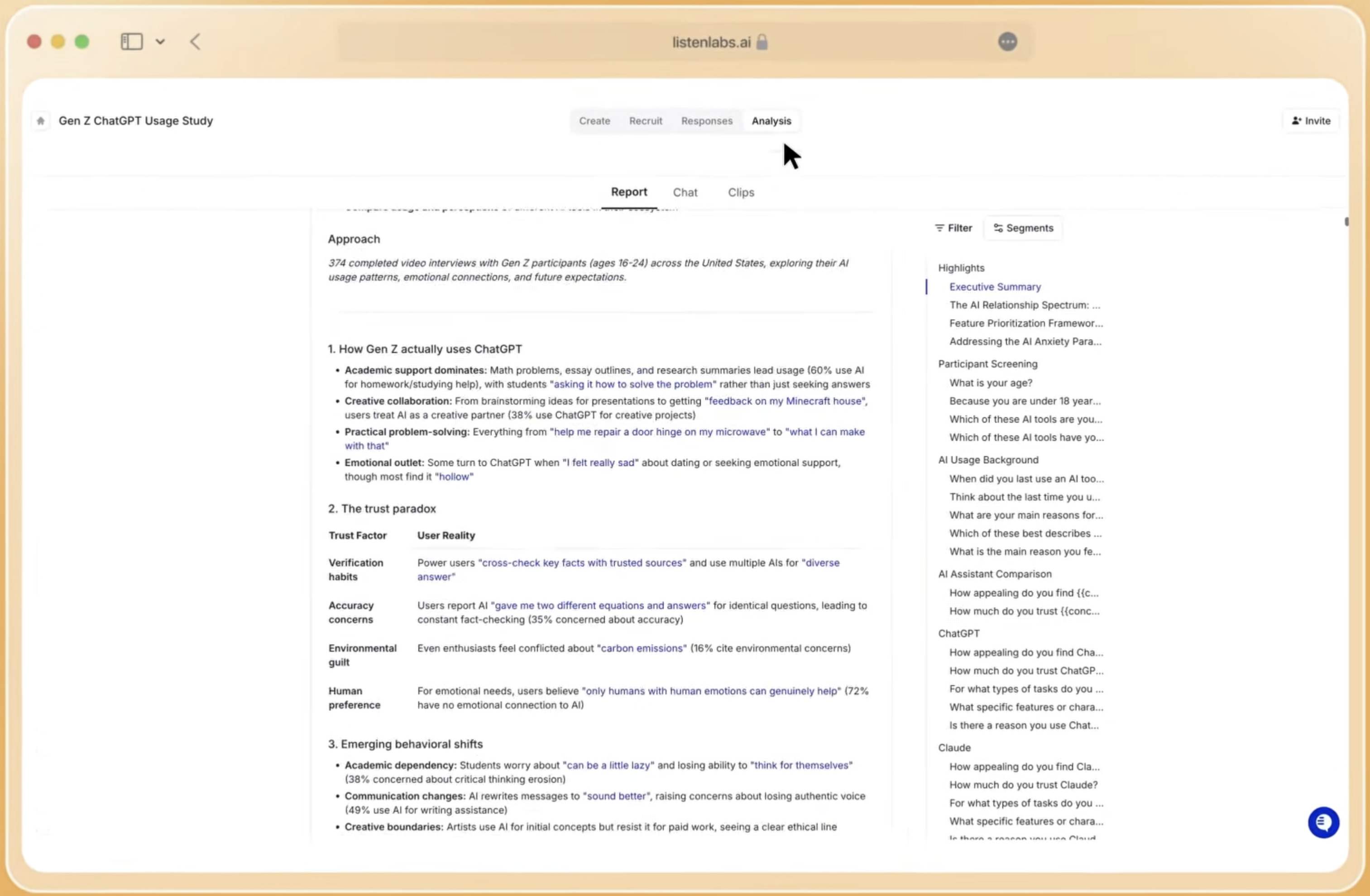
Walk through this five-step framework with a research specialist.
Frequently Asked Questions
How does AI emotional intelligence differ from traditional sentiment analysis in customer research?
Sentiment analysis classifies text as positive, negative, or neutral based on keyword and phrase patterns in transcripts. AI emotional intelligence operates across three simultaneous signal layers, including tone of voice, word choice, and facial micro-expressions, to detect specific emotional states such as confusion, disgust, trust, or surprise at the moment they occur. As described earlier, Listen Labs traces every emotional label to its timestamp, quote, and reasoning. That traceability makes emotional data actionable in enterprise research, because stakeholders can verify the evidence behind any finding instead of accepting an aggregate score.
Can AI emotional intelligence handle research conducted across multiple languages and cultures?
Listen Labs' Emotional Intelligence is available across 50+ languages, and the broader platform supports interview moderation in more than 100 languages with automatic translation and transcription. Cultural variation in emotional display norms is a documented limitation of any emotion AI system, which is why Listen Labs applies a three-layer Quality Guard that includes human review by a dedicated research operations team. That human oversight layer ensures emotional findings are interpreted within the appropriate cultural and contextual frame for each market, rather than applying a single-population model universally.
What compliance and data security standards does Listen Labs meet for emotional data collected in enterprise research?
Listen Labs holds SOC 2 Type II, GDPR, ISO 27001, ISO 27701, and ISO 42001 certifications. All data is protected with 256-bit encryption, and customer data is never used for AI model training. Emotional data collected through Listen Labs' Emotional Intelligence is subject to the same enterprise-grade security controls as all other interview data on the platform, which makes it suitable for use in regulated industries and multi-jurisdictional research programs.
How does Listen Labs' Emotional Intelligence integrate with existing research workflows?
Emotional Intelligence is built directly into the Listen Labs platform and integrates with the Research Agent for natural-language queries, chart generation, and highlight reel creation. Research teams do not need a separate tool, data export, or manual tagging process. Emotional scores appear alongside thematic analysis, verbatim quotes, and quantitative data within the same interface used to design studies, recruit participants, and generate deliverables. Mission Control stores all emotional findings alongside other study outputs, which enables cross-study queries and trend tracking over time.
How many interviews are needed to produce statistically meaningful emotional insights?
The minimum viable sample depends on the research objective and the degree of segmentation required. For directional creative testing or concept comparison, Listen Labs typically recommends a sample size sufficient to detect key emotional signals per stimulus or concept. For multi-market studies with segment-level breakdowns, a larger number of interviews per market can provide the statistical confidence needed to act on emotional differences between groups. Because Listen Labs conducts AI-moderated interviews in parallel across its 30-million-respondent network, studies at these scales complete in under 24 hours instead of the weeks required by traditional qualitative methods.
2026–2027 Outlook and Strategic Next Steps
The enterprise concentration noted earlier is expected to deepen as multimodal detection accuracy improves and compliance frameworks for emotional data mature. Contact centers are already shifting from post-call surveys to live emotional intelligence tools that transcribe interactions in real time, flag emotional shifts, and prompt agents to adjust tone and empathy. That pattern will extend into research moderation as enterprise teams demand always-on emotional insight programs instead of one-off studies.
For consumer insights, UX research, and product marketing leaders, the near-term priority is establishing a repeatable emotional intelligence layer within existing research programs before competitors do. The organizations that understand what customers feel, not just what they say, across creative, concept, usability, and brand research will carry a compounding advantage into product and campaign decisions through 2027 and beyond.
Listen Labs' Emotional Intelligence and Research Agent represent the only enterprise solution that combines multimodal Ekman-based detection, timestamp-level traceability, hybrid quality controls, and delivery of complete emotional deliverables in under 24 hours at a scale that traditional research methods cannot approach.