
Written by: Anish Rao, Head of Growth, Listen Labs | Last updated: June 27, 2026
Key Takeaways
-
AI-driven customer research compresses traditional 4–6 week cycles into 24-hour turnarounds by running recruitment, moderation, transcription, and analysis in parallel.
-
Enterprise case studies from Microsoft, Anthropic, P&G, Skims, and Robinhood show AI-moderated interviews delivering 5× faster insights at roughly one-third the cost of legacy methods.
-
Emotional Intelligence layers and real-time fraud detection (Quality Guard) add validated emotional signals and participant quality that transcripts alone cannot provide.
-
End-to-end platform integration removes handoff delays and data loss that occur when teams stitch together separate vendors for each research step.
-
Schedule a Listen Labs demo to map your current research backlog against a 48-hour pilot and see how AI-moderated interviews accelerate your next project.
Enterprise AI-Moderated Interview Wins Across Industries
The examples below draw from Listen Labs-powered programs across technology, CPG, fintech, and retail. Each case highlights a specific research challenge, the AI-moderated approach, and the measurable outcome.
Microsoft: 50th Anniversary Customer Stories at Scale
Microsoft needed authentic user stories about how Copilot empowers employees, at a scale and speed traditional research could not support. Using Listen Labs, the team gathered video testimonials and qualitative narratives from hundreds of users within a single day. The Director of Data Science at Microsoft noted: “We wanted users to share how Copilot is empowering them to bring their best self forward, and we were able to collect those user video stories within a day. Our leadership team was very thrilled at both the speed and the scale that Listen Labs enabled. I can reach out to hundreds of users at one third of the cost.” This program replaced a process that previously took six to eight weeks.
Anthropic (Claude): Rapid Churn Driver Identification
Anthropic’s product strategy team needed clarity on why Claude subscribers were canceling and what might bring them back. Listen Labs conducted 300+ user interviews in 48 hours, surfacing churn drivers five times faster than prior methods. The interviews identified where former Claude users were migrating, including OpenAI and Gemini, and what triggered switching behavior. The output included a prioritized list of ten must-fix items and high-value feature gaps. The Director of Product Strategy at Anthropic stated: “Listen Labs lets us understand user churn with a level of clarity and speed we’ve never had before.”
Procter & Gamble: Men’s Product Claims Testing
P&G needed to evaluate how men responded to new product claims before committing innovation resources. Listen Labs delivered 250+ interviews with quantified themes and verbatim proof points in hours. The research showed where claims felt exaggerated or unclear and revealed that comfort, safety, and reliability mattered far more than novelty. These findings prevented investment in features the market would dismiss. The Analytics and Insight Leader at P&G described Listen Labs as “a huge help” in shaping product and brand strategy before market entry.
Skims: Overnight Validation with Premium Buyers
Skims needed to validate a global campaign direction with high-income buyers overnight to de-risk a major launch. Listen Labs identified and qualified thousands of premium consumers in a single night, removing weeks of panel sourcing. The qualitative findings translated customer reactions into insights that secured board-level buy-in. The SVP of Data, Insights, and Loyalty at Skims noted: “I always struggled with understanding the why and Listen Labs nails this for me.”
Robinhood: Prediction Market Brand and Segment Fit
Robinhood needed to assess whether prediction markets felt on-brand and which user segments drove the highest re-engagement. AI-moderated interviews revealed that users who view prediction markets as “entertainment” rather than income drive 2.4x higher weekly re-engagement. The research also identified integration flows that boosted product uptake by 30–40% and matched the speed improvement seen in Anthropic’s churn study.
Chubbies: Overnight Consumer Feedback vs. Focus Groups
Switching to Listen Labs AI-moderated interviews let Chubbies capture hundreds of candid, one-to-one conversations overnight, a volume and turnaround that traditional focus groups, which typically cost $4,000–$12,000 per 90-minute session and take three to five weeks to organize, cannot match.
See how Listen Labs compresses a full research cycle into 24 hours by running your first study.
Big Patterns Across Successful AI-Driven Customer Research Programs
The six enterprise examples above, from Microsoft’s anniversary stories to Robinhood’s prediction market testing, reveal common structural factors that separate high-impact AI research programs from those that fail to deliver. Across these cases, several recurring factors distinguish programs that deliver reliable, decision-grade insights from those that stall.
24-hour turnaround as a structural requirement, not a feature. Every successful program treated speed as a design constraint, not a bonus. When research results arrive in 24 hours, they inform decisions that are still in motion. When they arrive in six weeks, the business context has shifted and the findings are stale.
Emotional intelligence as a second data layer. Speed alone does not help if the data lacks depth. Stated answers and emotional signals are different data points. Listen Labs’ Emotional Intelligence layer analyzes tone of voice, word choice, and subconscious micro-expressions, built on Ekman’s universal emotions framework, to surface reactions that transcripts alone miss. In creative testing and concept comparison, this distinction often determines which direction moves forward and which gets shelved.
Fraud prevention as a prerequisite for valid data. Quality Guard monitors every interview in real time across video, voice, content, and device signals. Participants are limited to three studies per month, which removes professional survey-takers. Behavioral matching operates on intent and past actions rather than self-reported demographics. Without these controls, scale introduces noise instead of signal.
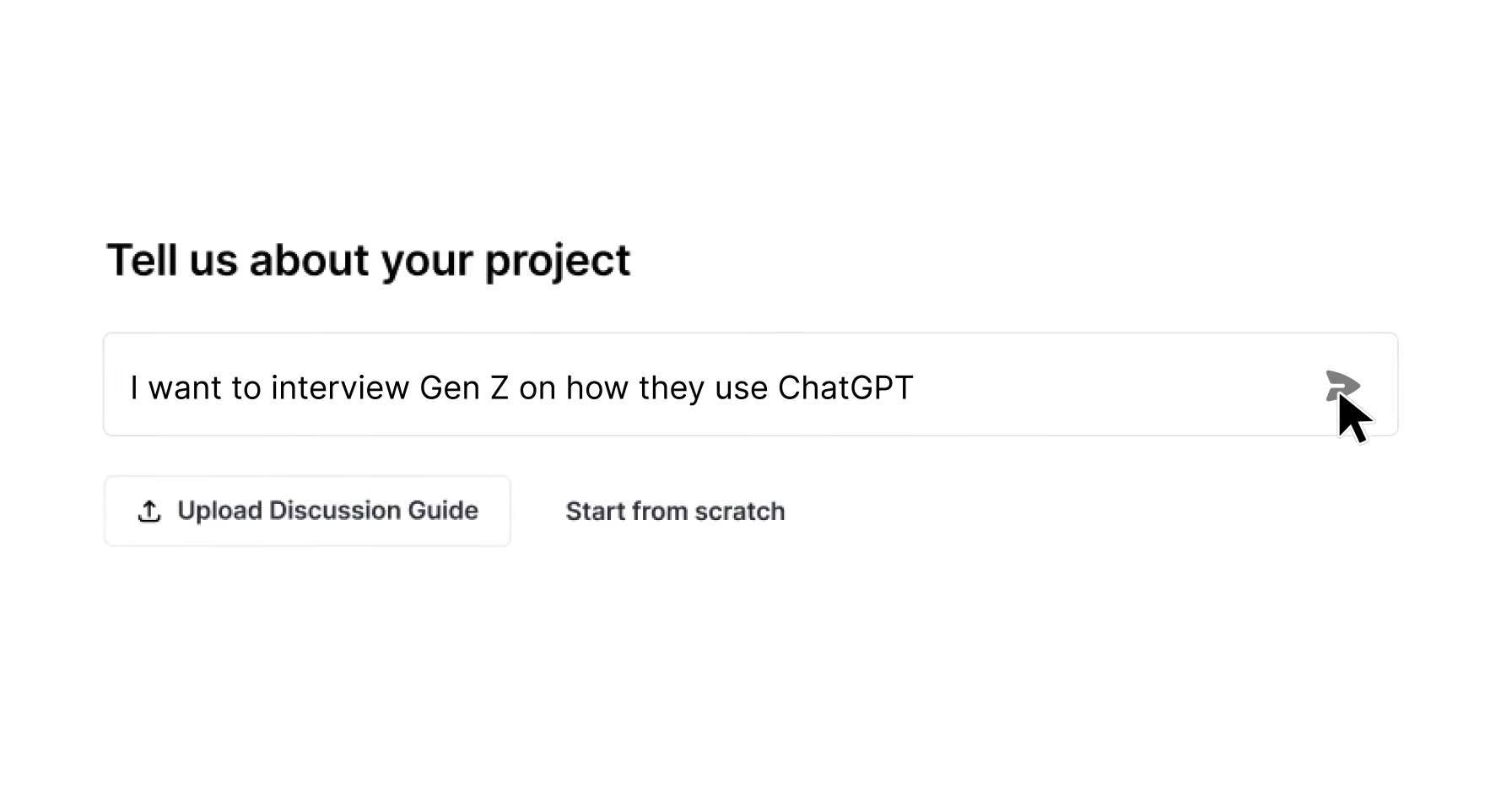
End-to-end integration to reduce handoff risk. Programs that fragment across separate recruitment vendors, moderation tools, transcription services, and analysis platforms introduce delay and quality loss at every handoff. Listen Labs has run over one million AI-powered customer interviews through a single platform that covers study design, recruitment from a 30M-respondent global network, AI moderation, analysis, and deliverable generation, with no external dependencies.
Proprietary data that compounds over time. Each study conducted on Listen Labs strengthens the platform’s ability to separate signal from noise, refine question quality, and match the right methodology to the research objective. This compounding data moat does not exist in general-purpose tools or newly launched competitors.
Map your current research backlog against Listen Labs capacity in a focused 48-hour pilot.
Why General-Purpose AI Cannot Replace Dedicated Research Platforms
General-purpose large language models can help draft discussion guides or summarize transcripts, but they lack the infrastructure that makes AI-driven customer research operationally viable at enterprise scale. They provide no participant recruitment capability, no fraud detection, no moderation engine, and no proprietary study data informing question design or analysis quality.
Listen Labs is built on tens of thousands of completed studies, giving the platform a calibrated understanding of which question types produce analyzable responses, which methodologies fit specific research objectives, and how to weight signals across hundreds of simultaneous interviews. Alfred Wahlforss, CEO of Listen Labs, has stated: “Companies use it for all kinds of large decisions. This AI interviewer means that you can have hundreds of one-on-one interviews run at scale.” That scale requires a full-stack platform, not a general-purpose model applied to a single step in the research process.
Maintaining Participant Quality When You Scale Interviews
Scaling qualitative interviews introduces participant quality risks that do not exist in small-sample human-moderated studies. Listen Labs addresses this through three integrated layers that work together.
Listen Atlas, the platform’s AI orchestration layer, matches and bids across multiple consumer and B2B panel partners, including Listen Labs’ proprietary database of 30M verified respondents across 45+ countries, using behavioral and intent data rather than self-reported demographics alone. A dedicated recruitment operations team handles hard-to-reach segments, including enterprise decision-makers, healthcare workers, engineers, and audiences below 1% incidence rate.
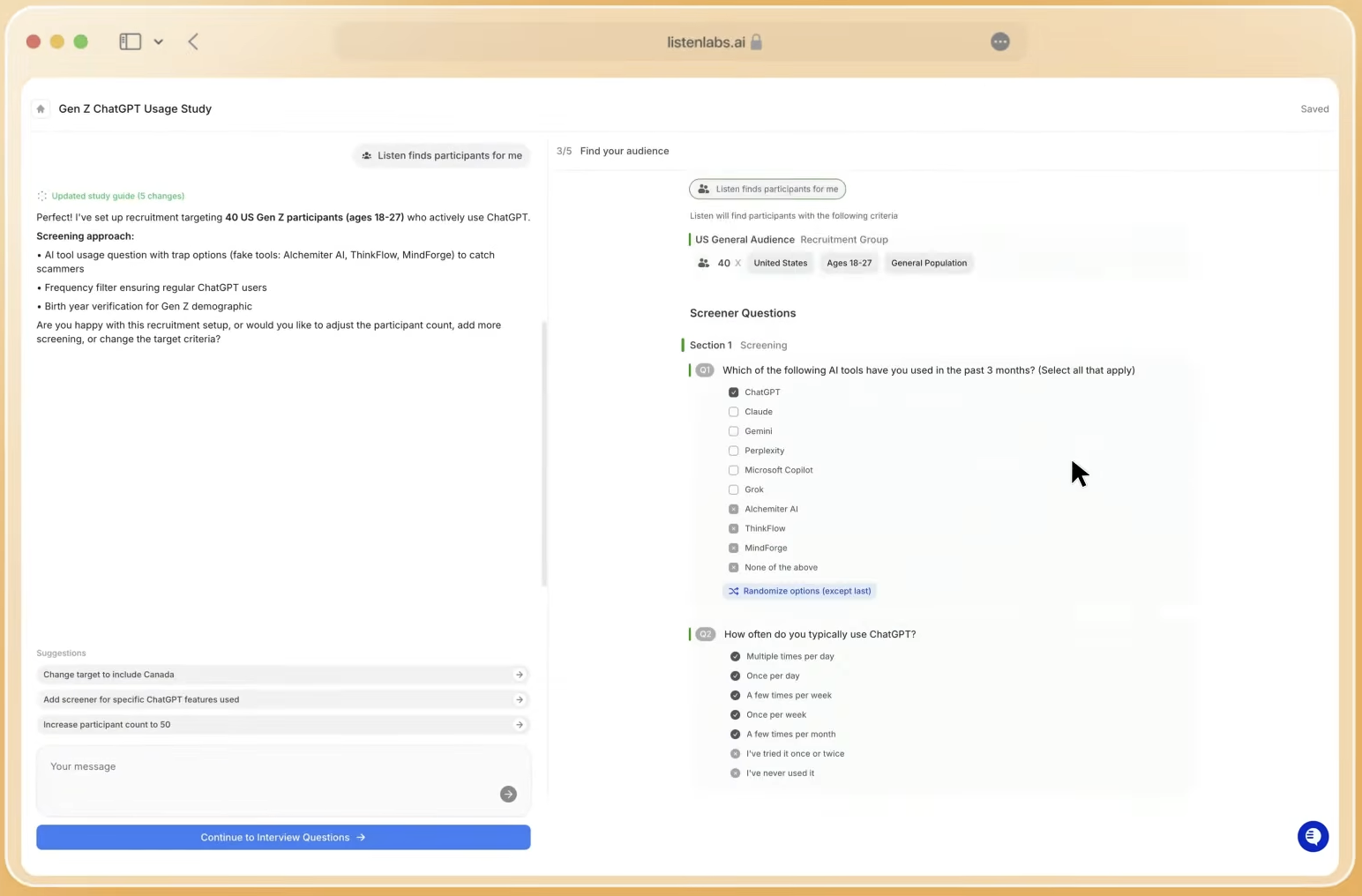
Quality Guard applies real-time monitoring across video, voice, content, and device signals during every interview, detecting fraud, low-effort responses, AI-generated scripts, and mismatched profiles before they enter the dataset. Participant frequency limits, with no more than three studies per month per respondent, remove the professional survey-taker problem that undermines commodity panel data.
The result is a reputation scoring system that compounds with every study completed on the platform. As Listen Labs serves more clients, audience quality strengthens, creating a flywheel that point-solution competitors cannot match.
Study Types That Gain the Most from AI-Moderated Interviews
AI-moderated interviews deliver measurable advantages across a broad range of qualitative study types. Concept and prototype testing benefits from large sample sizes that surface edge-case reactions traditional small-n studies miss entirely, as demonstrated by P&G’s claims testing program. Usability studies gain from the Emotional Intelligence layer’s ability to pinpoint moments of hesitation and friction that participants do not verbalize. Creative testing, as in the Skims campaign validation case, uses emotional signal data to distinguish genuine enthusiasm from polite approval.
Brand perception studies and consumer journey mapping benefit from the platform’s ability to run simultaneous interviews across multiple markets in 100+ languages, with automatic translation and transcription. Segmentation studies gain statistical confidence from sample sizes that qualitative methods have historically been unable to reach. Multi-market localization studies, which previously required coordinating separate agency relationships across regions, now run as a single unified program within one platform.
Enterprise AI Research Case Studies 2025: Additional Proof Points
The pattern across 2025 and into 2026 is consistent. Enterprises that shift from traditional qualitative cycles to AI-moderated interview programs report compressing timelines by five times or more, reducing per-study costs to approximately one-third of traditional agency rates, and increasing annual research output without proportional headcount growth.
The pattern holds across use cases: Robinhood’s prediction market study and Anthropic’s churn research both achieved the 5× speed improvement, while Microsoft’s anniversary program demonstrated the most dramatic compression, collapsing the traditional timeline to a single day. Platforms like Listen Labs layer on auto-recruiting, transcription, sentiment tagging, and insight summarization so teams jump from question to findings in hours, not weeks.
These outcomes are not isolated. They reflect a structural shift in what enterprise research infrastructure can deliver when the depth-versus-scale trade-off disappears by design.
Conclusion and Practical Next Steps
The evaluation framework for AI-driven customer research covers six dimensions: research quality, speed, cost, scalability, governance, and data security. Listen Labs addresses all six within a single end-to-end platform, from AI-assisted study design and global participant recruitment through AI-moderated interviews, Emotional Intelligence analysis, and automated deliverable generation. The platform holds SOC 2 Type II, GDPR, ISO 27001, ISO 27701, and ISO 42001 certifications, with 256-bit encryption and a strict policy against using customer data for AI model training.
For consumer insights leaders managing growing research backlogs, the practical next step is to map current research volume against Listen Labs capacity and run a 48-hour pilot on an existing backlog item. The pilot converts an abstract capability claim into a concrete, organization-specific proof point, with results in hand before the end of the business week.
Frequently Asked Questions
What makes AI-moderated interviews different from traditional qualitative research?
Traditional qualitative research separates recruiting, scheduling, moderation, transcription, and analysis into sequential steps handled by different vendors or team members. Each handoff introduces delay and quality risk. AI-moderated interviews run all of these steps in parallel within a single platform. The AI conducts personalized, adaptive conversations with dynamic follow-up questions, similar to a trained human interviewer, while simultaneously capturing video, audio, text, and emotional signals. The result is a research cycle that compresses from four to six weeks into under 24 hours, with sample sizes that can reach hundreds or thousands of participants rather than the five to fifteen typical of human-moderated qualitative studies.
How does Listen Labs ensure the quality of participants at scale?
Listen Labs uses three integrated quality layers. First, Listen Atlas, the platform’s AI orchestration layer, matches participants using behavioral and intent data across a global network of 30 million verified respondents in 45+ countries, rather than relying on self-reported demographics alone. Second, Quality Guard applies the real-time monitoring described earlier to detect fraud, low-effort responses, AI-generated scripts, and mismatched profiles before they enter the dataset. Third, a dedicated recruitment operations team adds a human review layer and enforces a limit of three studies per month per participant, eliminating the professional survey-taker problem that undermines commodity panel data. For hard-to-reach audiences, including enterprise decision-makers, healthcare workers, and segments below 1% incidence rate, the recruitment ops team partners with niche communities and specialized networks.
What types of deliverables does Listen Labs produce after interviews are complete?
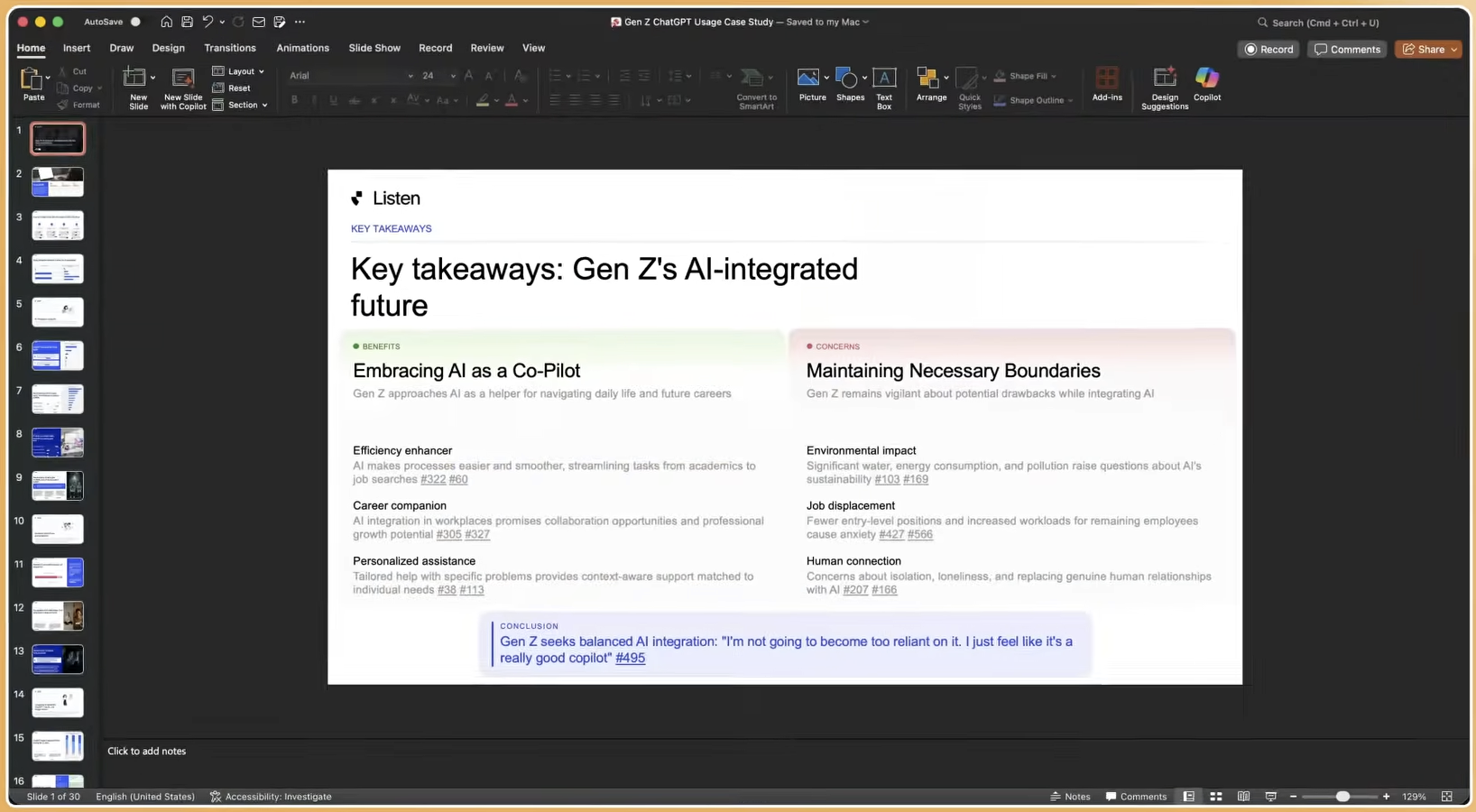
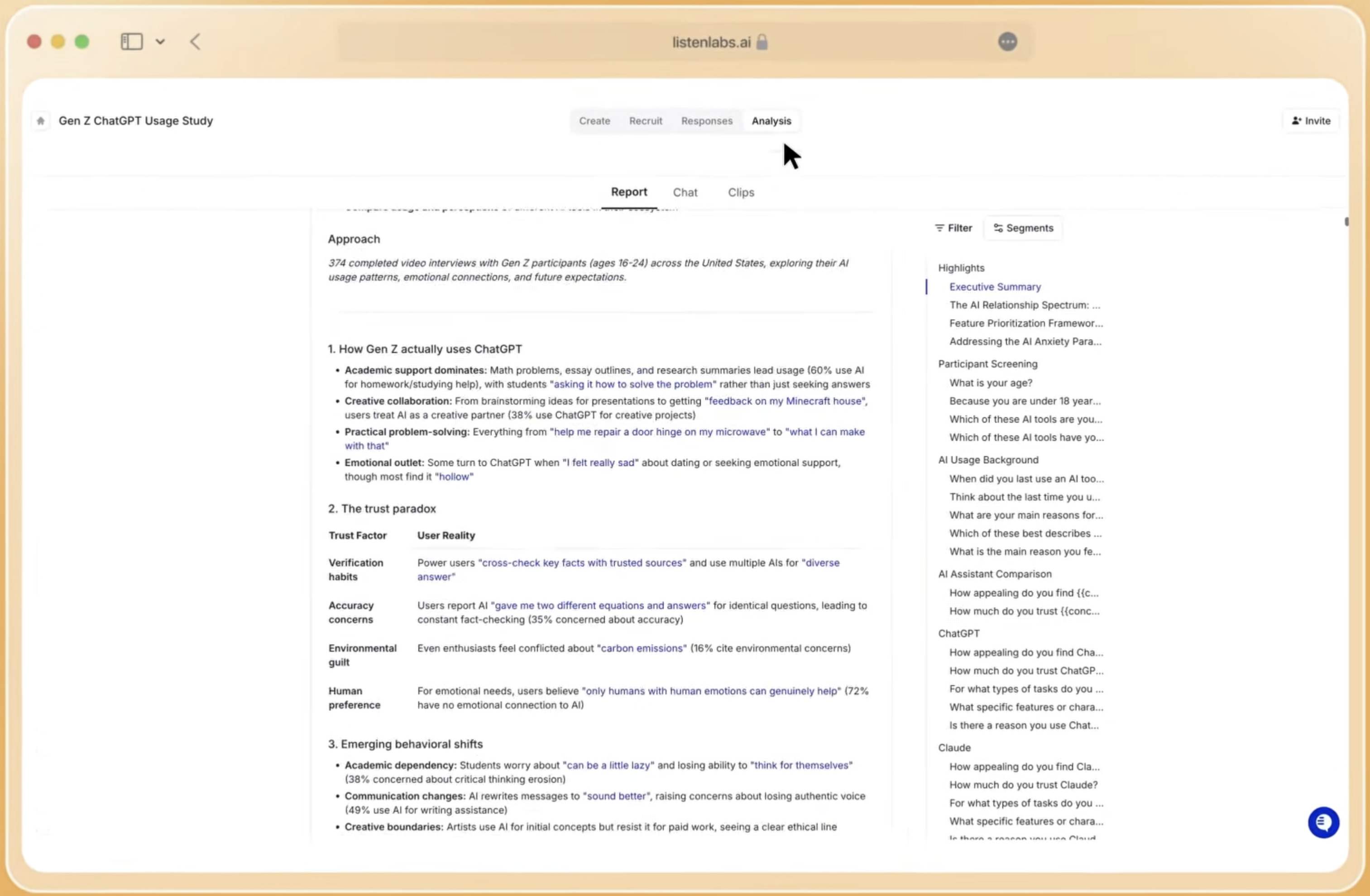
The Research Agent generates deliverables automatically from interview data. These include automated key findings and theme analysis, consultant-quality PowerPoint slide decks, memo-style reports, video highlight reels of the most significant interview moments, statistical charts and comparisons, segmentation breakdowns by demographics or custom cohorts, and responses to any natural-language query about the data. Deliverables are generated in under a minute. The Emotional Intelligence layer adds quantified emotion data per question and concept, traceable to the exact timestamp, verbatim quote, and reasoning behind each emotional label, enabling creative testing, concept comparison, and usability analysis that goes beyond what transcripts alone can surface.
Can Listen Labs support research across multiple countries and languages simultaneously?
Yes. The platform supports 100+ languages for interview moderation, with automatic translation and transcription across all supported languages. Emotional Intelligence is available across 50+ languages. Listen Labs covers 45+ countries across the Americas, Europe, APAC, and MEA. Multi-market studies run as a single unified program within one platform, replacing the need to coordinate separate agency relationships across regions. This makes global segmentation, localization research, and cross-market brand studies operationally feasible within a 24-hour window.
Is Listen Labs designed to replace an internal research team?
No. Listen Labs functions as a force multiplier for existing research teams, not a replacement. The platform enables research teams to run significantly more studies with the same headcount by automating the logistics-heavy steps, including recruiting, scheduling, moderating, transcribing, and generating initial analysis, so researchers can focus on strategic interpretation and stakeholder communication. Mission Control, the platform’s cross-study knowledge base, ensures that findings from every study accumulate into an institutional knowledge layer, reducing redundant research and enabling teams to answer questions from past studies in seconds rather than digging through archived reports.