
Written by: Anish Rao, Head of Growth, Listen Labs
Key Takeaways for Research and Insights Leaders
-
Traditional qualitative research recruitment creates 4–6 week delays that outpace enterprise decision cycles and leave research backlogs growing faster than team capacity.
-
AI research platforms remove sequential handoffs by automating participant sourcing, AI-moderated interviews, real-time quality monitoring, and instant analysis within a single workflow.
-
Modern platforms beat commodity-panel fraud through behavioral matching, real-time multi-signal monitoring, and strict participation limits that maintain higher respondent quality at scale.
-
Consolidating recruitment, moderation, and analysis onto one platform cuts costs by roughly two-thirds while enabling hundreds of simultaneous adaptive interviews that were previously impossible.
-
Listen Labs leads this category with a 30M+ verified network and full-stack automation, so your team can compress weeks-long cycles into results in under 24 hours.
The Problem: Four Recruitment Constraints Slowing Enterprise Research
Four dimensions define the recruitment challenge facing enterprise research teams today.
Speed. In large enterprises, internal prioritization queues and budget approvals can stretch typical qualitative research timelines from 4–6 weeks to six months. By the time a recruited sample is fielded and analyzed, the business question has often changed.
Scale. Human moderators can conduct only one interview at a time, historically capping qualitative studies at 5–15 participants. This ceiling forces teams to choose between statistical confidence and conversational depth. That trade-off limits the strategic value of every study.
Participant quality. Many research teams cite participant quality and reliability as a major recruiting challenge. Commodity panels introduce professional survey-takers who chase incentives, repeat respondents, and AI-generated scripts that pass basic screening but add little insight. Modern fraud operates across three tiers, from opportunistic individuals to industrial coordinated networks using VPNs and automation, which makes single-point verification insufficient.
Process fragmentation. Sequential handoffs between vendors, scheduling tools, transcription services, and analysis platforms introduce delay and quality loss at every stage. Each disconnected tool adds cost and coordination overhead that compounds across a research team’s annual study volume.
These four dimensions share a common root cause: sequential handoffs across disconnected systems. End-to-end AI research platforms remove those handoffs by consolidating the entire workflow.
The Solution: End-to-End AI Research Platforms for Qual-at-Scale
Qual-at-scale uses AI to automate time-consuming aspects of qualitative research like recruiting, interviewing, and analysis, enabling deeper insights at larger scales without traditional barriers of cost and time. End-to-end AI research platforms bring the entire research lifecycle into a single workflow that covers study design, participant sourcing, AI-moderated interviews, automated analysis, and insight management.
Consider a typical enterprise use case. A VP of Consumer Insights at a CPG company needs to evaluate a new product claim across three markets before a board presentation in 48 hours. On an AI platform, the team describes the research objective in natural language, and the AI co-designs the study guide and screener criteria. The recruitment layer matches and bids across a verified global network, fielding qualified participants within hours.
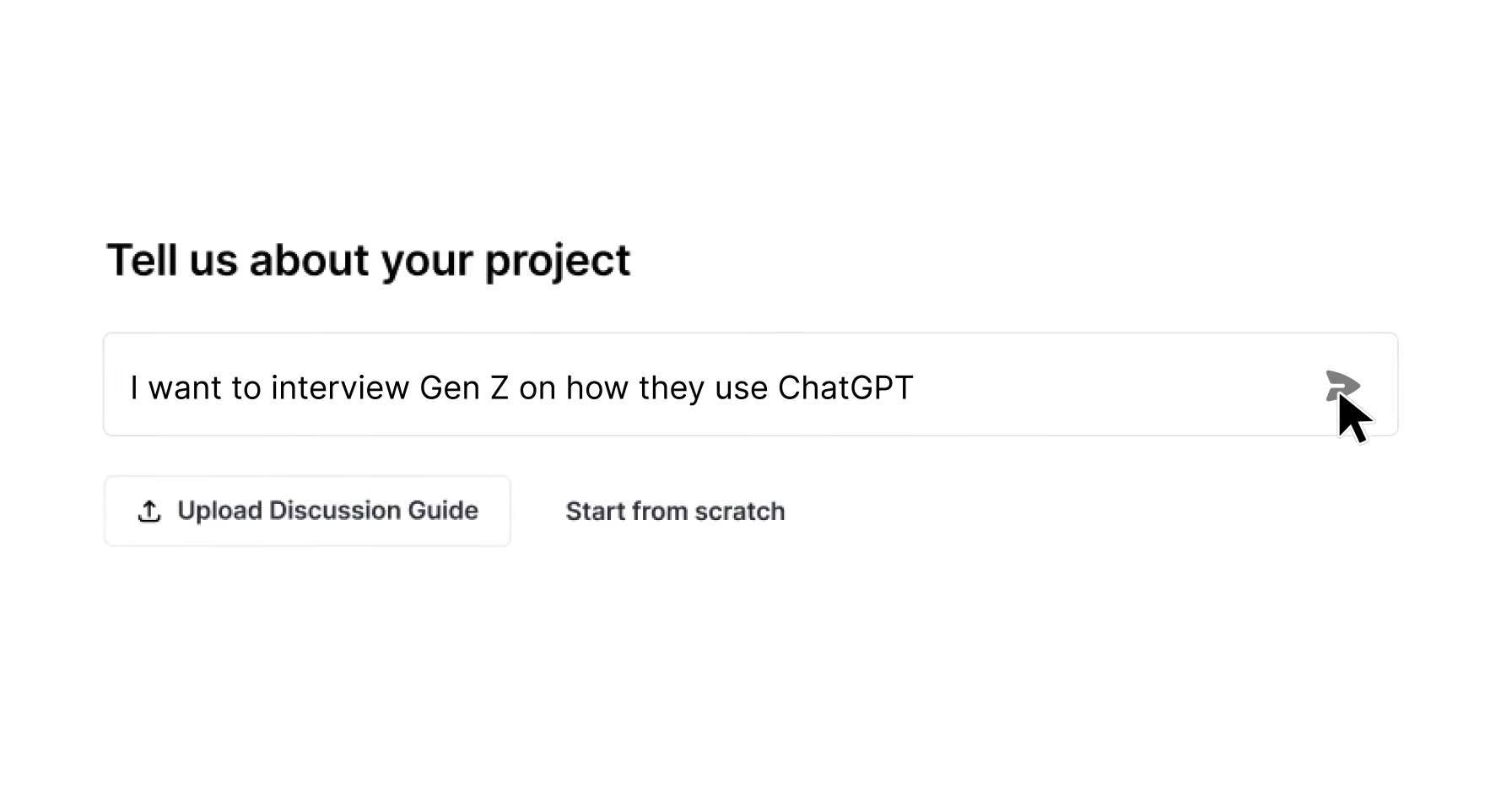
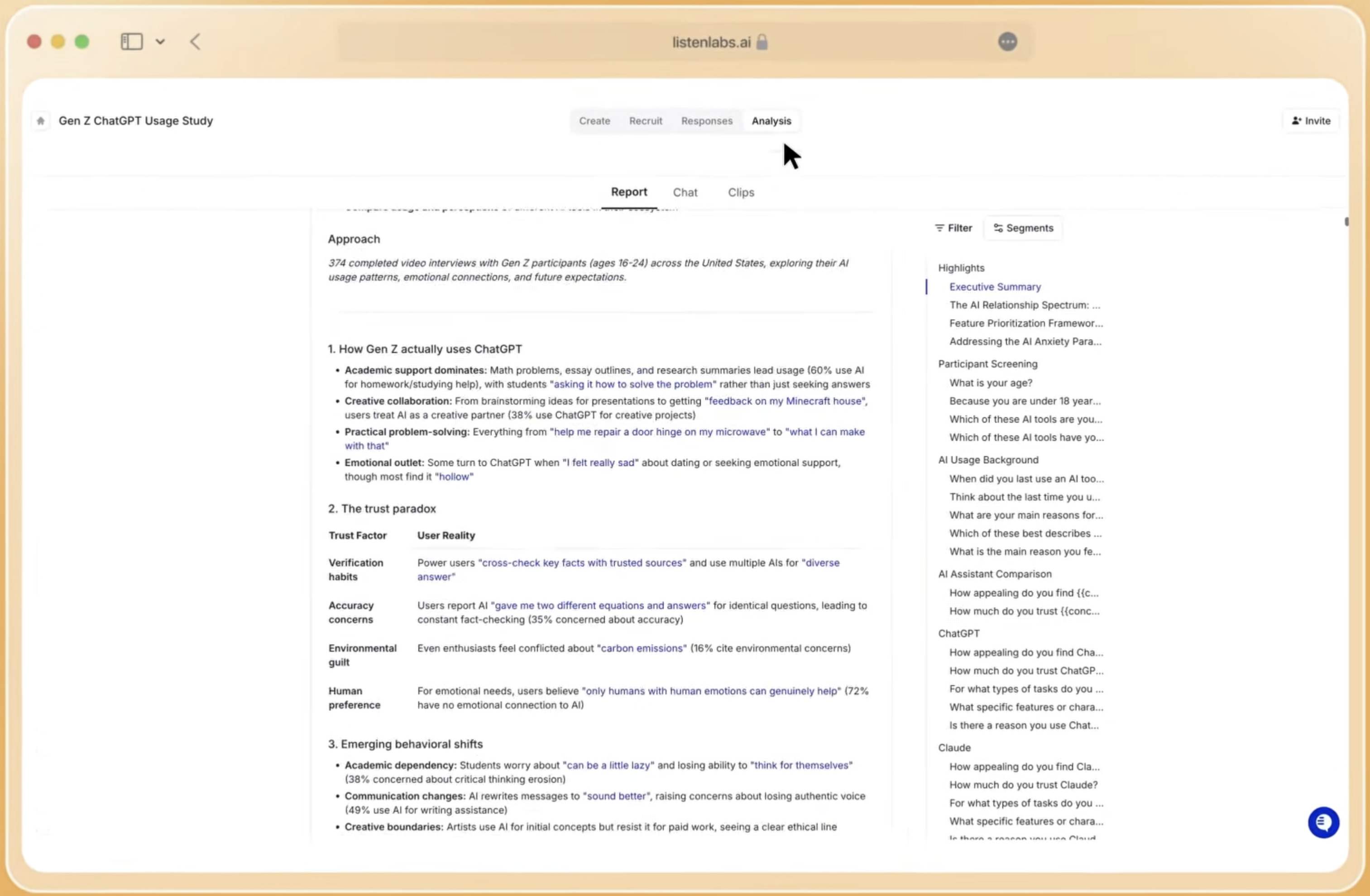
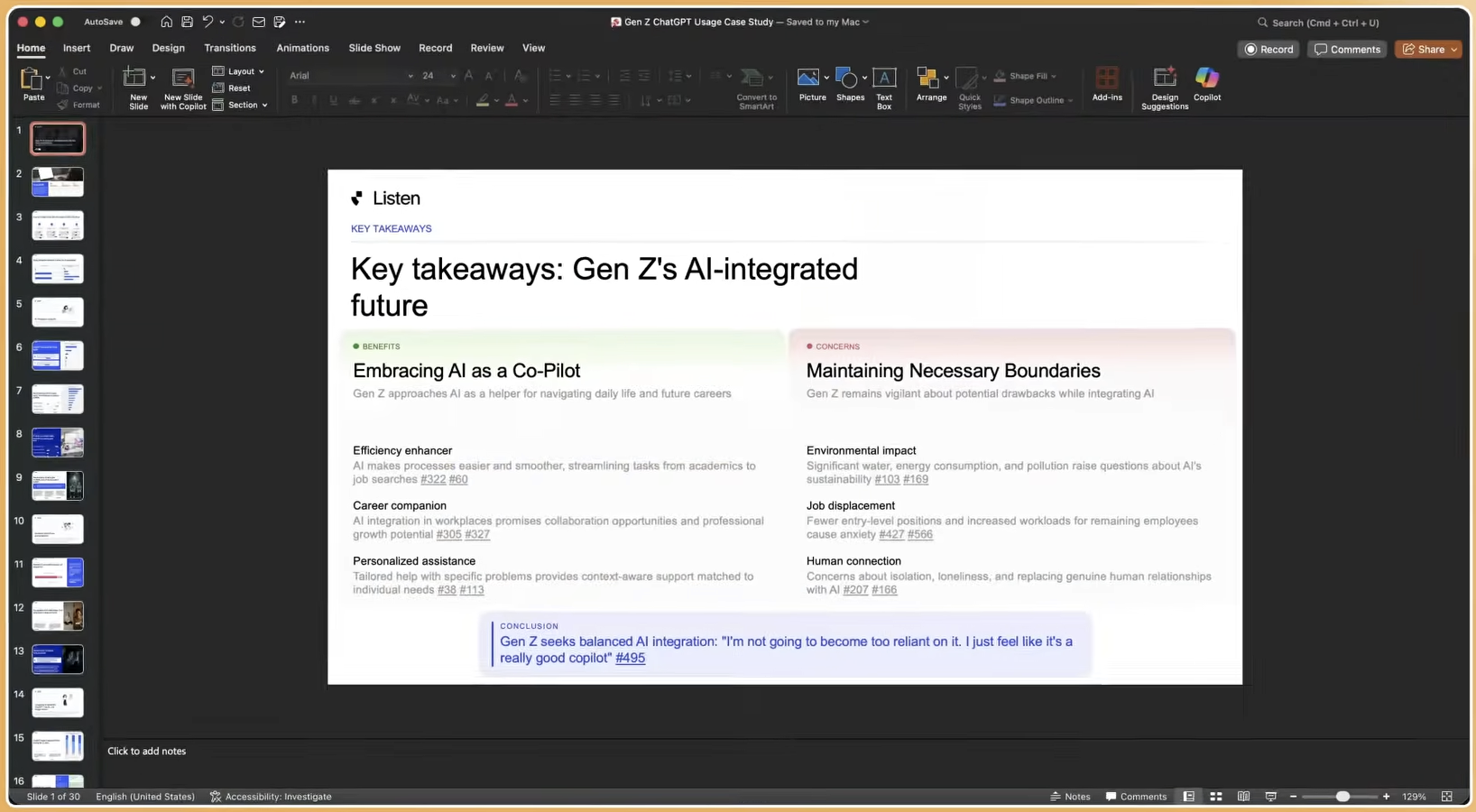
AI-moderated video interviews then run simultaneously across all three markets. Dynamic follow-up questions adapt to each participant’s responses. Real-time quality monitoring flags and removes low-effort or fraudulent sessions. Once fieldwork closes, automated analysis surfaces themes, emotional signals, and verbatim evidence. A slide deck and highlight reel generate in under a minute. The entire cycle completes before the board meeting, at a speed traditional methods cannot match.
Participant Recruitment: Slow Traditional Cycles vs. 24-Hour AI Turnaround
Traditional focus groups take 3–5 weeks and $4,000–$12,000 per 90-minute session. Even well-resourced research teams operating with established panel relationships rarely close recruitment in under two weeks for a mid-complexity study. A 2026 analysis of thousands of studies found that paying consumer participants below market rates resulted in recruitment timelines of 10–14 days with 18–25% no-show rates, which creates a compounding problem when each no-show requires re-recruitment and rescheduling.
AI platforms remove these sequential delays. Listen Labs compresses the full cycle from study brief to delivered results to less than 24 hours by running recruitment, moderation, and analysis in parallel rather than in sequence. Listen Labs has run over 1 million AI-powered customer interviews for companies including Microsoft, Perplexity, and Sweetgreen, which demonstrates enterprise-scale adoption of this model. Enterprise teams at Microsoft have used the platform to collect global customer stories within a single day, an outcome that previously required weeks of coordination.
Recruitment Methods: From Small-N Trade-Offs to Simultaneous Adaptive Interviews
Traditional qualitative research recruitment methods such as purposive sampling, snowball sampling, and panel recruitment are designed for small-n studies. The traditional 5–15 participant ceiling mentioned earlier stems from a methodological assumption that depth requires intimacy, and intimacy requires small groups. With qual-at-scale, that old trade-off between depth and scale no longer holds.
AI tools can engage hundreds or thousands of participants remotely and asynchronously when research requires large sample sizes or broad geographic reach. Each interview remains adaptive. The AI probes short or unexpected answers, follows emotional cues, and adjusts question framing based on prior responses. This behavior replicates a trained human moderator at effectively unlimited concurrency. The Anthropic Claude Code team used Listen Labs to conduct more than 300 user interviews in 48 hours, surfacing churn drivers five times faster than prior methods. “This AI interviewer means that you can have hundreds of one-on-one interviews run at scale.”
How Modern Platforms Raise Participant Quality Beyond Commodity Panels
Effective screeners for high-quality qualitative recruitment include behavioral questions and open-ended responses that reveal authentic recent experiences rather than optimized answers. Commodity panels rarely enforce these standards at the infrastructure level, which leaves quality assurance to individual researchers.
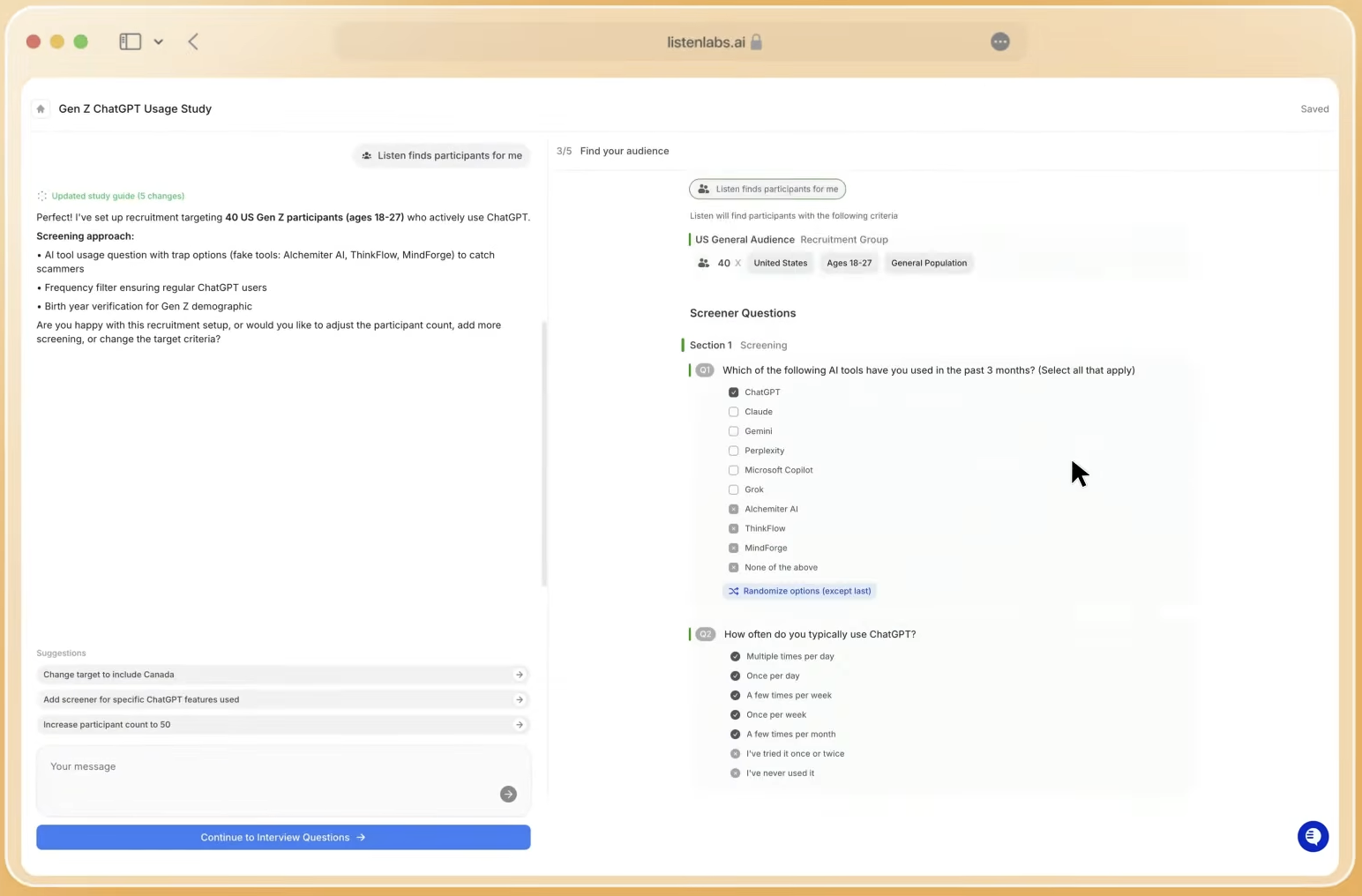
Listen Labs addresses this through Quality Guard, a multi-layer system that starts with behavioral matching on intent and past actions rather than self-reported demographics. This approach ensures that the right people enter the pool. During each interview, real-time monitoring across video, voice, content, and device signals catches fraud that passed initial screening. Finally, participation limits of three studies per month prevent the professional survey-taker contamination that undermines even well-screened panels over time.
Purpose-built recruitment infrastructure requires layered fraud controls including behavioral matching, real-time monitoring, and participant frequency limits to prevent panel fatigue and fraudulent responses. The platform’s 30M verified respondent network spans more than 45 countries and over 100 languages. A dedicated recruitment operations team handles audiences below 1% incidence rate, including enterprise decision-makers, healthcare workers, and highly specialized consumer segments.
Cost and Fragmentation: Moving to a Single-Platform Research Stack
Enterprise research budgets are consumed not just by panel fees but by the full stack of disconnected vendors such as recruitment platforms, scheduling tools, moderation services, transcription providers, and analysis software. Each layer adds cost, delay, and a potential point of quality failure. Platforms like Listen Labs layer on auto-recruiting, transcription, sentiment tagging, and insight summarization so teams jump from question to findings in hours, not weeks.
Consolidating onto a single platform replaces multiple vendor relationships with one subscription. Listen Labs clients report running more studies at approximately one third of the cost of the traditional multi-vendor approach. Research findings are stored in Mission Control, a cross-study knowledge base that allows teams to query institutional knowledge in seconds and avoid repeating work on previously answered questions.
Listen Labs: End-to-End AI Research Platform in Practice
Listen Labs operates as an end-to-end AI research platform that sources participants from its 30M+ verified network, conducts AI-moderated video interviews, analyzes responses, and delivers consultant-quality reports, slide decks, and video highlight reels within 24 hours. The platform is trusted by Microsoft, Google, Sony, Anthropic, Robinhood, Procter & Gamble, Skims, Levi’s, and Nestlé.
Key platform capabilities relevant to qualitative research recruitment include:
-
Listen Atlas: AI orchestration layer that automatically matches and bids across multiple consumer and B2B panel partners alongside Listen Labs’ proprietary database, covering more than 45 countries and over 100 languages.
-
Quality Guard: Real-time fraud detection across video, voice, content, and device signals with reputation scoring that compounds across every study conducted on the platform.
-
Emotional Intelligence: Multimodal analysis of tone of voice, word choice, and micro expressions built on Ekman’s universal emotions framework, available across 50+ languages and integrated directly into the Research Agent.
-
Research Agent: Automated generation of key findings, themes, slide decks, memos, highlight reels, and statistical charts from natural-language queries.
-
Mission Control: Centralized repository enabling cross-study queries, trend tracking, and institutional knowledge building across all completed research.
P&G used Listen Labs to conduct more than 250 interviews with quantified themes and verbatim evidence, directly shaping product and brand strategy in hours. Skims validated campaign direction with thousands of premium consumers overnight, securing board-level buy-in. Robinhood identified that users who view prediction markets as entertainment drive 2.4x higher weekly re-engagement, an insight delivered five times faster than prior research methods.
See how enterprise teams are multiplying their research output. Walk through a live study built around your specific use case.
How AI Research Platforms Compare to Traditional Approaches
The following section outlines category-level differences between AI research platforms and conventional alternatives.
AI research platforms compared to traditional research agencies:
-
Agencies deliver high-quality outputs but require multi-week timelines and significant budget, while AI platforms deliver comparable rigor in under 24 hours at roughly one third of the cost.
-
Agency capacity is fixed by headcount, while AI platforms scale to hundreds of simultaneous interviews without additional staffing.
AI research platforms compared to panel and recruitment platforms (Prolific, User Interviews, Respondent):
-
Standalone recruitment platforms solve participant sourcing but require separate tools for moderation, transcription, and analysis.
-
End-to-end platforms integrate recruitment directly into the research workflow, which removes handoff delays and vendor fragmentation.
AI research platforms compared to quantitative survey tools (SurveyMonkey, Qualtrics):
-
Surveys scale but use pre-set questions with no adaptive follow-up, which misses unexpected findings and emotional nuance.
-
AI-moderated interviews deliver the statistical confidence of large samples alongside the conversational depth of one-on-one qualitative sessions.
AI research platforms compared to manual in-house research:
-
In-house teams provide strategic context but become bottlenecks when study volume exceeds capacity.
-
AI platforms function as force multipliers, enabling the same team to run significantly more studies per quarter without proportional headcount increases.
Checklist for Evaluating AI Research Platforms
Teams evaluating AI research platforms for qualitative research recruitment should assess the following dimensions before committing to a vendor.
Data quality and fraud prevention:
-
Confirm that the platform uses layered verification with behavioral signals, real-time monitoring, and participation frequency limits rather than single-point screener checks.
-
Verify that commodity quantitative panels are excluded from the recruitment supply chain.
Privacy and compliance:
-
Check that the platform holds SOC 2 Type II, GDPR, ISO 27001, ISO 27701, and ISO 42001 certifications.
-
Confirm that customer data is excluded from AI model training.
Bias mitigation:
-
Ensure that the analysis engine processes all interview data objectively without human confirmation bias.
-
Confirm that emotional signals are captured beyond self-reported responses.
Organizational adoption:
-
Verify that the platform supports enterprise SSO and role-based access.
-
Check whether teams can bring their own participants or panel providers.
-
Confirm that an in-house research team is available to support methodology questions.
Frequently Asked Questions
What is the difference between traditional qualitative research recruitment and AI platform recruitment?
Traditional recruitment relies on manual screener design, sequential outreach to panel providers, and human scheduling. That process typically takes one to three weeks before a single interview occurs. AI platform recruitment automates matching, screening, and scheduling simultaneously, drawing from verified global networks with behavioral and intent data rather than self-reported demographics alone. The result is a fielded study within hours rather than weeks, with multi-layer fraud controls applied in real time throughout the process.
What types of qualitative research studies are best suited to AI recruitment platforms?
AI recruitment platforms work well for concept and prototype testing, usability studies, creative and ad testing, brand perception research, consumer journey mapping, multi-market segmentation studies, pricing research, and churn analysis. They excel when speed is critical, when sample sizes need to exceed what a human moderation team can handle, or when geographic reach spans multiple countries simultaneously. Studies requiring highly specialized audiences, such as enterprise decision-makers, healthcare professionals, or consumers below 1% incidence rate, also benefit from platforms with dedicated recruitment operations teams.
How do AI platforms ensure participant quality without relying on commodity panels?
Quality assurance on purpose-built AI platforms operates across multiple layers. Behavioral matching selects participants based on intent and past actions rather than self-reported profile data. Real-time monitoring during interviews detects low-effort responses, AI-generated scripts, device anomalies, and mismatched profiles. Participation frequency limits, such as a maximum of three studies per month per participant, prevent professional survey-taker contamination. Reputation scoring compounds across every study conducted on the platform, so the quality of the participant network improves continuously as study volume grows.
How does data security and privacy compliance work on enterprise AI research platforms?
Enterprise-grade AI research platforms maintain 256-bit encryption and hold certifications including SOC 2 Type II, GDPR, ISO 27001, ISO 27701, and ISO 42001. Customer data is not used for AI model training. Enterprise SSO is supported for access management. Teams operating across jurisdictions should confirm that the platform’s data residency and processing agreements align with regional privacy regulations before fielding studies involving sensitive consumer data.
Will adopting an AI research platform reduce the need for an internal research team?
AI research platforms are designed to multiply the output of existing research teams, not replace them. The platform handles logistics such as recruitment, moderation, transcription, and initial analysis. Researchers can then focus on strategic interpretation, stakeholder communication, and study design refinement. Teams that previously ran four to six studies per quarter due to capacity constraints can run significantly more without adding headcount, which reduces the backlog that frustrates both researchers and internal stakeholders.
Conclusion: Faster Recruitment, Higher Quality, and More Output
Qualitative research recruitment has historically been the primary constraint on enterprise insight velocity. Manual processes, fragmented vendor stacks, commodity panel quality risks, and the structural ceiling on human moderation capacity have collectively limited how much research teams can produce and how quickly. AI platforms that automate recruiting, interviewing, and analysis remove these barriers and compress cycles from weeks to hours while maintaining the methodological rigor that enterprise decisions require.
Switching to AI-moderated interviews lets teams capture hundreds of candid, one-to-one conversations overnight, a scale that was structurally impossible under traditional recruitment models. For VP and Director-level consumer insights leaders managing growing backlogs and fixed headcount, the category offers a direct path to multiplying research output without proportional cost increases.
Listen Labs leads this category with a 30M+ verified respondent network, Quality Guard fraud prevention, Emotional Intelligence signal capture, and a full-stack platform trusted by Microsoft, Google, P&G, Anthropic, and Nestlé. If your team is ready to move from weeks-long recruitment cycles to results in under 24 hours, see the platform solve your specific recruitment challenge in a live walkthrough.