
Written by: Anish Rao, Head of Growth, Listen Labs
Key Takeaways
- Enterprise teams in 2026 choose among three research options: pure AI or synthetic methods, traditional surveys, and AI-moderated human interviews that combine scale with real human depth.
- AI-moderated human interviews outperform surveys for exploratory or emotional research by enabling adaptive, conversational follow-up that reveals the “why” behind behaviors.
- Key evaluation dimensions include setup speed, recruitment quality, moderation depth, data controls, analysis automation, deliverable quality, and cross-study knowledge retention, where AI-moderated methods lead.
- Real-world results show Listen Labs clients like Microsoft, Anthropic, and P&G completing hundreds of interviews in 24–48 hours at one-third the cost of traditional qualitative research.
- Listen Labs delivers the full research lifecycle, from AI-assisted design through verified recruitment, adaptive moderation, and instant deliverables. Book a demo to see how it compresses research cycles into under 24 hours.
The 2026 Inflection Point for Research Teams
Consumer insights teams in 2026 operate under more pressure than at any prior point in the discipline’s history. Research backlogs grow faster than headcount, internal stakeholders expect faster answers, and the volume of decisions requiring customer evidence has multiplied. The debate around AI research vs surveys now determines whether insights arrive before or after the business moves on.
PwC’s 29th Global CEO Survey of 4,454 chief executives across 95 countries found that more than half of CEOs reported realizing neither revenue nor cost benefits from AI investments over the prior 12 months. This pattern signals that implementation approach, not AI adoption alone, drives outcomes. Meanwhile, Deloitte’s 2026 Global Human Capital Trends research found that organizations taking a human-centric approach to AI adoption are more likely to realize returns exceeding expectations compared to those taking a tech-focused approach. The same pattern holds for research methodology: the tool matters less than whether it keeps humans in the loop.
Three Research Categories Competing for Budget
Three distinct categories compete for enterprise research budgets in 2026.

- Pure AI / synthetic methods: Large language models simulate respondents or generate answers based on training data, with no real human participants involved.
- Traditional surveys: Structured questionnaires distributed at scale via platforms such as SurveyMonkey or Qualtrics, collecting pre-set responses without adaptive follow-up.
- AI-moderated human interviews: AI conducts live, adaptive conversations with real verified participants, combining the scale of surveys with the depth of qualitative interviews. This is the category Listen Labs leads.
Conflating these three categories produces flawed methodology decisions. Each category has a distinct capability profile.
Seven Core Dimensions for Comparing Methods
A rigorous comparison across methods requires consistent criteria. The seven dimensions that matter most to enterprise research operations are study setup speed, participant recruitment, moderation quality, data quality controls, depth versus scale balance, analysis automation, and deliverable format. An eighth dimension, cross-study knowledge retention, becomes critical for teams running ongoing research programs.
Category-by-Category Analysis Across Dimensions
Study Setup Speed and Effort
- Traditional surveys: Fast to build for simple questionnaires. Complex logic, branching, and quota management require significant configuration time.
- Synthetic AI: Instant generation of simulated responses, with no actual study setup or participant coordination required or possible.
- AI-moderated human interviews (Listen Labs): AI-assisted study co-design converts a natural-language research brief into structured objectives, questions, and probing context in seconds. Auto-QA flags issues before launch.
Recruitment Quality and Targeting
- Traditional surveys: Dependent on commodity panels with known fraud risks, including professional survey-takers and incentive-driven responses.
- Synthetic AI: No recruitment, because simulated respondents replace real people entirely.
- AI-moderated human interviews (Listen Labs): Listen Atlas matches across 30M verified respondents in 45+ countries using behavioral and intent data, not just self-reported demographics. Participants are capped at three studies per month.
Moderation Quality and Conversational Depth
- Traditional surveys: No moderation, since questions are fixed and unexpected responses cannot be probed.
- Synthetic AI: No moderation of real participants, and outputs reflect model training rather than lived experience.
- AI-moderated human interviews (Listen Labs): The AI probes short or interesting answers dynamically, replicating the behavior of a trained human interviewer. Traditional surveys may tell us what people do, but it takes a conversation to understand why.
Data Quality Controls and Safeguards
- Traditional surveys: Fraud detection is largely post-hoc, and commodity panels carry persistent quality risks.
- Synthetic AI: No fraud risk from participants, but significant validity risk from model hallucination and systematic bias in outputs.
- AI-moderated human interviews (Listen Labs): Quality Guard monitors every interview in real time across video, voice, content, and device signals. A dedicated recruitment operations team adds a human review layer.
Depth Versus Scale Trade-offs
- Traditional surveys: Scale to thousands of respondents but capture only surface-level, pre-set responses.
- Synthetic AI: Provide unlimited synthetic scale. Sturm and Pinheiro’s 2026 iScience study found AI-generated text tends to be more positive and motivational while human texts exhibit negative emotions, which flattens the emotional complexity that makes qualitative data actionable.
- AI-moderated human interviews (Listen Labs): With qual-at-scale, the old trade-off between depth and scale is no longer a barrier. Hundreds of adaptive interviews run simultaneously.
Analysis Speed and Rigor
- Traditional surveys: Quantitative outputs are straightforward to tabulate, while open-ended responses require manual coding that introduces analyst bias.
- Synthetic AI: Output generation occurs instantly, but outputs reflect model priors rather than real customer signal.
- AI-moderated human interviews (Listen Labs): The Research Agent processes all interview data, identifies themes, runs statistical tests, and generates segmentation breakdowns. Emotional Intelligence adds multimodal signal analysis across tone of voice, word choice, and micro-expressions, built on Ekman’s universal emotions framework.
Deliverable Quality and Stakeholder Readiness
- Traditional surveys: Produce charts and cross-tabs, and narrative interpretation requires analyst time.
- Synthetic AI: Generate text summaries instantly, with no video evidence or verbatim human quotes.
- AI-moderated human interviews (Listen Labs): Generate consultant-quality slide decks, memos, video highlight reels, and statistical charts in under a minute. Every emotional label is traceable to a timestamp and verbatim quote.
Cross-Study Knowledge Retention
- Traditional surveys: Findings live in disconnected reports, so institutional knowledge degrades over time.
- Synthetic AI: Maintain no persistent customer knowledge base, because each generation is stateless relative to real customer history.
- AI-moderated human interviews (Listen Labs): Mission Control serves as a living source of truth. Each study compounds the knowledge base, enabling cross-study queries and trend tracking in seconds.
Book a demo to see how Listen Labs compresses a full research cycle, from recruitment through deliverables, into less than 24 hours.
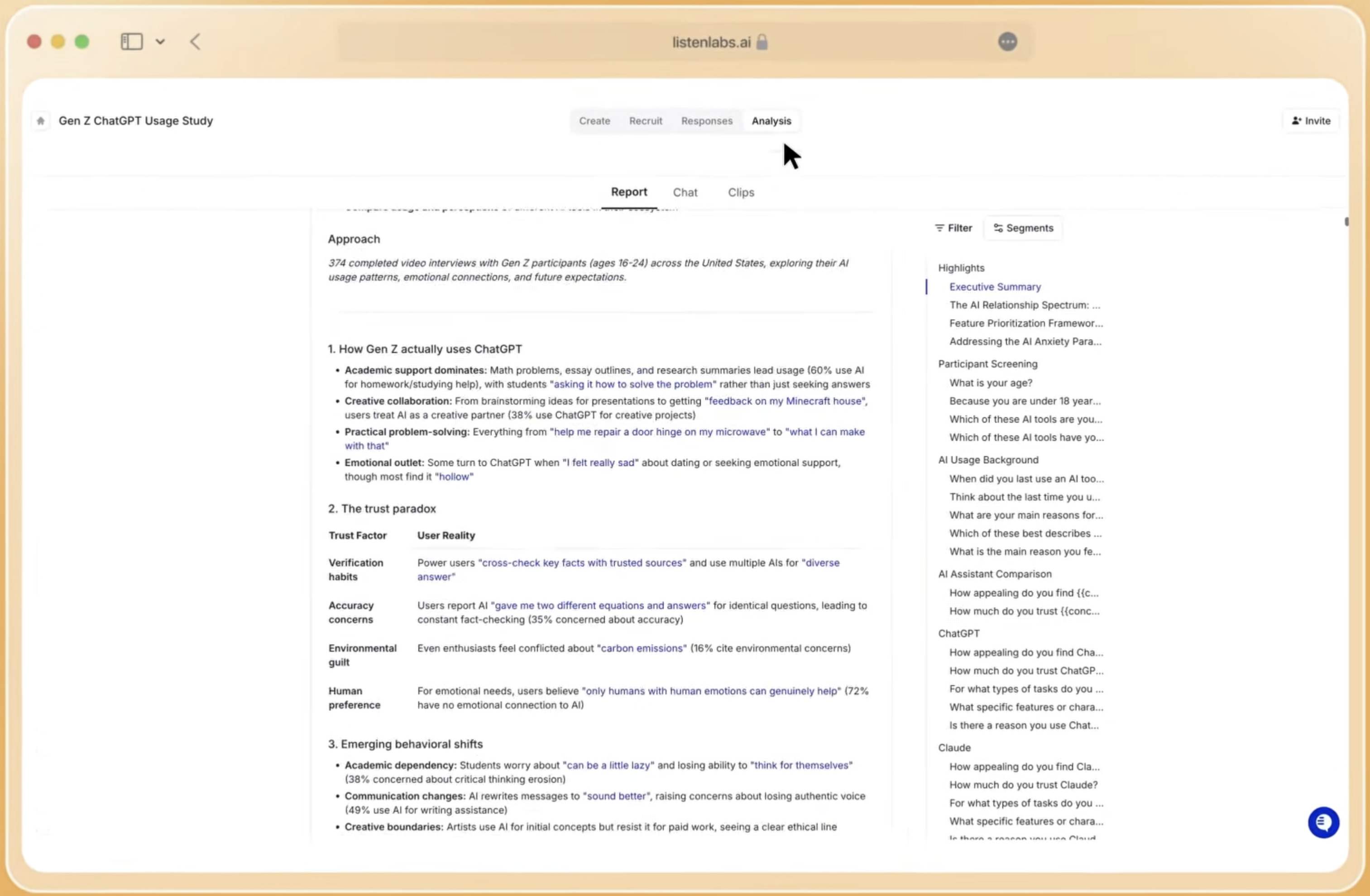
Best-Fit Use Cases by Method
Traditional surveys remain the right tool when the research objective is purely confirmatory. Teams use them to validate a known hypothesis with a large, representative sample, track a metric over time, or collect structured behavioral data where no follow-up is needed.
AI-moderated human interviews outperform surveys when the objective is exploratory, emotional, or requires understanding the why behind a behavior. The why is what differentiates customer research that is alright from customer research that is outstanding.
Enterprise examples from Listen Labs’ client base show how this plays out in practice. Microsoft collected global customer video stories for its 50th anniversary within a day, reaching hundreds of users at one-third of the cost of traditional methods. Anthropic surfaced churn drivers from more than 300 user interviews in 48 hours, five times faster than prior approaches. Procter & Gamble delivered over 250 interviews with quantified themes that directly shaped product strategy in hours, not weeks.
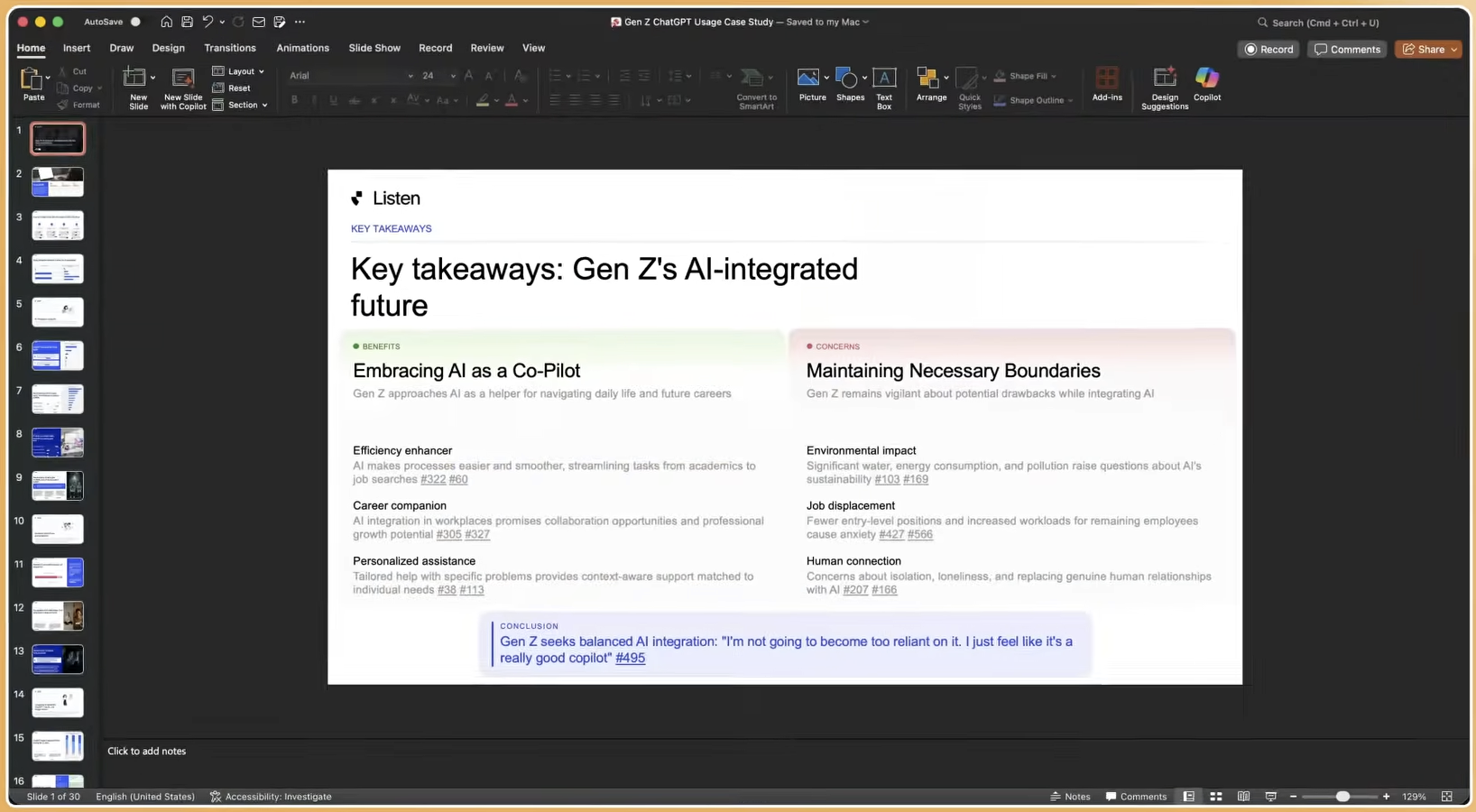
Operational and Long-Term Considerations for 2026
The hybrid reality of 2026 is that AI augments research rather than replacing it wholesale. The human-centric principle mentioned earlier applies directly to research methodology. Platforms that keep verified human participants at the center of data collection while automating the surrounding logistics deliver better outcomes than those that remove humans from the process entirely.
Synthetic panels, or AI-simulated respondents, represent the furthest extreme of removing humans from research. The limitations are structural. Rodrigues et al.’s 2026 iScience analysis showed emotional flattening that reflects limited grounding in embodied human sensory experience. Separately, RLHF-style training makes models overconfident and overly agreeable, creating a “digital Yes Man” effect that biases synthetic respondents toward validation rather than authentic disagreement or ambivalence. These limitations reflect structural properties of how language models are trained, not fixable software bugs.
Risks, Limitations, and Common Misconceptions
Three risks deserve explicit attention for enterprise teams evaluating AI research methods.
- Fraud in commodity panels: Traditional survey panels with open enrollment attract professional survey-takers. Quality Guard’s real-time monitoring and participant frequency limits directly address this risk, while commodity quant panels do not.
- Systematic bias in synthetic data: Rodrigues et al. (2026) found human-authored texts exhibited greater variability in document length whereas LLM outputs were more uniform. Synthetic panels produce internally consistent but emotionally flattened data that can mislead brand and product decisions.
- Over-reliance on AI-generated insights without human grounding: PwC’s 2026 CEO Survey highlights the importance of stakeholder trust in AI. Companies that manage these issues well tend to deliver stronger shareholder returns. Methodological transparency functions as a business performance variable, not just a compliance checkbox.
Decision Framework for Choosing Methods
Teams can match research goals to methods by first determining whether the objective is confirmatory or exploratory.
- Use traditional surveys when: the hypothesis is defined, the metric is trackable, sample size requirements exceed 1,000, and no follow-up probing is needed. These contexts are confirmatory and suit structured data collection.
- Use AI-moderated human interviews when: the objective is exploratory, emotional nuance matters, the research must complete within 24–48 hours, or the team needs to run studies at a volume that traditional qualitative methods cannot support. These contexts require adaptive follow-up that fixed surveys cannot provide.
- Avoid synthetic panels when: decisions involve brand perception, emotional response, behavioral authenticity, or any context where stakeholder trust in the data source is a factor. The systematic biases documented earlier make synthetic data unsuitable for these applications.
- Combine methods when: the team needs both breadth and depth. A survey can establish quantitative baselines, and AI-moderated interviews can explain the variance, a hybrid design that Listen Labs supports natively through mixed-method study configurations.
Book a demo to walk through how Listen Labs structures hybrid research programs for enterprise consumer insights teams.
FAQ
Is AI taking over surveying?
AI is transforming the research process around surveys, not eliminating surveys themselves. AI has changed the feasibility of running adaptive, conversational interviews at the scale that surveys previously monopolized. For confirmatory, metric-tracking, or large-sample quantitative work, surveys remain the appropriate instrument. For exploratory, emotional, or behavioral research, AI-moderated human interviews now offer a faster and deeper alternative. The practical outcome for most enterprise teams is a shift in the mix, with fewer standalone surveys and more hybrid designs that pair quantitative baselines with qualitative depth, rather than a wholesale replacement of one method by another.
Can you use AI to do surveys?
Teams can use AI in several distinct ways within survey workflows. AI can assist with survey design by drafting questions, identifying logical inconsistencies, and suggesting branching logic. AI can also analyze open-ended survey responses at scale, coding themes and surfacing patterns faster than manual analysis. The more significant development is AI-moderated interviewing, where the AI conducts live adaptive conversations with real human participants and collects responses that go beyond what fixed survey questions can capture. Listen Labs combines all three capabilities, including AI-assisted study design, AI moderation of human interviews, and automated analysis, within a single platform that also supports traditional survey-format questions like Likert scales, NPS, and MaxDiff alongside open-ended conversational responses.
Will surveying be replaced by AI?
Surveying as a category will not be replaced, but the conditions under which surveys are the best-fit tool are narrowing. Surveys retain clear advantages for large-scale quantitative tracking, structured behavioral data collection, and research contexts where stakeholder trust requires a familiar, auditable methodology. Where surveys have historically been used as a proxy for qualitative understanding, because running real interviews at scale was too slow or expensive, AI-moderated human interviews now offer a direct alternative that delivers both depth and scale. The net effect is that surveys will be used more precisely for what they do well, while AI-moderated interviews absorb the research volume that surveys were never ideally suited to handle.
Conclusion: A Practical Path Forward for Insights Teams
The AI research vs surveys debate in 2026 resolves most cleanly by recognizing that the depth-versus-scale trade-off has been structurally broken by AI-moderated human interviews. In the past, enterprise teams had to choose between knowing a lot about a few people or a little about many. Listen Labs is built around a different reality: real verified participants, adaptive AI moderation, automated analysis, and deliverables in less than 24 hours at one-third the cost of traditional qualitative research. The platform serves Microsoft, Google, Anthropic, P&G, Skims, and Nestlé because it does not ask research teams to choose between rigor and speed, or between depth and scale.
Enterprise consumer insights teams that plan to run five times more studies this year without adding headcount have one practical path forward. They need a platform that handles the entire research lifecycle end-to-end, keeps humans at the center of the data, and delivers results before the business decision has already been made.
Book a demo to see Listen Labs in action with your research use case.