
Written by: Anish Rao, Head of Growth, Listen Labs
Key Takeaways
- Enterprise research teams lose time and introduce quality risks when they stitch together Discuss.io for interviews with Dovetail for analysis. This fragmented workflow creates operational overhead that slows decision-making.
- Listen Labs replaces the two-tool stack with AI-moderated interviews, automated analysis, Emotional Intelligence insights, and centralized cross-study intelligence, all delivered in under 24 hours.
- Single-platform research solutions help companies like Microsoft and Nestlé collect insights faster than traditional qualitative studies while still preserving conversational depth.
- AI-powered interviewers help participants open up on sensitive topics, support 100+ languages, and enable global research programs without complex multilingual moderator logistics.
- Ready to replace your multi-tool workflow? Explore Listen Labs’ end-to-end research platform in a personalized demo.
Evaluation Criteria for End-to-End Research Platforms
When evaluating alternatives to the Discuss.io + Dovetail stack, enterprise research teams should assess platforms across nine critical dimensions:
- Research speed and turnaround time
- Insight depth and conversational quality
- Participant quality and fraud prevention
- Global reach and language support
- Analysis automation capabilities
- Emotional signal capture
- Repository and cross-study intelligence
- Security and compliance standards
- Total cost of ownership
The following sections evaluate Listen Labs against each of these criteria.
These dimensions reflect the operational realities facing Fortune 500 research teams in 2026. Speed determines whether insights arrive while business decisions remain open. Depth ensures that AI-moderated conversations capture the nuance that justifies qualitative investment. Quality controls prevent the “garbage in, garbage out” problem that undermines research credibility. Analysis automation determines whether teams can scale output without matching headcount growth.
Study Design and Setup Efficiency
The Discuss.io + Dovetail workflow forces researchers to design studies in one platform, conduct interviews there, export transcripts, and then rebuild project structures in a separate analysis tool. This handoff introduces version control risks, data formatting issues, and duplicated setup work that extends project timelines.
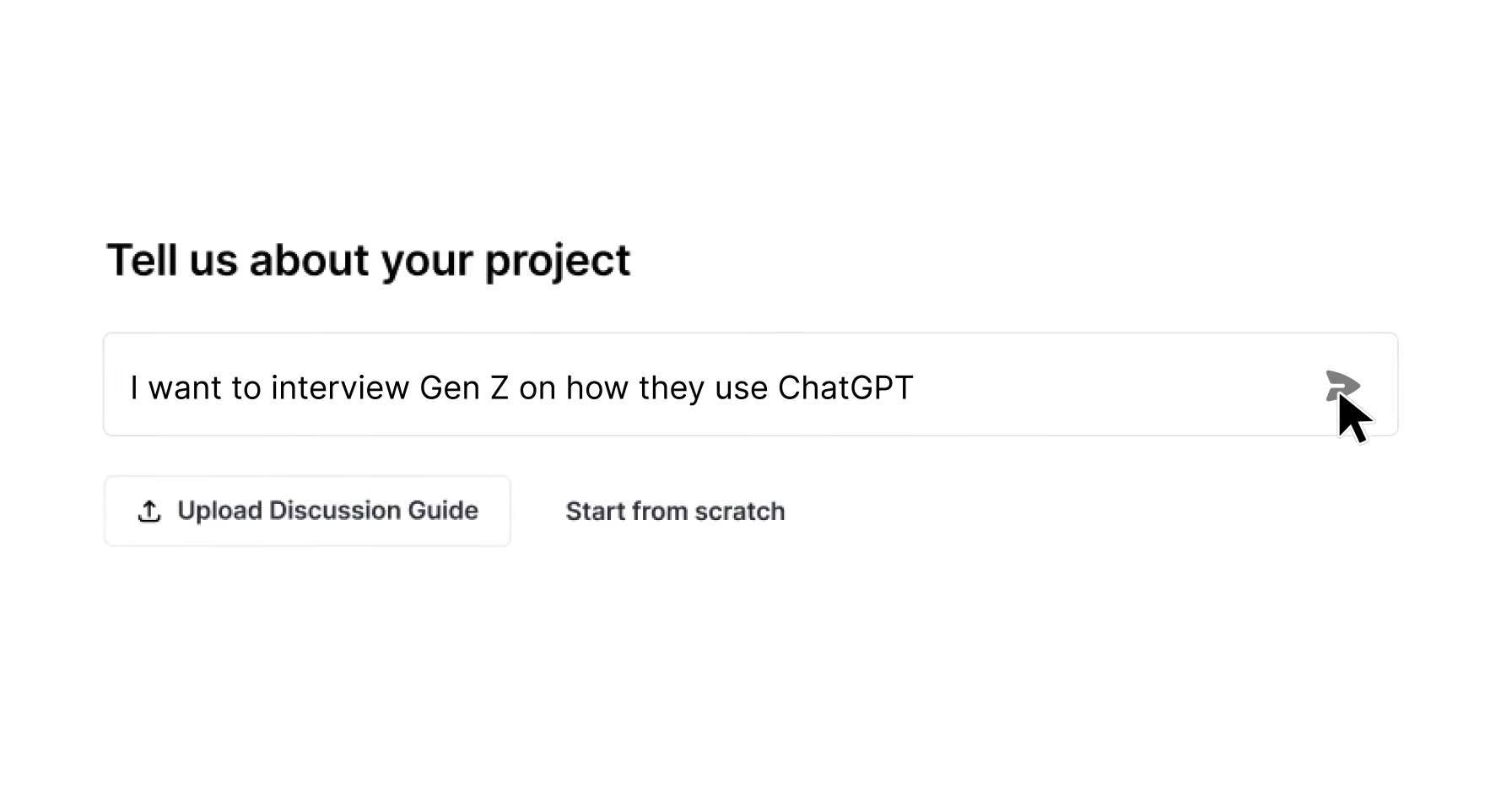
Listen Labs streamlines study creation with AI-assisted co-design that turns natural language briefs into structured objectives, questions, and probing context. Research Agent handles the full analysis workflow: from raw data to final output, so teams do not need to reconstruct study parameters in a separate analysis platform. Researchers can clone and adapt previous study designs, which maintains consistency across programs and reduces setup overhead.
Recruitment and Sampling at Global Scale
Discuss.io depends on external panel providers, which creates reliance on third-party recruitment quality and availability. Researchers must coordinate across multiple vendors, manage participant communications, and handle no-show rates that can bias samples and extend timelines.
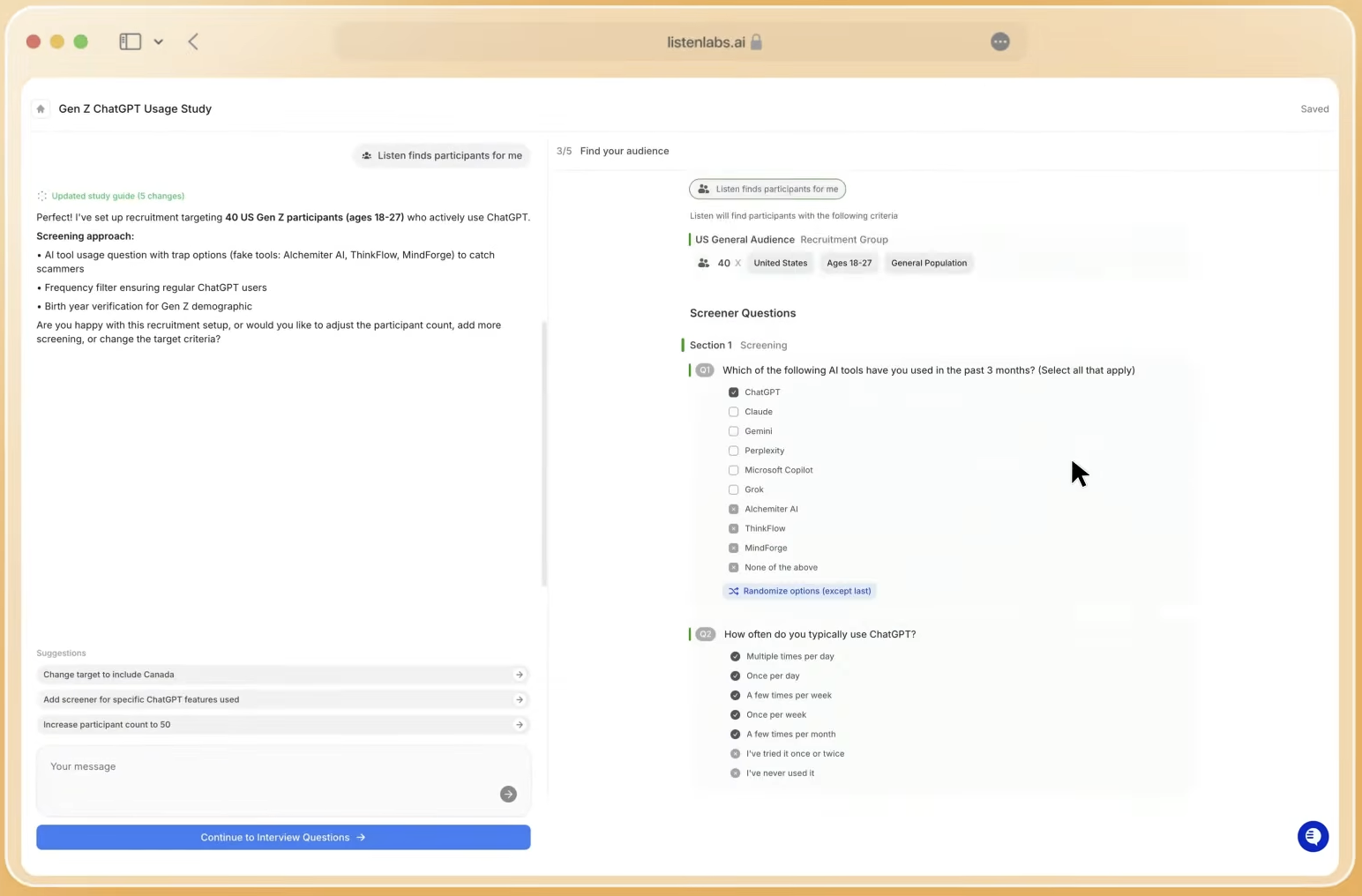
Listen Labs operates a global network of 30M verified participants across 45+ countries, with AI orchestration that automatically matches and bids on optimal participants across multiple panel sources. Quality Guard monitors recruitment in real time, while a dedicated ops team supports hard-to-reach segments such as enterprise decision-makers and consumers below 1% incidence rates. This integrated approach removes vendor coordination overhead and improves sample reliability.
Moderation Approach and Participant Experience
Discuss.io relies on live human moderation, which delivers conversational depth but limits scalability and adds scheduling complexity. Human moderators vary in skill, availability, and consistency, and live sessions require coordination across time zones and participant schedules.
Listen Labs runs AI-moderated video interviews with dynamic follow-up questions that adapt to each participant response. AI interviewers allow participants to open up more freely on sensitive topics such as health conditions or personal insecurities because they experience less fear of judgment. The platform supports 100+ languages with automatic translation, which enables global research programs without sourcing multilingual moderators.
Data Quality Controls and Fraud Prevention
Sample quality risks increase when respondents come from nontraditional sources such as quantitative panels or social media, because these individuals are often unaccustomed to reflective, open-ended qualitative questioning. Traditional workflows require manual quality assurance across many touchpoints, from recruitment through final analysis.
Quality Guard provides real-time monitoring across video, voice, content, and device signals to detect fraudulent responses, low-effort participation, and repeat respondents. Participants face a limit of three studies per month, which removes professional survey-takers who focus on incentives instead of thoughtful responses. This systematic quality control reduces the manual oversight burden that characterizes the Discuss.io + Dovetail workflow.
Qualitative and Quantitative Support in One Flow
The Discuss.io + Dovetail stack usually needs separate tools and workflows for quantitative data collection, so teams often choose between conversational depth and statistical confidence. This separation restricts the ability to combine rating scales, preference rankings, and open-ended exploration within a single participant interaction.
Listen Labs blends qualitative conversations with quantitative formats such as Likert scales, NPS, sliders, and MaxDiff within the same interview. The platform supports hundreds to thousands of participants per study versus the 5–15 participants common in traditional qualitative research methods. Teams gain statistical confidence alongside conversational insights without managing separate data collection workflows.
Analysis Workflow and Deliverable Creation
Once data collection finishes, whether qualitative, quantitative, or mixed-method, the analysis phase determines how quickly insights reach decision-makers. Dovetail requires manual tagging, theme identification, and report creation that can extend analysis timelines by weeks. Researchers spend the bulk of their time in analysis: finding patterns, quantifying insights, testing significance, adding macro context, formatting results for stakeholders who each need something different. This manual process creates bottlenecks that limit research team output regardless of interview speed.
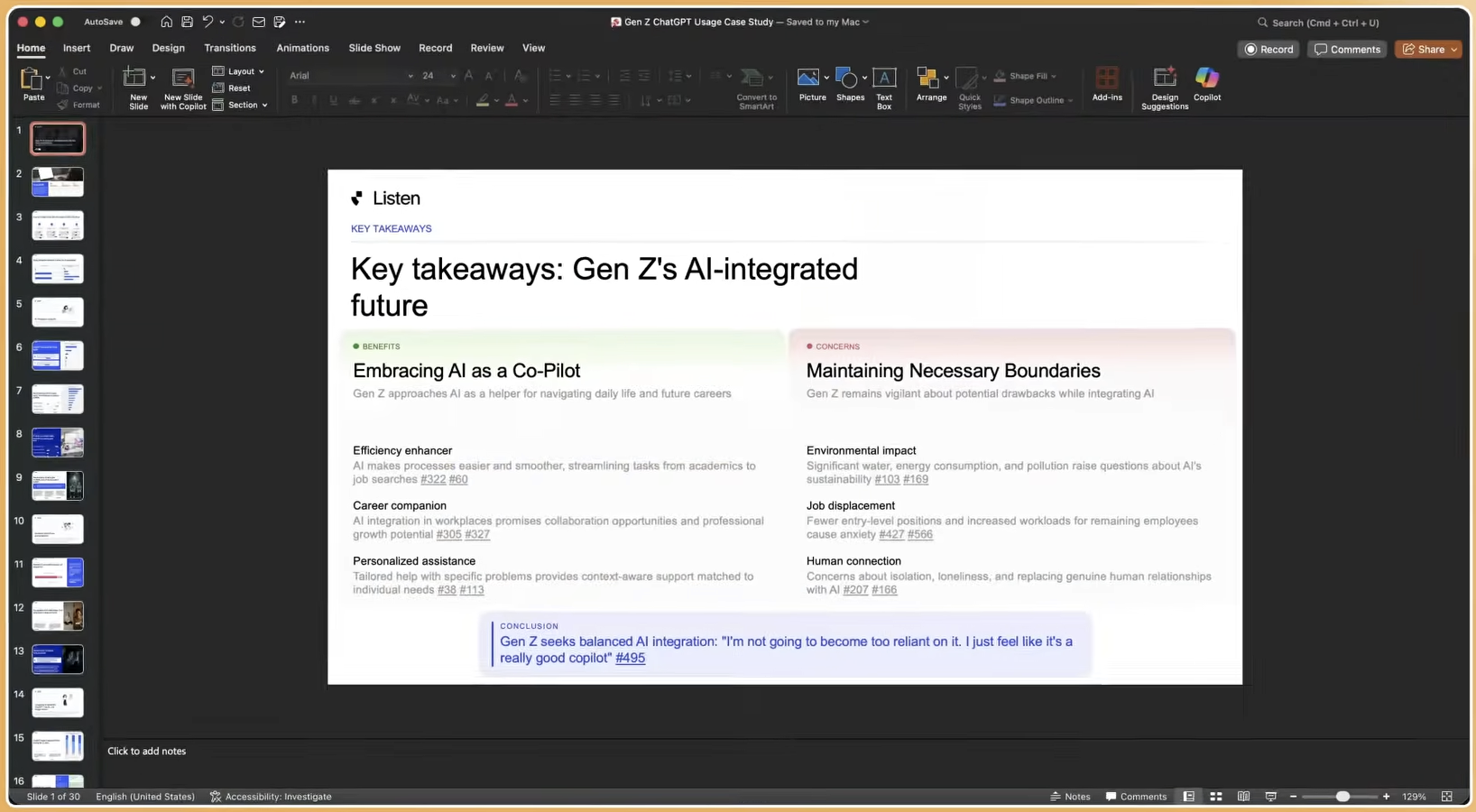
Listen Labs’ Research Agent automates theme identification, statistical analysis, and deliverable creation from raw interview data. AI tools can analyze large volumes of qualitative data in minutes instead of weeks, with automated report generating capacity building instant reports in hours instead of weeks. The platform produces slide decks, highlight reels, charts, and custom reports through natural language queries, and every insight links directly to the underlying response data for verification and deeper exploration.
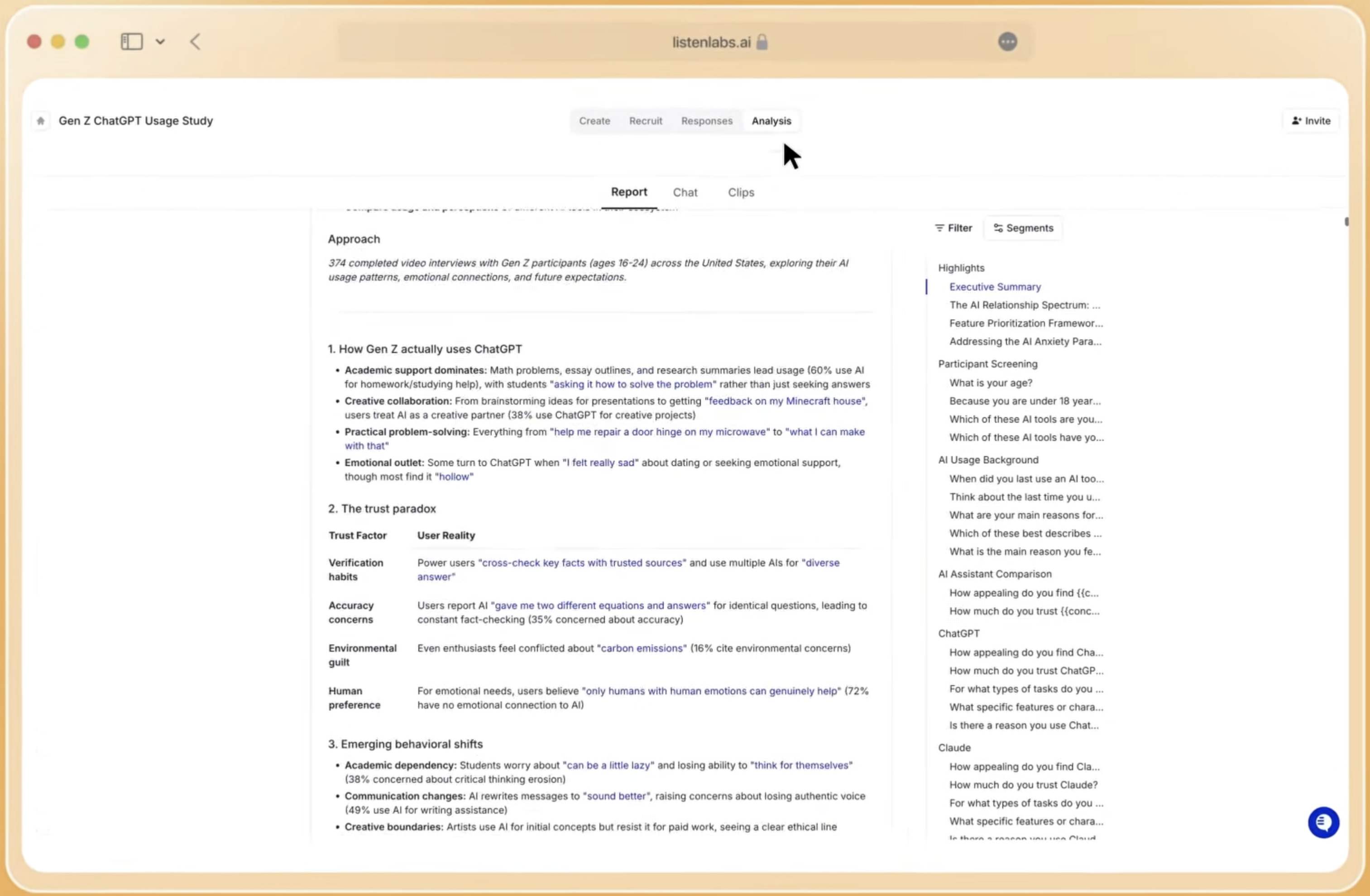
Transform your analysis workflow from weeks to hours. See automated deliverable creation in action.
Cross-Study Knowledge Management with Mission Control
Dovetail organizes research inside project-based silos, which makes it hard to surface insights from previous studies or track sentiment shifts over time. Teams often re-research similar questions because institutional knowledge stays scattered across individual project repositories.
Mission Control functions as a living repository where each study contributes to organizational knowledge. Teams can query insights across all previous research, track trends over time, and avoid repeating past work. This cross-study intelligence turns research from isolated projects into cumulative organizational learning, so teams build on previous insights instead of starting fresh each time.
Security, Compliance, and Enterprise Readiness
Enterprise research teams need platforms that meet strict security and compliance standards while supporting global operations. The Discuss.io + Dovetail stack requires separate security assessments, data handling agreements, and compliance checks across multiple vendors.
Listen Labs maintains SOC 2 Type II, GDPR, ISO 27001, ISO 27701, and ISO 42001 certifications as of 2026, which provides enterprise-grade security through a single vendor relationship. Customer data receives 256-bit encryption and is never used for AI model training. The platform supports enterprise SSO and data residency requirements across the 45+ countries where participants are located.
Scenario-Based Best-Fit Use Cases
Enterprise insights teams with growing research backlogs gain the most from Listen Labs’ speed and automation. VP and Director-level leaders can multiply their team’s research output without proportional headcount increases, meeting rising demand for customer insights across product, marketing, and strategy.
UX research groups running iterative testing cycles benefit from rapid turnaround and screen-sharing capabilities. Product managers and marketing leaders without dedicated research teams can use AI-assisted study design and automated analysis to run independent research programs.
Agencies and consultancies working under tight client timelines benefit from the platform’s 24-hour turnaround and global participant network. The ability to recruit niche audiences and deliver consultant-quality reports quickly supports competitive differentiation in client engagements.
Operational and Long-Term Considerations
Migrating from a two-tool stack to a single platform requires stakeholder alignment around new workflows and deliverable formats. Skepticism about AI-generated insights is natural, especially for teams used to manual analysis. A transition period where both systems operate in parallel addresses this resistance by allowing researchers to validate output quality against familiar Dovetail results and build confidence through direct comparison.
The global repeatability of AI-moderated interviews enables consistent research programs across markets and languages without sourcing local moderators or managing time zone coordination. This scalability supports international expansion and cross-market comparison studies that would be logistically difficult with human-moderated approaches.
Risks, Limitations, and Common Misconceptions
Teams moving to AI-moderated interviews often question whether automated conversations capture the same depth as human-led sessions. Participants can be measurably more open and candid with AI interviewers than with human interviewers, and in many cases AI unlocks as much or more data depth rather than forcing a tradeoff with scale. Even so, teams should run pilot studies to validate output quality against their own research standards.
Overestimating automation benefits creates another risk. AI handles analysis and deliverable creation, but human researchers remain essential for strategic interpretation, business context, and stakeholder communication. The platform amplifies human expertise rather than replacing it.
Sample quality concerns still require attention even with automated quality controls. Quality in AI-supported qualitative research can only be guaranteed through training, continuous learning, and blending AI with traditional approaches, including verification of data authenticity and bias detection.
Decision Framework for Platform Selection
Teams that prioritize speed and scale should compare Listen Labs’ end-to-end automation with the manual coordination required by the Discuss.io + Dovetail stack. However, workflow familiarity also matters. Organizations with established research methodologies may resist changing proven processes, which makes the familiar two-tool workflow more appealing despite its inefficiencies. This tension between innovation and familiarity explains why teams seeking to expand research capacity, and facing resource constraints, tend to favor integrated platforms that reduce operational overhead.
Budget considerations extend beyond platform fees to include hidden expenses such as vendor coordination, manual analysis time, and delayed decision-making. Teams should calculate total cost of ownership, including researcher time, external panel fees, and the opportunity costs of extended research cycles.
Global research requirements favor platforms with built-in multilingual capabilities and international participant networks. Teams focused on domestic research may see less value in global infrastructure, while organizations expanding internationally benefit from consistent research capabilities across markets.
Ready to evaluate Listen Labs against your specific requirements? Discuss your research goals with our team and see how the platform addresses your specific needs.
Making the Transition to Integrated Research
The fragmented Discuss.io + Dovetail workflow forces enterprise research teams to accept delays, quality risks, and operational complexity that no longer fit business needs in 2026. Listen Labs replaces this two-tool stack with a single AI-powered platform that sources verified participants, conducts adaptive interviews, captures emotional signals, automates analysis, and maintains a living research repository.
Leading enterprises including Microsoft, Anthropic, and P&G have already made this transition, achieving research turnarounds measured in hours instead of weeks while preserving the conversational depth that defines high-quality insights. The platform’s large participant network, Quality Guard fraud prevention, and Research Agent automation deliver the scale, speed, and reliability that modern research teams expect.
Transform your research workflow from fragmented to seamless. See how Listen Labs replaces your two-tool stack with a single, more powerful solution.
Frequently Asked Questions
How quickly can Listen Labs deliver research results compared to the Discuss.io + Dovetail workflow?
Listen Labs compresses the entire research cycle to the 24-hour turnaround mentioned earlier, from study design through final deliverables. This shift represents a dramatic improvement over the typical Discuss.io + Dovetail workflow, which often requires 4–6 weeks when you factor in recruitment coordination, interview scheduling, transcript export, Dovetail setup, manual analysis, and report creation. The platform’s AI-assisted study design, automated participant recruitment, simultaneous interview conduct, and Research Agent analysis remove the handoffs and manual processes that extend traditional research timelines.
Can AI-moderated interviews really match the quality of human-led Discuss.io sessions?
AI-moderated interviews build on the reduced social pressure described earlier and often capture more candid responses than human-led sessions. The AI conducts personalized conversations with dynamic follow-up questions that adapt to each participant, which maintains the conversational flow that defines strong qualitative research. Listen Labs’ AI interviewer supports 100+ languages and can probe deeper on interesting responses, so depth and nuance match or exceed traditional human moderation while enabling simultaneous interviews with hundreds of participants.
How does Listen Labs’ participant network compare to Discuss.io’s external panel approach?
Listen Labs’ participant network, described earlier, uses AI orchestration that automatically matches optimal participants based on behavioral and intent data rather than only demographics. The Quality Guard system monitors every interview in real time, and AI orchestration selects participants who fit the study profile while avoiding overuse of the same individuals. This integrated approach removes the vendor coordination, quality uncertainty, and geographic limitations that come with Discuss.io’s reliance on external panel providers.
What happens to our existing research repository when migrating from Dovetail?
Mission Control serves as a comprehensive repository that can absorb insights from previous research while enabling cross-study queries and trend tracking that static project-based storage cannot support. Teams can import key findings from past Dovetail projects to preserve institutional knowledge, and new Listen Labs studies automatically add to the growing knowledge base. This creates a living repository where each study builds on previous insights instead of existing in isolation, which turns research into cumulative organizational learning.
How does Listen Labs handle complex enterprise security and compliance requirements?
Listen Labs maintains enterprise-grade security certifications including SOC 2 Type II, GDPR, ISO 27001, ISO 27701, and ISO 42001 as of 2026, which provides comprehensive data protection through a single vendor relationship. Customer data receives 256-bit encryption and is never used for AI model training. The platform supports enterprise SSO, data residency requirements, and audit trails across the same 45+ countries referenced earlier, which removes the complexity of managing separate security assessments and compliance checks across multiple vendors in the Discuss.io + Dovetail stack.