
Written by: Anish Rao, Head of Growth, Listen Labs | Last updated: June 22, 2026
Key Takeaways for Enterprise Insights Leaders
- Enterprise customer insights teams need AI research assistants that handle live participant recruitment, interviews, and emotional signal capture, not just academic literature synthesis.
- Listen Labs is the only platform evaluated that meets all nine enterprise criteria: research cycle time, depth-plus-scale, fraud prevention, emotional intelligence, analysis objectivity, deliverable speed, global reach, security compliance, and total cost of ownership.
- The platform compresses the full research lifecycle from brief to stakeholder-ready deliverables in under 24 hours while maintaining video-verified participant quality across 45+ countries.
- Multimodal emotional intelligence analysis, automated reporting, and cross-study knowledge management remove the traditional trade-offs between qualitative depth and quantitative scale.
- Listen Labs replaces multiple vendors with a single compliant platform, so you can see the consolidated workflow in action and understand how leading enterprises accelerate customer insights.
Enterprise-Grade Evaluation Criteria and How This Guide Uses Them
Enterprise consumer insights teams require a platform that addresses every stage of the research lifecycle, not just one step. The nine criteria below define what “enterprise-grade” means in 2026, and each subsequent section explains how Listen Labs performs against these benchmarks in real deployments.
- Research cycle time: The platform must move from brief to deliverable in hours rather than weeks.
- Depth-plus-scale capability: It must remove the trade-off between qualitative richness and sample size.
- Participant quality and fraud prevention: Multi-layer verification controls must be built into the recruitment infrastructure.
- Emotional and multimodal signal capture: It must analyze tone, micro-expressions, and word choice alongside transcripts.
- Analysis objectivity: Pattern detection must be automated and resistant to individual bias.
- Deliverable speed: Stakeholder-ready outputs must be generated automatically.
- Global and language reach: The platform must recruit and moderate across 45+ countries and 100+ languages.
- Security and compliance posture: It must hold SOC 2, GDPR, ISO 27001, ISO 27701, and ISO 42001 certifications.
- Total cost of ownership: It must replace multiple vendors with a single subscription.
Study Design and Setup with an AI Co-Designer
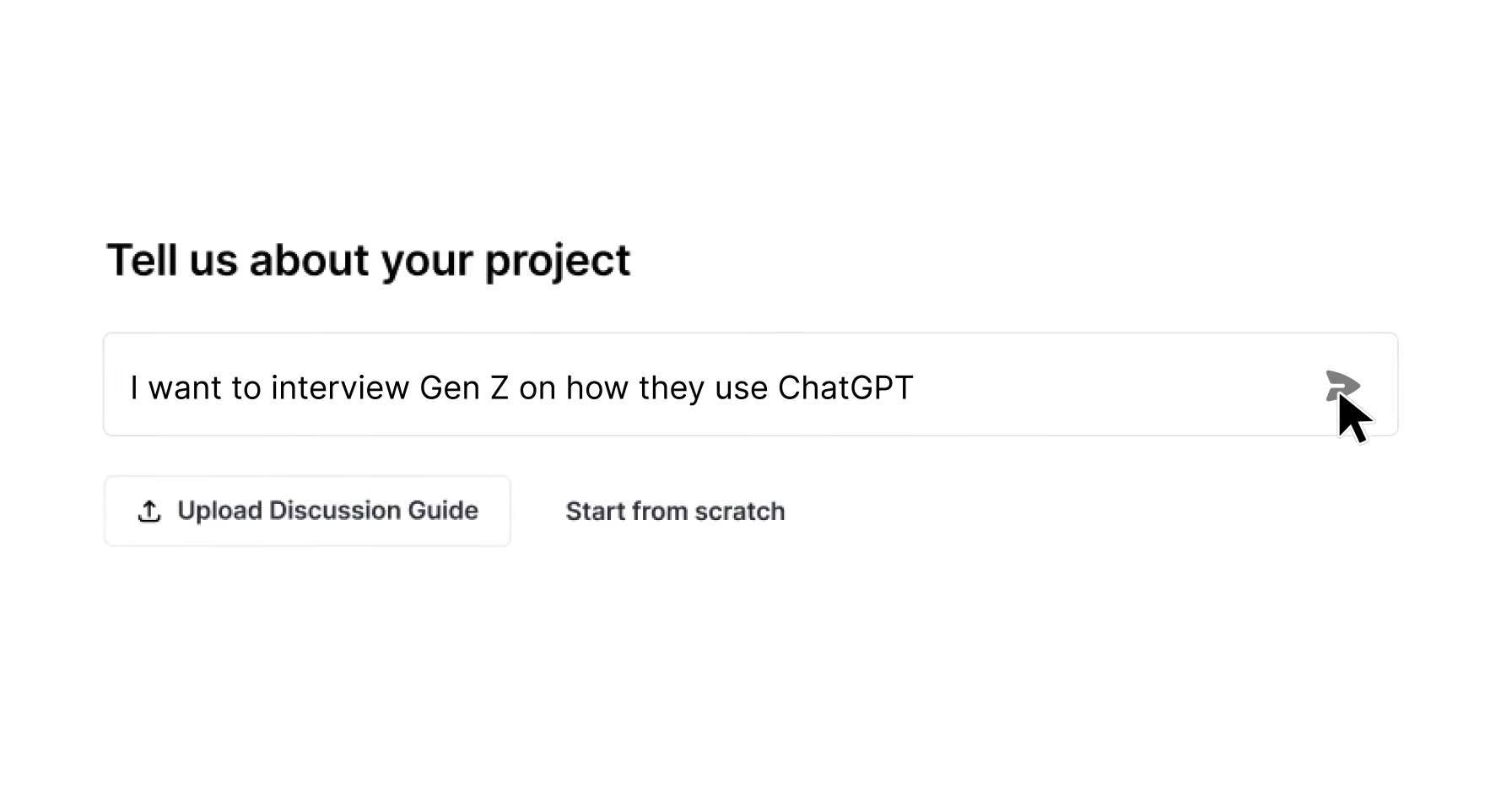
Enterprise research teams need an AI co-designer that converts a plain-language brief into a structured study guide before a single participant is recruited. Academic AI tools require researchers to supply all source material before any work begins. NotebookLM, for example, only answers from user-uploaded sources, preventing external drift but also preventing the platform from helping design a study from scratch.
Listen Labs’ AI-assisted study co-design accepts natural-language research goals and drafts objectives, questions, and probing context in seconds. A template library covers concept testing, usability studies, brand perception, creative testing, and multi-market segmentation. Advanced logic, including branching, skip logic, quotas, monadic randomization, and stimuli display for images, video, PDFs, and live URLs, is configurable without engineering support. An auto-QA layer flags issues in the guide before launch. The result is a workflow where the old trade-off between depth and scale is no longer a barrier, and a study can move from brief to field in under 24 hours.
Participant Sourcing and Quality Controls for Enterprise Studies
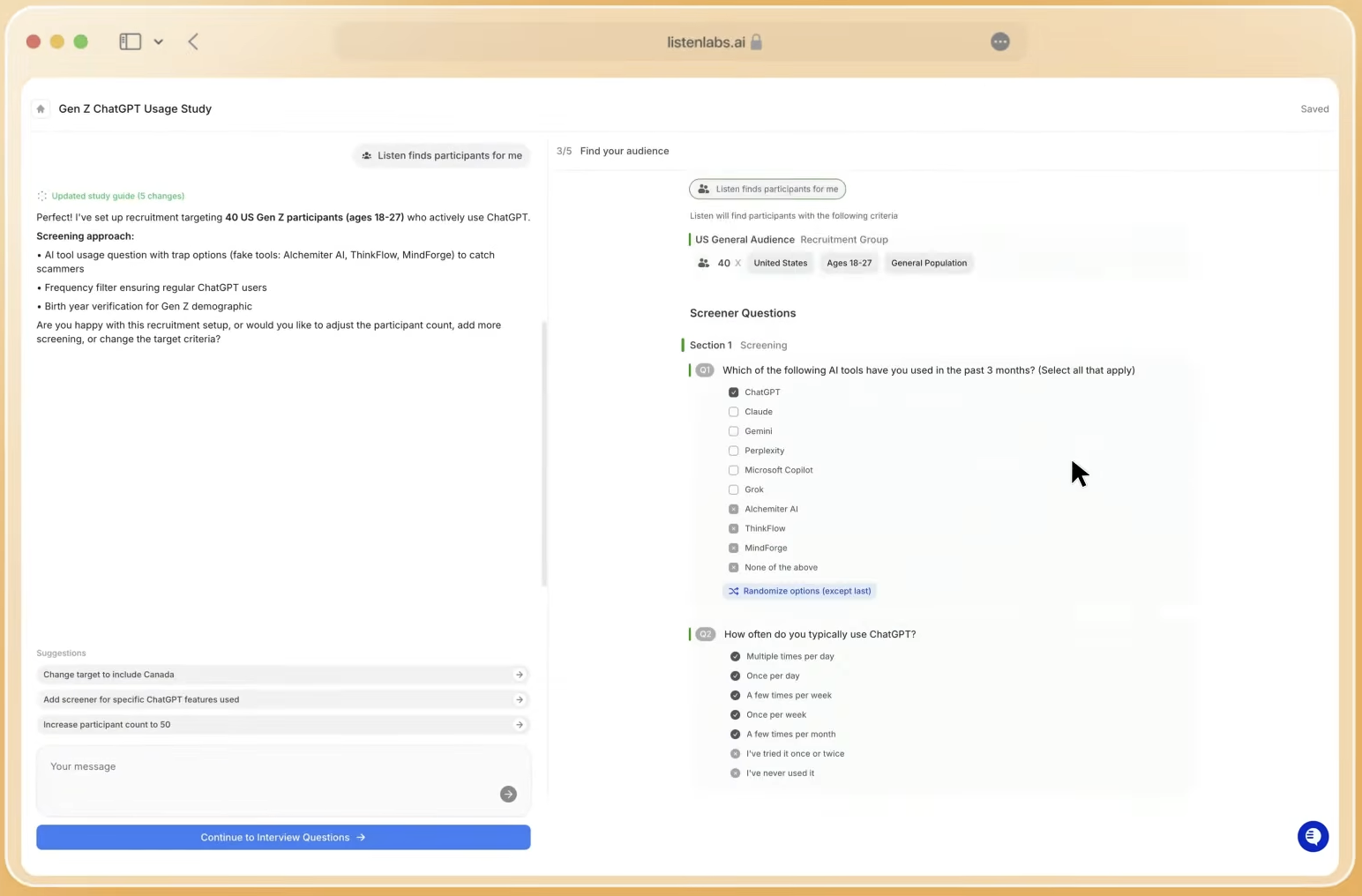
Participant quality is the single most consequential variable in qualitative research, and academic AI tools provide no support here. Enterprise-grade AI-moderated research requires multi-layer fraud detection across pre-interview, in-session, and post-interview stages, including face detection, face matching, video validation, location verification, IP/VPN detection, and AI-generated response detection.
Listen Labs addresses this through three reinforcing layers that work in sequence. Listen Atlas, the platform’s AI orchestration layer, matches participants across behavioral and intent data, not just self-reported demographics, drawing from a global network of 30M verified respondents across 45+ countries. This pre-interview screening is then reinforced by Quality Guard, which monitors every interview in real time across video, voice, content, and device signals to flag rushed, inconsistent, or scripted responses. Finally, participants are capped at three studies per month, which eliminates professional survey-takers. A dedicated recruitment ops team adds human review for audiences below 1% incidence rate.
These quality controls produce measurable outcomes in enterprise deployments. Microsoft used Listen Labs to collect global customer stories for its 50th anniversary within a single day. Skims identified and qualified thousands of premium consumers overnight, eliminating weeks of panel sourcing and enabling board-level buy-in on a global campaign launch before it went live.
Interview Moderation Approach and Conversational Depth
Built-in fraud detection is one of the most critical requirements for AI moderation to work long-term, and most tools now include screening capabilities to identify low-quality or fraudulent responses. But fraud prevention is only one dimension of moderation quality. Beyond detecting fraudulent responses, the deeper question is whether AI-moderated conversations produce the same exploratory richness as skilled human interviewers.
Research participants often share more candidly with AI moderators due to reduced social desirability bias, which supports more authentic emotional responses on sensitive topics. Listen Labs’ AI moderator conducts adaptive video interviews with dynamic follow-up questions across 100+ languages, probing deeper on short or interesting answers the same way a trained human interviewer would. For highly exploratory studies where a researcher needs to take an unscripted turn mid-conversation, a human moderator remains the stronger choice. Listen Labs is designed to handle the high-volume, structured-to-semi-structured work that constitutes the majority of enterprise research backlogs.
Data Capture with Multimodal Emotional Intelligence
AI lacks the full context of a business, a researcher’s intuition, and the ability to pick up on what participants are not saying, including pregnant pauses, word choice, shifts in tone, or body language, when operating from transcripts alone. Listen Labs’ Emotional Intelligence feature closes this gap by analyzing three simultaneous signal layers: tone of voice, word choice, and subconscious micro-expressions.
The framework is built on Ekman’s universal emotions model, the same standard used in clinical psychology and UX research, tracking anger, anticipation, disgust, fear, joy, sadness, trust, and surprise. Every emotion label is quantified per question and concept, and every label is traceable to the exact timestamp, verbatim quote, and reasoning behind it. Synthetic or avatar-based respondents cannot replicate the hesitation, contradicting facial expressions, or unprompted objections that real human participants exhibit on video, which is why video-verified participants and multimodal analysis together form the only defensible approach for enterprise emotional intelligence. The feature is available across 50+ languages and integrates directly with the Research Agent for natural-language queries and highlight reels of emotionally significant moments.
Automated Analysis and Reporting for Stakeholder-Ready Outputs
Researchers spend the bulk of their time in analysis: finding patterns, quantifying insights, testing significance, adding macro context, and formatting results for stakeholders who each need something different. Academic synthesis tools automate this for literature, extracting methodologies and outcomes from papers, but produce nothing from live interview data.
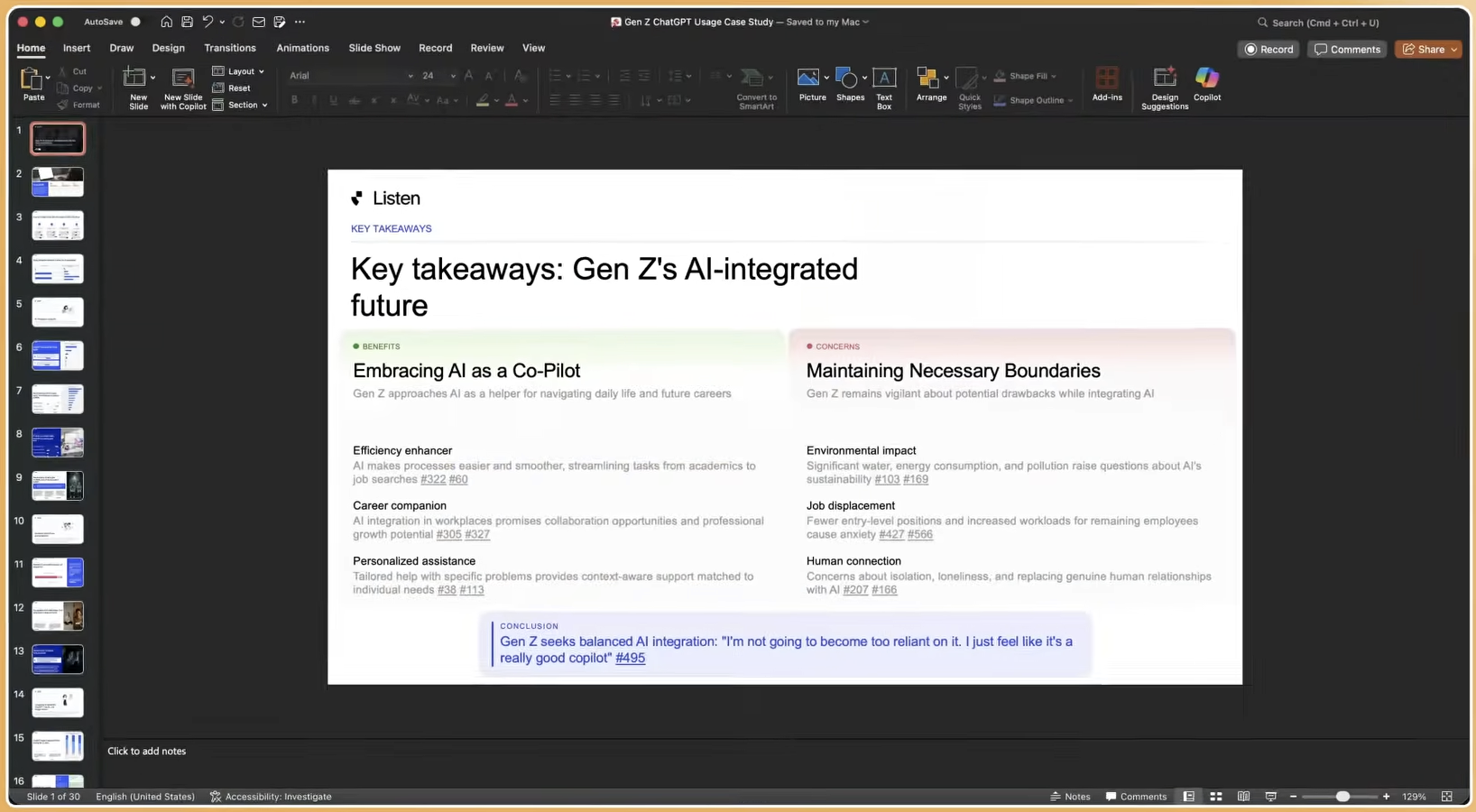
Listen Labs’ Research Agent handles the full analysis workflow from raw interview data to final output. Every insight links directly to the underlying response data, making findings auditable rather than opaque. One-click deliverables include branded slide decks, memo-style reports, video highlight reels, statistical charts, and segmentation breakdowns, all generated in under a minute. Anthropic used Listen Labs to surface churn drivers from 300+ user interviews in 48 hours, five times faster than previous methods, and received a prioritized list of ten must-fix items. P&G used the platform to evaluate how men respond to new product claims across 250+ interviews, delivering quantified themes and verbatim proof that directly shaped product and brand strategy.
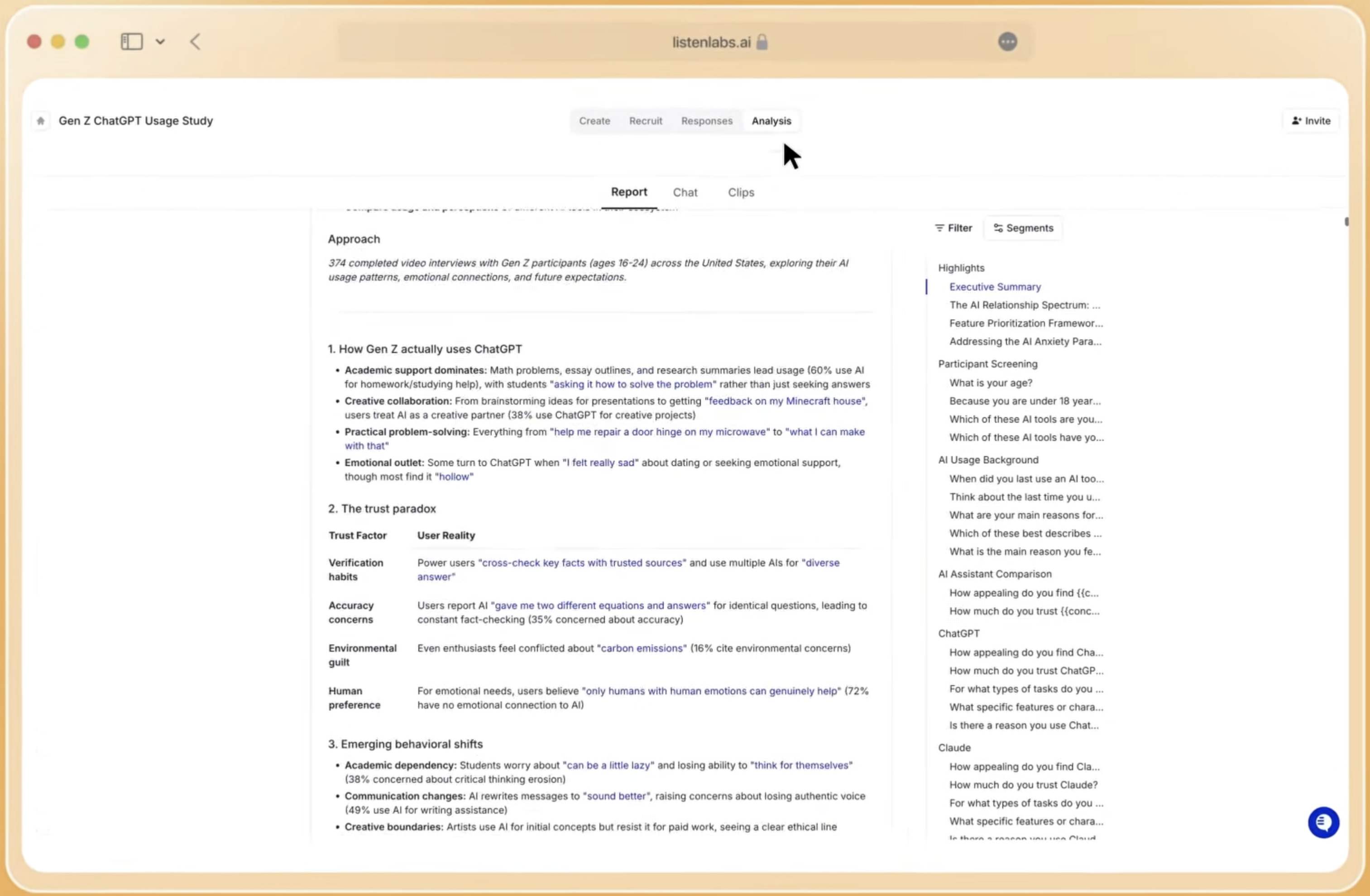
See how automated analysis clears your backlog and delivers stakeholder-ready reports in minutes.
Cross-Study Knowledge Management in Mission Control
Research value compounds when findings from past studies inform current decisions. Most enterprise teams lose that value because insights live in scattered slide decks and individual researchers’ memories. Listen Labs’ Mission Control serves as the organization’s source of truth for everything ever learned from customers across all studies.
Cross-study queries return answers in seconds. Trend tracking monitors customer sentiment and pain points over time. Each new study grows the institutional knowledge base rather than starting from zero, a capability that academic repositories and standalone analysis tools like Dovetail cannot replicate within an active research workflow.
Operational Requirements: Security, Compliance, and Adoption
Governance, security, and compliance requirements are non-negotiable evaluation criteria for enterprise AI assistants in 2026, as deploying at scale without adequate frameworks creates significant remediation work, particularly in regulated sectors handling sensitive or personally identifiable information. Listen Labs holds SOC 2 Type II, GDPR, ISO 27001, ISO 27701, and ISO 42001 certifications. Enterprise SSO is supported. Customer data is never used for AI model training. Data quality, lineage, and governance are repeatedly cited by 2026 enterprise technology leaders as gating factors and prerequisites for scaling AI initiatives.
Pricing follows a subscription model with per-participant credits that scale with audience difficulty. Organizations can self-recruit from their own user base at reduced cost. Companies with more than 100 employees go through a demo and pilot process, while smaller teams access a self-serve platform. Change management is supported by Listen Labs’ in-house research team, which brings 50+ years of combined expertise and works directly with enterprise clients on methodology and stakeholder buy-in.
Best-Fit Guidance by Team Persona
Overwhelmed insights teams at large enterprises face growing backlogs and 4–6 week research cycles. Listen Labs compresses that cycle to under 24 hours, enabling the same team to run significantly more studies per quarter without adding headcount. The platform enables hundreds of one-on-one interviews to run at scale simultaneously.
UX researchers needing faster iteration can run concept validation, prototype testing, and usability studies with 50–100+ participants instead of the 5–10 that manual scheduling allows. Screen sharing and mobile screen recording are supported natively.
Product managers and marketing leaders without dedicated research teams can describe goals in natural language and receive a complete study, including design, recruitment, moderation, analysis, and deliverables, without research methodology expertise.
Agencies and consultancies operating on client timelines measured in days rather than weeks can access Listen Labs’ 30M-participant network to reach niche audiences, including enterprise decision-makers, healthcare workers, and consumers below 1% incidence rate, and deliver findings before competitors finish recruiting.
Decision Framework for Selecting an AI Research Platform
The right platform depends on four operational variables that interact to narrow the field. Timeline is the first filter. If results are needed in days rather than weeks, an end-to-end AI platform is the only viable option. Budget becomes relevant once speed is established. Listen Labs replaces panel providers, moderators, transcription services, and analysis tools with a single subscription, reducing total cost to approximately one-third of traditional research.
Audience difficulty then determines whether a commodity panel suffices or whether hard-to-reach segments require dedicated recruitment ops and a large verified panel, capabilities that academic tools and commodity panels do not provide. Emotional data needs finally dictate the moderation format. If the research question involves creative testing, concept comparison, or usability friction, multimodal emotional analysis is required and is only available on platforms built for live video interviews.
Academic tools like Elicit and Consensus remain appropriate for systematic literature reviews and evidence synthesis from existing papers. They are not appropriate for any use case that requires recruiting participants, conducting live interviews, or capturing emotional signals, which describes the majority of enterprise consumer insights work.
Frequently Asked Questions
Can AI match a trained human interviewer in exploratory customer research?
For the majority of enterprise research use cases, including concept testing, brand perception, usability studies, creative testing, and churn analysis, AI-moderated interviews deliver comparable depth to skilled human interviewers, with the added advantage of reducing social desirability bias. Participants tend to share more candidly with AI moderators on sensitive topics. For highly exploratory studies where a researcher needs to take an unscripted turn mid-conversation based on intuition, a human moderator remains the stronger choice.
Listen Labs is designed to handle the structured-to-semi-structured work that constitutes the bulk of enterprise research backlogs, freeing human researchers to focus on the most strategically complex studies. The platform’s in-house research team, with 50+ years of combined expertise, continuously refines the methodology to maintain rigor across study types.
How do enterprise platforms prevent participant fraud at scale?
Effective fraud prevention at scale requires multiple reinforcing layers rather than a single screening step. As described in the Participant Sourcing section, Listen Labs applies three reinforcing layers: Listen Atlas for behavioral and intent-based matching, Quality Guard for real-time monitoring, and a three-study-per-month cap to eliminate professional survey-takers. For hard-to-reach segments, a dedicated recruitment ops team adds human review.
Participants who pass these checks contribute timestamped video evidence for every response, which makes every finding traceable to a specific clip and keeps the dataset auditable for compliance and stakeholder review.
Does an AI research assistant replace or augment existing research teams?
Listen Labs acts as a force multiplier for existing research teams, not a replacement. The platform automates the logistics-heavy, time-consuming stages of the research lifecycle, including recruitment, scheduling, moderation, transcription, and initial analysis, so researchers can focus on strategic interpretation, stakeholder communication, and exploratory work that benefits most from human judgment.
A team that previously completed four to six studies per quarter can run significantly more with the same headcount. The platform’s Research Agent handles deliverable generation, which means researchers spend less time formatting slide decks and more time acting on findings. Listen Labs’ in-house research team is available as a methodology partner, not a replacement for the client’s own expertise.
What compliance requirements matter most for global qualitative programs?
Global qualitative programs handling personally identifiable information from participants across multiple jurisdictions require a layered compliance posture. GDPR governs data collection and processing for participants in the European Union and sets the baseline standard for consent, data minimization, and the right to erasure. SOC 2 Type II certification demonstrates that security controls have been independently audited over time, not just at a point in time.
ISO 27001 covers information security management systems broadly. ISO 27701 extends that to privacy information management, which is directly relevant for research programs that collect video recordings and demographic data. ISO 42001 addresses AI management systems specifically, which matters as regulators in multiple jurisdictions begin scrutinizing AI-generated outputs used in business decisions. Listen Labs holds all five certifications, supports enterprise SSO, and never uses customer data for AI model training.
Conclusion: Why Listen Labs Fits the 2026 Enterprise Standard
The best AI research assistant for enterprise customer insights in 2026 is not the one that synthesizes the most academic papers. It is the one that compresses the entire research lifecycle into a single platform without sacrificing depth, data quality, or governance. Listen Labs exemplifies this approach by layering auto-recruiting, transcription, sentiment tagging, and insight summarization so teams jump from question to findings in hours, not weeks.
Qual-at-scale is ideal when research requires large sample sizes or broad geographic reach, and AI tools can engage hundreds or thousands of participants remotely and asynchronously, a capability that no academic synthesis tool, commodity panel, or human-dependent moderation platform can match at enterprise speed. Around 70% of Asia/Pacific organizations expect agentic AI to disrupt business models within the next 18 months, and the teams that build that infrastructure now will hold a durable competitive advantage in customer understanding.
See how enterprise teams go from brief to boardroom-ready insights in under 24 hours.