
Written by: Anish Rao, Head of Growth, Listen Labs | Last updated: June 19, 2026
Key Takeaways
- Traditional qualitative research timelines of four to six weeks create bottlenecks that prevent enterprise teams from keeping pace with fast-moving product decisions in 2026.
- AI-moderated interviews now deliver consultant-quality depth at scale, enabling hundreds of simultaneous conversations with results in under 24 hours.
- Effective platforms must combine verified participant quality, real-time fraud prevention, multimodal emotional signal capture, and enterprise-grade security certifications.
- Leading organizations including Microsoft, Anthropic, P&G, and Skims are already running 250–300+ interviews in 48 hours to accelerate insight cycles five times faster than legacy methods.
- Listen Labs is the only end-to-end platform covering the full research lifecycle, so you can see how the platform compresses research cycles from weeks to hours.
Why Traditional Research Is Broken in 2026
Five structural problems define the failure of legacy research infrastructure. Speed is the most visible. Traditional manual coding cycles alone consume four to six weeks, and in large enterprises, internal prioritization and budget approval can stretch total timelines to six months.
Cost compounds the problem. A single agency-led qualitative study requires specialized moderators, panel fees, transcription, and report writers, which makes it prohibitively expensive to run more than a handful of studies per quarter. Participant quality is a persistent risk. Respondent fraud rates in panel-based qualitative research typically range from 10 to 30 percent, and professional survey-takers introduce false patterns that contaminate thematic analysis.
Emotional depth is routinely sacrificed because transcripts capture only stated responses, not the hesitation, confusion, or delight visible in a participant's face and voice. Institutional knowledge also evaporates. Findings live in scattered slide decks and individual researchers' memories, which forces teams to re-research questions already answered.
The result is a research team that functions as a bottleneck rather than a force multiplier. Qual at scale, the approach that lets AI handle the time-consuming parts of research, exists to remove these constraints without sacrificing the depth that makes qualitative insight valuable.
The Five Dimensions for Evaluating AI Customer Research Tools
These five dimensions give enterprise teams a practical way to judge whether a platform truly delivers qual at scale and directly addresses the structural problems described above.
Speed to insight. In 2026, best-in-class platforms deliver end-to-end results in under 24 hours. The timeline advantage is greatest for platforms that automate the full chain from screener to deliverable, since tools that automate only the interview step remain significantly slower. Any platform that requires manual recruitment, scheduling, or analysis reintroduces the delays that make traditional research untenable.
Sample quality and fraud prevention. Scale without quality is worthless. Effective fraud prevention operates across three phases: pre-screening, real-time behavioral monitoring during interviews, and post-study validation. AI-moderated interviews enable real-time multi-signal fraud detection across response latency, linguistic complexity, reasoning depth, emotional markers, and cross-reference consistency simultaneously, a capability unavailable to human moderators managing single conversations.
Emotional intelligence capture. Multimodal AI detects the Say-Do Gap by analyzing non-verbal signals such as voice tone, eye gaze, and facial expressions in video interviews, revealing true consumer reactions beyond stated survey responses. Platforms that rely on transcripts alone miss the signal layer that most influences creative, concept, and usability decisions.
Scalability without proportional cost. AI moderation enables running thousands of interview sessions in parallel without fatigue, which delivers the statistical confidence of large samples alongside the conversational depth of one-on-one interviews. The depth-versus-scale trade-off is no longer a barrier for teams using the right platform.
Enterprise security and compliance. A February 2026 systematic review in Frontiers in Artificial Intelligence discusses the impact of artificial intelligence on privacy. Platforms must demonstrate SOC 2, GDPR, ISO 27001, ISO 27701, and ISO 42001 certification, with customer data never used for model training.
How Listen Labs Captures Emotional Signals at Scale
Listen Labs' Emotional Intelligence analyzes three layers of signal, tone of voice, word choice, and subconscious micro expressions, to surface nuanced emotions that transcripts alone miss. The system is built on Ekman's universal six emotions framework, the same standard used in clinical psychology and UX research.
Multimodal AI maps temporal audio information such as pitch and volume with spatial visual data such as facial muscle movements to assess sentiment confidence. The system can flag, for example, a flat voice pitch despite a participant claiming excitement.
Every emotion is quantified per question and concept, with every label traceable to the exact timestamp, verbatim quote, and AI reasoning behind it. This traceability reshapes three research categories in particular. In creative testing, teams can identify the precise moment an ad loses attention. In concept comparison, a natural-language query surfaces a side-by-side emotional breakdown across stimuli, segments, and markets. In usability testing, moments of hesitation and frustration that participants never verbalize become visible data points.
Emotional Intelligence is available across 50+ languages and integrates directly with the Research Agent for chart generation and highlight reels.
Real-Time Fraud Prevention and Participant Quality
Listen Labs operates a three-layer protection model designed so that each layer catches what the others might miss. First, the platform works exclusively with high-quality, non-commodity panel sources, which keeps professional survey-takers out and establishes a clean baseline before any interview begins. Second, Quality Guard monitors every interview in real time across video, voice, content, and device signals, detecting fraud, low-effort responses, AI-generated scripts, and mismatched profiles that slip through initial screening.
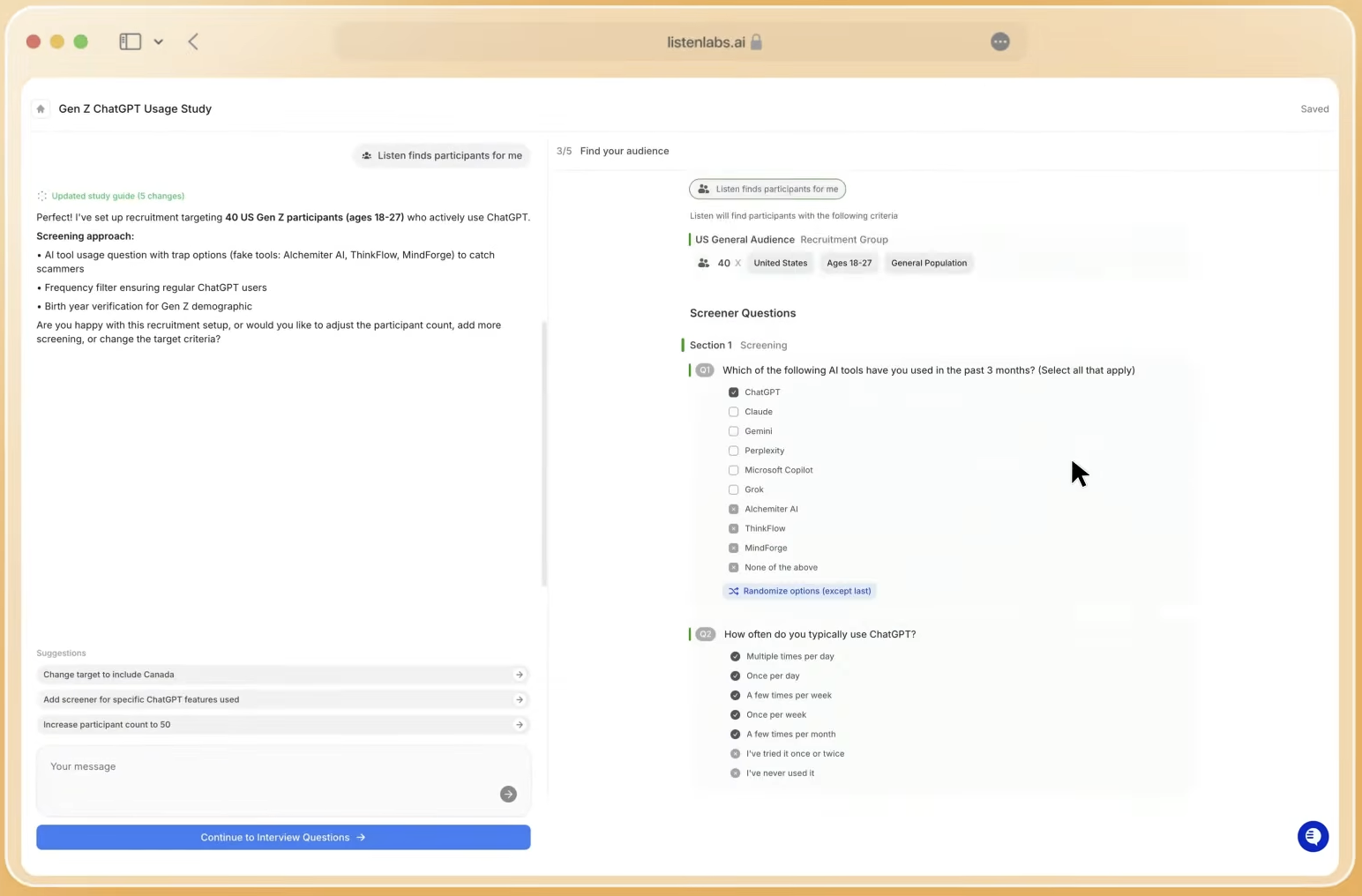
Third, a dedicated recruitment ops team adds a human review layer for the hardest cases, sourcing audiences below 1 percent incidence rate, including enterprise decision-makers, healthcare workers, and highly specialized consumer segments where automated screening alone is not sufficient. Participants are limited to three studies per month, which eliminates panel fatigue and repeat respondents.
The Listen Atlas AI orchestration layer matches participants on behavioral and intent data, not just self-reported demographics, across a global network of 30 million verified respondents in 45+ countries. Verified panels with multi-step enrollment, identity confirmation, and participation-history tracking provide a stronger starting point than open recruitment or single-verification panels, and Listen Labs' reputation scoring compounds across every study run on the platform, creating a quality flywheel competitors cannot easily replicate.
Running 300+ Interviews in 48 Hours: Enterprise Results
Listen Labs has run over one million AI-powered customer interviews for companies including Microsoft, Perplexity, and Sweetgreen. Microsoft's Director of Data Science describes reaching hundreds of users at one third of the cost, collecting global customer stories for the company's 50th anniversary within a single day.
Anthropic's Director of Product Strategy used Listen Labs to complete 300+ user interviews in 48 hours, surfacing Claude subscription churn drivers in 48 hours instead of the typical four to six week timeline and delivering a prioritized list of ten must-fix items. P&G ran 250+ interviews to evaluate how men respond to new product claims, surfacing where claims felt exaggerated before market launch.
Skims validated campaign direction with thousands of high-income buyers overnight, securing board-level buy-in. Robinhood identified that users who view prediction markets as entertainment drive 2.4x higher weekly re-engagement, with insights delivered within sprint cycles rather than across quarters.
Addressing Common Objections
The most frequent concern is whether AI interviewers match trained human researchers. Listen Labs maintains the same methodological rigor as an excellent in-house research team, supported by 50+ years of combined in-house research expertise that continuously refines the platform's methodology. With AI-moderated interviews, talking to users at scale is no longer the hard part, the challenge is understanding what they mean, which is where the Research Agent's automated analysis and traceability become decisive.
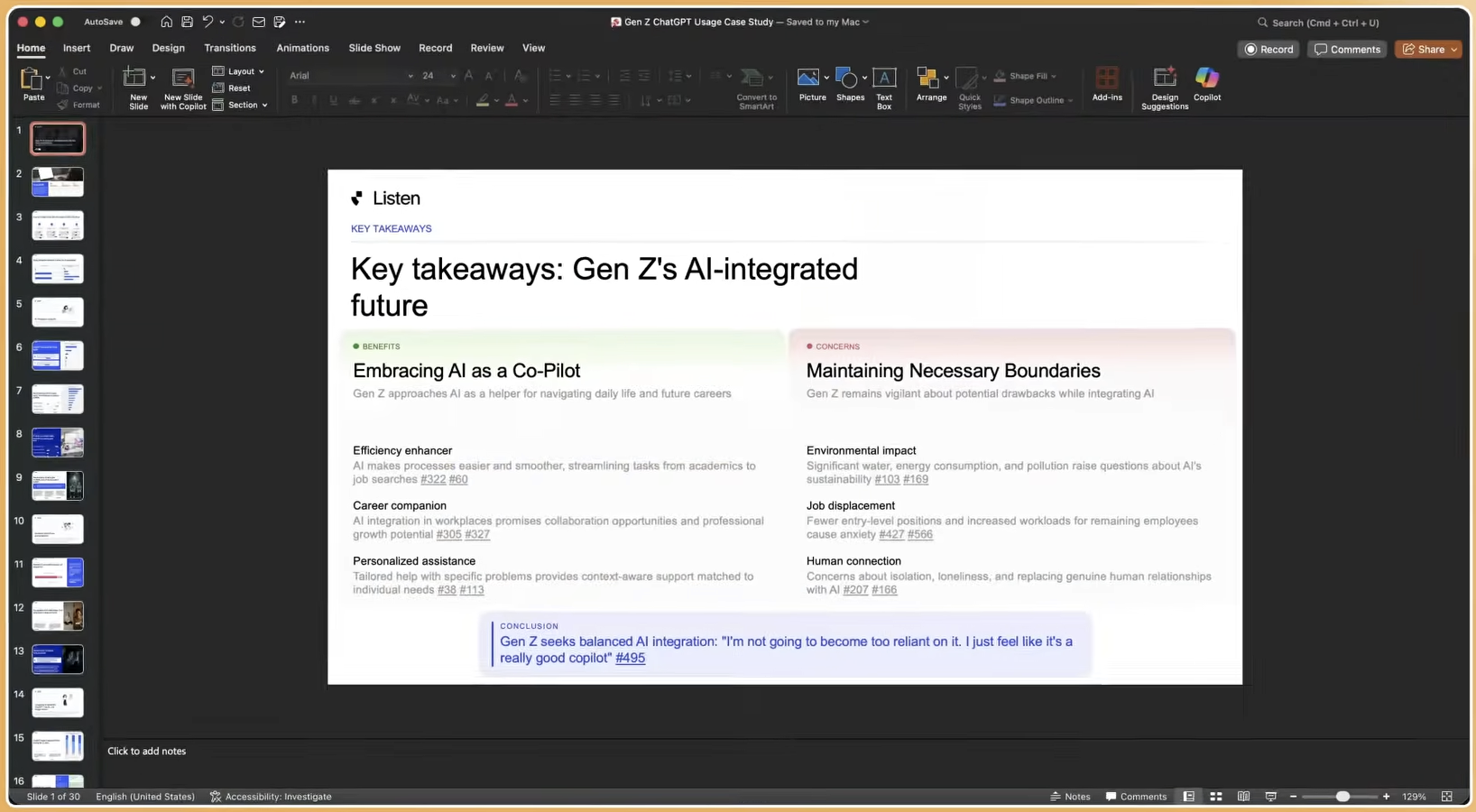
On participant quality, the three-layer protection model described above addresses this directly. On team replacement, Listen Labs acts as a force multiplier, not a substitute. The platform enables existing research teams to run more studies with the same headcount, freeing researchers to focus on strategic analysis rather than logistics.
Matching Listen Labs Capabilities to Your Team
Consumer insights leaders at Fortune 500 companies use Listen Labs to eliminate research backlogs and multiply study output without adding headcount. UX research leads use screen-sharing and usability testing capabilities to run 50–100+ participant studies within sprint cycles rather than talking to five to ten users per study.
Product managers and brand managers without dedicated research teams use the natural-language study design interface to describe goals and receive structured study guides, recruited participants, moderated interviews, and final reports without research methodology expertise. Agencies and consultancies use the platform's global reach and speed to deliver client research in days rather than weeks, including niche audiences that traditional panels cannot source.
Enterprise Security, Pricing Transparency, and Self-Recruit Options
Listen Labs holds SOC 2 Type II, GDPR, ISO 27001, ISO 27701, and ISO 42001 certifications. Customer data is never used for AI model training. The platform uses 256-bit encryption throughout. Privacy by Design, embedding privacy protection from the initial system development stage through proactive minimization of data collection and secure handling across the data lifecycle, is the architectural standard the platform is built against.
Pricing operates on a subscription model. Enterprises pay for platform access covering a set number of studies and credits, then spend credits per participant recruited, with credit cost varying by audience difficulty. Organizations can also bring their own participants, studying their existing user base at reduced cost, or connect their own panel provider.
Decision Checklist: Choosing the Right AI Research Platform in 2026
A platform worth evaluating in 2026 must deliver end-to-end automation from study design through final deliverables, not just one step in the chain. It must operate a verified, non-commodity panel with real-time fraud detection and human recruitment ops for hard-to-reach segments. It must capture emotional signals through multimodal analysis, not transcripts alone, with full traceability to timestamps and verbatim quotes.
It must scale to hundreds of simultaneous interviews without proportional cost increases. It must hold enterprise-grade security certifications and keep customer data out of model training. It must support self-recruitment for organizations that want to study their own users. It must also have demonstrated results at Fortune 500 scale, not just in controlled pilots.
Listen Labs is the only platform in the AI customer research tools landscape that meets every criterion on this list simultaneously. The platform leads the qual-at-scale category across every measurable dimension, with enterprise clients including Microsoft, Google, Sony, Anthropic, P&G, Skims, Levi's, Nestlé, and Robinhood.
Frequently Asked Questions
How does Listen Labs compare to general-purpose LLMs for research design?
General-purpose LLMs can draft a discussion guide or summarize a transcript, but they have no access to the proprietary data that makes research design effective at scale. Listen Labs is built on tens of thousands of completed studies, which gives the platform deep pattern recognition around which question types produce better analysis, which methodologies suit which objectives, and how to separate signal from noise across different research contexts.
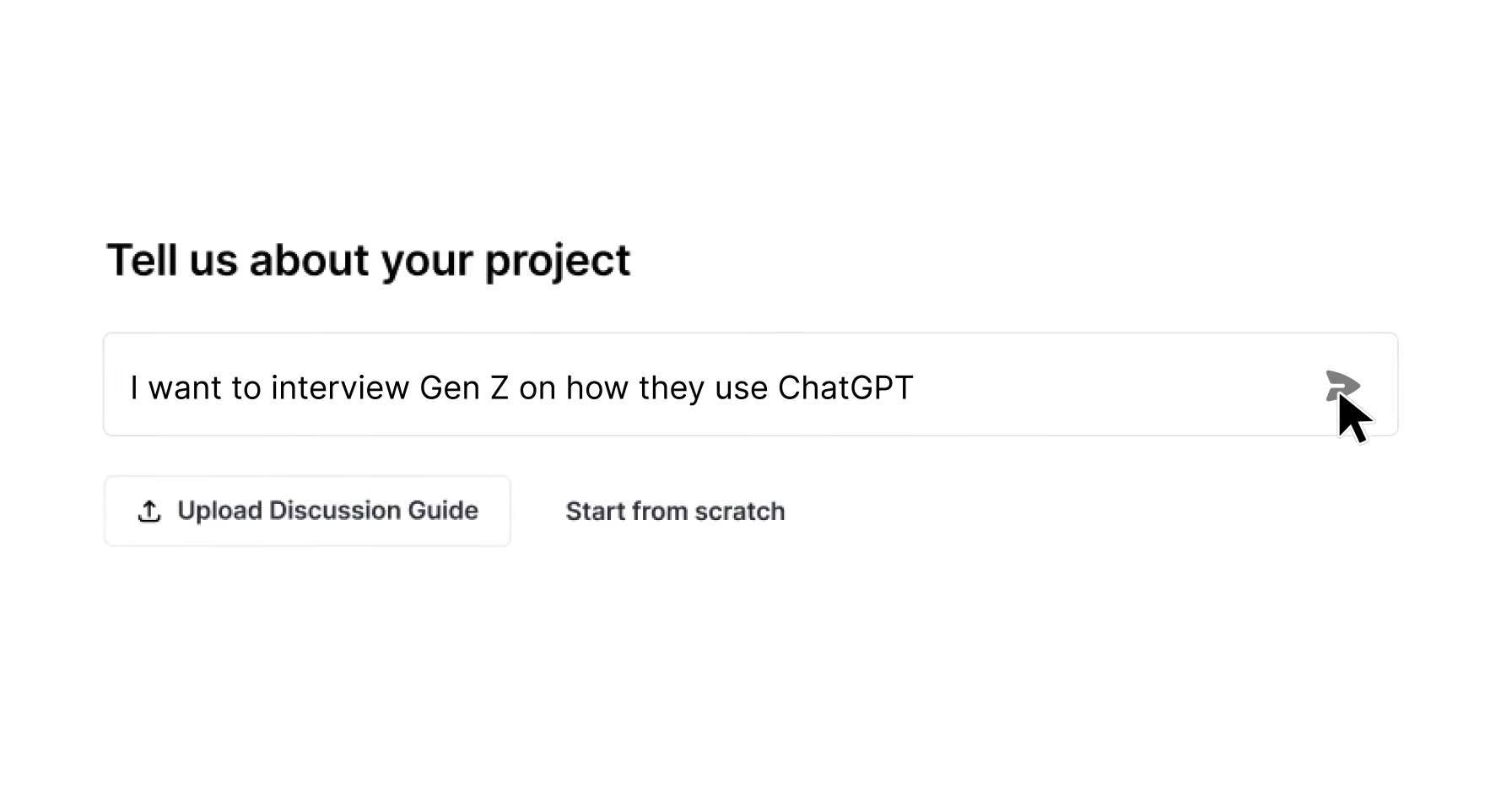
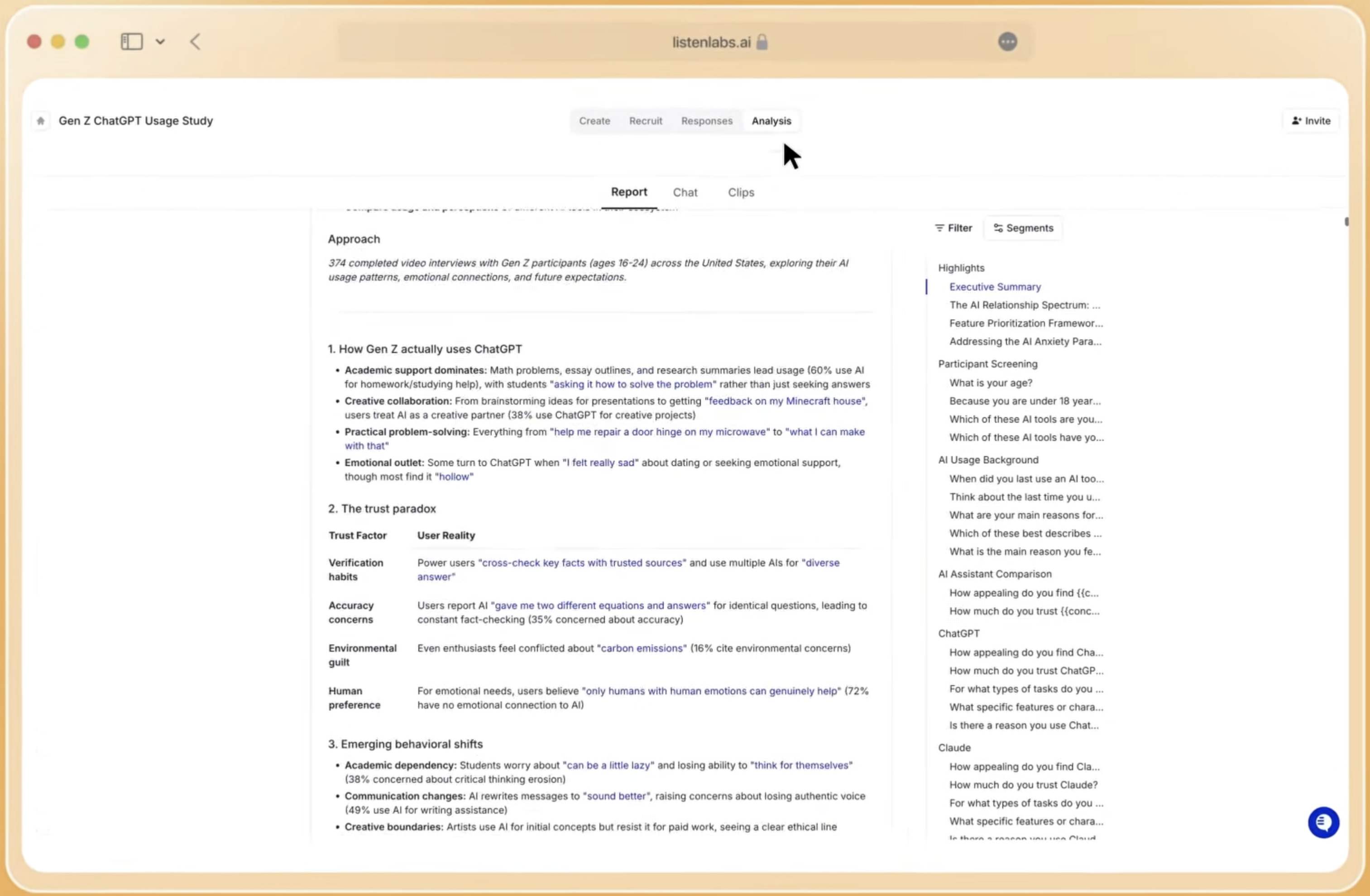
Beyond study design, Listen Labs handles the entire research lifecycle. The platform covers recruitment from a 30-million-person verified network, AI-moderated video interviews with adaptive follow-up, real-time fraud detection, emotional signal analysis, and automated deliverables. A general-purpose LLM handles none of those steps.
Can AI interviewers match trained human researchers?
For the vast majority of enterprise research needs, Listen Labs' AI delivers comparable quality to a skilled human moderator at dramatically greater speed and scale. The platform's in-house research team continuously refines the methodology, ensuring the AI probes short or interesting answers the same way a trained interviewer would.
The practical advantage is that AI moderation runs hundreds of parallel sessions without fatigue, scheduling conflicts, or moderator variability, while the research team focuses on strategic interpretation rather than logistics. Human researchers retain an edge in highly sensitive topics requiring personal rapport, or in initial discovery phases in entirely unfamiliar markets.
What safeguards prevent fraud when scaling to hundreds of interviews?
Listen Labs operates three independent protection layers. The platform works exclusively with high-quality, non-commodity panel sources, which excludes professional survey-takers from the outset. Quality Guard monitors every interview in real time across video, voice, content, and device signals, detecting fraud, low-effort responses, AI-generated scripts, and demographic mismatches as they occur.
A dedicated recruitment ops team provides human review for hard-to-reach segments, and participants are capped at three studies per month to prevent panel fatigue. The Listen Atlas AI orchestration layer matches participants on behavioral and intent data rather than self-reported demographics, and the platform's reputation scoring compounds across every study, which means participant quality improves as the platform scales.
Will Listen Labs replace my research team?
No. Listen Labs is designed as a force multiplier for existing research teams. The platform eliminates the logistical burden of recruitment, scheduling, moderation, transcription, and initial analysis, tasks that consume the majority of a researcher's time without requiring their strategic expertise.
This shift frees researchers to focus on interpretation, stakeholder communication, and the kinds of nuanced judgment calls that define high-value research. Teams using Listen Labs run significantly more studies with the same headcount, clearing backlogs and expanding research coverage across the organization rather than replacing the people who make research meaningful.
Conclusion
The core problem for enterprise insights teams in 2026 is not a shortage of research questions, it is a research infrastructure that cannot keep pace with the speed at which those questions need answers. Traditional surveys may tell us what people do, but it takes a conversation to understand why, and until now, those conversations have been too slow, too expensive, and too limited in scale to serve as a continuous intelligence layer for large organizations.
Listen Labs was built by researchers, for researchers, to collapse that constraint entirely. From study design to emotional signal capture to board-ready deliverables, the platform delivers what the market has needed for years, qual at scale without compromise.