
Written by: Anish Rao, Head of Growth, Listen Labs
Key Takeaways
-
Multimodal AI emotional analysis detects nuanced emotions like joy, frustration, and confusion across voice, facial expressions, and text, capturing 70% more signals than traditional sentiment analysis.
-
Ekman’s universal emotions framework identifies eight core states (joy, anger, surprise, confusion, fear, sadness, trust, anticipation) that consistently shape customer behavior across cultures.
-
A five-step workflow moves from research objectives to actionable insights in 24 hours, replacing multi-week cycles with AI-moderated interviews and traceable analysis.
-
Real-world examples from Anthropic, Skims, and P&G show emotional analysis uncovers churn drivers, validates campaigns, and prioritizes features, which boosts retention and ROI.
-
Listen Labs addresses fraud, bias, and scale with Quality Guard, global language support, and objective AI processing, enabling enterprise-grade emotional analysis at any scale.
How AI Emotional Analysis Elevates Customer Feedback
AI emotional analysis for customer feedback uses a multimodal approach that detects emotions like anger, joy, confusion, and surprise from voice tone, facial micro-expressions, and text patterns beyond traditional sentiment analysis. Unlike basic text-only tools, multimodal emotion AI captures 70% more nuanced emotional signals by analyzing three distinct layers: vocal patterns, word choice, and subconscious visual cues. This technology builds on established frameworks like Ekman’s universal emotions to identify eight core emotional states that drive customer behavior.
Core emotions include:
-
Joy/Happiness: Positive satisfaction and delight, for example an enthusiastic tone when describing product benefits.
-
Anger/Frustration: Irritation with experience or service, for example sharp vocal patterns during complaint descriptions.
-
Surprise: Unexpected reactions to features, for example raised eyebrows and widened pupils during demos.
-
Confusion: Uncertainty about processes or products, for example hesitant tone and pauses when explaining usage.
-
Fear: Concern about risks or changes, for example worried expressions when discussing data security.
-
Sadness: Disappointment with outcomes, for example flat vocal tone when describing failed expectations.
-
Trust: Confidence in brand or solution, for example relaxed posture and steady voice patterns.
-
Anticipation: Excitement about future possibilities, for example forward-leaning posture and animated gestures.
The business impact proves substantial. E-commerce businesses implementing AI-powered emotional analysis can achieve higher customer satisfaction compared to text-only approaches. To capture these gains, organizations need a clear, repeatable workflow that turns raw emotional signals into decisions within a single day.
Five-Step Workflow for AI Emotion Detection in Customer Feedback
Implementing AI emotion detection in customer feedback follows a systematic five-step approach that transforms traditional research cycles from weeks to hours.
Step 1: Define Research Objectives
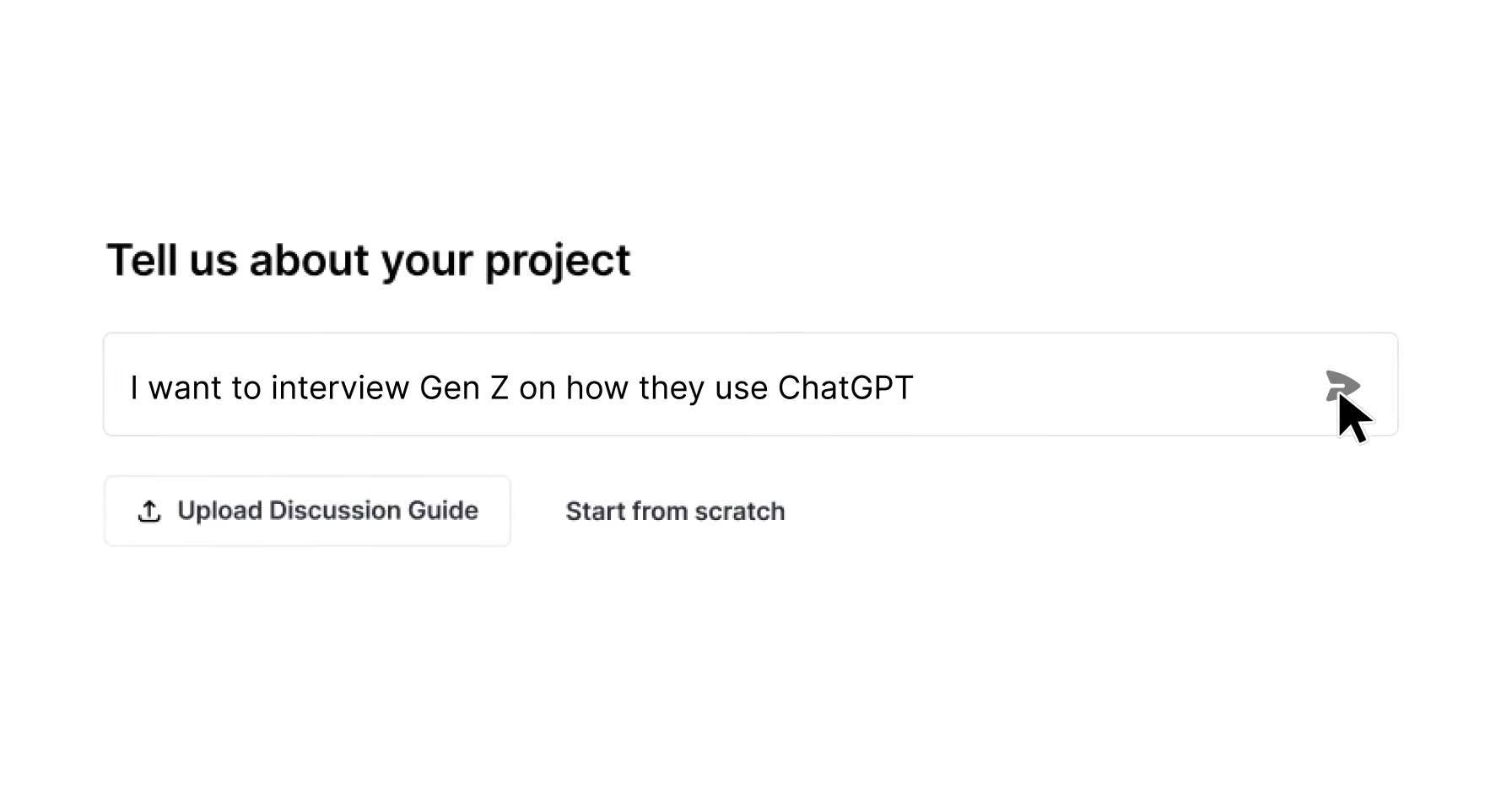
Start with natural language briefs that describe the emotional insights you need. AI structures these objectives around specific emotional triggers such as confusion during onboarding, delight with new features, or frustration with support processes. Timeline: 30 minutes.
Step 2: Recruit Target Participants
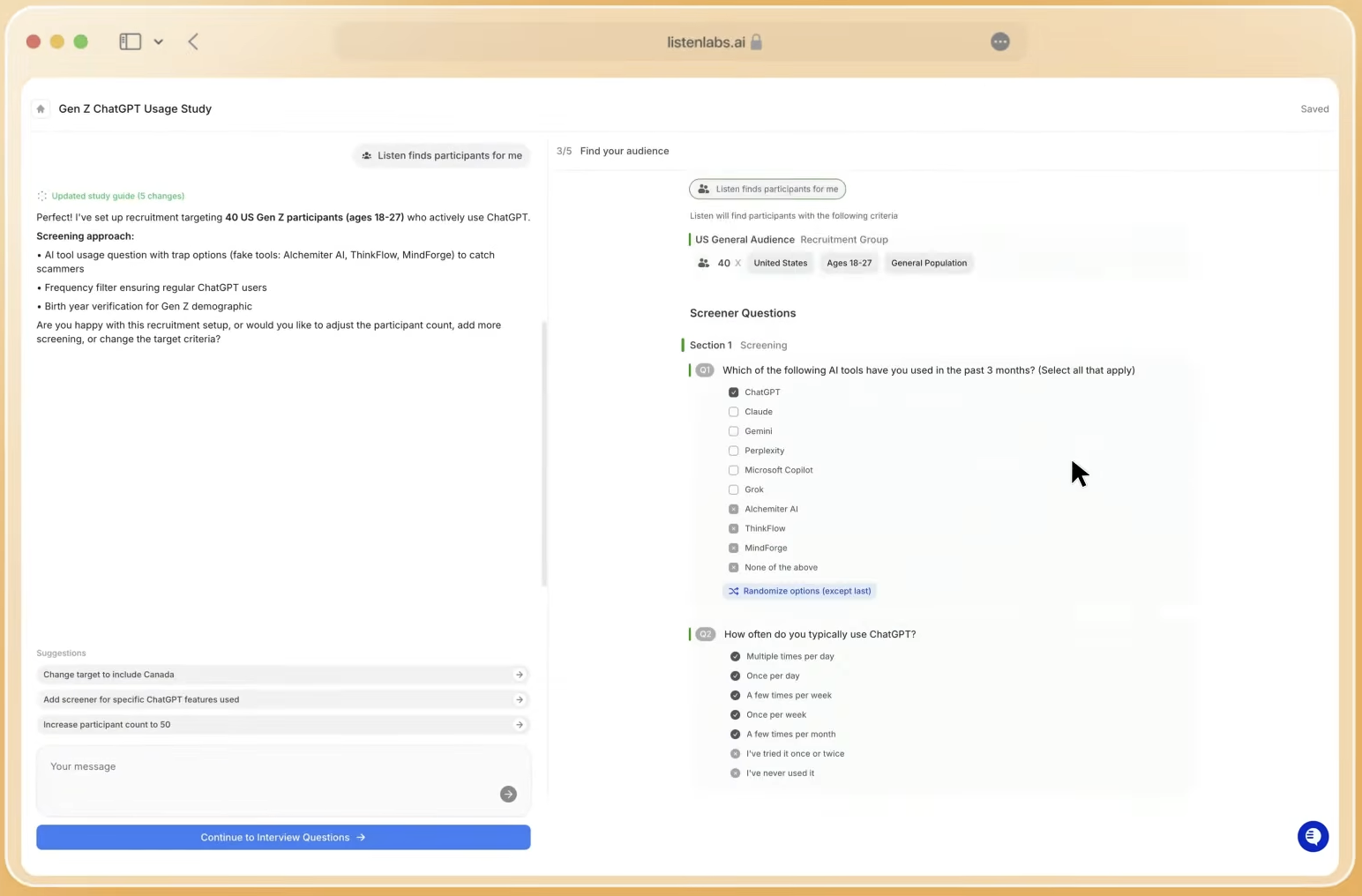
Access global participant networks spanning 30+ million verified respondents across 45+ countries. Rather than relying only on demographic filters, AI orchestration matches participants based on behavioral patterns and intent data so you reach people with relevant experience. This precision targeting is protected by quality controls that remove professional survey-takers and fraudulent profiles before they enter your study. Timeline: 2–4 hours.
Step 3: Conduct AI-Moderated Video Interviews
Deploy adaptive AI interviewers that conduct personalized conversations with dynamic follow-up questions. Advanced conversational AI in 2026 enables emotional comprehension by detecting subtle emotions based on context, creating human-like interactions that capture authentic responses. Timeline: 1–24 hours depending on sample size.
Step 4: Run Multimodal Emotional Analysis
Process video, audio, and text data simultaneously using Ekman’s universal emotions framework with traceable AI reasoning. Every emotion label connects to exact timestamps, verbatim quotes, and analytical justification. Support for 50+ languages enables consistent analysis across global audiences. Timeline: 2–6 hours.
Step 5: Deliver Actionable Insights
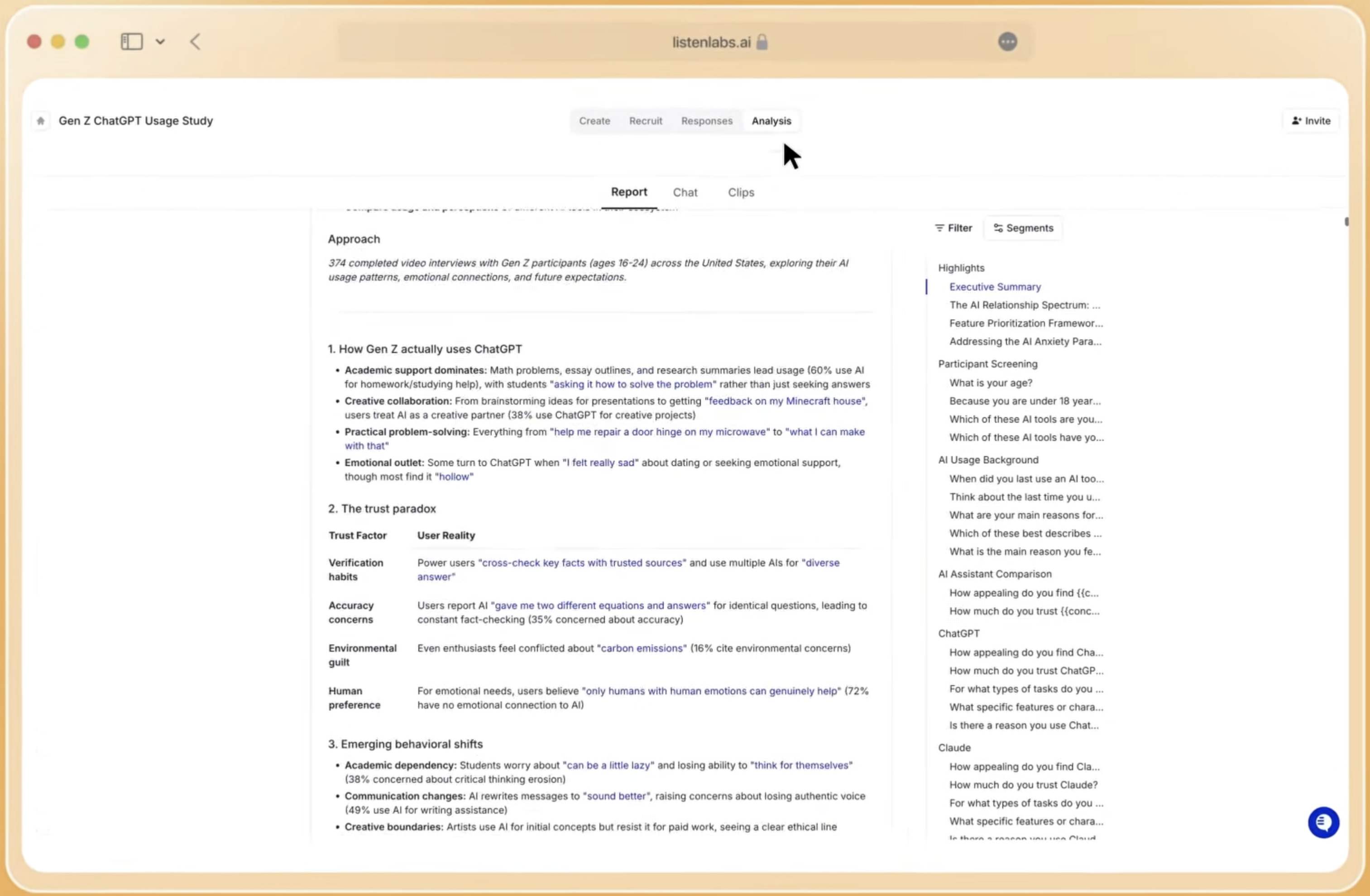
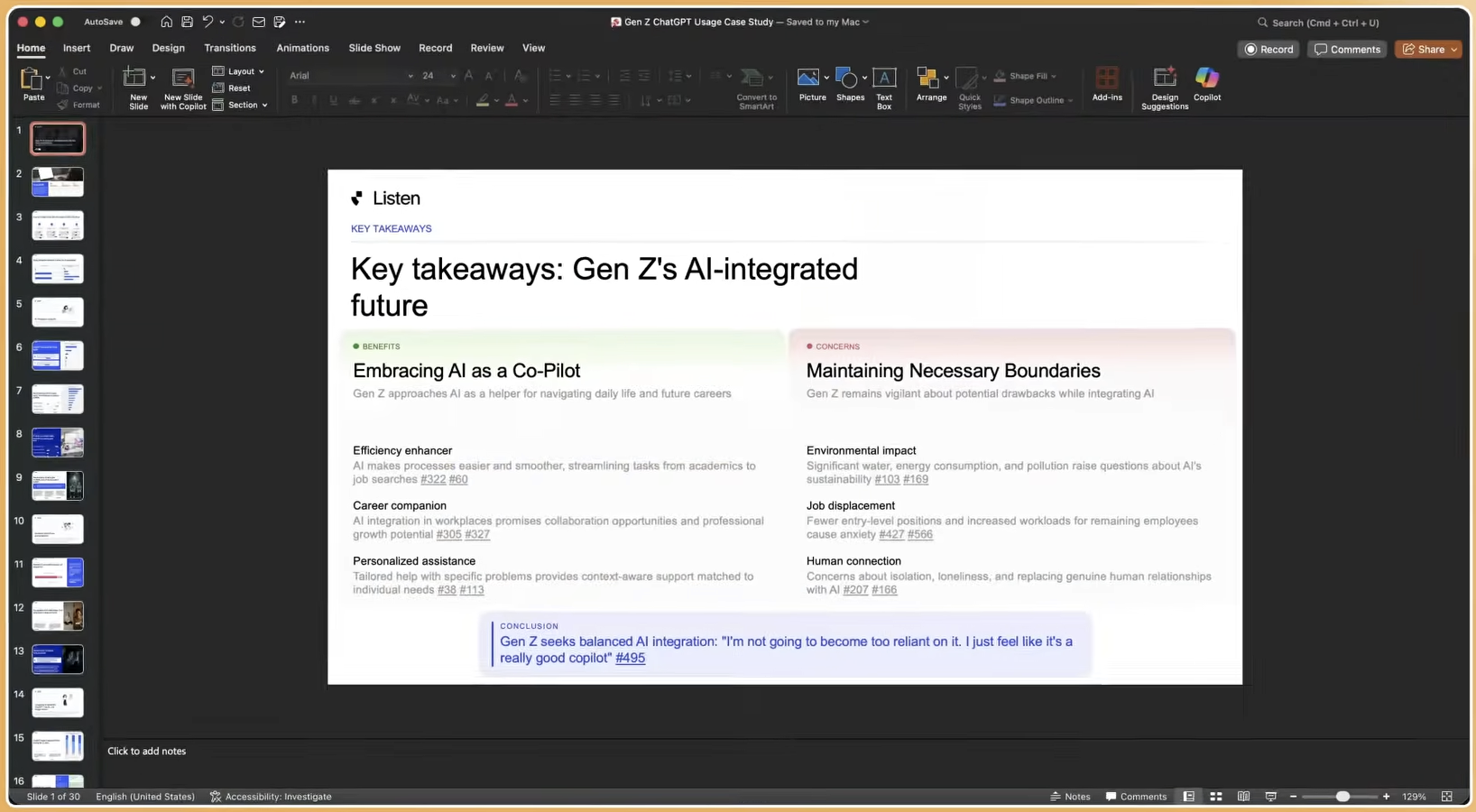
AI Research Agents automatically create consultant-quality reports, slide decks, video highlight reels, and statistical charts. Natural language queries allow instant exploration of emotional patterns across segments, concepts, and timeframes. Timeline: 1–2 hours.
This end-to-end workflow compresses traditional research cycles from weeks to 24-hour deliverables without sacrificing depth or quality. See how your team can achieve 24-hour turnarounds on emotional insights.
Scientific Frameworks Behind Ekman Emotions and Multimodal AI
Effective AI emotional analysis depends on scientifically validated frameworks that keep results accurate and consistent across different customer feedback scenarios. Ekman’s universal emotions framework serves as the foundation, building on the eight core emotional categories described earlier to maintain consistency across cultures and languages.
Practical applications show how these frameworks work in real studies. In brand testing, surprise emotions highlight unexpected positive reactions to creative concepts, while confusion points to messaging clarity issues. Multimodal sentiment analysis integrates text, voice tone, facial expressions, and gestures for deeper emotion interpretation, capturing nuances that single-channel analysis misses.
The multimodal advantage creates a measurable difference. Traditional text-only sentiment analysis reaches moderate accuracy, while multimodal approaches that include voice and visual cues achieve higher precision in enterprise environments. Traceable emotion labels add transparency for decision-makers by showing exactly why AI identified each emotional state.
Successful implementation also respects cultural context and language variation. AI models trained on diverse datasets across demographics and regions maintain performance for global customer bases. Explore how these validated frameworks can enhance accuracy in your specific research scenarios.
Real-World Examples of Scaling AI Customer Interview Emotions
Enterprise deployments of AI emotional analysis deliver measurable business impact across many use cases and industries. Companies use emotional analysis to collect customer stories and pinpoint authentic moments of joy and satisfaction with product features.
Anthropic’s Claude team completed 300+ user interviews in 48 hours to understand subscription churn drivers, surfacing emotional patterns five times faster than traditional methods. The analysis revealed specific frustration triggers and migration patterns to competitors, which supported targeted retention strategies.
Skims validated creative campaigns with thousands of high-income buyers overnight, using emotional analysis to separate authentic enthusiasm from polite responses. The multimodal approach detected micro-expressions and vocal patterns that signaled genuine excitement, guiding global campaign decisions.
P&G evaluated men’s product claims through emotional analysis and discovered that comfort and reliability emotions resonated more strongly than novelty-focused messaging. These insights directly shaped product positioning and marketing strategy.
Key use cases include:
-
Usability Testing: Hesitation and confusion emotions reveal friction points before launch.
-
Creative Testing: Surprise and delight confirm campaign effectiveness.
-
Churn Analysis: Frustration and disappointment support proactive retention strategies.
-
Feature Validation: Anticipation and trust help prioritize development roadmaps.
Quantified results show clear ROI. Organizations reduce research costs while increasing sample sizes. Time-to-insight drops from weeks to 24 hours, which enables rapid iteration and decision-making that keeps pace with competitive markets.
Challenges in Sentiment-Based Interviews and How Listen Labs Solves Them
Traditional sentiment analysis interviews have serious limitations that multimodal AI emotional analysis addresses in a structured way. AI fails to detect subtle emotional cues such as body language, hesitant objections, silence, and unspoken group dynamics in basic implementations, while advanced multimodal systems capture these signals.
Quality issues affect many commodity research approaches. Professional survey-takers, fraudulent profiles, and low-effort responses contaminate traditional panels. Listen Labs’ Quality Guard system monitors every interview in real time across video, voice, content, and device signals, reaching zero fraud rates through behavioral matching and reputation scoring.
Scale versus depth trade-offs previously forced organizations to choose between statistical confidence and qualitative richness. Modern AI emotional analysis removes this constraint by running hundreds of personalized interviews at once, each with adaptive follow-up questions that capture nuanced emotional responses.
Cultural and linguistic variation complicates global programs. AI integration risks bias, superficiality, or ethical missteps without scientifically validated measures. Listen Labs addresses these risks through diverse training datasets, cultural validation, and transparent AI reasoning that explains emotional classifications.
Bias mitigation also requires a disciplined process. Human analysts often emphasize findings that confirm existing hypotheses and overlook unexpected insights. AI analysis reviews all data consistently, identifies patterns across hundreds of responses without confirmation bias, and then provides traceable reasoning for every emotional classification.
Conclusion: Turning Emotional Signals into Enterprise Decisions
AI emotional analysis for customer feedback gives enterprises a practical way to clear research backlogs and capture emotional signals they previously missed. Organizations that adopt multimodal approaches improve retention while cutting research cycles from weeks to hours. The combination of Ekman-based frameworks, Quality Guard systems, and end-to-end automation positions Listen Labs as a powerful platform for scaling qualitative insights without losing depth. Start with Listen Labs to transform your customer research capabilities and uncover the hidden emotions that drive business outcomes.
Frequently Asked Questions
How accurate is AI emotional analysis compared to human researchers?
AI emotional analysis using multimodal approaches can reach high accuracy in enterprise applications, comparable to trained human researchers while processing hundreds of interviews simultaneously. The main advantage lies in consistency and scale, because AI maintains the same analytical standards across thousands of responses without fatigue or bias. Listen Labs’ Emotional Intelligence feature uses Ekman’s validated framework with traceable reasoning, so every emotion classification includes timestamp evidence and analytical justification. Human researchers excel at contextual interpretation, so the strongest implementations combine AI scale with human strategic oversight.
What types of customer emotions can AI detect that traditional surveys miss?
AI emotional analysis captures subconscious emotional signals that participants do not verbally express, including micro-expressions of confusion during product demonstrations, hesitation patterns that indicate uncertainty, vocal stress that suggests frustration, and genuine enthusiasm versus polite responses. Traditional surveys only capture self-reported emotions and miss key signals that appear through tone, facial expressions, and body language. Listen Labs’ multimodal analysis identifies eight core emotions (joy, anger, surprise, confusion, fear, sadness, trust, and anticipation) with intensity scoring and exact timestamp precision.
How does multimodal AI emotional analysis handle different languages and cultures?
Advanced AI emotional analysis systems support 50+ languages with cultural validation to keep emotion detection accurate across diverse global markets. Ekman’s universal emotions framework provides a scientific foundation that translates across cultures, while AI models trained on diverse demographic datasets account for cultural expression differences. The system adapts to regional communication styles, recognizing that emotional expression varies between cultures while maintaining consistent analytical standards. Global enterprises can run unified research programs across multiple markets and still compare emotional insights.
What is the difference between AI emotional analysis and basic sentiment analysis?
Basic sentiment analysis classifies text as positive, negative, or neutral using keyword matching and simple algorithms, which misses emotional nuance and context. AI emotional analysis uses multimodal processing to detect specific emotions like frustration, delight, confusion, and anticipation through voice patterns, facial expressions, and linguistic cues. A simple sentiment model might classify “The product is fine” as neutral, while emotional analysis detects hesitation in voice tone and flat facial expressions that indicate disappointment. This granular emotional intelligence supports targeted business actions instead of broad sentiment categories.
How quickly can AI emotional analysis process large volumes of customer interviews?
Modern AI emotional analysis platforms process hundreds of customer interviews within 24 hours, compared to traditional research cycles that often take several weeks. The system runs simultaneous AI-moderated interviews, analyzes multimodal emotional data in real time, and generates comprehensive reports with highlight reels and statistical breakdowns. Processing speed scales with infrastructure, so enterprise implementations can analyze 1000+ interviews overnight while maintaining quality standards. This acceleration enables rapid iteration on product development, marketing campaigns, and customer experience improvements based on fresh emotional insights.