
Written by: Anish Rao, Head of Growth, Listen Labs | Last updated: July 13, 2026
Enterprise testing teams face a persistent dilemma. Automated QA catches functional bugs, yet customers still churn because products feel confusing, slow, or misaligned with real workflows. The gap rarely sits in test coverage. It sits in what teams test for. Functional correctness does not guarantee usability, and lab metrics do not predict real-world friction.
Key Takeaways
- Enterprise scale product testing closes the gap between automated QA and real-world feedback by inserting AI-moderated interviews at every stage of the QA pipeline.
- The seven testing stages, from requirements through production monitoring, each create a moment to capture emotional friction and behavioral insight that functional tests miss.
- Listen Labs delivers statistically reliable, emotionally rich feedback in under 24 hours at enterprise volume, removing the traditional trade-off between research depth and scale.
- Advanced emotional intelligence analysis tracks tone, micro-expressions, and word choice alongside transcripts to surface unspoken user friction and genuine reactions.
- Teams that want to accelerate enterprise testing can book a demo with Listen Labs and plug AI-moderated customer validation into existing workflows.
The Seven Stages of Enterprise Testing With Customer Validation
Enterprise testing strategy spans seven distinct stages, from requirements gathering through production monitoring. Traditional QA treats these stages as checkpoints for technical correctness. Each stage also marks a point where user expectations, behaviors, or emotions can drift away from the specification. Those gaps turn passing tests into failing products. Here is how to add customer validation at every stage.
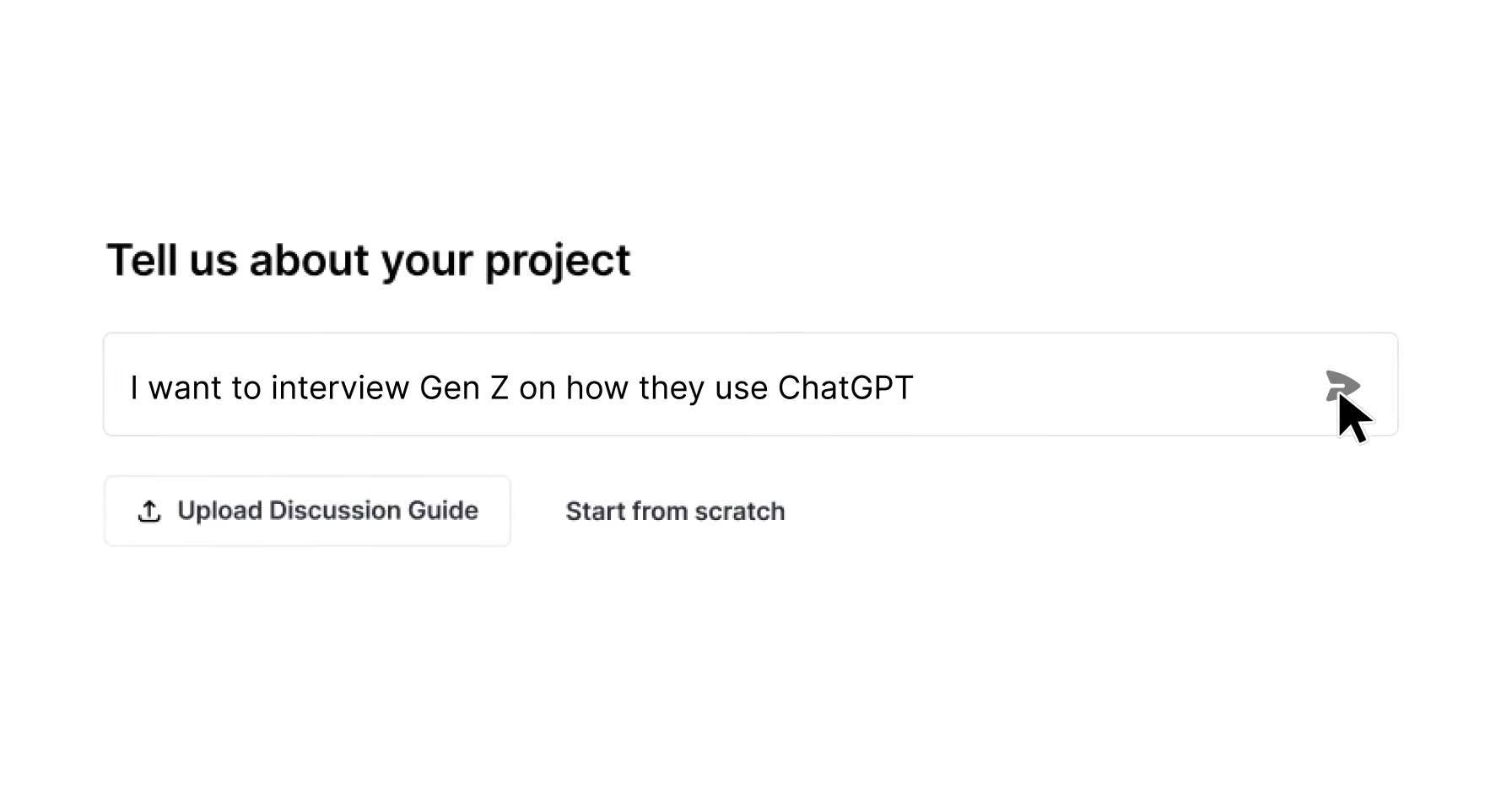
- Requirements: AI-moderated interviews validate assumptions before any code is written. Unclear or shifting requirements are the most common source of bugs, delays, and rework in enterprise software testing. Talking to 50–100 target users at this stage surfaces misaligned expectations before they become expensive defects. Traditional agency recruitment takes weeks. Listen Labs sources verified participants from its 30M-person global network and delivers synthesized findings in under 24 hours.
- Unit and Integration: Automated unit tests verify logic in isolation. Integration testing often becomes the bottleneck because ownership is distributed and failures are hard to reproduce. Integration testing is the true bottleneck to release speed in enterprise software for this reason. Pairing integration test results with brief AI-moderated user sessions on affected workflows reveals friction that log files cannot explain.
- System Testing: End-to-end system tests confirm that components work together. At this stage, AI-moderated interviews on representative task flows highlight usability failures that pass functional checks. Real users expose confusion, hesitation, and misinterpretation that scripted tests overlook.
- Acceptance Testing: User acceptance testing (UAT) usually relies on a small internal group. Replacing or augmenting that group with hundreds of AI-moderated external interviews produces statistically reliable signal. Qual-at-scale suits research that needs large sample sizes or broad geographic reach because AI tools can engage hundreds or thousands of participants remotely and asynchronously.
- Performance Testing: Load and stress tests measure system behavior under synthetic conditions. Lower environments often fail to mirror diverse real-world user journeys. AI-moderated interviews with users in target markets capture perceived performance, including lag, timeout frustration, and workaround behavior that synthetic load tests never see.
- Security Testing: Compliance and penetration testing verify technical controls. Enterprise applications must comply with regulations such as GDPR for EU personal data and HIPAA for U.S. healthcare data. Customer interviews at this stage reveal data-trust concerns and consent-flow confusion that security scans do not flag.
- Production Monitoring: Shift-right practices such as A/B testing, chaos engineering, and real-user monitoring observe live behavior. Shift-right testing allows teams to test against actual user experience and behaviors rather than artificial loads. Continuous AI-moderated interview loops run alongside telemetry and convert behavioral anomalies into explained customer narratives within hours. Anthropic used this approach to surface churn drivers from more than 300 user interviews in 48 hours. The team identified where former Claude users migrated and received a prioritized list of must-fix items five times faster than traditional methods.
Across all seven stages, the evaluation framework stays consistent. First comes speed. Listen Labs delivers findings in under 24 hours instead of the 4–6 weeks typical for traditional agencies, so teams can validate at every stage without delaying releases. That speed only matters when it remains affordable. Listen Labs operates at roughly one-third of traditional research spend, as Microsoft’s Director of Data Science confirmed, which makes continuous validation financially realistic.
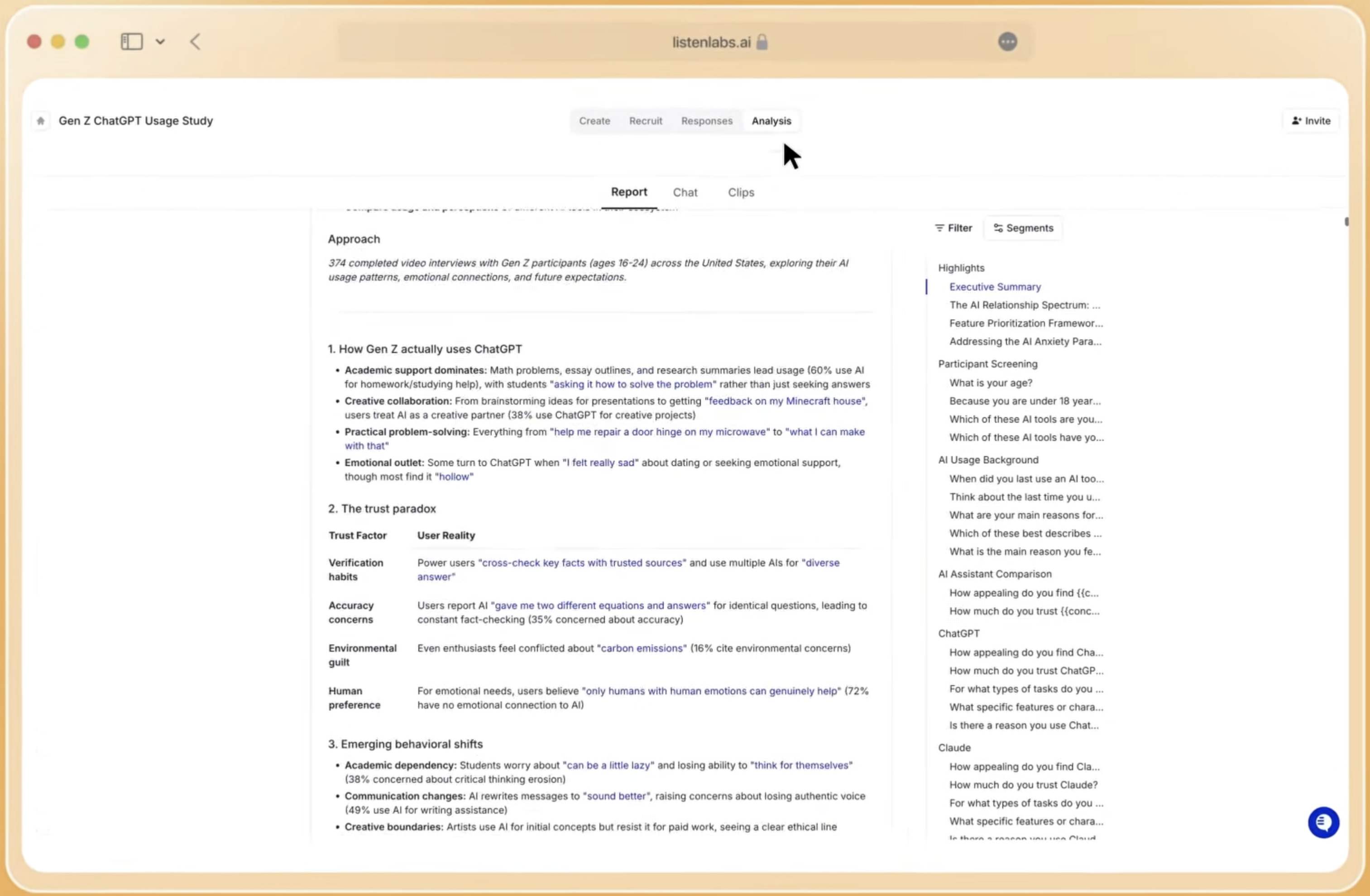
Scale follows. Hundreds of simultaneous interviews replace sequential human moderation, so teams gain both depth and statistical confidence. Scale must pair with data quality. Behavioral matching and real-time fraud detection ensure that every participant is genuine and relevant, unlike commodity panels. Governance then protects enterprise requirements through SOC 2, ISO 27001, ISO 27701, and ISO 42001 compliance. Finally, emotional-signal capture tracks tone, micro-expressions, and word choice alongside transcripts. Together, these six criteria define what makes customer validation practical to embed at enterprise scale and reduce QA cycle time while improving post-release defect detection.
Teams ready to map these seven stages to their own pipeline can book a demo and see how Listen Labs fits into an enterprise testing strategy end to end.
Solving the Depth-Versus-Scale Trade-Off in Research
Running customer validation across all seven stages sounds resource intensive with traditional methods. Agencies often need 4–6 weeks per study, and human-moderated interviews rarely scale beyond a dozen participants without major cost and scheduling overhead. This trade-off has kept customer validation limited to a few high-stakes checkpoints instead of woven through the full pipeline.
Qual-at-scale removes that depth-versus-scale barrier. Listen Labs runs hundreds of simultaneous, adaptive AI-moderated interviews, each personalized with dynamic follow-up questions. This is the qual-at-scale advantage mentioned earlier. Teams gain both the statistical confidence of large samples and the conversational depth of one-on-one interviews without stretching timelines. The platform’s track record, with more than 1 million interviews across enterprise clients, shows that this scale is operationally proven rather than theoretical.
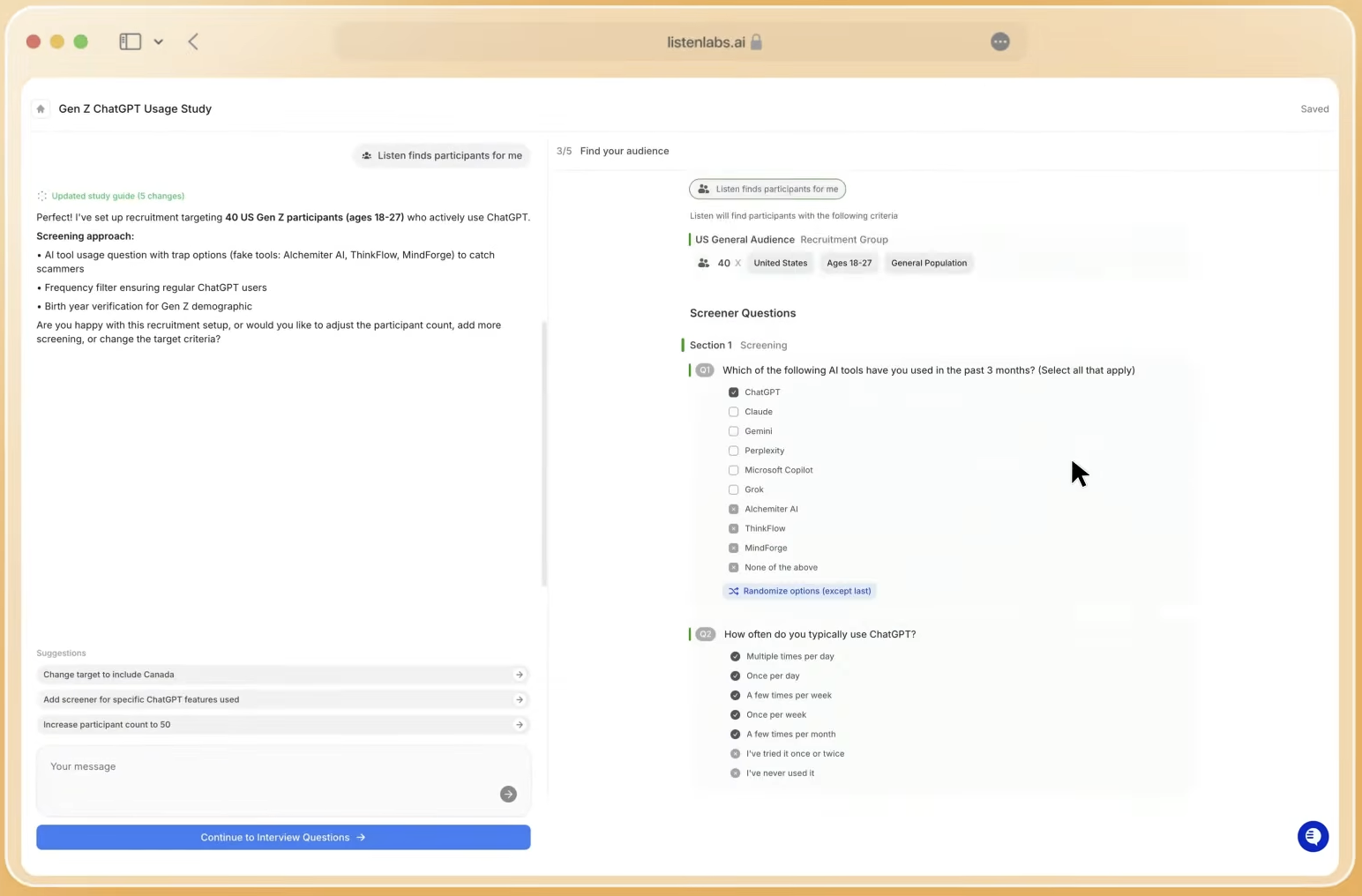
Participant quality stays high through three reinforcing mechanisms. Listen Atlas, the platform’s AI orchestration layer, matches participants on behavioral and intent data instead of self-reported demographics alone. Quality Guard monitors every interview in real time for fraud, low-effort responses, and mismatched profiles. Frequency caps limit each participant to three studies per month, which removes the professional survey-taker problem that weakens commodity panel data.
Emotional Intelligence in Product Testing
Scale and quality solve the logistics problem, so teams can run hundreds of interviews without sacrificing participant integrity. Volume alone still fails to surface the friction that matters most. The most costly issues appear in moments when users hesitate, frown, or give polite answers that hide real confusion. Emotional signal becomes the differentiator at that point.
Transcripts capture what participants say. They do not capture the frown before a participant recovers and gives a polite answer, the hesitation before clicking a CTA, or the widened eyes when a price point appears. Listen Labs’ Emotional Intelligence layer analyzes three parallel signal streams: tone of voice, word choice, and subconscious micro-expressions. The system builds on Ekman’s universal emotions framework, the same standard used in clinical psychology and UX research.
Every emotion is quantified per question and concept, and every label links to the exact timestamp, verbatim quote, and reasoning behind it. In usability testing, this detail surfaces moments of friction that participants never verbalize. In concept testing, it highlights which stimulus triggers genuine delight instead of polite approval. In creative testing, it pinpoints the exact frame where engagement drops. P&G used this depth of signal to find where product claims felt exaggerated or unclear before market launch, shaping product and brand strategy from more than 250 interviews in hours rather than weeks. Skims validated a global campaign direction overnight with thousands of premium consumers and secured board-level buy-in with qualitative clarity that translated directly into leadership confidence.
Readiness Checklist for Enterprise Deployment
Before deploying AI-moderated customer validation at enterprise scale, confirm the following steps in sequence.
- Compliance posture: Listen Labs holds SOC 2 Type II, GDPR, ISO 27001, ISO 27701, and ISO 42001 certifications. Verify that your data-processing agreements and regional data-residency requirements align before moving forward.
- SSO integration: After compliance clearance, set up enterprise SSO for seamless access management across large research teams.
- Test-management tooling: With access in place, identify which stages of your existing QA pipeline, such as requirements, UAT, and production monitoring, will trigger customer validation studies and map the handoff points.
- Internal research team capacity: That mapping reveals capacity needs. Listen Labs functions as a force multiplier, not a replacement, so decide which study types your team will own strategically and which to delegate to the platform’s automated workflow.
- Participant sourcing strategy: Finally, choose whether to draw from Listen Labs’ 30M-person global panel, bring your own participants, or combine both. Self-recruited participants cost fewer credits per interview.
Common Pitfalls and How AI-Mediated Loops Mitigate Them
Three failure modes appear repeatedly in enterprise testing programs that rely on QA automation alone.
- Over-reliance on lab metrics: Most product tests run for relatively short periods with limited usage, so small irritations that consumers initially overlook can become deal-breakers in real-world repurchase behavior over time. Continuous AI-moderated interview loops running alongside production monitoring catch this drift before it becomes churn.
- Siloed research repositories: Findings from past studies often sit in scattered reports and individual memories, which forces teams to re-research the same questions. Listen Labs’ Mission Control acts as a cross-study knowledge base. Teams can run natural-language queries across every study ever conducted on the platform and surface answers in seconds.
- Confirmation bias in human analysis: Human analysts unconsciously emphasize findings that confirm existing hypotheses. Research Agent handles the full analysis workflow from raw data to final output and processes all interview data objectively. It identifies patterns across hundreds of responses without analyst bias. One researcher ran a full buying intent analysis across three user segments in under a minute.
Frequently Asked Questions
Is an AI moderator as rigorous as a trained human researcher?
Listen Labs’ AI moderator maintains the same methodological rigor as a well-resourced in-house research team. It probes short or unexpected answers with dynamic follow-up questions and adapts conversation flow based on participant responses. Study-design logic builds on tens of thousands of completed studies. The platform’s in-house research team, with more than 50 years of combined expertise, continuously reviews and refines the methodology. For most enterprise research needs, including concept testing, usability studies, churn analysis, and creative validation, the AI delivers comparable quality at far greater speed and scale. Human researchers then focus on strategic interpretation instead of logistics.
How does pricing work for enterprise teams?
Listen Labs uses a subscription model. Enterprises pay for platform access, which includes a set number of studies and credits, then spend credits per participant recruited. Credit cost varies based on audience difficulty. General population studies cost fewer credits than niche or hard-to-reach segments such as enterprise decision-makers, healthcare workers, or consumers below 1% incidence rate. Companies with more than 100 employees go through a demo and pilot process to determine the right configuration. Smaller teams can access the self-serve platform directly.
Can we use our own customer list instead of the Listen Labs panel?
Yes. Listen Labs supports self-recruitment, so organizations can study their own user base at a reduced credit cost per participant. Teams can also bring their own panel provider or combine proprietary recruitment with Listen Labs’ 30M-person global network. The platform’s Quality Guard monitoring applies regardless of participant source and maintains data integrity across all recruitment paths.
What data security certifications does Listen Labs hold?
Listen Labs maintains enterprise-grade security with 256-bit encryption and holds SOC 2 Type II, GDPR, ISO 27001 for information security management, ISO 27701 for privacy information management, and ISO 42001 for AI management systems. Customer data is never used for AI model training. The platform supports enterprise SSO for access management across large, distributed research teams.
Conclusion: Scale Customer Validation Without Scaling Headcount
Enterprise scale product testing succeeds when automated QA pipelines and continuous AI-moderated customer validation loops operate as a single system. The seven stages, from requirements through production monitoring, each present a defined opportunity to insert customer interviews that surface what functional tests cannot. Teams uncover emotional friction, behavioral misalignment, and the gap between what users say and what they do. Platforms like Listen Labs add auto-recruiting, transcription, sentiment tagging, and insight summarization so teams move from question to findings in hours, not weeks.
Benchmarks from Microsoft, Anthropic, P&G, and Skims show a consistent pattern. These organizations achieve faster validation cycles, lower cost per insight, and research output that scales without proportional headcount growth. According to the World Quality Report 2025, nearly 90% of organizations are pursuing generative AI in their quality engineering practices, yet only 15% have reached enterprise-scale deployment. Customer validation loops help close the gap between piloting and scaling.
Teams can map this playbook to their own constraints, including testing stages, compliance requirements, and research backlog, and then identify where AI-moderated customer validation closes gaps that the current pipeline leaves open. Book a demo with Listen Labs to build an enterprise scale product testing program around continuous customer validation that delivers results in under 24 hours.