
Written by: Anish Rao, Head of Growth, Listen Labs | Last updated: July 5, 2026
Key Takeaways
- Qualitative research reveals the “why” behind customer behavior that quantitative data alone cannot explain.
- Seven proven methods — in-depth interviews, focus groups, usability testing, ethnographic studies, diary studies, concept testing, and open-ended surveys — deliver actionable insights when run at scale.
- Listen Labs compresses weeks-long research cycles into same-day results by combining AI-moderated interviews with automated analysis and recruitment.
- Enterprise teams at Microsoft, Anthropic, P&G, Skims, and Robinhood use Listen Labs to reduce churn, validate concepts, and increase conversion with statistically robust sample sizes.
- Teams ready to replace slow research cycles with same-day insights can book a demo with Listen Labs and see the workflow in action.
1. In-Depth Interviews That Cut Churn 5× Faster
In-depth interviews reveal the real reasons customers churn, not just the surface explanations they select in a survey. Traditional surveys show what people do, but it takes a conversation to understand why they behave that way. In-depth interviews (IDIs) are one-on-one, semi-structured conversations where an interviewer or AI moderator asks adaptive follow-up questions that dig beneath initial answers. This approach works especially well for churn analysis, where the stated reason often differs from the root cause.
Anthropic used Listen Labs to understand why Claude users were canceling. Listen Labs conducted more than 300 user interviews in 48 hours. The study surfaced churn drivers 5× faster than the team’s previous approach, identified where former users migrated, including to OpenAI and Gemini, and delivered a prioritized list of ten “must-fix” items and high-value feature gaps. “Listen Labs lets us understand user churn with a level of clarity and speed we’ve never had before,” said the Director of Product Strategy at Anthropic. The entire study ran in 48 hours using Listen Labs’ AI-moderated interview platform and 30M-respondent panel [Anthropic].
2. Focus Groups Reimagined Without Groupthink
Focus groups remain one of the most cited qualitative research examples in business, yet the classic format carries a structural flaw. Traditional focus groups cost $4,000–$12,000 per 90-minute session and take 3–5 weeks to execute, and a single skeptical voice can sway the room. That dynamic exposes message fragility instead of revealing genuine consumer sentiment. AI-led one-on-one interviews recreate the exploratory depth of focus groups while removing social conformity bias and heavy logistics.
How Emotional Intelligence Reduces Groupthink Bias
Listen Labs’ Emotional Intelligence feature strengthens concept validation by capturing how people feel, not just what they say. Built on Ekman’s universal emotions framework, it analyzes tone of voice, word choice, and subconscious micro-expressions at the same time. Two concepts can receive identical verbal ratings while triggering very different emotional responses, and Emotional Intelligence highlights those differences so teams see which ideas truly resonate.
Microsoft used Listen Labs to collect global customer stories for its 50th anniversary celebration at speed and scale. The team gathered user video stories within a single day. “Our leadership team was very thrilled at both the speed and the scale that Listen Labs enabled. I can reach out to hundreds of users at one third of the cost,” said the Director of Data Science at Microsoft. Platforms like Listen Labs add auto-recruiting, transcription, sentiment tagging, and insight summarization, so teams move from questions to findings in hours instead of weeks.
3. Usability Testing That Lifts Conversion
Usability testing uncovers interface friction that quietly erodes conversion. Many users never verbalize these issues, yet they abandon flows when they encounter them. Usability studies observe participants as they complete real tasks, such as clicking through a prototype, navigating a checkout flow, or locating a feature. Moderators capture hesitation, confusion, and error patterns that point directly to design problems. With qual-at-scale, the old depth-versus-scale trade-off no longer blocks teams, so they can test with 50–100 or more users instead of five to ten.
The Emotional Intelligence layer described earlier becomes especially powerful in usability work. It pinpoints the exact timestamp where a participant’s expression shows frustration before they speak up. Product teams receive precise, actionable data tied to specific moments in the flow instead of relying on post-session self-reports.
Skims needed to validate a global campaign direction with thousands of high-income buyers on an overnight timeline. Listen Labs identified and qualified premium consumers quickly, removing weeks of recruiting. The study tested campaign direction before launch, which helped the team move forward with confidence and secure board-level buy-in. “I always struggled with understanding the why and Listen Labs nails this for me,” said the SVP of Data, Insights, and Loyalty at Skims. Results arrived in under 24 hours.
4. Ethnographic Studies That Reveal Hidden Journeys
Ethnographic research reveals how people behave in real life, not just how they describe their behavior in a lab. Researchers observe consumers in their natural environment, such as at home, in-store, or during product use, and see behaviors and motivations that participants cannot or do not articulate in structured interviews. This observational approach works especially well for CPG and personal care categories, where habitual and often unconscious routines drive purchase decisions.
Traditional ethnography relied on in-person observation, which limited studies to small, local samples. AI tools now engage hundreds or thousands of participants remotely and asynchronously. This shift extends ethnographic reach across regions and lifestyles that in-person teams could not cover at once.
Procter & Gamble needed to understand how men respond to new product claims before committing to market investment. Listen Labs delivered more than 250 interviews with quantified themes and verbatim proof in hours. The study highlighted where claims felt exaggerated or unclear and showed that comfort, safety, and reliability mattered far more than novelty. Those findings helped P&G avoid investing in features consumers would dismiss. “Listen Labs has been a huge help,” said the Analytics and Insight Leader at P&G. The full study completed in hours.
Book a demo to see how Listen Labs runs enterprise-grade ethnographic studies in a single day.
5. Diary Studies That Pinpoint Retention Drop-Off
Diary studies track how customer experiences evolve over time, which makes them ideal for understanding retention. Participants log experiences, emotions, and behaviors at regular intervals over days or weeks. This cadence captures longitudinal patterns that single-session interviews miss. Because participants record experiences in real time instead of recalling them weeks later, diary studies can identify the exact moment in a journey where engagement drops, a finding that retrospective interviews often miss due to recall bias.
Listen Labs’ Emotional Intelligence layer strengthens diary analysis by tracking emotional trajectory across sessions. It shows whether frustration builds gradually or spikes at a specific touchpoint, and it links each emotional signal to the exact timestamp and verbatim quote that triggered it. Teams see both when engagement drops and why it drops at that moment.
Robinhood used Listen Labs to assess whether prediction markets felt on-brand and to identify which user segments drove the highest re-engagement. Qualitative interviews revealed experience patterns that aligned with Robinhood’s core offering and showed that users who view prediction markets as entertainment, not income, drive 2.4× higher weekly re-engagement. The study delivered insights 5× faster than the team’s previous approach and revealed integration flows that increased uptake by 30–40%.
6. Concept Testing That De-Risks Launches
Concept testing with AI helps teams rank ideas and avoid costly misfires before launch. In these studies, target consumers react to product, messaging, or creative concepts so teams can spot fatal flaws and compare alternatives. Traditional concept testing relied on sequential focus groups or monadic survey cells that took weeks to field. AI-moderated interviews run hundreds of parallel sessions at once, which produces statistically meaningful sample sizes with enough conversational depth to explain not only which concept wins, but why it wins.
One researcher ran a full buying intent analysis across three user segments in under a minute using Listen Labs’ Research Agent. The tool generates slide decks, memos, highlight reels, and statistical comparisons automatically from interview data. Every insight links back to the underlying response, so stakeholders can trace conclusions directly to the source.
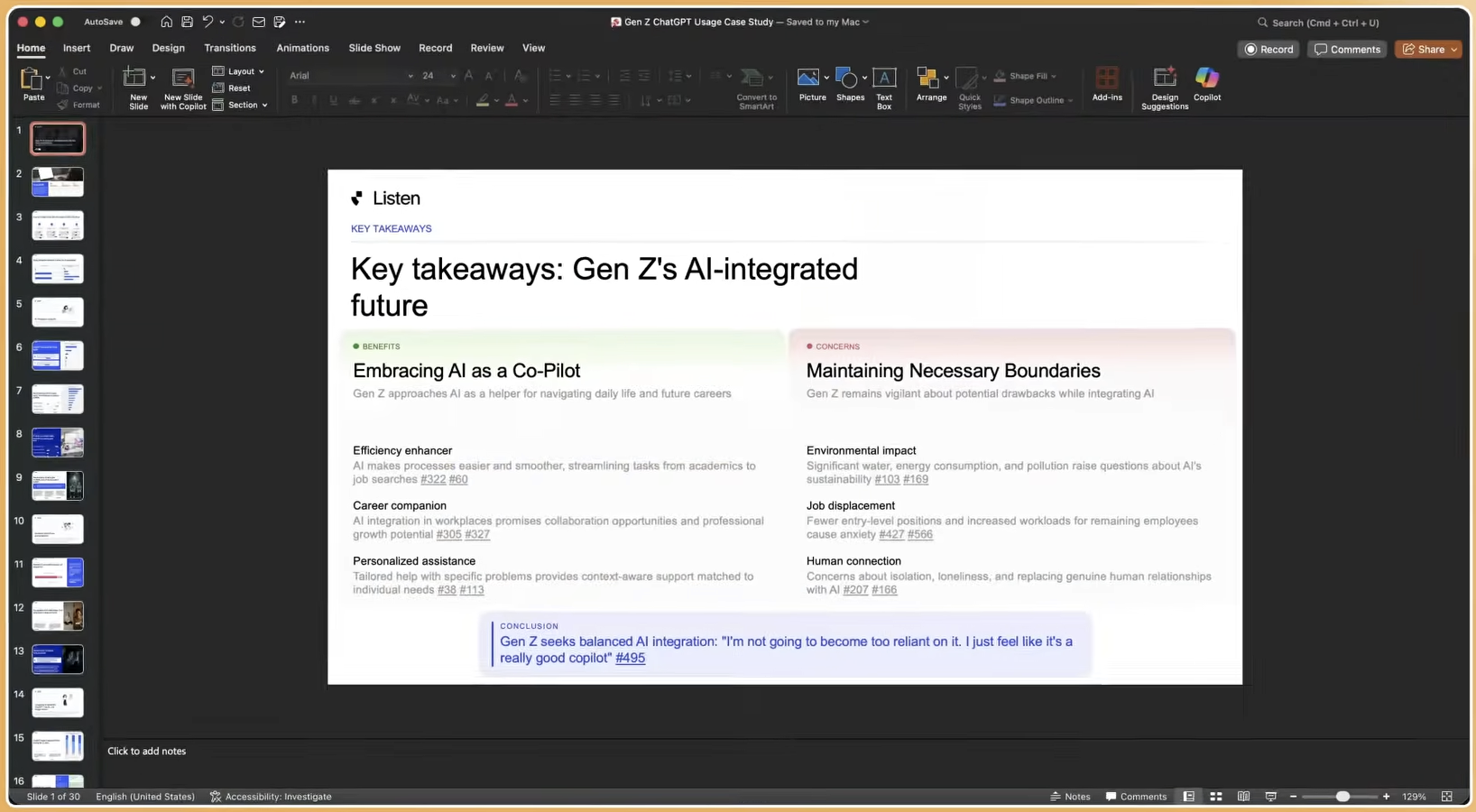
Microsoft’s concept validation work with Listen Labs showed how quickly global user stories can be collected. The team gathered stories within a day, a process that previously required 6–8 weeks through traditional research infrastructure. The Research Agent then produced stakeholder-ready deliverables automatically, removing the manual report-writing bottleneck that usually follows fieldwork.
7. Open-Ended Surveys That Surface Unexpected Drivers
Open-ended survey questions give enterprises a fast entry point into qualitative research at scale. When appended to quantitative instruments or used as standalone pulse studies, they capture verbatim language, unexpected themes, and emotional context that closed-ended scales cannot encode. The main barrier has always been analysis. Hundreds of open-ended responses take significant time to code, theme, and synthesize while keeping analyst bias in check.
Researchers spend most of their time on analysis, including pattern finding, quantifying insights, testing significance, adding macro context, and formatting results for different stakeholders. Listen Labs’ Research Agent automates this heavy lift. It processes open-ended data objectively, identifies themes across hundreds of responses, and generates branded deliverables in under a minute.
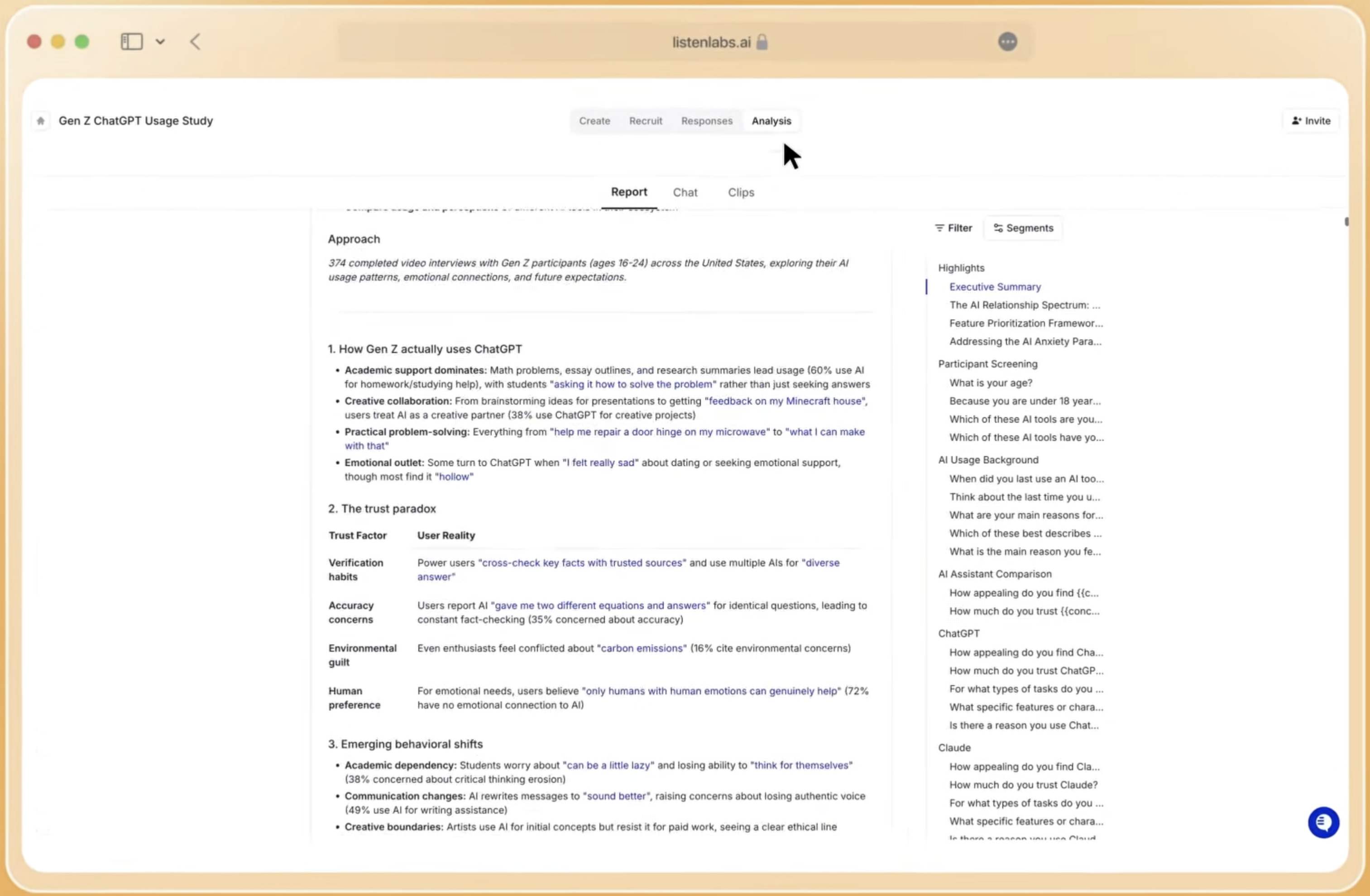
The Anthropic churn study described earlier shows how open-ended probes within structured interviews reveal competitive triggers and feature gaps in customers’ own words. Those qualitative details would not appear in closed-ended scales alone. Book a demo and run your first open-ended study the same day.
Frequently Asked Questions
Is an AI moderator as effective as a trained human researcher for qualitative interviews?
Listen Labs’ AI moderator conducts personalized, adaptive conversations with dynamic follow-up questions, the same probing behavior that separates a skilled human interviewer from a static survey. The platform is built by a team with more than 50 years of combined research expertise. The methodology is continuously refined against tens of thousands of completed studies, which gives it a level of calibration that individual human moderators cannot match at scale.
How does Listen Labs ensure participant quality and prevent fraudulent responses?
Listen Labs applies three layers of quality control to protect data integrity. It sources exclusively from high-quality, non-commodity panels. Quality Guard monitors every interview in real time across video, voice, content, and device signals to detect fraud and low-effort responses. Participants are capped at three studies per month to limit professional survey-takers, and a dedicated recruitment operations team adds human review for hard-to-reach segments.
How long does a typical qualitative study take from brief to final report?
Listen Labs compresses the full research lifecycle to less than 24 hours, from study design and participant recruitment to AI-moderated interviews, analysis, and deliverable generation. Traditional qualitative research cycles in enterprise settings often run 4–6 weeks and can stretch to six months once internal prioritization and budget approval enter the process.
Do I need research methodology expertise to run a study on Listen Labs?
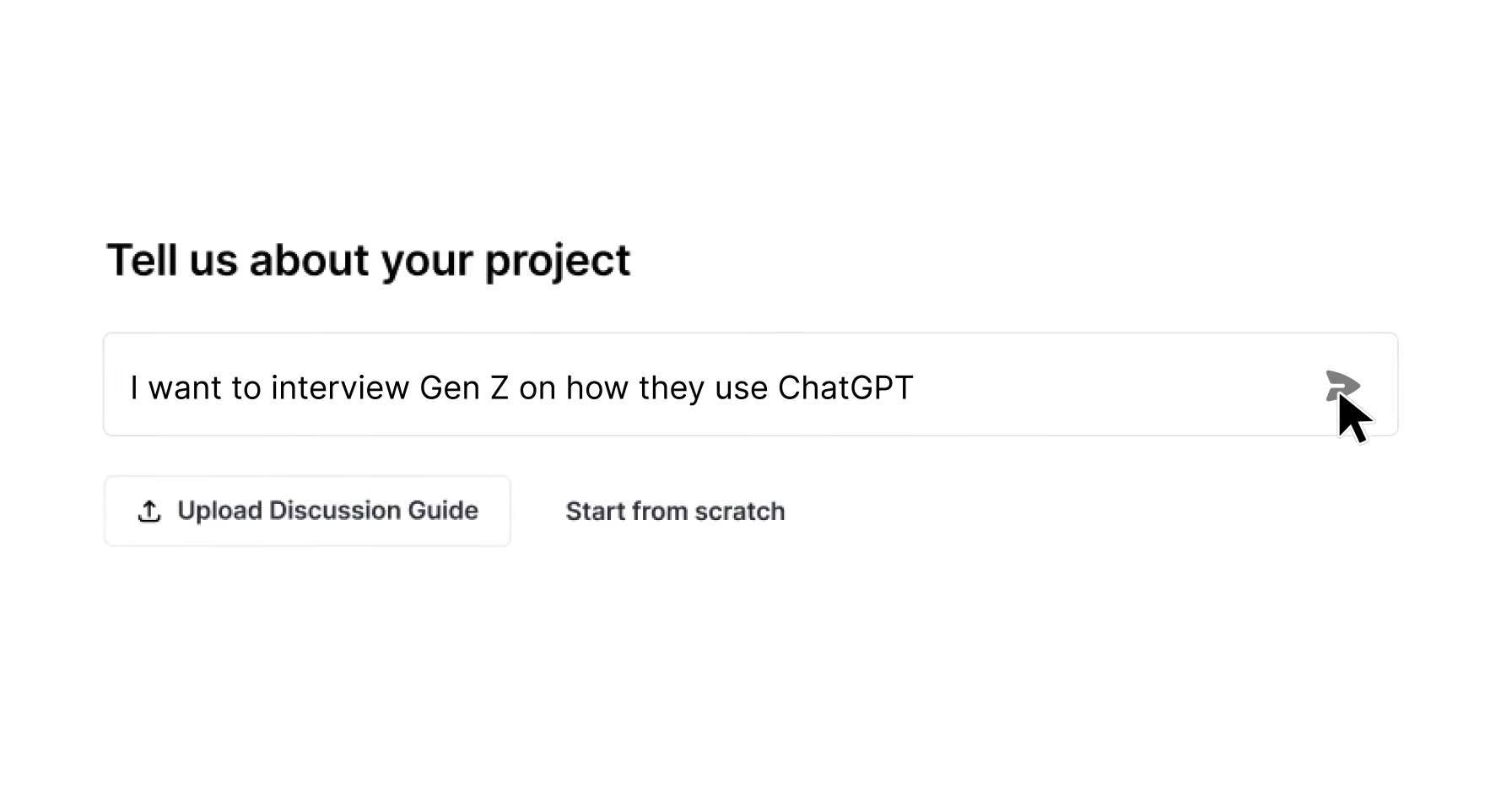
No. The platform’s AI-assisted study co-design tool lets any user describe research goals in natural language and receive a structured study guide with objectives, questions, and probing context in seconds. Templates, auto-QA, and the in-house research team’s embedded methodology support product managers, brand managers, and marketing leaders so they can run enterprise-grade studies without prior research training.
How does Listen Labs handle data security and privacy compliance?
Listen Labs maintains enterprise-grade security with 256-bit encryption, and customer data is never used for AI model training. The platform holds SOC 2 Type II, GDPR, ISO 27001, ISO 27701, and ISO 42001 certifications, which cover a broad range of enterprise and international data protection requirements.
Conclusion
These seven qualitative research methods — in-depth interviews, focus groups, usability testing, ethnographic studies, diary studies, concept testing, and open-ended surveys — historically shared a common limitation: they took too long to deliver results. Listen Labs removes that delay by handling the entire research lifecycle on a single platform. Teams move from AI-assisted study design and global participant recruitment to AI-moderated interviews, automated analysis, and stakeholder-ready deliverables in less than a day.
Enterprises including Microsoft, Anthropic, P&G, Skims, and Robinhood now replace weeks-long research cycles with same-day insights while maintaining methodological rigor and participant quality. The depth-versus-scale trade-off that defined qualitative research for decades no longer constrains modern teams. See how your team can replace weeks-long research cycles with same-day insights — book your demo now.