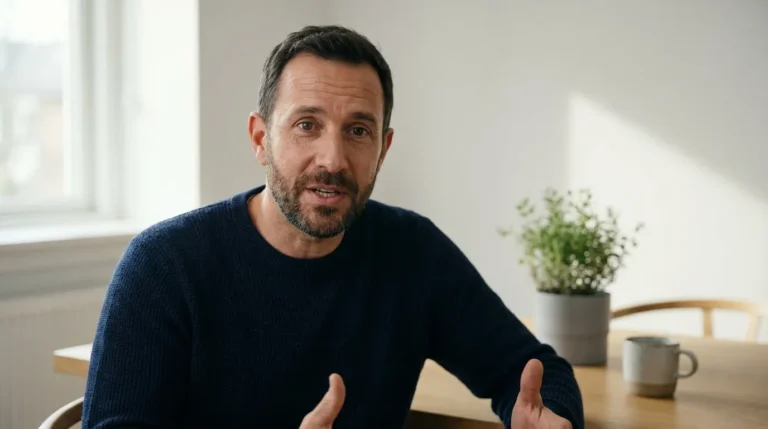
Written by: Anish Rao, Head of Growth, Listen Labs | Last updated: July 13, 2026
Key Takeaways for Enterprise Research Teams
- AI research assistants fall into two categories: academic literature tools for published papers and commercial platforms for real customer insights.
- Enterprise teams care most about research cycle time, participant quality, emotional signal capture, fraud prevention, security compliance, and total cost of ownership.
- Listen Labs compresses the full research lifecycle, from study design through AI-moderated interviews and analysis, into under 24 hours while scaling to hundreds of participants.
- The platform improves participant quality with multi-layer fraud detection, behavioral matching across a large verified network, and strict monthly study caps that remove professional survey-takers.
- Listen Labs offers an end-to-end commercial platform that addresses eight core enterprise criteria in a single workflow. Experience the 24-hour research cycle in a personalized demo.
Research cycle time: compressing weeks into a single day
A traditional qualitative research cycle often runs four to six weeks from study design through final report delivery. In large enterprises, internal prioritization queues and budget approvals can stretch that timeline to six months. Product decisions usually move ahead long before findings arrive.
Traditional focus groups alone cost $4,000–$12,000 per 90-minute session and take three to five weeks to complete. Quantitative survey tools shorten timelines but lose conversational depth. Panel and recruitment platforms help with sourcing yet leave moderation, analysis, and reporting to separate vendors, which adds more handoffs and delay.
Listen Labs compresses the entire research lifecycle to under 24 hours, including study design, participant recruitment, AI-moderated interviews, emotional analysis, and stakeholder-ready deliverables. The platform has conducted over one million AI-powered customer interviews for companies including Microsoft, Perplexity, and Sweetgreen. Microsoft’s team collected global customer video stories for the company’s 50th anniversary within a single day, a project that previously required six to eight weeks.
See how your team can achieve similar speed with a personalized demo of the 24-hour research cycle.
Depth versus scale: achieving qual-at-scale
Speed alone does not matter if research quality drops. The historical trade-off in qualitative research is clear: in-depth interviews deliver nuance but usually cap at 5–15 participants. Surveys reach thousands but produce surface-level, pre-set responses with no follow-up.
Qualitative methods make up for their speed and sample-size limitations tenfold in their ability to uncover nuance and complexity in human decision-making. That benefit appears only when sample sizes are large enough to reach thematic saturation.
With qual-at-scale, the old trade-off between depth and scale no longer blocks teams. Listen Labs conducts hundreds of AI-moderated qualitative interviews at the same time, each personalized and adaptive. The AI probes short or unexpected answers like a trained human moderator, generating dynamic follow-up questions in real time. Anthropic’s team ran more than 300 user interviews in 48 hours to surface churn drivers and received a prioritized list of ten “must-fix” product items five times faster than traditional methods.
Traditional studies are typically limited to 20–30 in-depth interviews, whereas AI-moderated platforms enable collection of qualitative data from hundreds of participants. Many clients reinvest efficiency savings into larger sample sizes rather than lower budgets.
Participant quality and fraud prevention for enterprise-grade data
Commodity panels carry well-documented quality risks. Professional survey-takers chase incentives, repeat respondents appear across studies, and AI-generated scripts can pass basic screening. Kantar reports that researchers discard 38% of survey data on average due to quality concerns, which represents wasted budget at every stage.
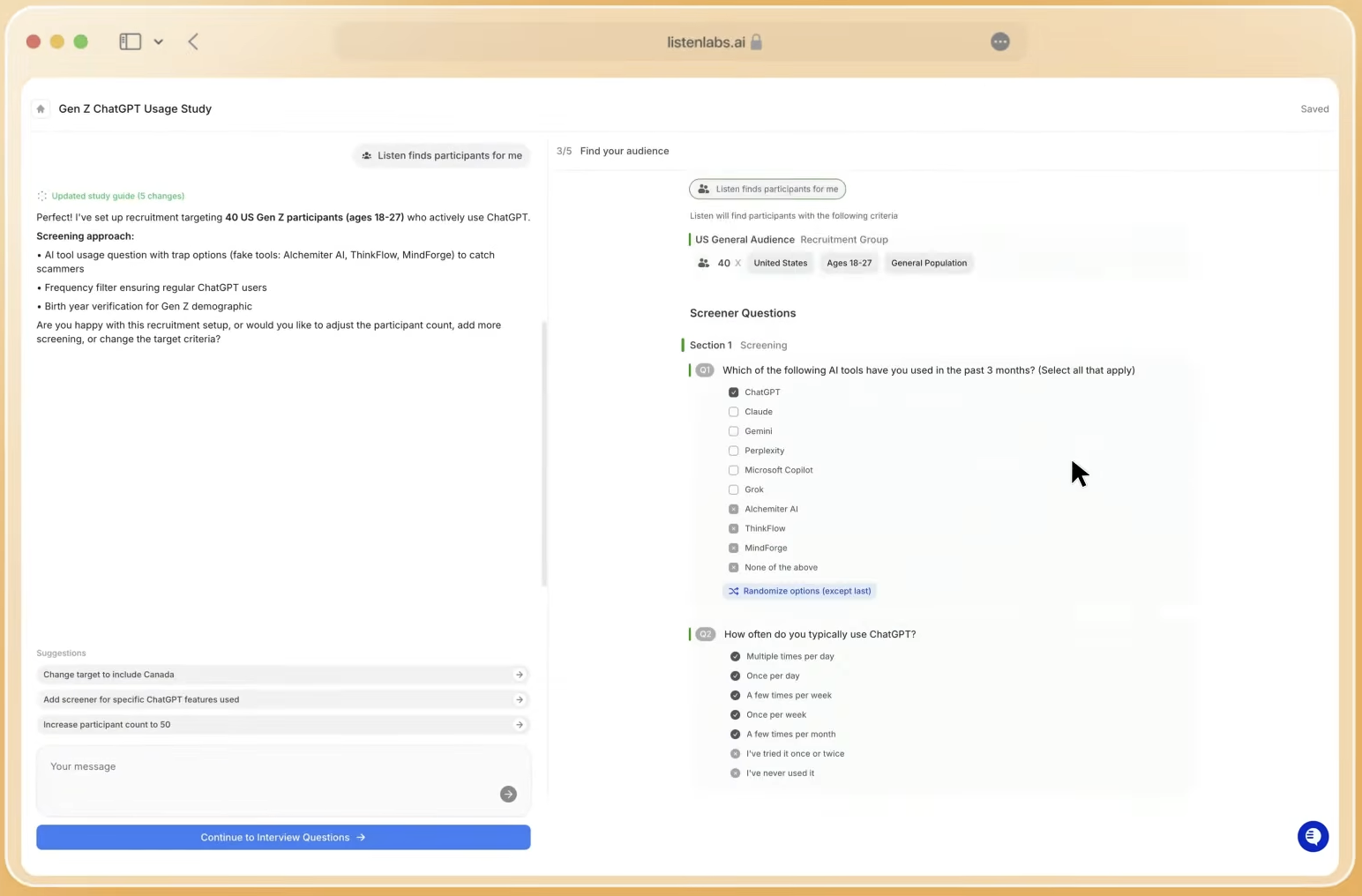
Listen Labs addresses participant quality through three compounding layers, each solving a different failure mode in traditional panels. Listen Atlas, the platform’s AI orchestration layer, matches participants on behavioral and intent data across a network of 30 million verified respondents in 45+ countries, not just self-reported demographics, so the right people receive invitations first. Even verified panels can include bad actors, so Quality Guard monitors every interview in real time across video, voice, content, and device signals to detect fraud, low-effort responses, and mismatched profiles. To prevent the professional survey-taker problem, participants are capped at three studies per month, which removes the incentive to game the system. A dedicated recruitment operations team adds human review for hard-to-reach segments, including enterprise decision-makers, healthcare workers, and audiences below 1% incidence rate.
In 2026, Microsoft and Anthropic both cited participant quality and speed as primary reasons for adopting Listen Labs at scale. This enterprise confidence in data quality infrastructure helped drive Listen Labs’ recent $500M+ valuation.
Emotional signal capture across the full research lifecycle
Most research tools capture only what participants say. Transcripts, survey responses, and self-reported ratings miss the emotional layer entirely, such as a frown during a product demo, a pause before a pricing answer, or widened pupils when a new feature appears. Two concepts can receive identical verbal ratings while triggering completely different emotional responses.
Listen Labs’ Emotional Intelligence feature analyzes three simultaneous signal layers, tone of voice, word choice, and subconscious micro-expressions, using Ekman’s universal emotions framework, the same standard used in clinical psychology and UX research. Every emotion is quantified per question and concept, and every label is traceable to the exact timestamp, verbatim quote, and reasoning behind it. The feature works across 50+ languages and connects directly with the Research Agent for natural-language queries, charts, and highlight reels of emotionally significant moments.
Practical applications span the full research lifecycle. In early-stage creative testing, the platform identifies exactly where viewers disengage or express confusion. For concept comparison, it provides side-by-side emotional breakdowns across stimuli and markets. During usability testing, it catches hesitation and frustration that participants do not verbalize. In brand research, it measures emotional response to a brand versus competitors and reveals gaps between what customers say and how they actually feel. P&G used this capability to evaluate how men respond to new product claims before market launch, surfacing where claims felt exaggerated or unclear and confirming that comfort, safety, and reliability matter more than novelty.
Analysis objectivity and deliverable speed with Research Agent
Researchers spend the bulk of their time in analysis, finding patterns, quantifying insights, testing significance, adding macro context, and formatting results for stakeholders. Manual analysis of qualitative data is also prone to confirmation bias, where analysts may unconsciously emphasize findings that confirm pre-existing hypotheses.
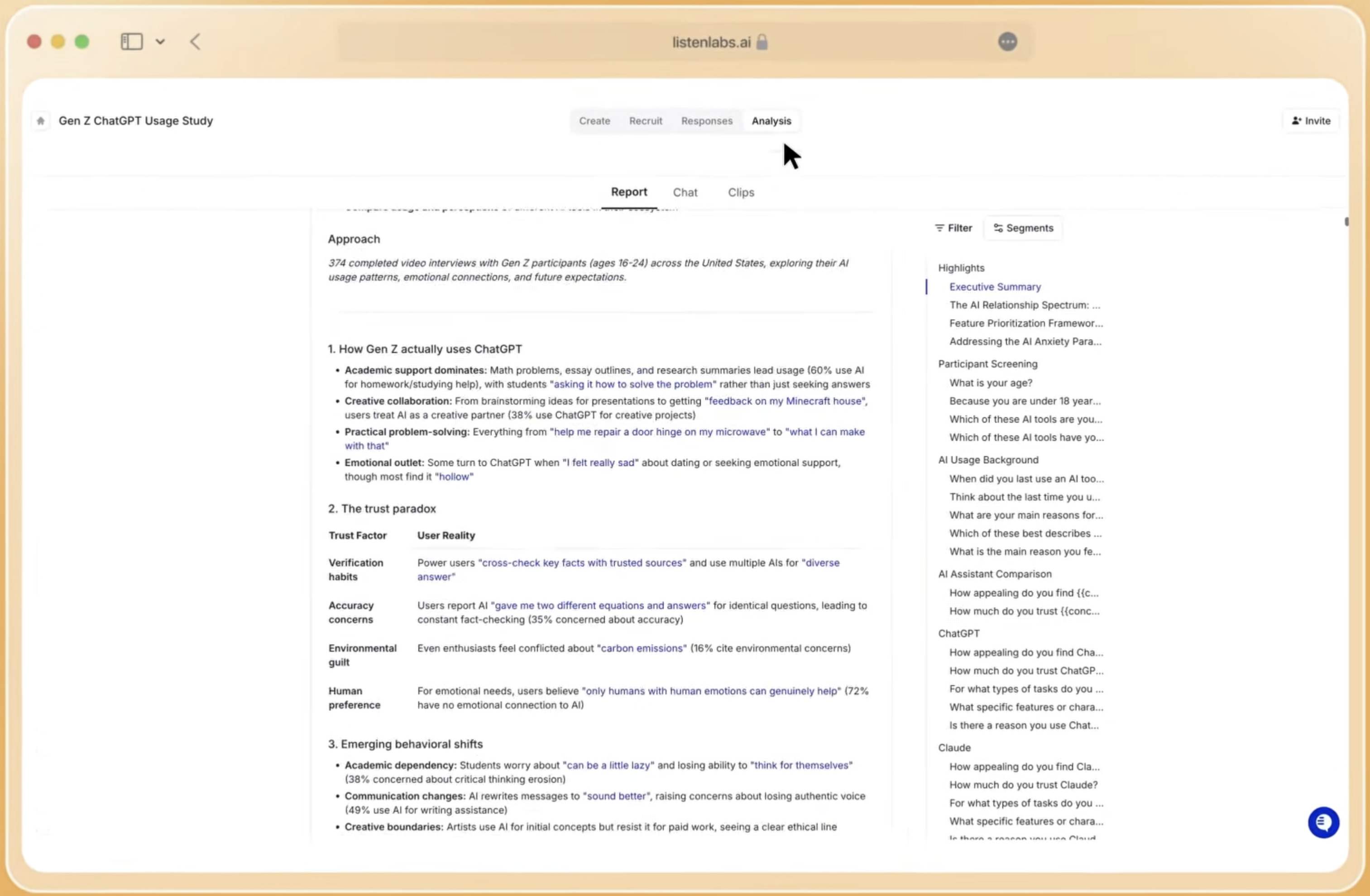
Capturing rich emotional and behavioral data only creates value when teams can analyze it quickly and objectively. Listen Labs’ Research Agent processes all interview data objectively, identifying themes and patterns across hundreds of responses without human bias. One researcher ran a full buying intent analysis across three user segments in under a minute. The Research Agent generates consultant-quality PowerPoint slide decks, memo-style reports, video highlight reels, statistical charts, and segmentation breakdowns in under a minute, all traceable back to the underlying response data. AI-assisted analysis cuts reporting time by 50% to 80% for research operations compared to manual methods.
Global and multilingual reach for multi-market studies
Enterprise consumer insights programs increasingly require simultaneous research across multiple markets. Listen Labs supports studies in 45+ countries across the Americas, Europe, APAC, and MEA. AI-moderated interviews run in 100+ languages, with automatic translation and transcription built into the platform.
P&G has used Listen Labs for multi-market product claim evaluation, delivering more than 250 interviews with quantified themes and verbatim proof that shaped product and brand strategy. Skims validated campaign direction with thousands of high-income buyers overnight before a global launch, removing weeks of recruiting and panel sourcing while securing board-level buy-in on the findings.
Security and compliance for regulated enterprises
Enterprise procurement teams apply a consistent set of security requirements to any platform that handles customer data. Listen Labs holds SOC 2 Type II, GDPR, ISO 27001, ISO 27701, and ISO 42001 certifications. The platform uses 256-bit encryption, supports enterprise SSO, and maintains strict tenant isolation, so customer prompts, interview recordings, and response data are never used for AI model training. This policy is a non-negotiable requirement for most Fortune 500 legal and privacy teams and separates Listen Labs from general-purpose LLM tools that may use interaction data to improve underlying models.
Total cost of ownership compared to traditional agencies
A single large qualitative study through a traditional agency, covering recruitment, moderation, transcription, analysis, and report writing, can cost hundreds of thousands of dollars. For many B2B concept tests, AI-moderated interviews provide equivalent insights at substantially lower costs and faster timelines than full-service live moderated sessions.
Listen Labs replaces multiple vendors, including recruitment platforms, scheduling tools, moderation services, transcription providers, analysis software, and report writers, with a single subscription-plus-credit model. Enterprises pay for platform access and spend credits per participant recruited, with credit cost varying by audience difficulty. Microsoft’s Director of Data Science highlighted the ability to reach hundreds of users at roughly one-third of the cost of traditional methods.
Get a custom cost comparison for your research program in a personalized demo.
Workflow comparison: Listen Labs 24-hour research cycle
The Listen Labs research workflow covers five sequential stages in a single platform. Unlike traditional research that requires separate vendors for each step, which creates handoff delays and fragmented data, Listen Labs keeps all stages in one integrated system so projects move from idea to insight without coordination overhead.
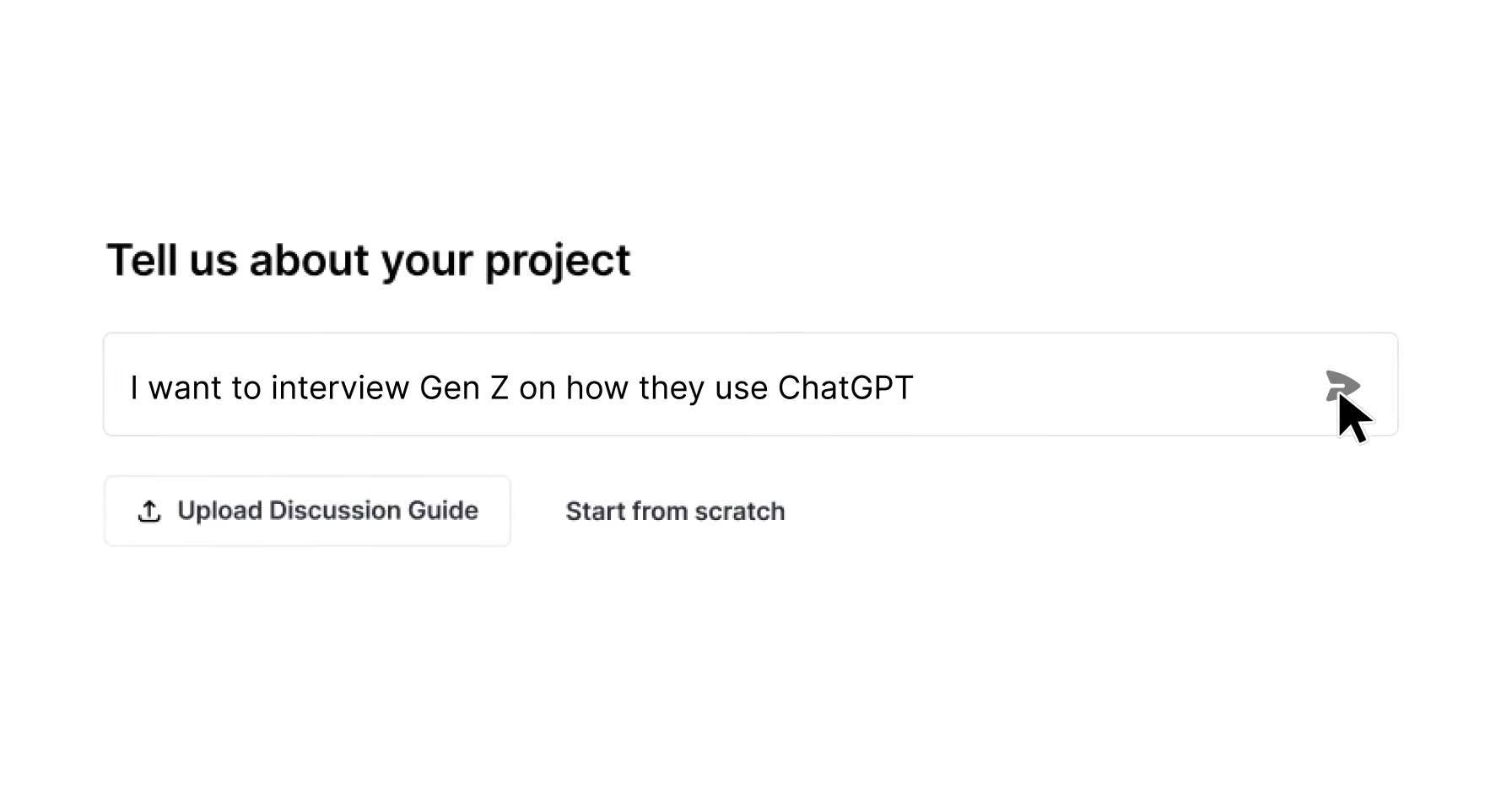
- AI-assisted study design: Describe research goals in natural language, and the AI drafts structured objectives, questions, and probing context. Advanced stimuli support includes images, video, PDFs, prototypes, and live URLs, with branching logic, quotas, and skip logic built in.
- Listen Atlas recruitment: The AI orchestration layer matches and bids on participants across Listen Labs’ verified network and partner panels. Organizations can also self-recruit from their own user base at reduced cost.
- AI-moderated interviews: The platform conducts personalized video interviews with dynamic follow-up questions, capturing video, audio, text, and screen recordings at the same time. Mixed-method formats combine qualitative depth with quantitative scales.
- Emotional Intelligence analysis: Multimodal signal analysis runs in parallel, quantifying emotional response per question and concept with timestamp-level traceability.
- Research Agent deliverables: Automated key findings, slide decks, memos, highlight reels, and statistical charts are generated in under a minute, with Mission Control storing all findings for cross-study queries and trend tracking.
How reliable is AI as a research assistant?
The primary gap identified in AI moderation involves missed follow-up threads on unexpected responses. Listen Labs addresses this directly. The AI is trained to probe short or surprising answers with dynamic follow-up questions, and the Research Agent flags thematic gaps in the data.
Hallucination risk, a legitimate concern with general-purpose LLMs, is mitigated in Listen Labs through full traceability. Every insight generated by the Research Agent links back to the specific interview response, timestamp, and verbatim quote that supports it. Robinhood used this traceable analysis to identify that users who view prediction markets as entertainment drive 2.4x higher weekly re-engagement than those who view them as income, a finding that directly shaped product integration decisions. P&G’s analytics and insight team used the same approach to validate product claim language before market launch.
Listen Labs functions as a force multiplier for existing research teams rather than a replacement. The platform handles logistics, moderation, and initial analysis so researchers can focus on strategic interpretation and stakeholder communication.
Scenario-based guidance for enterprise teams
Different enterprise roles share a common need for faster, higher-quality insights, yet each group evaluates AI research assistants through a slightly different lens.
- Consumer insights leaders at Fortune 500 companies need to multiply research output without proportional headcount increases. Listen Labs’ end-to-end platform allows the same team to run significantly more studies per quarter and clear the backlog of internal requests from product and brand teams.
- UX research leads need faster feedback loops that match sprint cycles. Listen Labs’ screen-sharing capability, 24-hour turnaround, and ability to test with 50–100+ users instead of 5–10 directly address the depth-versus-scale constraint in product development.
- Product managers and marketing leaders without research teams need self-serve simplicity. They describe research goals in natural language, and the platform handles study design, recruitment, moderation, and analysis, which removes the methodology expertise barrier.
- Consultancies and agencies need speed and niche audience access. Listen Labs’ dedicated recruitment operations team can source enterprise decision-makers, healthcare workers, and audiences below 1% incidence rate within the 24-hour cycle.
Decision framework for choosing the right tool
Matching research goals to the right tool type starts with four variables: the nature of the research question, the required timeline, audience accessibility, and budget constraints.
Teams should first clarify whether they need to synthesize existing academic literature or gather new customer insights, because these goals require different tools. Academic literature tools such as Elicit, Consensus, and SciSpace work well for synthesizing published research, mapping scholarly evidence, or conducting systematic reviews. They do not help teams understand what specific customers think, feel, or need.
For customer insight work, the next decision point is timeline and sensitivity. Traditional qualitative agencies remain relevant for highly sensitive studies that require human moderator judgment. The four-to-six-week timeline and high cost make them a poor fit for continuous insight programs or time-sensitive product decisions.
Quantitative survey tools fit large-scale measurement of known variables but cannot uncover unexpected findings, emotional nuance, or the “why” behind behavioral patterns. Listen Labs fits best when teams need to understand customer motivations, test concepts or creative, validate product direction, or run continuous consumer intelligence programs, especially when speed, scale, participant quality, and enterprise security all matter at once.
Frequently Asked Questions
How long does a Listen Labs study take from start to finish?
The full research cycle, from study design through AI-moderated interviews to final deliverables, completes in under 24 hours for most studies. This window includes AI-assisted study design, participant recruitment from Listen Labs’ verified network, interview moderation, emotional signal analysis, and generation of slide decks, memos, and highlight reels. Complex studies that target hard-to-reach audiences may take slightly longer due to recruitment operations, but the platform still compresses work that traditionally takes four to six weeks into roughly a single business day.
How many participants can a single study include?
Listen Labs supports studies that range from small targeted samples to hundreds of simultaneous AI-moderated interviews. Because the AI conducts interviews in parallel rather than sequentially, scheduling and moderator availability do not create a practical upper limit. Anthropic ran more than 300 interviews in 48 hours, and Skims validated campaign direction with thousands of participants overnight. The platform supports both one-off studies and ongoing research programs with recurring participant pools.
What languages does Listen Labs support?
Listen Labs supports more than 100 languages for AI-moderated interview conduct, with automatic translation and transcription built into the platform. Emotional Intelligence analysis is available across 50+ languages. The global panel covers 45+ countries across the Americas, Europe, APAC, and MEA, which makes simultaneous multi-market studies straightforward without separate regional vendors.
How does Listen Labs pricing work?
Listen Labs uses a subscription-plus-credit model. Enterprises pay for platform access, which includes a set number of studies and credits, and then spend credits per participant recruited. Credit cost varies based on audience difficulty, so general population studies require fewer credits than niche or hard-to-reach segments such as enterprise decision-makers or healthcare professionals. Companies with more than 100 employees go through a demo and pilot process. Smaller organizations can access the platform through a self-serve option. Total cost of ownership is approximately one-third of equivalent traditional agency spend.
How does Listen Labs protect customer data?
Listen Labs holds SOC 2 Type II, GDPR, ISO 27001, ISO 27701, and ISO 42001 certifications. The platform uses 256-bit encryption and supports enterprise SSO. Customer data, including interview recordings, transcripts, and response data, is never used for AI model training. Tenant isolation ensures that data from one organization does not influence outputs for another. These certifications and policies meet the security requirements of Fortune 500 legal, privacy, and IT procurement teams.
Conclusion: Selecting an AI research assistant for customer understanding
The term “AI research assistant” covers two distinct product categories with separate use cases. Academic literature tools synthesize published research. Commercial customer-research platforms replace slow, fragmented, and expensive traditional qualitative workflows with an end-to-end system that delivers verified participant recruitment, AI-moderated interviews, emotional signal capture, objective analysis, and stakeholder-ready deliverables, all within a single rapid cycle.
For enterprise insights leaders, UX research leads, product managers, and agencies evaluating options against the eight criteria covered above, research cycle time, depth versus scale, participant quality, emotional intelligence, analysis objectivity, global reach, security compliance, and total cost of ownership, Listen Labs is the only platform that addresses all eight within a single integrated workflow. The platform is trusted by Microsoft, Google, Sony, Anthropic, Robinhood, P&G, Skims, Levi’s, and Nestlé, with a track record spanning over one million customer interviews.
Explore how Listen Labs can compress your research lifecycle into a single business day.