
Written by: Anish Rao, Head of Growth, Listen Labs | Last updated: July 10, 2026
Key Takeaways
- Enterprise AI qualitative research platforms need to cover sourcing, AI-moderated interviews, analysis, and compliant deliverables in one governed environment.
- Listen Labs completes full research cycles in under 24 hours while capturing emotional signals from tone, expression, and word choice with full timestamp traceability.
- Quality Guard and Listen Atlas maintain high-quality global samples across 45+ countries with fraud detection and participant frequency limits that remove professional respondents.
- The platform supports diverse methodologies from IDIs and usability testing to mixed methods, with a governance stack that includes SOC 2 Type II, ISO 27001, ISO 27701, and ISO 42001.
- Listen Labs replaces multiple vendors with a single subscription model and has delivered over one million interviews for enterprise clients like Microsoft and Anthropic—see how it accelerates your research in a personalized walkthrough.
Enterprise Standards for AI Qualitative Research Platforms
Roughly 72% of insights teams use some form of AI in qualitative research in 2026, up from 31% two years earlier. This widespread adoption does not mean all platforms meet enterprise requirements, because many tools that work for small teams lack the governance, scale, and integration capabilities that Fortune 500 procurement demands. Procurement, legal, and security stakeholders apply a distinct set of requirements before any platform reaches a large-enterprise contract. The following evaluation framework helps VP- and Director-level Consumer Insights leaders compare platforms such as Listen Labs, CoLoop, Dovetail, Conveo, and NVivo across the capabilities that matter most in enterprise procurement.
Research Speed Across the Full Project Lifecycle
Traditional qualitative research cycles often run 4 to 6 weeks from study design to final report, and in large enterprises internal prioritization and budget approval can extend that to six months. AI-moderated interview platforms deliver in-depth qualitative findings in three days rather than the four to six weeks typical of agency-led programs. Listen Labs compresses the full cycle, including study design, participant sourcing, AI-moderated interviews, automated analysis, and deliverable generation, into this single-day window.
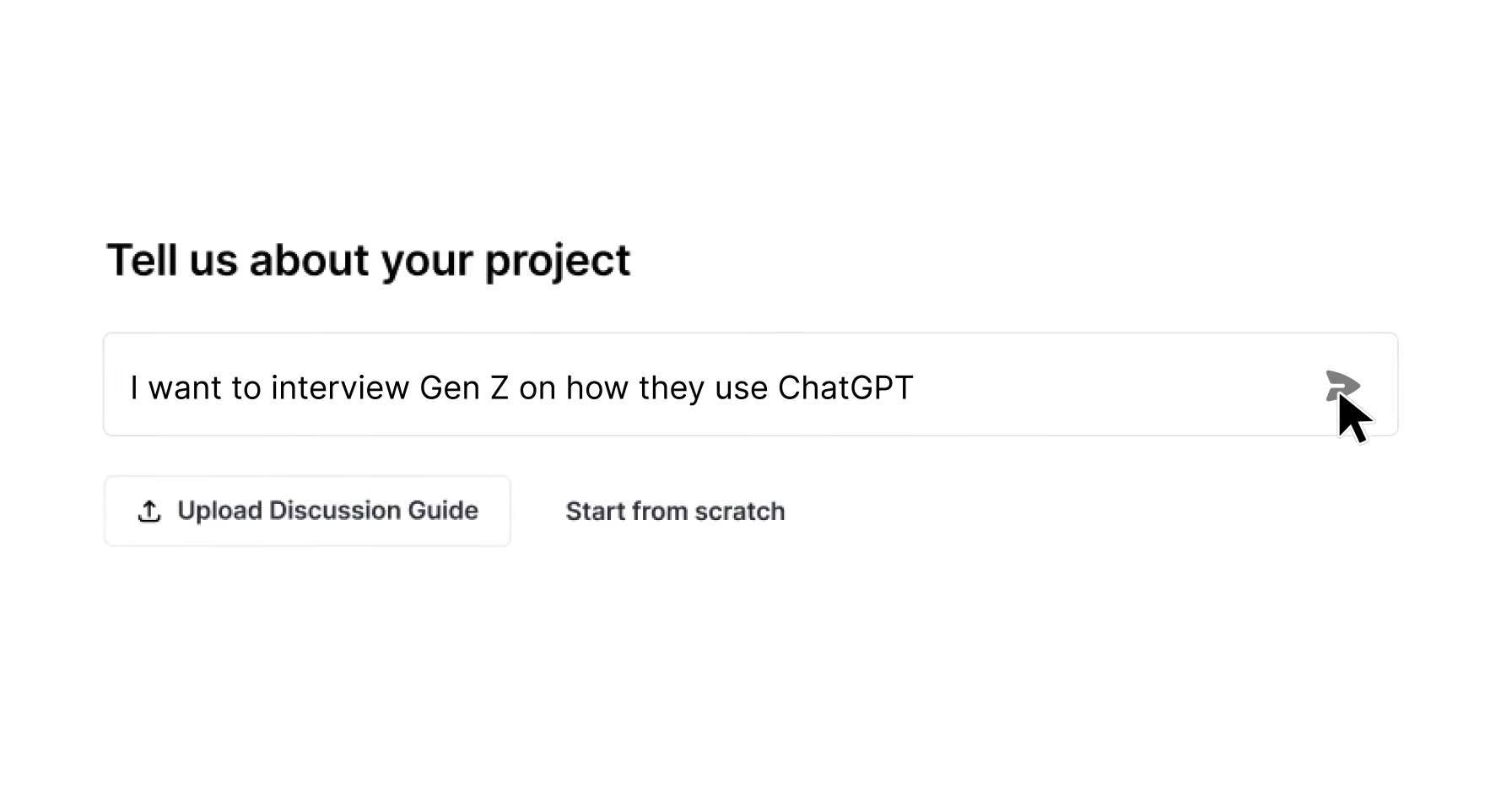
This interview volume includes companies such as Microsoft, Perplexity, and Sweetgreen. These deployments demonstrate speed at enterprise scale. The Microsoft team collected global customer video stories for the company's 50th anniversary within a single day. Anthropic's Claude Code team completed 300+ user interviews in 48 hours, surfacing churn drivers five times faster than prior methods.
Analysis-only tools like Dovetail and NVivo do not conduct interviews, so they cannot contribute to sourcing or moderation speed. Platforms that rely on human moderators introduce scheduling bottlenecks that AI-led systems remove. With qual-at-scale, the old trade-off between depth and scale no longer blocks decision-making, because AI can schedule and conduct interviews, analyze transcripts for themes, and generate quantitative insights from those interviews simultaneously across hundreds of participants.
See a 24-hour research cycle in action to understand how Listen Labs compresses the timeline from study design to deliverables.
Emotional Intelligence and Traceable Insight Depth
Transcript-only platforms capture what participants say but miss tone of voice, micro-expressions, and hesitation, which often contradict verbal responses. Listen Labs' Emotional Intelligence feature analyzes three layers at once: tone of voice, word choice, and subconscious micro-expressions. The system uses Ekman's universal emotions framework, a standard in clinical psychology and UX research, so emotional labels follow a proven structure rather than ad hoc categories. It tracks anger, anticipation, disgust, fear, joy, sadness, trust, and surprise.
Every emotional label connects to the exact timestamp, verbatim quote, and the reasoning behind the classification. This clear evidence chain separates the approach from black-box summarization tools that produce theme labels without audit-ready support. Enterprise buyers require an unbroken evidence chain, from AI theme to verbatim quote to timestamped video clip to participant metadata, to pass compliance, legal, and stakeholder scrutiny. Platforms missing any element frequently stall before a procurement decision.
NVivo supports manual coding with human-defined categories but does not perform multimodal emotional signal analysis. CoLoop and Dovetail offer theme clustering from transcripts without timestamp-level emotional traceability. Listen Labs' Emotional Intelligence works across 50+ languages and connects directly to the Research Agent for natural-language queries, charts, and highlight reels of emotionally significant moments.
Sample Quality Controls and Global Reach
Enterprise-grade AI platforms need strong fraud detection that identifies problematic responses before they contaminate results. Listen Labs' Quality Guard monitors every interview in real time across video, voice, content, and device signals. Participants are limited to three studies per month, which removes professional survey-takers and reduces fatigue. A dedicated recruitment operations team adds a human review layer for audiences below 1% incidence rate, including enterprise decision-makers, healthcare workers, and highly specialized consumer segments.
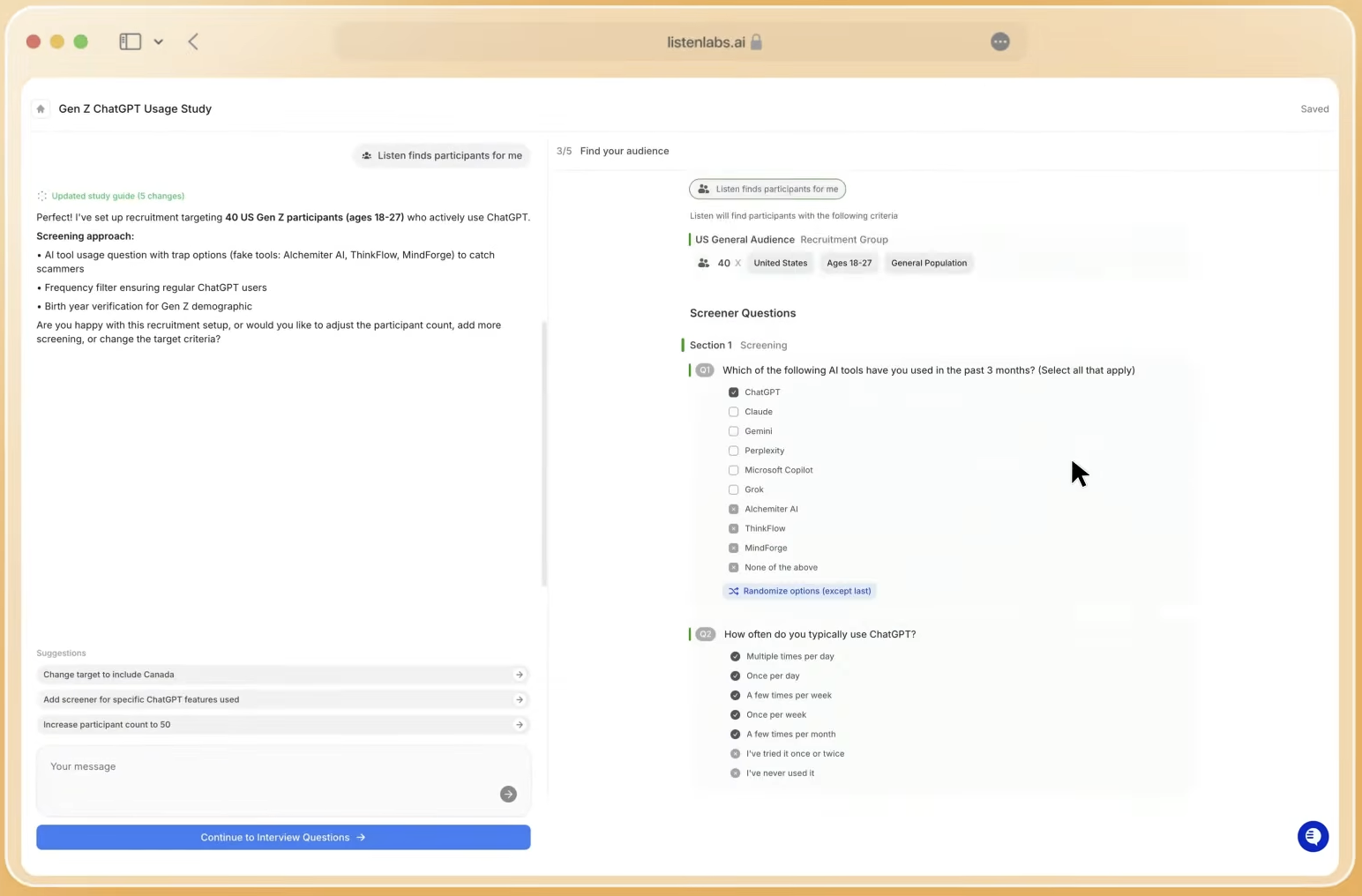
Listen Atlas, the platform's AI orchestration layer, matches and bids across Listen Labs' proprietary database and multiple consumer and B2B panel partners, drawing on a global network of 30 million verified respondents across 45+ countries and 100+ languages. This multi-source approach gives enterprises flexibility, because organizations can also self-recruit from their own user base at reduced cost when they already hold the relationship and consent framework. Both approaches avoid the commodity panels used by some competitors, which carry persistent risks of incentive-driven responses and repeat respondents that Quality Guard is specifically designed to prevent.
Methodological Coverage for Enterprise Research Teams
Platforms like Listen Labs layer on auto-recruiting, transcription, sentiment tagging, and insight summarization so teams move from question to findings in hours, not weeks. Study types supported include free-flowing in-depth interviews, semi-structured interviews, usability testing with screen sharing, including iOS mobile screen recording, creative testing, concept and prototype testing, brand perception studies, consumer journey mapping, ad testing, pricing research, and diary or ethnographic formats.
Advanced stimuli support covers images, video, audio, PDFs, prototypes, and live URLs. Logic capabilities include monadic and sequential randomization, quotas, branching, skip logic, piping, and version control. Mixed-method designs combine qualitative questions with Likert scales, NPS, sliders, grids, and MaxDiff in a single study. NVivo requires researchers to import data from external sources before analysis begins. Survey tools like Qualtrics scale but cannot probe or follow up dynamically. Focus groups introduce group dynamics and social desirability bias that one-on-one AI-moderated interviews structurally avoid.
Analysis Transparency and Governance for AI Research
AI data governance is the key to scaling AI in 2026, and enterprise AI governance frameworks now require traceability, auditability, and explainability as baseline requirements rather than differentiators. The AI governance landscape as of April 2026 maps requirements across the EU AI Act, NIST AI RMF, and ISO 42001, creating a multi-standard compliance environment that enterprise procurement teams enforce.
Listen Labs maintains the governance certifications outlined earlier, plus GDPR compliance. Customer data is never used for AI model training. Enterprise SSO is supported. Every insight generated by the Research Agent links back to the source interview, timestamp, and verbatim quote, which gives teams a clear audit trail. Many leaders do not yet have mature AI governance in place, so certification documentation becomes a meaningful differentiator during procurement review. Platforms that produce summarized outputs without an auditable evidence chain create compliance exposure for enterprise buyers.
Total Cost of Ownership for AI Qual Platforms
Traditional qualitative research can add significant time and cost to a large quantitative program when commissioned as a separate engagement. Listen Labs replaces multiple vendors, including recruitment platforms, scheduling tools, moderation services, transcription providers, analysis software, and report writers, with a single subscription-plus-credit model. Enterprises run more studies at roughly one third of the cost of the traditional multi-vendor approach.
Credit cost varies by audience difficulty, so general population studies consume fewer credits than niche or hard-to-reach segments. Mission Control, the platform's cross-study knowledge base, compounds the return on each study by making past findings queryable in seconds and reducing re-research of previously answered questions. Analysis-only tools require separate spend on recruitment, moderation, and transcription before any repository value appears.
Enterprise Case Results That Validate the Criteria
The speed, sample quality, and cost criteria outlined above translate into measurable outcomes at Fortune 500 scale. Three cases illustrate how Listen Labs delivers on these requirements in production environments:
- Microsoft: Collected global customer video stories for the company's 50th anniversary within one day. The Director of Data Science at Microsoft stated, "I can reach out to hundreds of users at one third of the cost."
- Anthropic (Claude Code): Completed 300+ user interviews in 48 hours, surfaced churn drivers five times faster, identified migration destinations such as OpenAI and Gemini, and delivered a prioritized list of ten must-fix items and feature gaps.
- Procter & Gamble: Ran 250+ interviews with quantified themes and verbatim proof delivered in hours, revealing where product claims felt exaggerated or unclear before market launch and showing that comfort, safety, and reliability outranked novelty in consumer priority.
Review case results for your industry and see how Listen Labs delivers similar outcomes for your research objectives.
Risks, Limitations, and When AI Tools Fit
AI tools cannot replace researcher expertise in complex judgment calls, nuanced interpretation, or strategic recommendations, and sensitive topics or VIP respondents may still require human moderators. Hallucinations and information accuracy remain the most common concerns among research professionals using AI tools. Listen Labs addresses this through full traceability, because every theme and finding links to the source verbatim and timestamp, so researchers can verify outputs rather than accept black-box summaries.
Analysis-only tools like NVivo remain appropriate when teams already hold large transcript archives from externally conducted studies and need structured coding without conducting new fieldwork. Change management represents a real adoption cost. Adopting AI research tools requires training and workflow changes that the tools alone cannot solve. Listen Labs' in-house research team, with 50+ years of combined expertise, provides methodology support throughout onboarding and ongoing use.
Criteria-Based Decision Checklist
Use the following checklist to map platform capabilities to your team's requirements before entering a procurement process:
- Speed: Does the platform deliver a complete research cycle, from sourcing through deliverables, in under 24 hours?
- Emotional intelligence: Does the platform capture multimodal signals such as voice, expression, and word choice with timestamp-level traceability?
- Sample quality: Does the platform enforce participant frequency limits, real-time fraud detection, and non-commodity panel sourcing?
- Global reach: Does the platform support 45+ countries and 100+ languages natively, including self-recruitment options?
- Methodological flexibility: Does the platform support IDIs, usability testing, stimuli, logic, and mixed methods in a single study?
- Governance stack: Does the platform hold SOC 2 Type II, ISO 27001, ISO 27701, and ISO 42001 certifications with full audit trails?
- Traceability: Is every AI-generated insight linked to a verbatim quote, timestamp, and participant record?
- Total cost of ownership: Does the platform replace multiple vendors under a single subscription, including recruitment, moderation, analysis, and reporting?
- Enterprise references: Has the platform been validated at Fortune 500 scale with named, quantified outcomes?
Frequently Asked Questions
What security certifications should an enterprise AI qualitative research platform hold?
Enterprise procurement and security teams typically require SOC 2 Type II as a baseline, confirming that security controls have been independently audited over a sustained period. ISO 27001 covers information security management systems, ISO 27701 extends that to privacy information management, and ISO 42001 specifically addresses AI management systems, which now appears as a standard requirement as organizations apply AI governance frameworks aligned with the EU AI Act and NIST AI RMF. GDPR compliance is mandatory for any platform handling data from EU residents. Listen Labs holds all five certifications and does not use customer data for AI model training.
How does Listen Labs prevent low-quality or fraudulent participants from entering a study?
Quality Guard applies three layers of protection. First, Listen Labs works exclusively with non-commodity panel sources, excluding platforms known for professional survey-takers. Second, real-time AI monitoring analyzes video, voice, content, and device signals during every interview to detect fraud, low-effort responses, AI-generated scripts, and mismatched profiles. Third, participants are limited to three studies per month across the platform, which prevents panel fatigue and repeat-respondent bias. A dedicated recruitment operations team adds a human review layer for hard-to-reach segments below 1% incidence rate.
Can enterprise teams use their own participants instead of the Listen Labs panel?
Yes. Listen Labs supports self-recruitment, allowing organizations to source participants from their own customer base, CRM, or community at a reduced credit cost. Teams can also bring their own panel provider. This approach works well for proprietary customer communities, loyalty program members, or B2B account holders where the enterprise already holds the relationship and consent framework.
How does Listen Labs handle multilingual research across global markets?
The platform supports 100+ languages for interview moderation, with automatic transcription and translation across all supported languages. Emotional Intelligence is available across 50+ languages. Listen Atlas, the recruitment orchestration layer, sources participants across 45+ countries in the Americas, Europe, APAC, and MEA. Studies can run simultaneously across multiple markets without sequential execution, which removes the scheduling bottlenecks that make traditional multi-market qualitative programs slow and expensive.
What deliverables does Listen Labs generate, and how quickly?
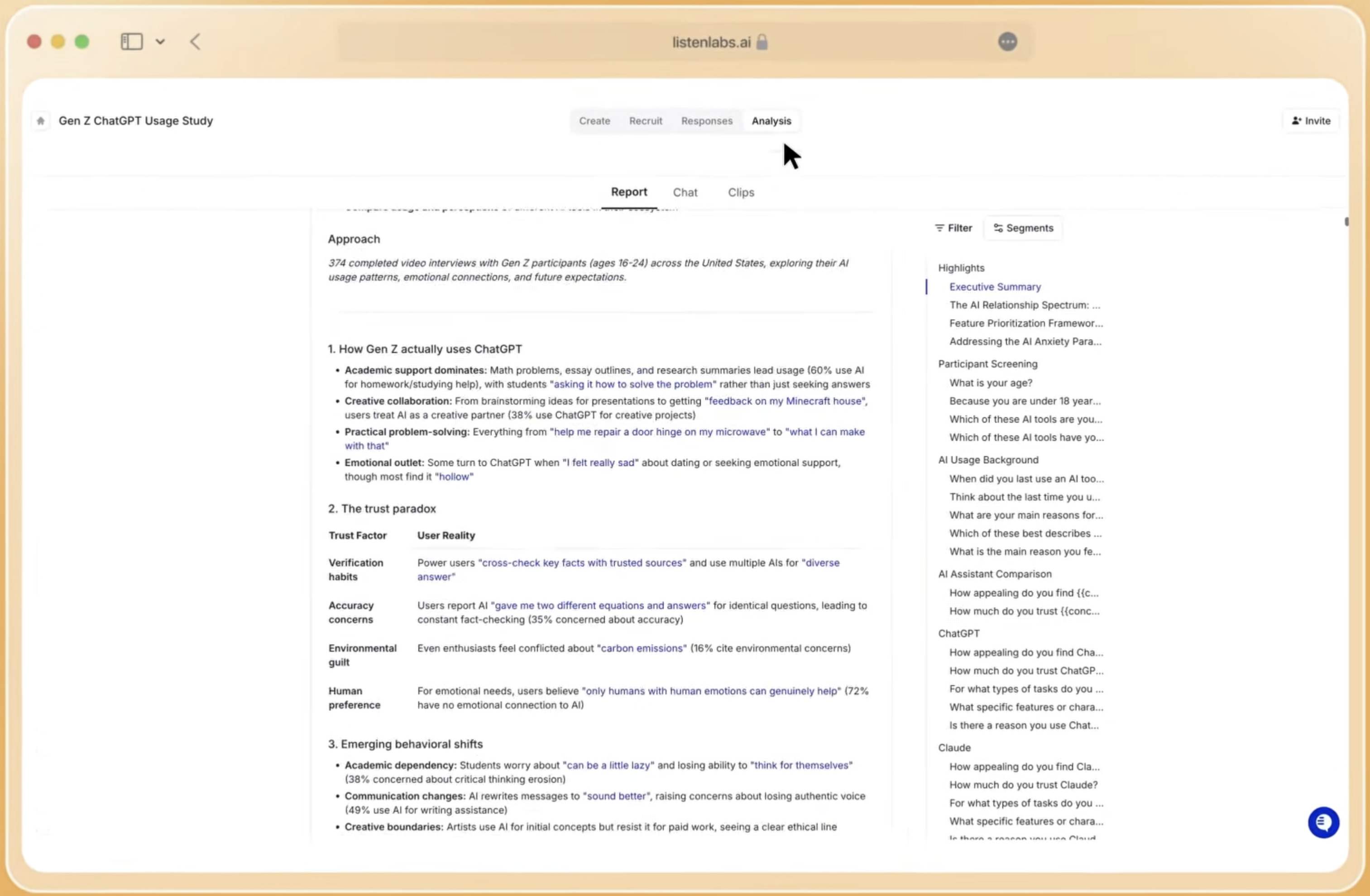
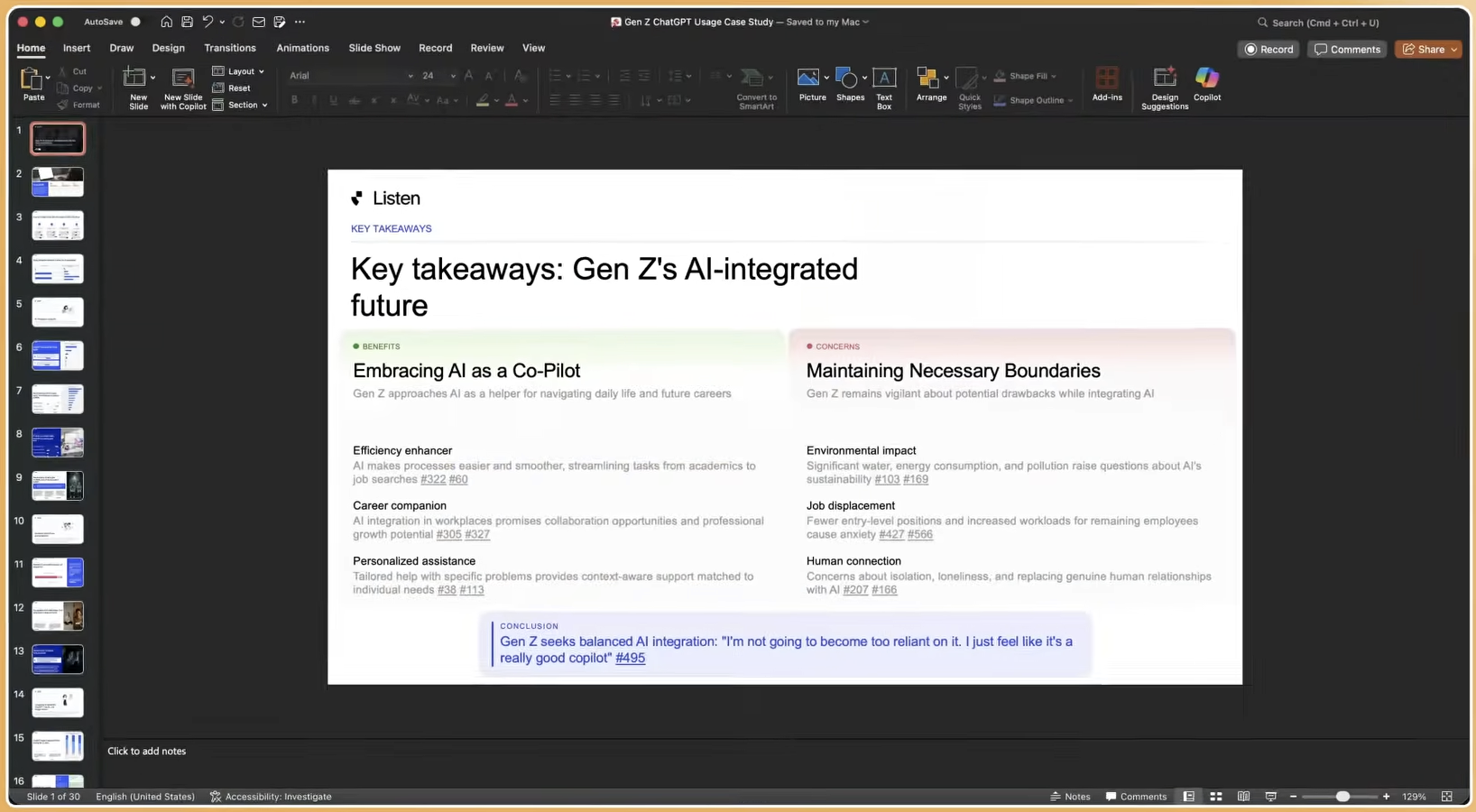
The Research Agent generates deliverables in under a minute from completed interview data. Outputs include automated key findings and theme analysis, consultant-quality PowerPoint slide decks, memo-style reports, video highlight reels, statistical charts and comparisons, segmentation breakdowns by demographics or custom cohorts, and custom reports based on any natural-language query. Mission Control makes all findings from past studies queryable in seconds, which enables cross-study trend tracking and institutional knowledge building without manual report retrieval.
Conclusion: Applying the Evaluation Framework at Enterprise Scale
The criteria of research speed, emotional intelligence, sample quality, global reach, methodological flexibility, analysis transparency, governance stack, total cost of ownership, and enterprise references provide a complete evaluation framework for VP- and Director-level Consumer Insights leaders. AI can now schedule and conduct interviews, analyze transcripts for themes, and generate quantitative insights from qualitative interviews, which removes the depth-versus-scale trade-off that has constrained enterprise research programs for decades.
With the million-plus interview track record described earlier, Listen Labs serves hundreds of enterprise customers including Microsoft, Google, SKIMS, Nestlé, Sweetgreen, Perplexity, and Robinhood, delivering the speed advantage described earlier with a fully certified governance stack and traceable evidence on every insight. No other platform covers the complete research lifecycle from study design through recruitment, moderation, analysis, and deliverables under a single SOC 2 Type II, ISO 27001, ISO 27701, and ISO 42001 certified environment.
Walk through the platform against your requirements, including compliance needs, research backlog, and budget constraints.