
Written by: Anish Rao, Head of Growth, Listen Labs | Last updated: July 4, 2026
Key Takeaways
- Participant observation studies often stall at execution, not theory. Common friction points include observer role selection, real-time documentation, bias controls, and ethical exit.
- Observer role choice (non-participant, moderate, or full) depends on access, research risk, and whether an insider perspective is essential to the objectives.
- Teams reduce the Hawthorne effect by spending extended time in the setting, taking notes unobtrusively, and using consistent rapport-building techniques that fit enterprise constraints.
- Structured field notes, reflexivity journals, member checking, and triangulation across data sources reduce observer bias and confirm findings.
- Listen Labs enables teams to pair traditional fieldwork with AI-moderated interviews for faster validation and continuous discovery. See how it integrates with your qualitative workflows.
Step 1: Choose the Observer Role and Level of Participation
The first decision in any participant observation study is how much the researcher will participate in the setting being studied. Three positions exist along this spectrum.
A non-participant observer watches without joining activities. This role suits settings where researcher involvement would distort behavior or where access is limited to observation only, such as retail floor audits and call center monitoring. The tradeoff is reduced rapport and a higher risk that participants perform for the observer rather than behave naturally.
A moderate participant joins some activities while maintaining a research identity known to the group. This is the most common enterprise choice. It balances access and authenticity, works well in CPG in-home usage studies or tech onboarding observations, and keeps consent straightforward because participants know a researcher is present.
A full participant embeds completely, sometimes without disclosing researcher status. Covert observation should be a last resort, carefully justified, and reviewed by an institutional ethics board. For most enterprise studies, the legal and reputational risk outweighs the naturalism benefit.
The decision inputs are access (what the gatekeeper will permit), research risk (sensitivity of the setting), and study objectives (whether insider perspective is essential to the question). These inputs must be weighed together because access constraints often force tradeoffs with research objectives. Planning timelines for role selection often require several business days to work through these tradeoffs and involve the research lead, legal or compliance, and the business stakeholder sponsoring the study. The primary cost drivers at this stage are researcher time spent in these alignment discussions and any site-access fees.
Step 2: Set Clear Objectives and Secure Access Through Gatekeepers
Clear objectives prevent scope creep in the field. Each objective should name a specific behavior or decision the team needs to understand, the context in which it occurs, and the business question it informs. A CPG team studying pantry restocking behavior, for example, needs different objectives than a retail team studying checkout abandonment.
Gatekeeper identification follows objective-setting. Gatekeepers are the individuals or organizations that control access to the observation site and its participants. In enterprise settings, gatekeepers may be store operations managers, HR departments, community organizations, or platform administrators. Gaining access typically requires a formal research brief, a summary of consent procedures, and a data-handling commitment.
Consent considerations at this stage include whether individual participants will be informed before the study begins, what they will be told about the research purpose, and how they can withdraw. Informed consent is generally required as participants have a right to know they are being observed, although public low-risk settings may not require individual consent depending on institutional guidelines. Access timelines in applied research settings vary depending on the type of study and any required approvals.
Step 3: Build Rapport and Manage the Hawthorne Effect
The Hawthorne effect, the tendency of participants to alter behavior when they know they are being observed, is the central validity threat in participant observation. Teams can reduce it by spending extended time in the setting so participants acclimate, or by taking notes unobtrusively.
Rapport-building techniques that work within enterprise constraints include arriving early to allow informal conversation before formal observation begins, participating in low-stakes shared activities such as a team standup or a store walk, and being transparent about the research purpose without over-explaining it. Consistency matters. Visiting at the same time of day and interacting with the same individuals across sessions reduces novelty and the performance behavior it triggers.
Enterprise-specific constraints on rapport include time limits imposed by site access agreements, legal restrictions on what researchers can discuss with employees or customers, and the presence of cameras or security systems that remind participants they are in a monitored environment. Documenting these constraints in the study protocol allows the analysis team to weight observations accordingly.
Step 4: Take Jottings in the Field and Expand Them into Full Notes
Once rapport is established and the Hawthorne effect begins to diminish, the researcher’s focus shifts to capturing what they observe without disrupting the natural flow they have worked to create. Experienced field researchers develop a personal shorthand system for capturing observations in real time without breaking the flow of their presence in the setting. These in-the-moment jottings, such as symbols, abbreviated phrases, and quick sketches, are not the final record. They are the raw material that gets expanded into structured field notes as soon as possible after leaving the site, ideally the same day.
The following field-note template is designed to be copied into any shared document or note-taking tool:
- Date / Time / Location: [ISO date, HH:MM, site name or pseudonym]
- Participants present: [Role labels, not names, for example “Shopper A,” “Store Associate B”]
- Observed behavior: [Specific, descriptive account, including actions, sequences, and spatial movement. Use specific descriptive words rather than vague evaluative terms.]
- Verbatim dialogue: [Exact quotes or close approximations, in quotation marks]
- Emotional cues: [Non-verbal signals such as facial expression, posture, pace, or hesitation]
- Researcher interpretation: [Kept strictly separate from descriptive content, including possible meanings, hypotheses, and questions to follow up]
- Observer effect noted: [Any moment where researcher presence appeared to influence behavior]
The two-column method places raw factual observations on the left and reflections, questions, interpretations, and emotional reactions on the right, which maps directly to the template structure above. After each field session, write a brief “so what” memo: one paragraph on the most surprising observation and its possible meaning. These memos often become the backbone of analysis and final reporting.
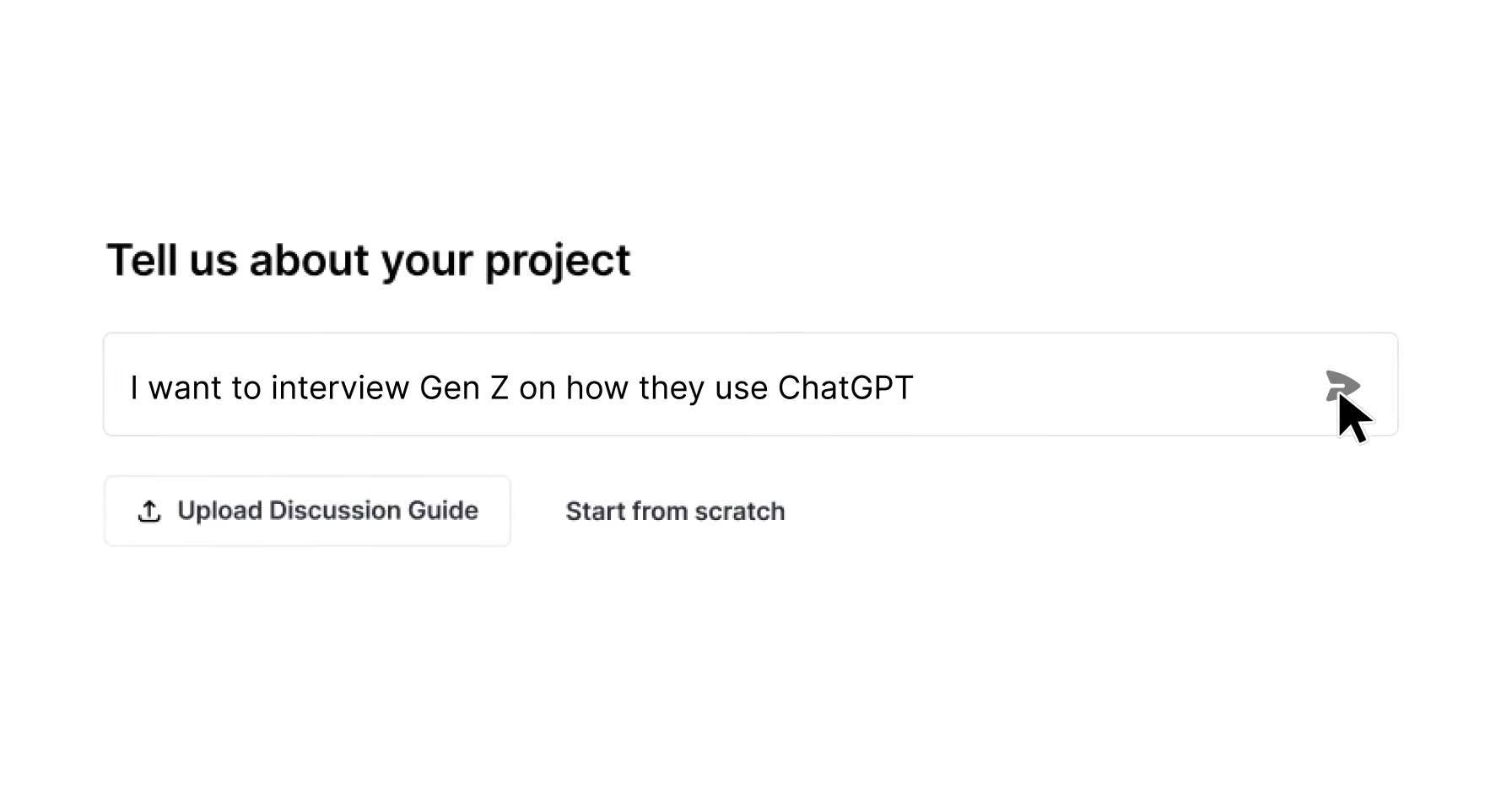
When fieldwork generates hundreds of sessions, AI-moderated interview platforms can run parallel in-depth interviews that validate and extend field observations at scale. See how Listen Labs handles this integration with existing qualitative workflows.
Step 5: Use a Reflexivity Journal to Surface and Reduce Bias
Observer bias, the tendency of researchers to unconsciously record what they expect or want to see, can be reduced through standardized observation forms, multiple observers, triangulation across data sources, and maintaining a separate reflective column to flag assumptions. A reflexivity journal turns this reduction into a systematic practice rather than an incidental one.
The following prompts can be copied into a shared team document and completed after each observation session:
- What did I expect to see today, and did my expectations match what occurred?
- Which moments surprised me, and why might that surprise reveal an assumption I hold?
- Whose perspective did I find easiest to adopt, and whose did I find hardest? What does that tell me?
- Did I record any observation using an evaluative word, such as “chaotic” or “efficient,” rather than a descriptive one? What specific behaviors would replace that word?
- Was there anything I chose not to write down? Why?
- How did my presence appear to affect the setting today?
- What questions am I carrying into the next session that I should not let become hypotheses?
Confirmability in qualitative observation is strengthened by reflecting on personal assumptions and inviting colleagues to review interpretations to reduce researcher bias. Scheduling a brief peer-review of reflexivity journals every two to three sessions builds this check into the project rhythm.
Step 6: Confirm Findings with Member Checking and Triangulation
Member checking is the practice of returning preliminary interpretations to participants or site contacts to verify accuracy. It does not mean asking participants to validate the researcher’s conclusions. It means confirming that the descriptions of observed behavior and context are factually accurate from the perspective of those who were present. In enterprise studies, member checking is often conducted through a brief follow-up conversation or a summary document shared with a gatekeeper contact.
Triangulation cross-validates findings across multiple data sources. Observer bias can be reduced through triangulation across data sources. In practice, this means comparing field-note themes against interview transcripts, survey data, behavioral analytics, or sales records. A retail team observing checkout behavior, for example, might triangulate field observations against transaction data and exit-survey responses to determine whether the friction points they observed are statistically representative.
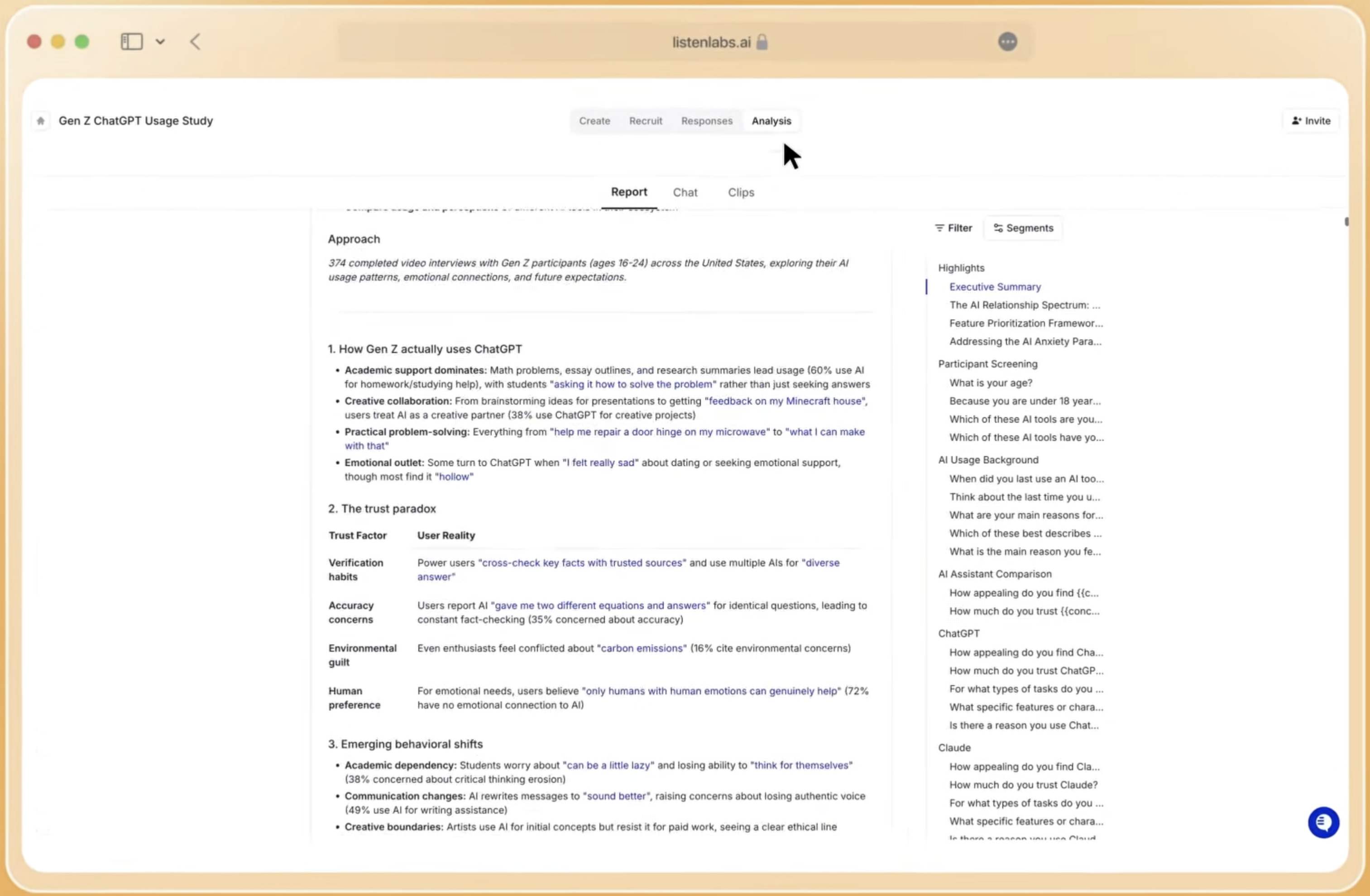
Mixed-methods sampling strengthens triangulation. Pairing participant observation with AI-moderated in-depth interviews conducted at scale across a broader sample allows teams to test whether patterns observed in a small field study hold across a larger and more diverse population. Listen Labs supports this workflow directly, enabling teams to move from field observation to scaled interview validation without switching platforms.
Step 7: Close the Study with Ethical Exit and Compliant Data Hand-Off
Ethical exit is the planned, respectful conclusion of the researcher’s presence in a site. Observation protocols should include a final step of withdrawing from the site respectfully, thanking participants, and clarifying any follow-up communication. In enterprise studies, this includes notifying gatekeepers of the study’s conclusion, confirming what data was collected and how it will be stored, and providing a summary of findings to site contacts where contractually appropriate. These commitments to gatekeepers and participants require specific data-handling actions that must be completed before the study can be considered fully closed.
The following compliance checklist covers the minimum requirements for enterprise data hand-off:
- All field notes anonymized using pseudonyms or role labels, with no participant names in final records
- Audio or video recordings stored in encrypted, access-controlled repositories
- Retention period confirmed and documented per organizational data policy
- Participant consent records archived separately from observation data
- Gatekeeper notified of study completion and provided agreed-upon deliverable summary
- Any incidental sensitive disclosures, such as health, financial, or legal information, flagged to legal or compliance before analysis proceeds
- Data destruction schedule confirmed for raw materials not required for final reporting
Confidentiality must be maintained through pseudonyms, secure note storage, and avoiding identifying details that could expose participants or sites. Listen Labs maintains SOC 2 Type II, GDPR, ISO 27001, ISO 27701, and ISO 42001 certifications, and customer data is never used for AI model training. These standards align directly with enterprise compliance requirements at the data hand-off stage. Discuss how Listen Labs fits your organization’s compliance framework.
Supporting Frameworks that Strengthen Participant Observation
A research funnel structures the scoping process before fieldwork begins. The funnel moves from broad business question to specific observation objectives to the behaviors and contexts that will be documented. A CPG team investigating how consumers decide which cooking oil to purchase might scope from “purchase decision drivers” to “in-aisle decision behavior” to “label-reading sequences and cart abandonment moments at shelf.” Each level of the funnel narrows the observation focus and reduces the risk of collecting unfocused data.
Mixed-methods sampling strategies for participant observation include purposive sampling, which selects sites and participants that represent the range of the phenomenon, maximum variation sampling, which deliberately includes diverse contexts to surface contrasting patterns, and theoretical sampling, which selects subsequent observation sites based on emerging themes from earlier sessions. The choice depends on whether the study goal is to describe a typical experience, map the full range of variation, or build and test a conceptual framework.
Insight-to-action workflows connect field findings to business decisions. In tech product development, observation findings typically feed into sprint planning or roadmap prioritization. In CPG, they inform packaging, messaging, or shelf placement decisions. In retail, they shape store layout, associate training, or digital-physical integration. Naming the downstream decision at the study design stage ensures that field-note templates capture the specific behavioral evidence those decisions require.
Participatory practices combined with participant observation are time-consuming, with sustained engagement difficult to maintain. Pairing field observation with AI-moderated interviews allows teams to extend the reach of their findings without proportionally extending the timeline.
Troubleshooting Common Participant Observation Pitfalls
Unclear objectives. Early-warning signal: researchers return from the first session with notes that cover everything and illuminate nothing. Mitigation: return to the research funnel and rewrite each objective as a specific observable behavior before the next session.
Gatekeeper resistance. Early-warning signal: access requests go unanswered or are granted with significant restrictions after initial agreement. Mitigation: involve legal and communications stakeholders in the access negotiation earlier, and prepare a one-page plain-language summary of the study’s purpose and data protections for gatekeeper review.
Low-quality field notes. Early-warning signal: notes contain evaluative summaries such as “the interaction was awkward” rather than specific behavioral descriptions. Mitigation: conduct a field-note review after the first two sessions using the template in Step 4, and schedule a peer calibration session before continuing.
Researcher burnout. Early-warning signal: reflexivity journal entries become shorter and less specific over successive sessions. Mitigation: rotate observers across sessions where possible, cap continuous observation blocks at ninety minutes, and build debrief time into the project schedule after each site visit.
Stakeholder misalignment. Early-warning signal: business sponsors begin requesting findings before fieldwork is complete or reframe the research question mid-study. Mitigation: establish a study brief sign-off process before fieldwork begins, and schedule a mid-study alignment check with sponsors to surface expectation gaps before they affect analysis. See how Listen Labs’ Research Agent keeps stakeholders aligned in real time without disrupting fieldwork.
Measuring Success in Participant Observation Studies
Study cycle time, the elapsed days from study brief approval to final deliverable, is the primary operational metric. Tracking it across studies reveals whether process improvements are reducing time-to-insight. Participation and completion rates measure whether the recruited sample was sufficient and whether attrition introduced bias. Theme consistency across observers and sessions indicates whether the observation protocol is producing reliable data or whether individual researcher variation is introducing noise. Downstream insight usage, such as whether findings were cited in a product decision, a campaign brief, or a strategic plan, is the ultimate measure of research value and is worth tracking explicitly in a research impact log.
Lightweight tracking methods include a shared spreadsheet updated after each session with cycle-time milestones, a brief post-study survey sent to business stakeholders asking whether findings influenced a specific decision, and a quarterly review of the research backlog to assess whether participant observation studies are being completed at a pace that meets organizational demand.
Advanced Strategies for Scaling Participant Observation
Scaling to multi-market studies requires standardizing the observation protocol across sites while allowing for local adaptation in rapport-building and gatekeeper engagement. A doctoral study combining participatory practices with participant observation across multiple European Union countries enabled deeper triangulation and trust-building than either approach alone. Enterprise teams running multi-market studies should assign a protocol owner responsible for cross-site consistency and schedule cross-market calibration sessions after the first observation wave.
Integrating behavioral signals such as transaction data, app usage logs, heatmaps, or sensor data alongside field notes strengthens triangulation and reduces the interpretive burden on observation alone. The combination of observed behavior and behavioral data is particularly powerful in retail and digital product contexts where the gap between what consumers say and what they do is well documented.
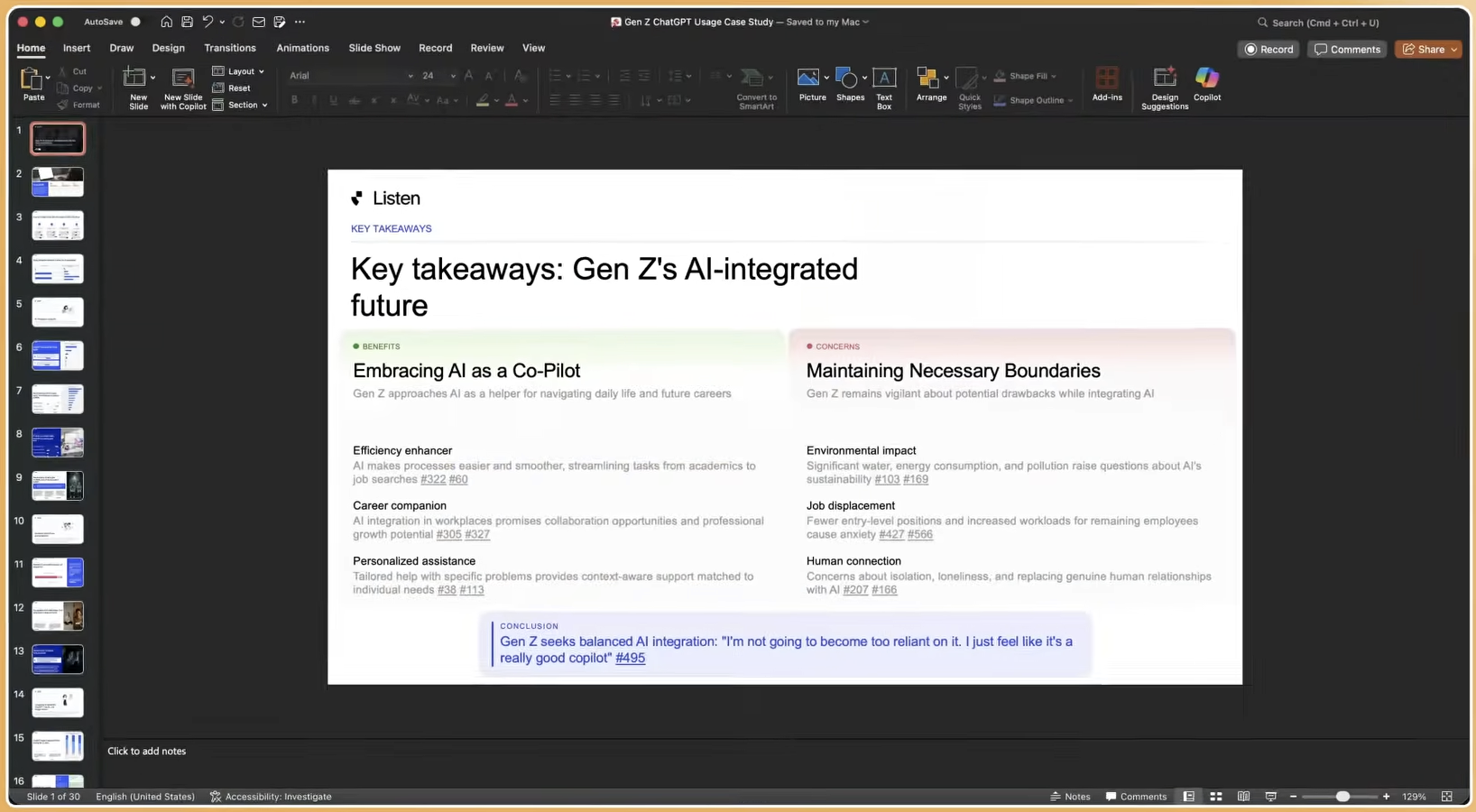
Piloting an always-on observation program requires three readiness criteria. Teams need a standardized field-note template in use across the team, a reflexivity practice embedded in the project rhythm, and a data hand-off process that meets compliance requirements without manual intervention. Teams that meet these criteria can move from periodic observation studies to continuous discovery programs. Listen Labs supports this transition by enabling parallel AI-moderated interview programs that run continuously alongside fieldwork, feeding findings into a shared knowledge base accessible across the organization. Explore always-on research program design with the Listen Labs team.
Frequently Asked Questions
How long does a participant observation study typically take from planning to final report?
Applied enterprise studies often run several weeks end-to-end when factoring in gatekeeper access, fieldwork sessions, note expansion, analysis, and reporting. The planning phase, which includes objective-setting, role selection, consent preparation, and access negotiation, accounts for part of that total. Studies in regulated industries or community settings can take longer due to ethics review requirements. Teams that pair field observation with AI-moderated interviews for triangulation can compress the analysis and reporting phase significantly, since interview data is analyzed automatically rather than manually coded.
Do non-researchers on product or marketing teams need formal training to conduct participant observation?
Some foundational training is necessary. Non-researchers typically need instruction in the difference between descriptive and evaluative note-taking, the basics of the Hawthorne effect and how to mitigate it, consent procedures, and the reflexivity practice. A half-day workshop covering these topics, combined with a supervised practice session in a low-stakes setting before real fieldwork begins, is sufficient for most enterprise contexts. The field-note template and reflexivity prompts in this guide are designed to support non-researchers in the field without requiring advanced methodological training.
How do enterprise teams handle privacy and compliance in participant observation studies?
Compliance requirements vary by industry, geography, and the sensitivity of the observation setting. At minimum, enterprise studies should have documented consent procedures, anonymized field notes, encrypted storage for any recordings, and a defined data retention and destruction schedule. Studies involving employees, minors, healthcare settings, or financial services contexts require additional review. GDPR applies to any study involving participants in the European Union regardless of where the research team is based. Teams should involve legal and compliance stakeholders at the objective-setting stage, not after fieldwork has begun.
When should a participant observation study be repeated or retired?
A study should be repeated when a significant change in the context being observed, such as a product launch, a store redesign, a policy change, or a market shift, makes prior findings potentially obsolete. It should also be repeated when triangulation reveals that field observations conflict with other data sources in ways that cannot be explained by the existing dataset. A study should be retired when successive observation sessions produce no new themes and findings have been consistently validated across multiple data sources, a state researchers call theoretical saturation. Tracking theme consistency across sessions, as described in the Measuring Success section, provides the evidence needed to make this call confidently.
How do participant observation findings connect to quantitative research programs?
Participant observation is most valuable as a source of hypotheses and behavioral descriptions that quantitative instruments can then test at scale. Themes identified in field notes become survey items. Behaviors observed in specific contexts become segments for quantitative analysis. Verbatim dialogue becomes the language used in concept statements or ad copy tested with larger samples. The connection works in the other direction as well. Quantitative anomalies, such as an unexpected drop in a satisfaction metric or a spike in a behavioral signal, can trigger a participant observation study designed to explain what the numbers cannot. AI-moderated interview platforms like Listen Labs occupy the middle ground, delivering qualitative depth at quantitative scale and enabling teams to move fluidly between discovery and validation without switching research infrastructure.
Conclusion
Participant observation delivers reliable customer understanding when teams execute each of the seven steps with discipline. These steps include selecting the right observer role, securing access through gatekeepers, managing the Hawthorne effect through rapport, capturing structured field notes in real time, maintaining a reflexivity practice, verifying findings through member checking and triangulation, and exiting the field with a compliance-ready data hand-off. Each step has a corresponding template or checklist in this guide that teams can copy and adapt without starting from scratch.
The shift toward always-on customer intelligence means these steps are no longer reserved for annual deep-dive studies. Teams that build participant observation into a repeatable operational rhythm, supported by AI-moderated interview programs that validate and extend field findings at scale, produce a continuous stream of insight that keeps pace with product development, campaign planning, and strategic decision-making. See how Listen Labs compresses the research cycle from weeks to hours while preserving the rigor this playbook describes.