
Written by: Anish Rao, Head of Growth, Listen Labs | Last updated: July 8, 2026
Key Takeaways for 2026 Enterprise Buyers
- Traditional qualitative research cycles of 4–6 weeks create growing backlogs that leave insights arriving after business decisions have already been made.
- Fragmented tool stacks with separate vendors for recruitment, moderation, and analysis introduce delays, cost, and quality risks that slow enterprise research programs.
- Enterprise platforms must be evaluated across nine criteria: (1) study design flexibility, (2) participant quality at volume, (3) moderation depth, (4) emotional signal capture, (5) analysis workflow and deliverables, (6) enterprise security and compliance, (7) global reach and multilingual support, (8) operational requirements and change management, and (9) risks and limitations.
- End-to-end AI platforms that handle the complete workflow from design through reporting can deliver results in under 24 hours while maintaining depth and enterprise-grade compliance.
- Listen Labs addresses the research backlog problem with AI-moderated interviews, real-time quality controls, and cross-study knowledge management. See Listen Labs in a live demo.
Study Design Control and Methodological Flexibility
Researchers need tight control over study design to trust qual-at-scale results. Analysis-only tools like Dovetail organize research conducted elsewhere and offer no design layer at all. Survey platforms like Qualtrics provide structured question builders but no adaptive interview logic. End-to-end AI platforms vary significantly in how they support branching logic, stimuli presentation, mixed methods, and iterative design.
The strongest platforms in this category support AI-assisted co-design, where researchers describe goals in natural language and the platform drafts structured objectives, questions, and probing context, alongside template libraries for common study types. Advanced capabilities that enable complex research designs without custom development include monadic and sequential randomization for unbiased concept testing, quota controls for representative samples, skip logic and piping for personalized flows, and the ability to show images, video, audio, PDFs, prototypes, or live URLs within an interview. These features remove setup work that usually adds days to timelines. Listen Labs covers this full range, with auto-QA that flags issues in the study guide before launch and version control that supports rapid refinement between waves.
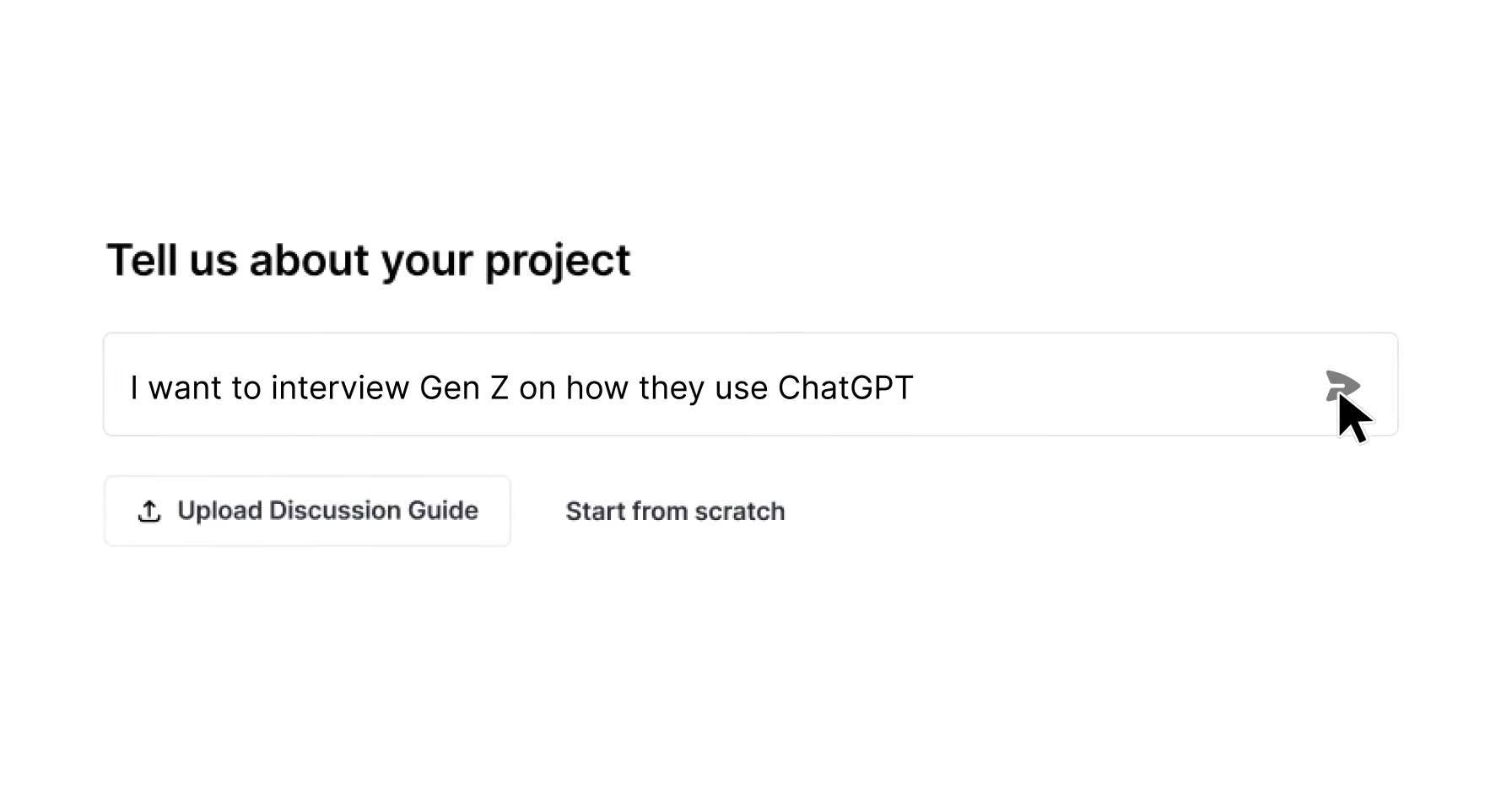
Participant Sourcing and Quality Controls at Volume
Participant quality determines whether a qual-at-scale program produces trustworthy insight. Market research panels aggregating tens of millions of participants can produce 30–40% problematic responses without proper safeguards, while researcher-centric platforms that vet participants during onboarding achieve problematic data rates of 5% or less. Sample fraud rates can be higher on third-party panels compared to first-party recruiting from a company's own customer list.
Platforms that rely on commodity panels, without frequency limits, behavioral verification, or real-time monitoring, expose enterprise research programs to professional survey-takers and incentive-driven responses that degrade data quality at scale. Research professionals often report difficulty recruiting for specialized studies, particularly niche B2B decision-makers or underrepresented populations.
Listen Labs addresses this through Listen Atlas, an AI orchestration layer that matches across behavioral and intent data across a 30M verified respondent network spanning 45+ countries. Quality Guard monitors every interview in real time across video, voice, content, and device signals. Participants are capped at three studies per month, which removes the professional survey-taker problem. A dedicated recruitment operations team handles hard-to-reach segments that automated panel matching cannot reliably source.
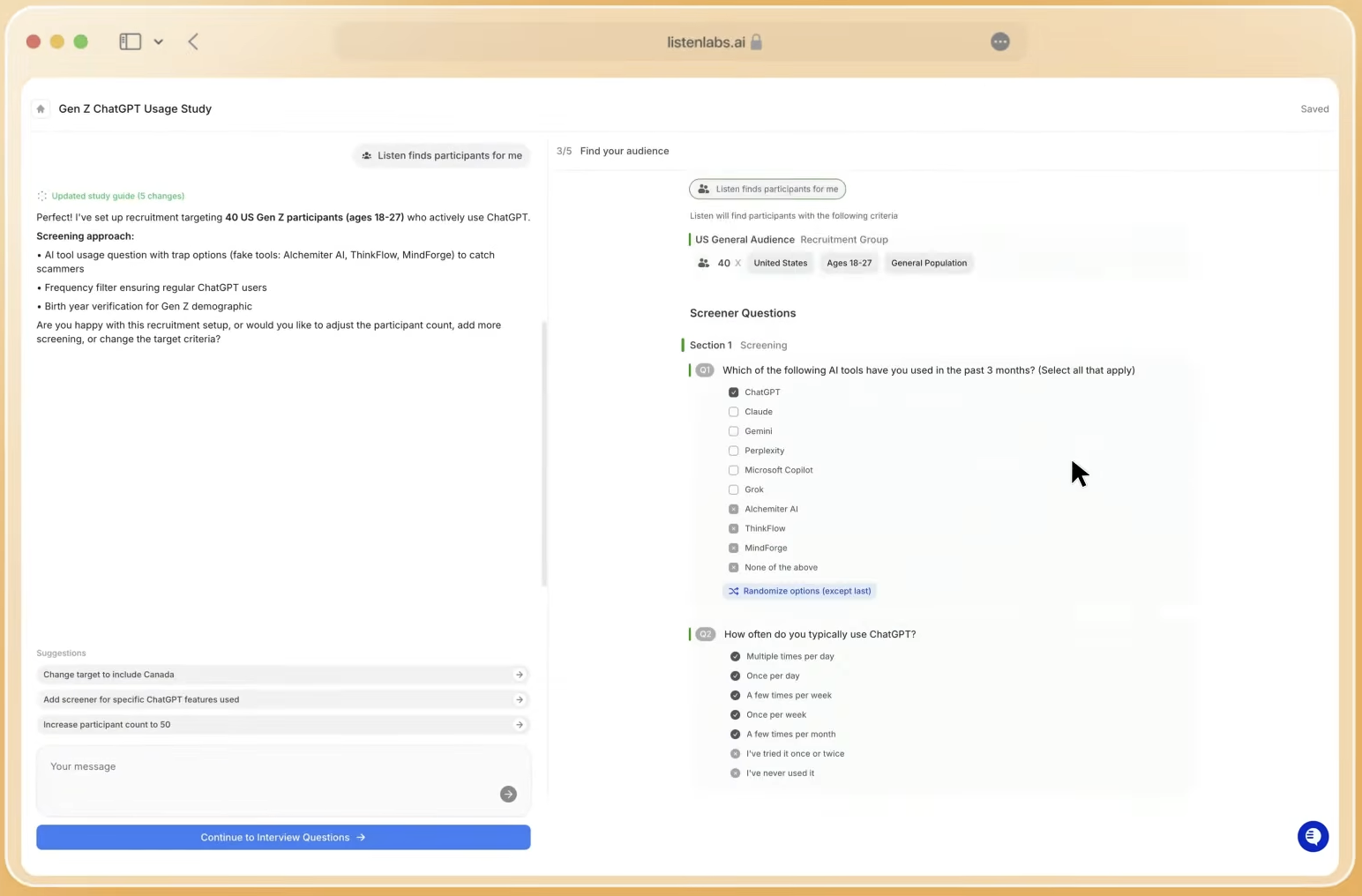
Watch Quality Guard and Listen Atlas in action to see how Listen Labs delivers verified respondents for specialized enterprise audiences.
Moderation Approach and Conversational Depth
Moderation quality shapes the depth and reliability of every interview. Human-dependent models like UserTesting produce slower turnaround and limited scalability because moderator hours are linear. Survey-style platforms capture structured responses but cannot probe, follow up, or adapt to unexpected answers. AI-moderated platforms vary in whether their interview logic is truly adaptive or simply a scripted sequence with conditional branching.
AI moderation can surface more real-reason disclosures than seller debriefs. Enumerate.ai's analysis identifies moderator consistency as the binding constraint in traditional qualitative research. A single human moderator becomes fatigued and pattern-matches by session fifteen, which causes probing depth to degrade in ways that are hard to detect in transcripts. AI moderation holds consistent probing standards from the first to the hundredth interview.
Listen Labs conducts AI-led video interviews with dynamic follow-up questions that probe deeper on interesting or short answers, similar to a trained human interviewer. In AI-moderated one-on-one interviews, the average participant speaks for 8–20 minutes, which creates a meaningful difference in data richness per respondent.
Emotional Signal Capture for Deeper Insight
Extended interview time still captures only part of the story. Most platforms in this category capture only what participants say. Transcripts, survey responses, and self-reported ratings miss the emotional layer entirely, such as the frown during a concept reveal, the hesitation before answering a pricing question, or the widened pupils at a product demonstration. The 2026 GRIT Insights Practice Report notes emotion and affect analytics entering industry tracking with immediate strong adoption, reflecting growing recognition that verbal data alone produces incomplete insight.
Enterprise evaluation of qualitative insights platforms should verify whether multimodal analysis covers facial signals, voice signals, and behavioral signals, not just post-interview sentiment tagging on transcripts. This distinction matters because real-time multimodal analysis during the interview captures signals that disappear from the recording and cannot be reconstructed from text.
Listen Labs' Emotional Intelligence layer analyzes three signal streams, tone of voice, word choice, and subconscious micro expressions, built on Ekman's universal emotions framework, the same standard used in clinical psychology and UX research. Every emotion is quantified per question and concept, and every label is traceable to the exact timestamp, verbatim quote, and reasoning behind it. The capability is available across 50+ languages and integrates directly with the Research Agent for natural-language queries, charts, and highlight reels of emotionally significant moments.
Analysis Workflow, Deliverables, and Knowledge Reuse
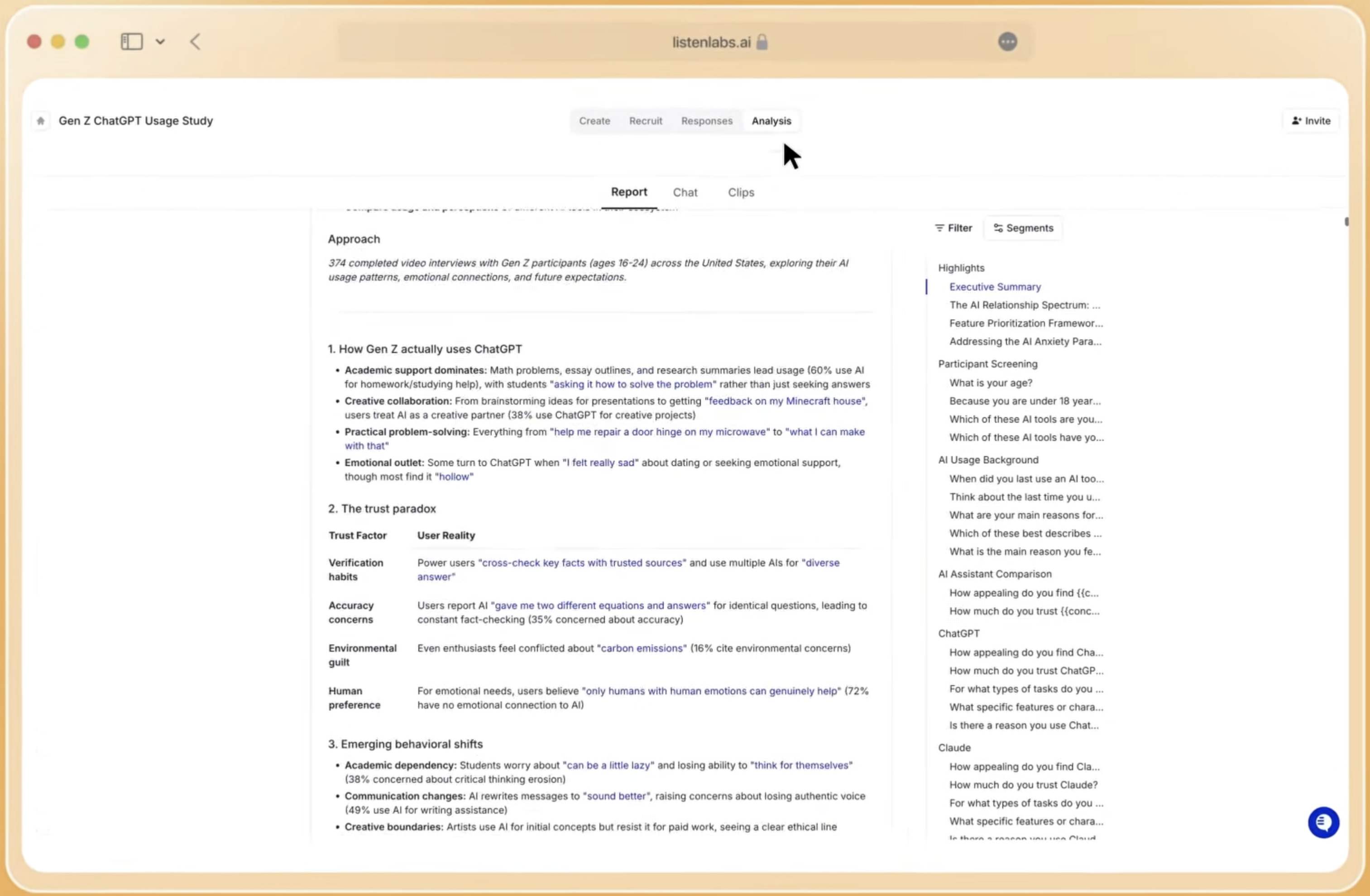
Analysis workflow determines whether teams clear their backlog or simply move it downstream. Analysis-only tools like Dovetail organize past research but do not conduct new research, which leaves the synthesis burden on the research team. Platforms that conduct interviews but produce only raw transcripts shift the analysis work downstream without reducing it. AI-assisted analysis compresses mechanical tasks like transcript preparation, initial coding, and cross-corpus search from days to hours, while strategic work such as setting hypotheses, reviewing themes, and noticing contradictions remains essential human judgment.
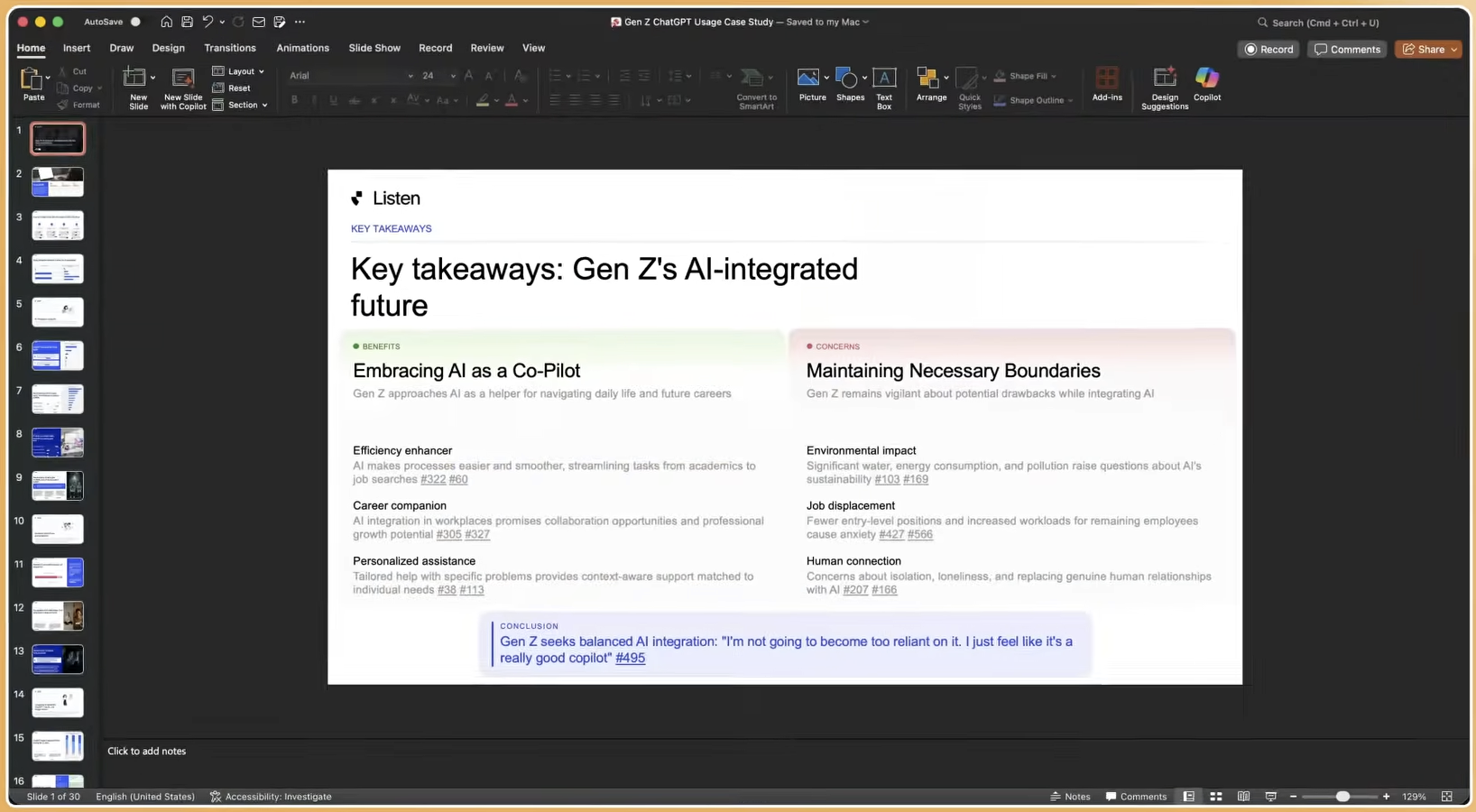
The strongest end-to-end platforms automate key findings, theme identification, persona generation, segmentation, and deliverable creation, while also maintaining a cross-study knowledge repository that prevents institutional knowledge from being lost between projects. Listen Labs' Research Agent generates slide decks, memos, highlight reels, charts, and custom reports in under a minute from natural-language queries. Mission Control serves as the organization's source of truth across all studies, enabling cross-study queries and trend tracking so teams can answer questions from past research in seconds without digging through old reports.
Enterprise Security, Compliance, and Global Reach
Enterprise evaluation of qualitative insights platforms should confirm SOC 2 certification, encryption at rest, SSO, and regional hosting options as baseline requirements. GDPR compliance and ISO certifications are increasingly required by procurement teams at Fortune 500 enterprises, particularly for programs involving consumer data across multiple jurisdictions.
Global reach forms a separate but related criterion that affects which teams can use the platform. AI-moderated interviews enable multilingual and geographic coverage in Tier-2 cities, rural populations, and underserved languages previously excluded by recruitment costs. Platforms that require additional vendors for non-English markets reintroduce the fragmentation problem that integrated platforms are designed to eliminate.
Listen Labs holds SOC 2 Type II, ISO 27001, ISO 27701, and ISO 42001 certifications, maintains GDPR compliance, and supports enterprise SSO. Customer data is never used for AI model training. The platform supports 100+ languages for interview moderation with automatic translation and transcription, covering 45+ countries across the Americas, Europe, APAC, and MEA.
Review Listen Labs' security posture with your team in a demo.
Team-Specific Use Cases and Impact
Different teams benefit from these platforms in distinct ways, even though they share the same infrastructure. Consumer insights teams at large enterprises gain the ability to run concept testing, brand perception studies, consumer journey mapping, multi-market segmentation, and ad testing without adding headcount, which directly addresses the research backlog problem. UX research groups benefit from screen-sharing and usability testing capabilities that allow testing with 50–100+ users instead of the 5–10 typical of human-moderated sessions.
Product managers and brand managers without dedicated research support can describe goals in natural language and receive study design, recruitment, moderation, and analysis automatically. Consultancies and agencies gain the speed and global reach needed for client timelines measured in days rather than weeks. Listen Labs has run over 1 million AI-powered customer interviews for companies including Microsoft, Perplexity, and Sweetgreen, which demonstrates enterprise-scale adoption across tech, CPG, retail, and food and beverage verticals.
Operational Requirements and Change Management
Adopting an end-to-end AI platform reduces the need to manage multiple vendors but changes how research teams create value. The platform handles recruitment, moderation, and much of the analysis, so teams shift from execution work to higher-level decisions about which questions to ask and how to apply findings. Rather than managing vendor relationships and tool integrations, teams focus on strategic questions such as which insights matter most, how findings should influence decisions, and how to measure research impact.
This shift is most visible in the move from project-based research to continuous customer intelligence programs, where always-on infrastructure replaces one-off studies. That change affects how teams prioritize requests, communicate findings, and track their own contribution to business outcomes. The importance of research to business strategy has grown in recent years, reflecting a broader shift toward embedding customer intelligence in ongoing decision-making rather than treating it as a periodic input.
This shift requires infrastructure that can support continuous insight generation rather than one-off projects. Platforms that support longitudinal tracking and cross-study knowledge management are better positioned for this operating model than those designed for discrete projects.
Risks and Limitations to Weigh
Several risks apply across this platform category regardless of vendor. Rigid question structures produce shallow data even at large sample sizes. Bad research questions produce more wrong data at volume, and poor recruitment means large samples of the wrong participants perform worse than small samples of the right ones. Hidden recruitment complexity is a common source of cost overruns, because platforms that appear to offer simple panel access often require significant manual effort for niche or hard-to-reach audiences.
Overestimating automation creates another risk. Analysis-only platforms are sometimes positioned as end-to-end solutions when they lack recruitment, moderation, or both. Buyers should verify whether a platform covers the complete workflow from study design through reporting, or only isolated stages. Enterprise evaluation should check whether the platform supports the full workflow from study design through reporting or only isolated stages such as interviewing or analysis.
Decision Framework and Buyer Checklist
This checklist aligns directly with the nine criteria outlined in the key takeaways and helps match platform options to enterprise constraints and goals. Each item reflects a specific operational or quality requirement that affects backlog reduction and insight reliability.
- Study design flexibility: Can researchers control objectives, branching, randomization, and stimuli without custom development, or are they limited to rigid templates?
- Participant quality at volume: Does the platform use frequency limits, behavioral verification, and real-time fraud detection, or does it rely on commodity panels?
- Moderation depth: Does the AI adapt dynamically to participant responses, or does it follow a fixed script with conditional branching?
- Emotional signal capture: Does the platform analyze tone, micro expressions, and word choice in real time, or only post-interview sentiment on transcripts?
- Analysis workflow and deliverables: Does the platform handle coding, synthesis, and creation of decks and memos, or does it output only raw transcripts?
- Enterprise security and compliance: Does the platform hold SOC 2 Type II, ISO certifications, and GDPR compliance, and does it support enterprise SSO?
- Global reach and multilingual support: Does the platform support 100+ languages and 45+ countries natively, or does multilingual coverage require additional vendors?
- Operational requirements and change management: Does the platform support longitudinal tracking and cross-study knowledge management that fit a continuous insight model?
- Risks and limitations: Does the vendor clearly explain constraints around recruitment, automation boundaries, and suitable use cases for the platform?
Frequently Asked Questions
How quickly can an enterprise realistically expect results from an AI-moderated qualitative study?
End-to-end AI platforms that handle recruitment, moderation, and analysis within a single workflow can deliver results in under 24 hours for studies with standard audience profiles. Studies targeting the hard-to-reach segments described earlier may require additional recruitment operations time, yet they still compress timelines dramatically compared to traditional 4–6 week cycles. Listen Labs has delivered global customer stories for Microsoft within a single day and completed 300+ user interviews for Anthropic within 48 hours.
How do AI-moderated platforms ensure participant quality when running hundreds of interviews simultaneously?
The most robust platforms apply multiple layers of quality control. These layers include behavioral matching on intent and past actions rather than self-reported demographics, real-time monitoring across video, voice, content, and device signals to detect fraud and low-effort responses, participant frequency limits to eliminate professional survey-takers, and dedicated human review for niche recruitment. Platforms that rely solely on automated panel matching without these controls are more exposed to the fraud rates documented across commodity panels. Listen Labs' Quality Guard combines all of these layers and builds a reputation score across every interview conducted on the platform, which creates a compounding quality advantage over time.
What is the practical difference between AI-moderated interviews and survey-style platforms for capturing consumer insight?
Survey platforms capture structured responses to pre-set questions with no ability to follow up, probe, or adapt to unexpected answers. AI-moderated interviews conduct personalized conversations where the AI asks follow-up questions based on what the participant actually says, which uncovers motivations, emotional reactions, and context that surveys cannot surface. The difference is most significant for concept testing, brand perception research, and usability studies where the most valuable findings are often the ones researchers did not anticipate.
Can these platforms support multilingual and multi-market research programs without additional vendors?
Platform support for multilingual research varies significantly. Some platforms support a limited number of languages or require separate vendor arrangements for non-English markets. Listen Labs supports 100+ languages for interview moderation with automatic translation and transcription and covers 45+ countries across the Americas, Europe, APAC, and MEA natively. Emotional Intelligence capabilities are available across 50+ languages, which enables consistent multimodal analysis across global programs without additional tooling.
What security certifications should enterprise procurement teams require from qualitative research platforms?
Enterprise procurement teams should require the security certifications detailed in the Enterprise Security section above, with SOC 2 Type II and GDPR compliance as non-negotiable baselines. ISO 27001, ISO 27701, and ISO 42001 provide additional assurance for information security, privacy, and AI governance. Enterprise SSO support and a clear policy on whether customer data is used for AI model training are additional requirements that frequently surface in procurement reviews. Listen Labs meets all of these requirements and does not use customer data for AI model training.
Conclusion: Choosing a Platform That Clears the Backlog
The category of enterprise platforms for scalable qualitative customer insights tools spans a wide range of capabilities, from analysis-only repositories to end-to-end AI platforms that compress the research cycle to under 24 hours. The evaluation criteria that matter most in 2026, including speed-to-insight, participant quality at volume, conversational depth, emotional signal capture, analysis automation, security, global reach, operational fit, and risk transparency, consistently favor platforms that own the complete research workflow rather than improving a single stage.
With qual-at-scale, the old trade-off between depth and scale is no longer a barrier. Consumer insights leaders who evaluate platforms against this nine-criterion framework will see that the gap between integrated AI platforms and fragmented stacks is structural, not incremental. The research backlog problem is not solved by faster analysis or better panels in isolation. It is solved by a single platform that handles every stage without handoffs, at the quality and security standards enterprise programs require.
See Listen Labs run adaptive qualitative interviews at enterprise scale in a demo.