Written by: Anish Rao, Head of Growth, Listen Labs
Key Takeaways
- AI-moderated interviews compress traditional 6-week media consumer research cycles to 24 hours while preserving qualitative depth and statistical scale.
- The five-step pipeline of AI-assisted study design, verified participant sourcing, adaptive interviews, multimodal emotional analysis, and automated reporting removes the trade-off between depth and scale.
- Verified global networks with real-time Quality Guard monitoring deliver 87% completion rates and remove professional survey-takers that corrupt data.
- Emotional Intelligence layers capture tone, word choice, and micro-expressions to surface feelings transcripts alone miss, which improves ad creative testing accuracy.
- Listen Labs delivers a complete end-to-end workflow trusted by Microsoft, Anthropic, P&G and others—see how these teams use the platform.
The Problem: Slow Media Research Holds Back Campaign Decisions
A traditional qualitative consumer research cycle takes a median of approximately 6 weeks from question to decision. For media and marketing teams, that lag is campaign-ending. By the time ad creative findings arrive, the flight has already launched or the budget window has closed.
The cost structure compounds the problem. Agency-led qualitative studies typically cost thousands of dollars for 20 in-depth interviews. That spend creates budget pressure and limits research frequency to a handful of studies per year. Async AI-moderated studies cut per-participant costs and shrink turnaround to a few days instead of one to four weeks.
The consequences for media teams are concrete. Enterprises like Microsoft, Anthropic, P&G, Skims, and Robinhood have shifted to AI-moderated consumer interviews and report insights arriving 5x faster than traditional methods. Anthropic surfaced churn drivers from 300+ user interviews in 48 hours. Robinhood identified that users who view prediction markets as entertainment drive 2.4x higher weekly re-engagement. That finding shaped product integration strategy and would not have been feasible on a six-week agency timeline.
Five-Step Automation Pipeline for Media Consumer Research
Step 1: Fast, Guided Study Design with AI
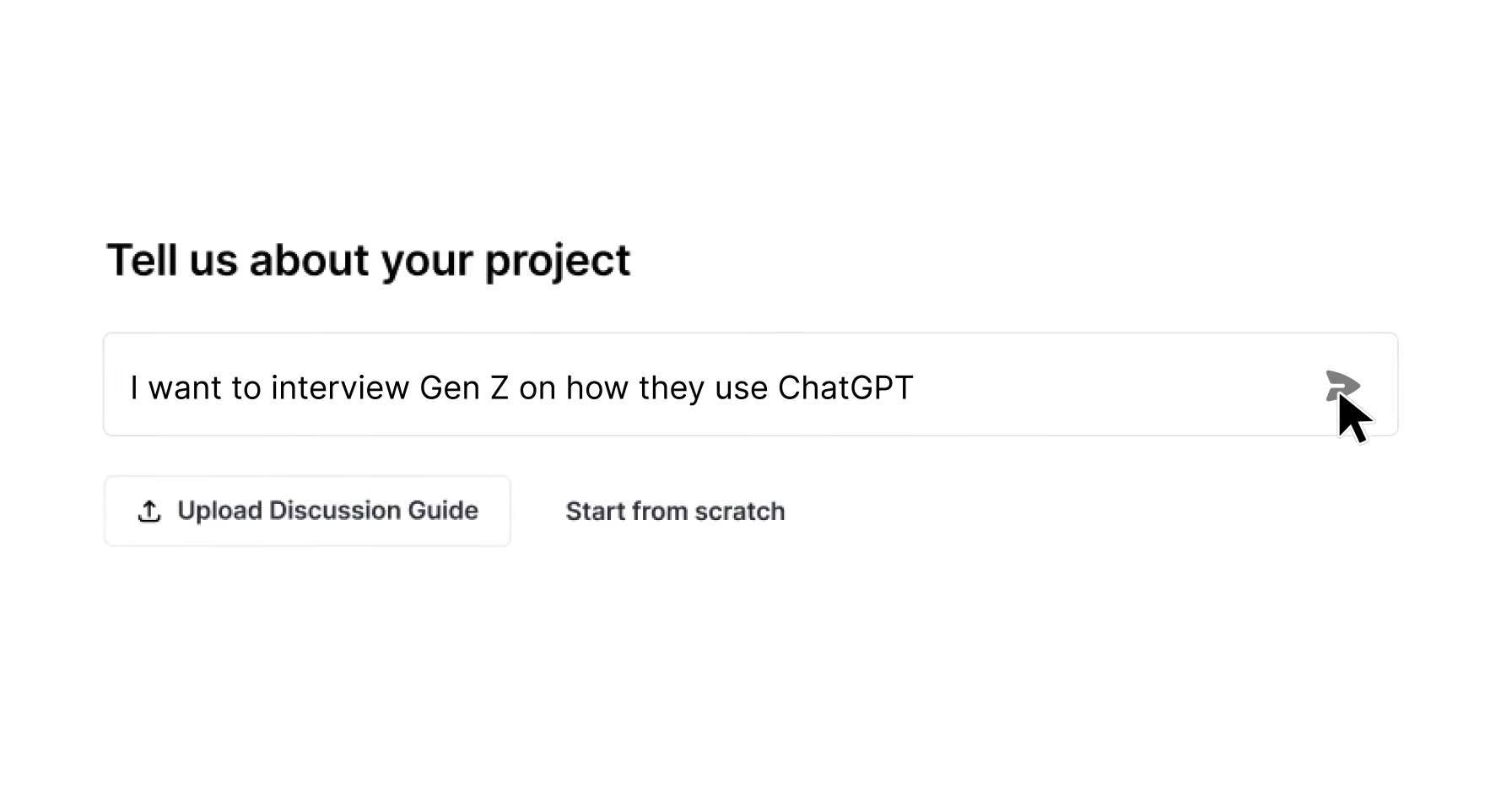
Effective automation starts with a focused research question. Listen Labs’ AI-assisted study co-design accepts natural-language descriptions of research goals and drafts structured objectives, interview questions, and probing context in seconds. Once the core structure is in place, teams attach stimuli such as ad creative, video cuts, brand assets, and prototype URLs, then configure monadic or sequential randomization for concept comparison. Before launch, Auto-QA flags guide issues, which removes the back-and-forth that typically consumes the first week of a traditional engagement and lets teams field studies the same day.
Step 2: High-Quality Participant Sourcing from Verified Networks
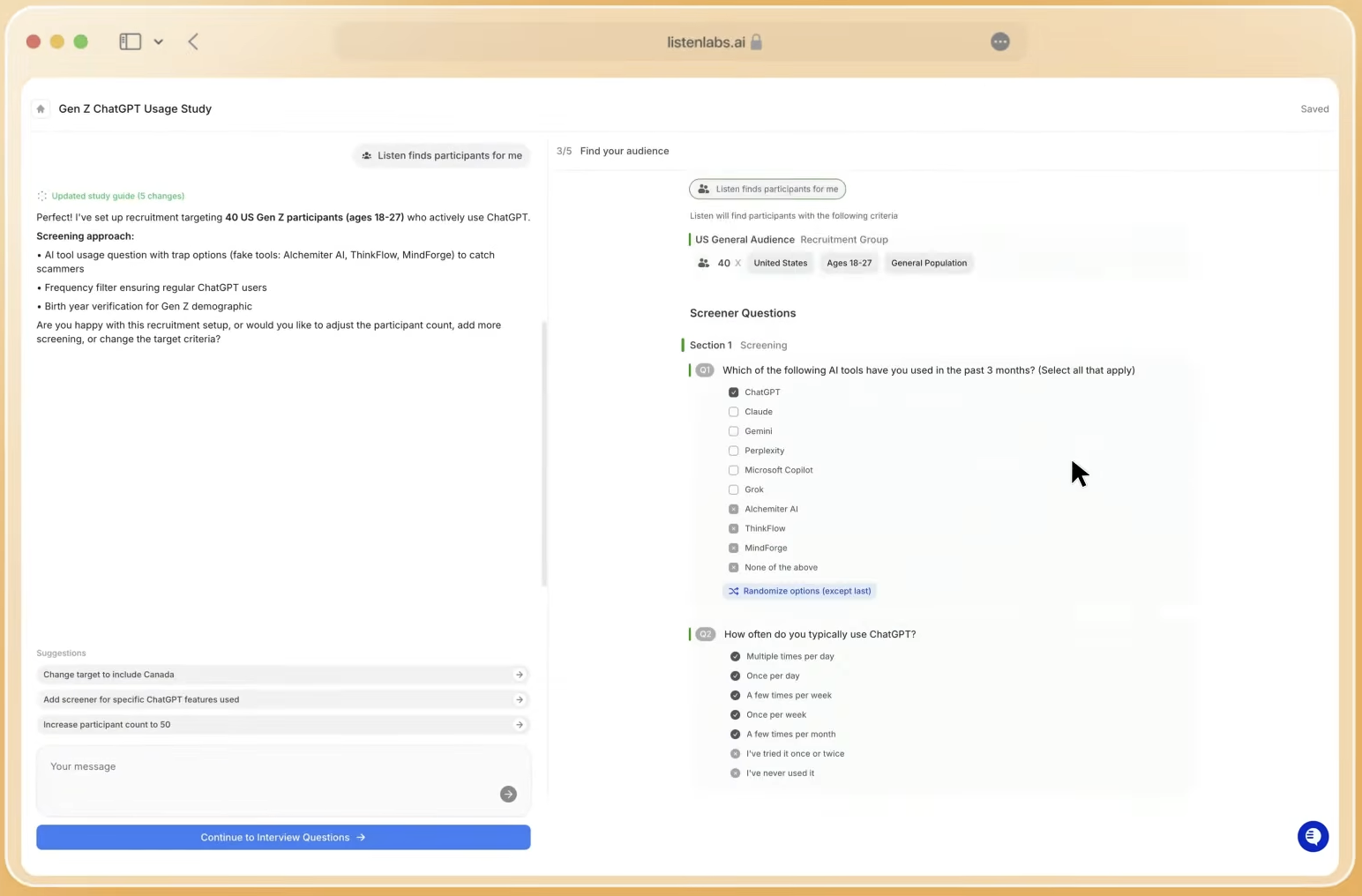
Participant quality is the single largest variable in consumer research reliability. Listen Labs’ Listen Atlas layer draws from a global network of 30M verified respondents across 45+ countries and 100+ languages, using AI orchestration to match and bid across multiple panel partners and a proprietary database. Quality Guard monitors every interview in real time across video, voice, content, and device signals to detect fraud, low-effort responses, and mismatched profiles. Participants are capped at three studies per month, which removes professional survey-takers. AI-moderated studies achieve an 87% completion rate versus 34% for human-led video studies on the same recruit pool, a 2.56x improvement that directly reduces field time and sets up large-scale data collection in the next step.
Step 3: AI-Moderated Data Collection at Scale
Listen Labs conducts video interviews with dynamic follow-up questions that probe deeper on short or interesting answers the way a trained human moderator would. With qual-at-scale, the old trade-off between depth and scale is no longer a barrier, because hundreds of adaptive, personalized conversations run simultaneously across 100+ languages. Mixed-methods formats combine qualitative probing with Likert scales, NPS, sliders, and MaxDiff items in a single session. This structure removes the need for separate survey deployments and keeps all data in one place.
Step 4: Multimodal Emotional Signal Analysis for Creative
Transcripts capture what participants say, while Listen Labs’ Emotional Intelligence captures what they feel. The system analyzes three signal layers, tone of voice, word choice, and subconscious micro expressions, to surface emotions that transcripts alone miss. Built on Ekman’s universal emotions framework, every emotion is quantified per question and concept, and every label is traceable to the exact timestamp, verbatim quote, and reasoning behind it.
For ad creative testing, teams can pinpoint the precise frame where viewers disengage, the moment a product claim triggers confusion, or the section of a brand video that produces genuine delight. Multimodal approaches that combine voice tone, facial expressions, and text improve emotion classification accuracy compared to single-signal methods. This emotional layer turns standard feedback into moment-by-moment creative guidance.
Step 5: Automated Synthesis and One-Click Reporting
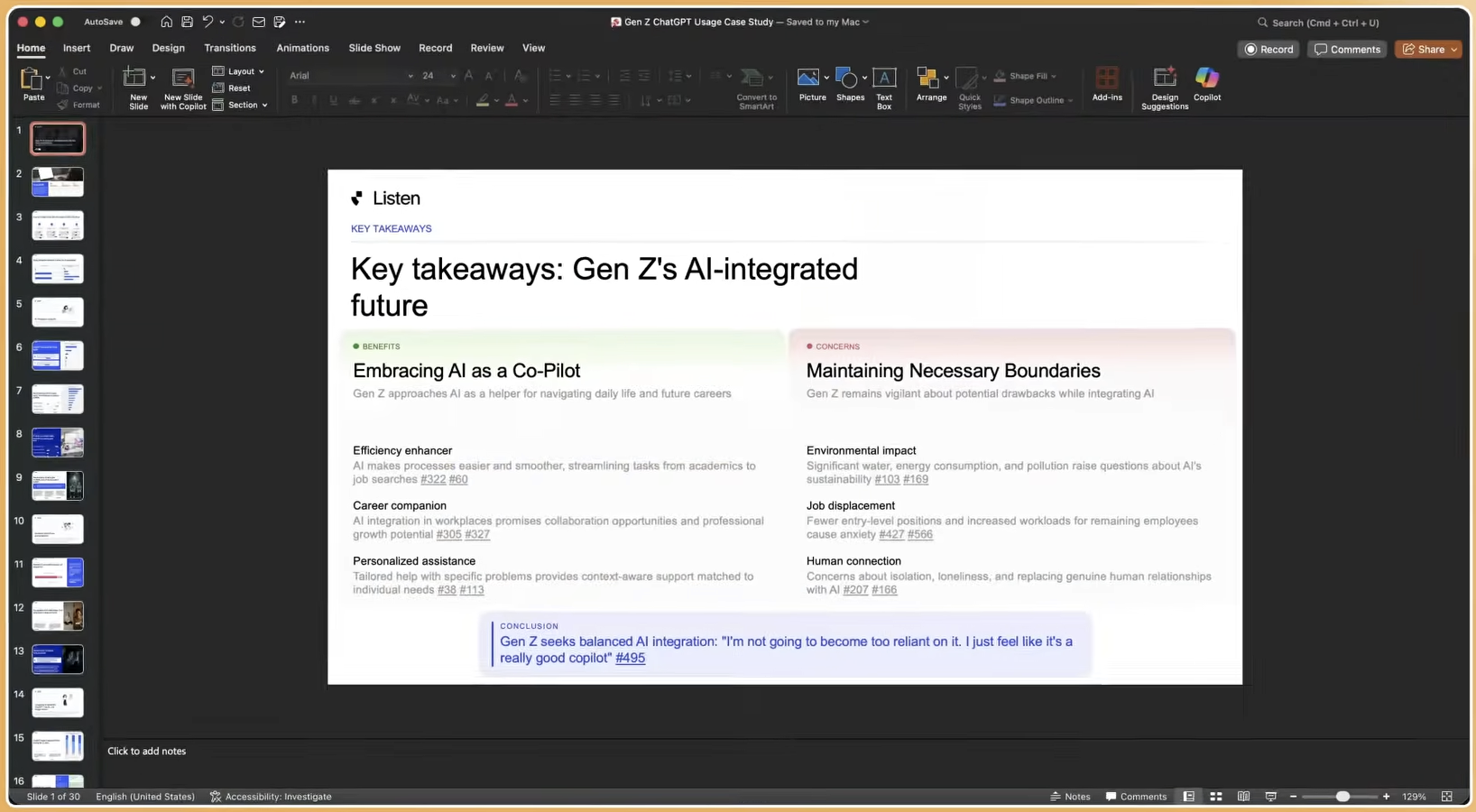
Research Agent handles the full analysis workflow, from raw data to final output. It generates automated key findings, themes, and personas, then produces consultant-quality slide decks, memos, and highlight reels. The system runs statistical significance tests and supports natural-language queries against the full dataset. One researcher ran a full buying intent analysis across three user segments in under a minute. Every insight links back to the underlying response data, which preserves traceability for stakeholder review and speeds decision-making.
Frameworks That Connect Mixed Methods to Action
Media consumer research programs perform better when they follow clear frameworks that define when to use AI moderation for breadth and when to escalate to human depth. The Exploratory Sequential Design, a widely recognized mixed-methods approach, runs an initial AI-moderated wave of 50+ interviews per segment to generate themes. A saturation gate then requires no new substantive categories before teams transition to quantitative measurement. This structure works especially well for campaign testing, where the qualitative strand identifies what to count and the quantitative strand establishes prevalence.
Beyond one-off campaign testing, teams can apply these same automation capabilities to continuous monitoring. For always-on brand sentiment programs, platforms like Listen Labs layer on auto-recruiting, transcription, sentiment tagging, and insight summarization so teams jump from question to findings in hours, not weeks. Mission Control serves as the organization’s source of truth across all studies, enabling cross-study queries, trend tracking, and institutional knowledge building. Each new study grows the knowledge base instead of creating an isolated deliverable.
Global multi-market studies follow the same pipeline with localization built in. Listen Labs supports 100+ languages for interview moderation with automatic translation and transcription. This capability enables simultaneous fielding across markets that would otherwise require sequential agency engagements spanning months.
Common Automation Pitfalls and How to Prevent Them
Several failure modes recur in media consumer research automation programs. Addressing them early prevents downstream rework and protects data quality.
- Unclear objectives: Vague research questions produce unfocused interview guides and unactionable findings. AI-assisted study design surfaces ambiguity before launch by requiring teams to specify the decision the research will inform.
- Low-quality respondents: Commodity panels introduce professional survey-takers and fraudulent profiles that corrupt qualitative data. Quality Guard’s real-time monitoring and participant frequency limits address this at the infrastructure level rather than through post-hoc screening.
- Analysis bottlenecks: AI-native qualitative synthesis reduces total synthesis time from 16–26 days to 3–4 hours, including real-time transcription, coding, theming, and draft findings. Teams that bolt AI onto 2019 manual processes capture only a fraction of this efficiency gain.
- Stakeholder misalignment: Research findings that arrive without clear business implications stall at the insights team. Research Agent’s one-click deliverables, including slide decks formatted for executive review, highlight reels of emotionally significant moments, and stat-tested segment comparisons, reduce the translation gap between findings and decisions.
Measuring Success of Automated Media Research
The following indicators track the performance of an automated media consumer research program over time.
Study cycle time: traditional baseline is the 6-week median mentioned earlier, and the AI-moderated target is 48 hours, tracked via brief-to-deliverable timestamp. Completion rate: traditional baseline is 34% for human-led video, and the AI-moderated target is 87%, tracked via panel field report per study. Studies per quarter: traditional baseline is 20–30, and the AI-moderated target is 100+, tracked via Mission Control study log. Cost per completed interview: traditional baseline can be hundreds of dollars, while AI-moderated cost is significantly lower, tracked via platform credit report.
Downstream campaign impact connects research investment to business outcomes. Teams track creative performance lift, concept-to-launch conversion rate, or reduction in post-launch brand sentiment issues. At Robinhood, teams measured integration flow uptake improvements of 30–40% after AI-moderated consumer research identified which product experiences felt on-brand.
Advanced Considerations for Continuous Consumer Intelligence
Organizations ready to move beyond one-off studies toward continuous consumer intelligence programs should evaluate three structural upgrades that extend the core pipeline.
- Always-on programs: Continuous fielding against a rolling participant pool enables trend tracking across campaign cycles, product launches, and competitive events. Mission Control aggregates findings across studies and surfaces shifts in brand sentiment or creative resonance without requiring a new study brief each time.
- Advanced segmentation: Research Agent supports breakdowns by demographics, behavioral cohorts, and custom segments within a single study. Emotion signal data from Emotional Intelligence can be queried by segment, such as identifying which audience group showed the highest confusion response to a specific ad claim.
- Pilot approach: Running both AI-moderated and traditional research on the same topic initially builds confidence before full transition. A hybrid model that uses AI for broad discovery across 100–200 conversations and human moderation for deep-dive analysis of the most surprising findings with 10–15 participants is the recommended entry point for teams with existing agency relationships.
Teams that adopt these upgrades move from isolated projects to a durable consumer intelligence system that supports every major media and marketing decision.
Frequently Asked Questions
How long does a typical AI-moderated consumer research study take with Listen Labs?
Listen Labs compresses the full research lifecycle, including study design, participant recruitment, interview fielding, analysis, and deliverable generation, to under 24 hours for most studies. A 300-interview study, such as the one Anthropic used to surface Claude churn drivers, completed in 48 hours. Traditional agency-led qualitative studies covering equivalent scope require 4–6 weeks at minimum, and enterprise prioritization queues can extend that to six months.
What types of media and marketing research studies does Listen Labs support?
Listen Labs supports ad creative testing, brand sentiment and perception studies, concept and message testing, video analysis, competitive positioning research, multi-market localization studies, usability testing with screen sharing, consumer journey mapping, and pricing research. The platform handles both one-off studies and ongoing research programs. Mixed-methods designs that combine qualitative interview depth with quantitative formats such as Likert scales, NPS, and MaxDiff run within a single session.
How does Listen Labs ensure participant quality for media research studies?
Three layers of protection operate simultaneously. First, Listen Labs works exclusively with high-quality, non-commodity panel sources, so no professional survey-takers from commodity quant panels enter the sample. Second, Quality Guard monitors every interview in real time across video, voice, content, and device signals to detect fraud, low-effort responses, AI-generated scripts, and mismatched profiles, which is the system that enables the 87% completion rate described in Step 2. Third, a dedicated recruitment operations team adds human review for hard-to-reach segments, and participants are limited to three studies per month to prevent panel fatigue and remove incentive-driven respondents.
What emotional signal data does Listen Labs capture during ad creative testing?
As described in Step 4, Emotional Intelligence captures tone, word choice, and micro expressions. Built on Ekman’s universal emotions framework, the same standard used in clinical psychology and UX research, the system tracks emotions including anger, anticipation, disgust, fear, joy, sadness, trust, and surprise. Every emotion label is quantified per question and concept and traceable to the exact timestamp and verbatim quote.
For ad creative testing specifically, teams can identify which emotions appear at each moment in a video, such as tracking when joy peaks during a product reveal or when confusion spikes during a pricing explanation. Emotional data integrates directly with Research Agent for natural-language queries, charts, and highlight reels of emotionally significant moments.
Can Listen Labs reach niche or hard-to-find audiences for media research?
Yes. The dedicated recruitment operations team partners with niche communities, micro-creators, and specialized networks to source participants below 1% incidence rate, including enterprise decision-makers, engineers, healthcare workers, and highly specialized consumer segments. Organizations can also bring their own participants by recruiting from their existing user base at reduced cost or by supplying their own panel provider. The 30M+ verified respondent network spans 45+ countries across the Americas, Europe, APAC, and MEA, which enables simultaneous multi-market fielding without sequential agency engagements.
Conclusion: Put Automated Media Market Research into Practice
The five-step pipeline of AI-assisted study design, verified participant sourcing, adaptive AI-moderated interviews, multimodal emotional signal analysis, and one-click reporting removes the forced choice between qualitative depth and quantitative scale that has constrained media consumer research for decades. Studies that previously required 4–6 weeks and $15,000–$25,000 per engagement now complete in under 24 hours at a fraction of the cost, with emotional signal data that transcripts alone cannot provide.
Listen Labs is the only end-to-end platform that handles every stage of this workflow, from study design and global recruitment through AI moderation, emotional analysis, and automated deliverable generation, within a single system trusted by Microsoft, Google, Anthropic, P&G, Skims, Robinhood, Sony, Levi’s, and Nestlé.
Explore a live demo of the full workflow and see how Listen Labs delivers consultant-quality consumer insights in under 24 hours.