
Written by: Anish Rao, Head of Growth, Listen Labs
Key Takeaways
- Traditional travel concept testing takes 4–6 weeks and costs $15,000–$50,000, but AI-moderated platforms now compress the full cycle to under 24 hours at a fraction of the cost.
- Travel-specific stimuli, screeners that separate business versus leisure travelers, and seasonal timing are essential to generate actionable insights rather than misleading averages.
- Mixed-methods sampling, with 20–40 AI-moderated qualitative interviews plus 150–300 quantitative respondents, delivers both depth and statistical reliability within a single day.
- Emotional-signal capture reveals the gap between what travelers say and how they actually feel, producing auditable findings that stakeholders can trust for go/no-go decisions.
- Listen Labs executes the entire research lifecycle, including design, recruitment, moderation, analysis, and deliverables, inside one platform. Book a demo to run your first travel product concept test this week.
Step 1: Define Objectives and Success Criteria Up Front
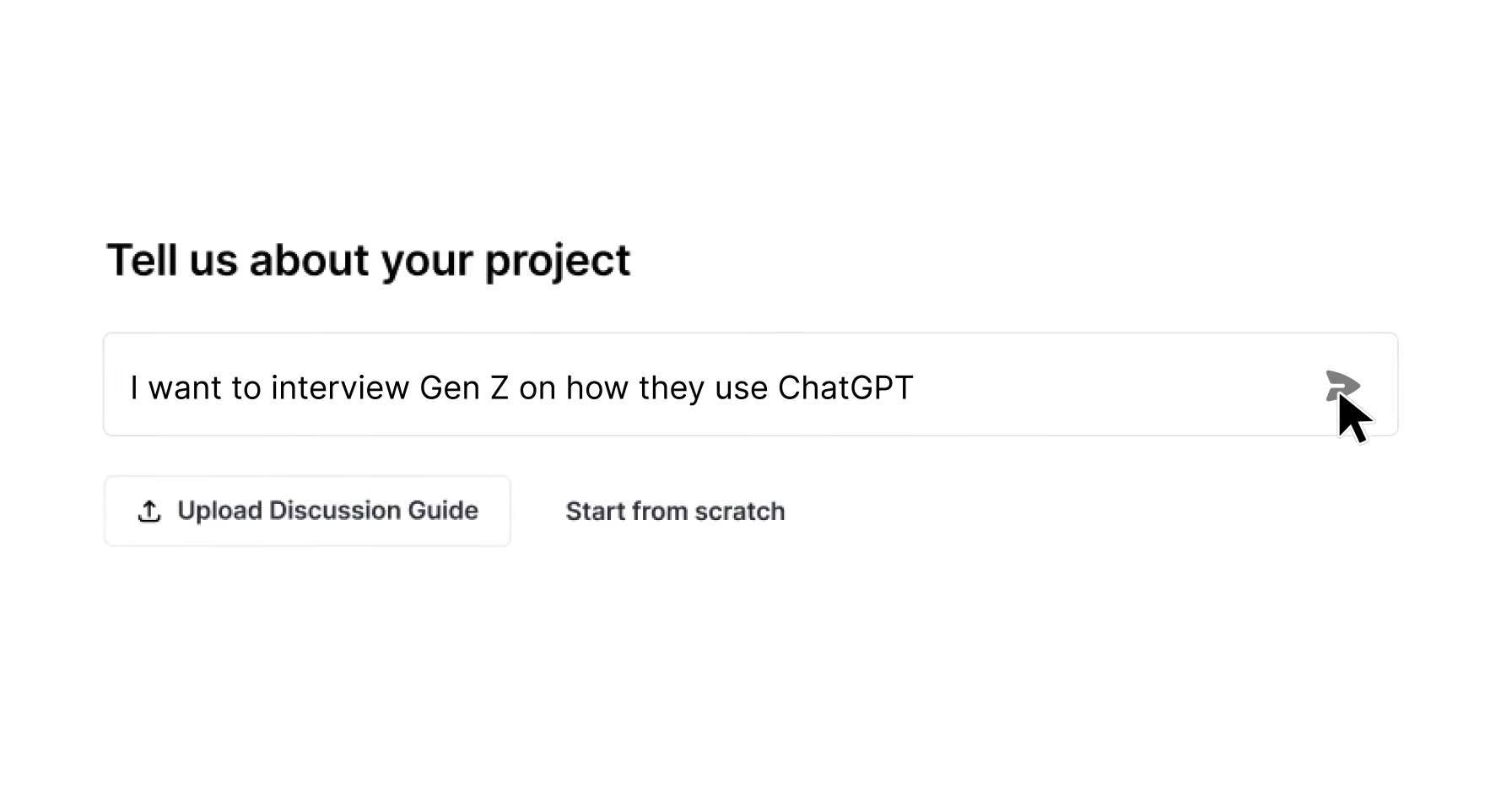
Every concept test that delivers actionable results starts with a single, written decision question. For a carry-on designed for digital nomads, that question might be: “Does this bag’s TSA-compliant laptop compartment and 40L capacity justify a $295 price point among travelers who fly more than eight times per year?” Vague objectives produce vague findings, so keep the decision question specific and measurable.
Required inputs at this stage include a concept description, a target traveler segment, a go/no-go threshold, and a timeline tied to a product or campaign milestone. Decision points center on two axes: depth versus scale, and budget versus speed. As noted earlier, traditional methods create a structural incentive to skip testing entirely. AI-moderated platforms compress the cycle to under 24 hours at a fraction of the cost, which keeps testing aligned with real product timelines.
Set scoring thresholds before fieldwork begins. Define decision criteria such as a required Top 2 Box appeal or purchase intent threshold before seeing results to prevent post-hoc adjustment. For travel consumer categories, a strong concept often shows high top-2-box scores on purchase intent, uniqueness, and clarity.
Step 2: Design Travel-Native Stimuli and Question Flow
Travel product concept tests work best when stimuli mirror real travel conditions. Show a carry-on next to a standard overhead bin diagram, a TSA-compliant liquids pouch against the 3-1-1 rule, or a mobile check-in flow at boarding gate screen resolution. Use TSA compliance visuals, durability mockups, and packing logistics diagrams so respondents react to concrete details.
For a leisure-family app check-in flow, a monadic structure keeps feedback clean. Each participant cell sees one version of the flow, either the current three-tap design or the proposed single-screen redesign, and rates it on clarity, confidence, and likelihood to use before any comparison appears. Monadic testing reduces comparison bias because each respondent evaluates only one concept in isolation, mirroring real-world encounters where buyers see one option at a time.
Place a comprehension check as the first question. If respondents cannot accurately describe the concept in their own words, all downstream answers on relevance, appeal, and purchase intent become noise. Follow comprehension with the core KPI battery, including appeal, purchase intent, uniqueness, relevance, and an open-ended “what would have to be true for you to actually buy or use this?” Ask about specific features only after this core battery.
Once the question flow is locked, the next decision is how many respondents to recruit and in what configuration.
Mixed-Methods Sampling Framework for Travel Concepts
Travel concept testing benefits from a layered sampling approach that combines qualitative depth with quantitative breadth. A practical structure for a 24-hour cycle is:
- Run 20–40 AI-moderated qualitative interviews across two traveler segments, business and leisure, to surface language, objections, and emotional reactions.
- Field a quantitative monadic survey to 150–300 respondents per concept cell to produce statistically reliable purchase intent and uniqueness scores.
- Use the qualitative verbatims to annotate and explain quantitative score patterns, especially when scores fall in the 40–60% ambiguous zone.
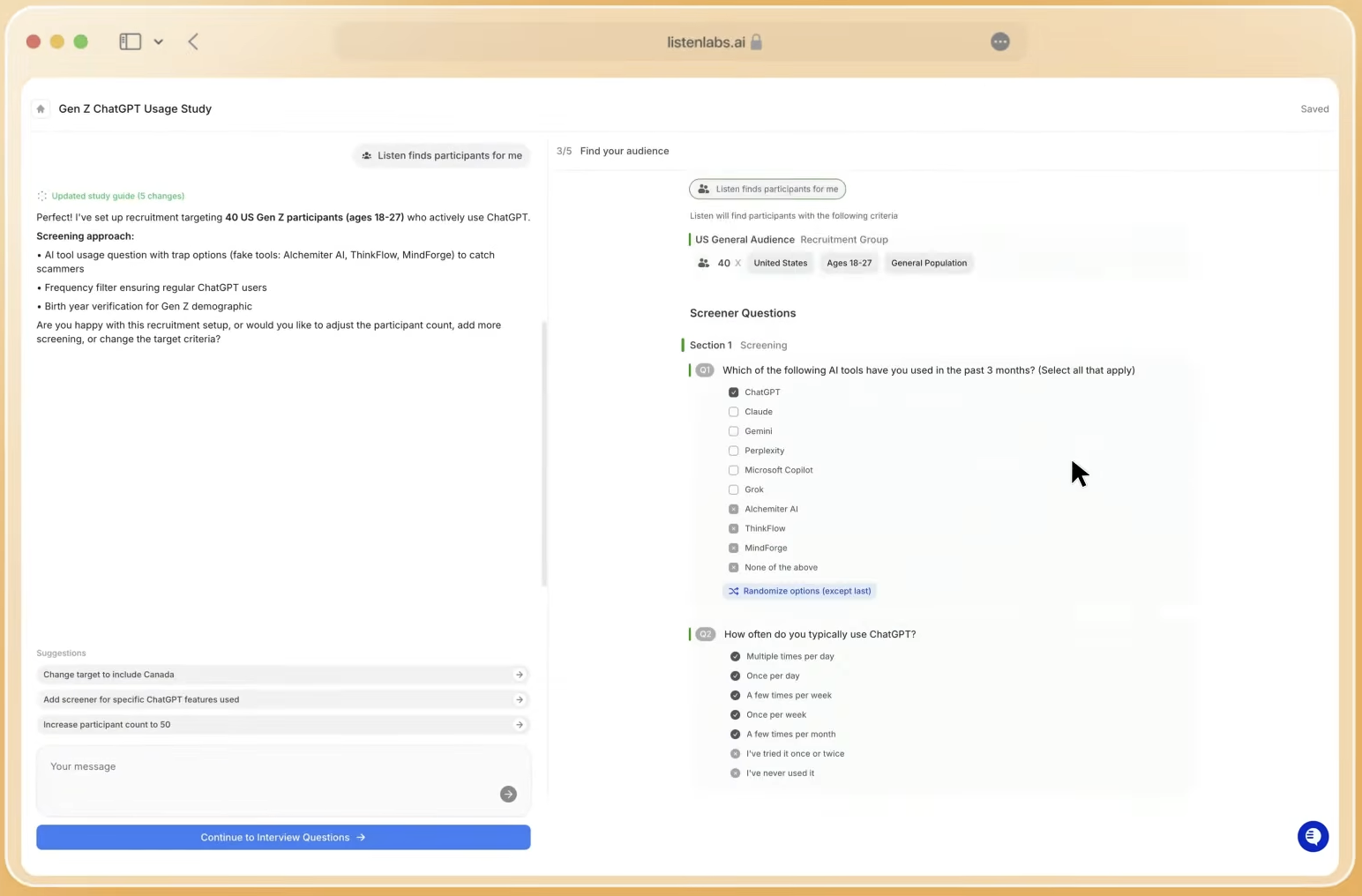
For both speed and depth, start with 5–8 unmoderated video tests for directional signal, then survey 50–100 people for quantitative validation, enabling 24-hour synthesis. Listen Labs executes both layers simultaneously within its platform, drawing from a verified network of 30 million respondents across more than 45 countries.
Step 3: Build and Field Screeners for Business and Leisure Travelers
Business and leisure travelers must be recruited and tested separately because they approach travel products with fundamentally different mental models and priorities, such as speed, efficiency, and loyalty program integration for business, and value, group coordination, and experience quality for leisure. Mixing the two groups produces averaged findings that rarely guide clear action.
Screener criteria for a frequent-flyer cell should include:
- Flight frequency of at least 8 round trips per year
- Primarily solo, employer-reimbursed trips
- Booking through a corporate portal, airline direct, or travel management company
- Active loyalty program membership in at least one major program
- At least one flight in the past 60 days
Screener criteria for a leisure segment should include:
- Flight frequency of 2–6 round trips per year
- Family or group travel that is self-funded
- Booking through an OTA or airline direct
- At least one leisure trip in the past six months
Seasonal timing matters because booking behavior shifts dramatically between peak windows, such as January, spring, and early fall, and off-season periods. Schedule fieldwork during peak booking windows to capture realistic urgency and decision dynamics. Incentives for travel research participants should match the audience and session duration, with higher amounts often provided to business travelers and corporate travel managers.
Book a demo to see how Listen Labs’ recruitment infrastructure fields travel-native screeners in hours and sources verified frequent flyers and leisure travelers simultaneously.
Step 4: Run Adaptive Interviews with Emotional-Signal Capture
Travel concept testing works best with adaptive probing that follows the participant’s friction points. Static open-ended questions produce static answers. When a leisure traveler says “I like the bag but I’m not sure about the wheels,” the next probe should be “What specifically about the wheels concerns you, durability, maneuverability, or something else?” rather than a pre-scripted question about color options.
For well-defined concept testing questions, AI-moderated interviews deliver equivalent insight quality at roughly one-third the cost and one-fifth the time of live moderated sessions. No 2024 University of Melbourne HCI study examined AI-moderated interviews or reported 78% comparable richness, 10x volume, or one-fifth the cost. The sole Melbourne HCI paper from that year addresses AI moderation in multiplayer games.
Emotional signal capture closes the gap between stated and felt responses. Two travelers may both rate a luggage concept 4 out of 5 on appeal, but one shows genuine anticipation while the other shows suppressed confusion. Listen Labs’ Emotional Intelligence layer analyzes tone of voice, word choice, and subconscious micro-expressions, built on Ekman’s universal emotions framework, to surface these divergences at the timestamp level. Every emotional label is traceable to the exact verbatim and the reasoning behind it, which makes findings auditable for stakeholders who require evidence, not assertion.
Step 5: Choose Monadic or Sequential Monadic Design
The choice between monadic and sequential monadic testing depends on the decision type, not only on budget. High-stakes decisions and final validation usually require cleaner, unanchored scores.
Monadic testing is best for high-stakes or complex concepts, final validation before major investment, and collecting unbiased absolute scores, with a recommended sample size of 100–200 respondents per concept cell. Use it when concepts are substantially different, such as a hard-shell carry-on versus a hybrid softside, or when the go/no-go threshold must be benchmarked against category norms.
Sequential monadic testing involves evaluating 2–3 concepts in randomized order followed by comparison questions and is best for early-stage screening, cost- or time-constrained studies, and comparing similar concepts, with a recommended total sample size of 150–300 respondents. For a travel app testing two check-in flow variants, sequential monadic design fits well because the concepts share the same functional category and participants can evaluate each independently before comparing.
For pricing validation within either design, add Van Westendorp Price Sensitivity Meter questions, including too cheap, bargain, expensive, and too expensive, alongside concept metrics to identify optimal price zones. Misalignment between price signals and other concept signals, such as premium packaging with a budget price, creates consumer confusion that suppresses purchase intent more than high price alone.
Step 6: Turn Raw Data into Segment-Level Insights
Raw interview data does not qualify as insight until it is structured against your decision criteria. The analysis phase must separate signal from noise, segment findings by traveler cohort, and map results to the thresholds set in Step 1. For travel products, segment breakdowns by business versus leisure, domestic versus international, and seasonal booking window often reveal divergent purchase intent scores that aggregate data hides.
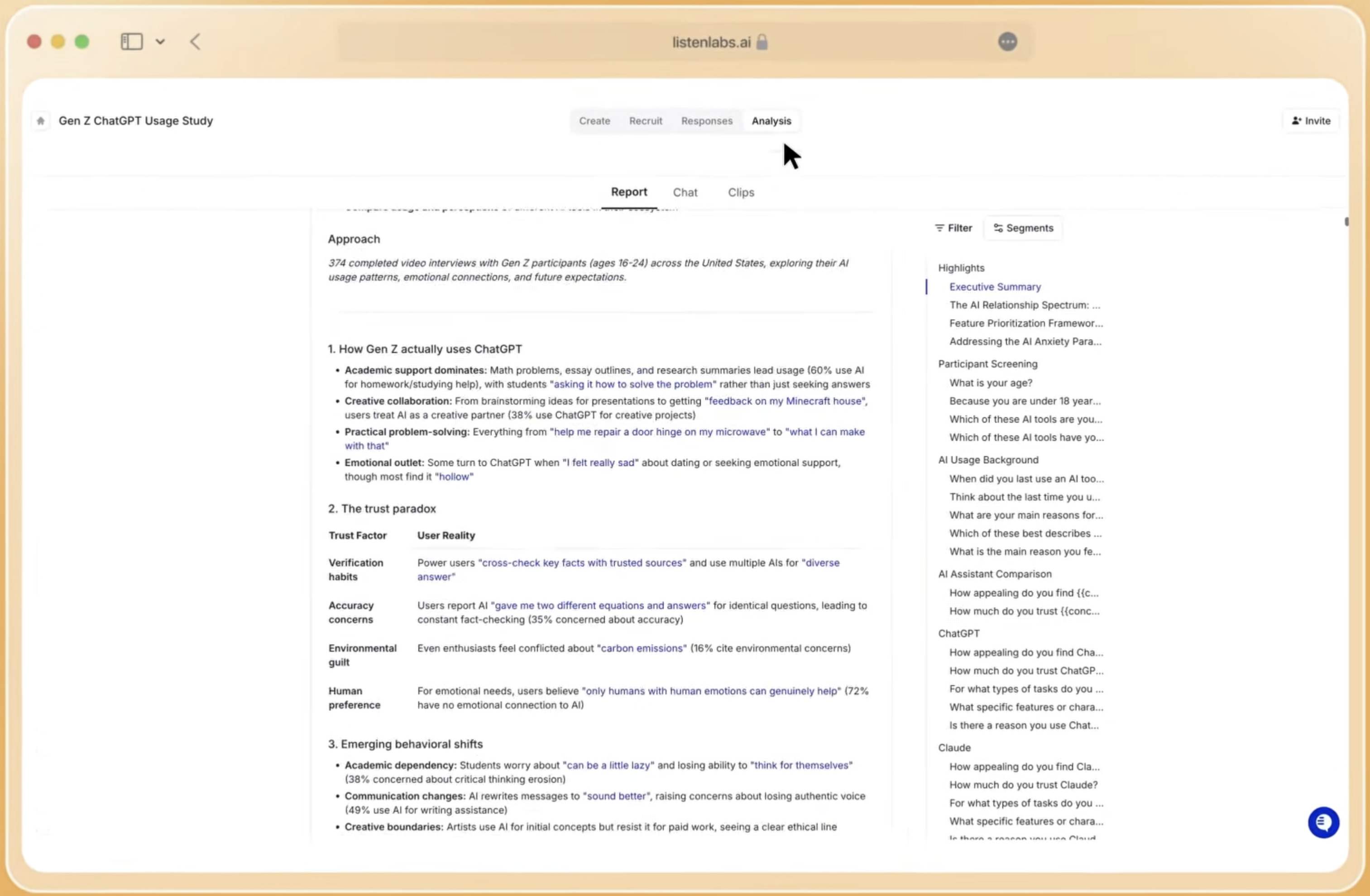
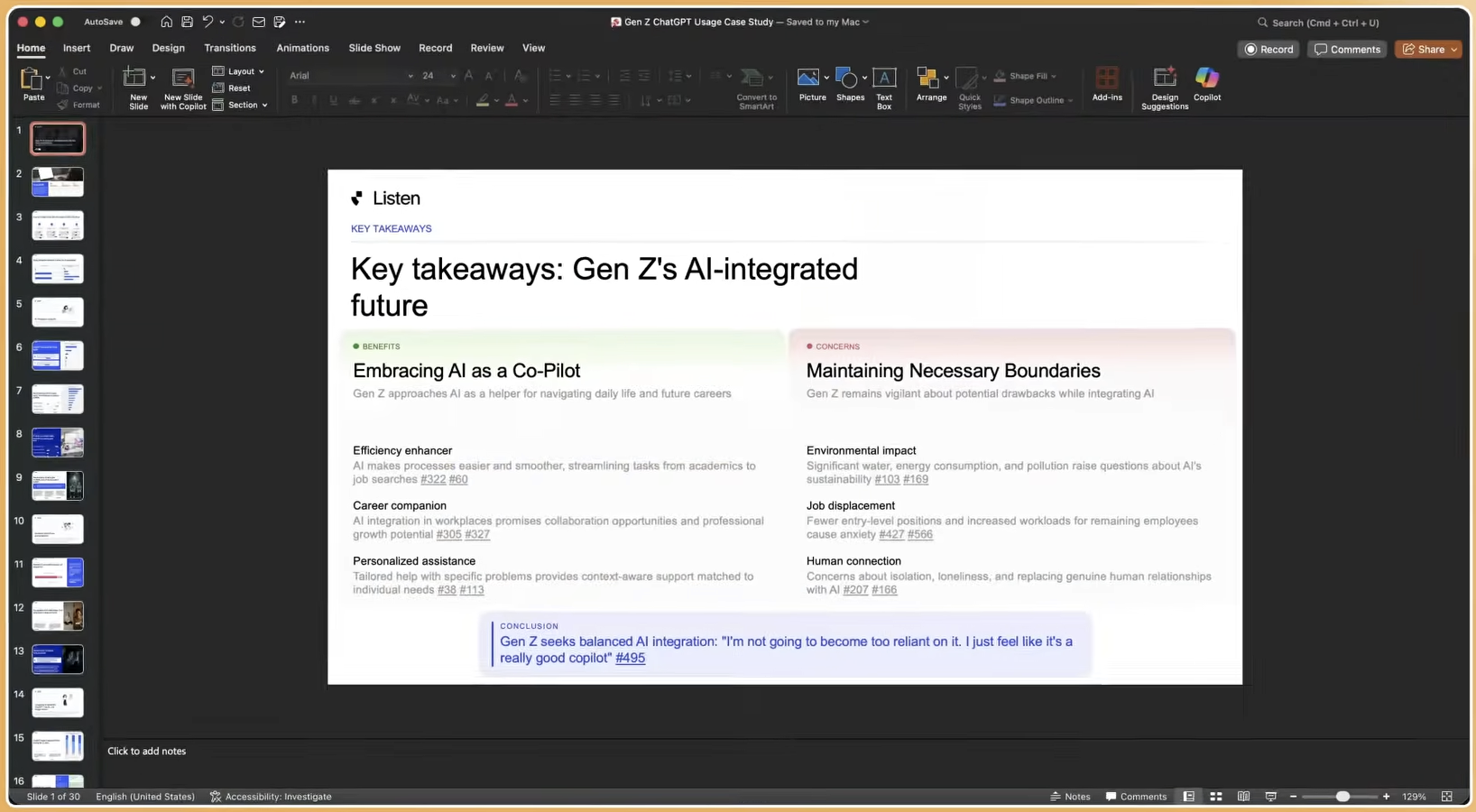
Listen Labs’ Research Agent automates the analytical heavy lifting. Key themes, verbatim evidence, emotional intensity scores, and segment comparisons are generated within minutes of fieldwork closing. One-click deliverables, including slide decks, memos, and video highlight reels, are produced in under a minute and arrive formatted for stakeholder presentation without manual report writing.
Compare concept test results against pre-set decision criteria: high signal means move to design, medium signal means iterate and retest, and low signal means kill the idea. This framework prevents the most common post-fieldwork failure mode, which is debating thresholds after results are visible.
Step 7: Make Go/No-Go Decisions Within 24 Hours
The final step converts insight into a documented decision with a clear rationale. A travel product concept test should produce three outputs. First, a go/no-go recommendation tied to the pre-set threshold. Second, a prioritized list of concept modifications if the signal is medium. Third, a segment-level breakdown showing which traveler cohort drives the strongest intent.
Simple UX changes identified through testing, such as removing one checkout field or adding Apple Pay, can increase mobile conversion rates by 30–40% within weeks. The value of sub-24-hour concept testing lies in the ability to iterate on findings before a market window closes, rather than receiving a report after the launch decision has already been made by default.
Rigorous analysis of launched CPG products shows failure rates of 25% after one year and approximately 40% after two years, and 36 online travel companies shut down in 2024, often due to building products without sufficient validation of user need. Concept testing at the speed travel teams actually operate provides a structural fix.
Listen Labs compresses the entire research lifecycle, including study design, recruitment from a 30 million person verified network, AI-moderated interviews, emotional signal analysis, and stakeholder-ready deliverables, into under 24 hours. Book a demo to run your first travel product concept test this week.
Frequently Asked Questions
What makes concept testing for travel products different from standard concept testing?
Travel products are evaluated under conditions that standard consumer categories do not share, such as TSA compliance requirements, packing logistics, durability across transit environments, and the emotional volatility of travel itself, ranging from pre-trip anticipation to in-airport stress. These context-specific factors require stimuli that simulate real travel conditions, screeners that separate business and leisure travelers, and timing aligned with seasonal booking windows. A concept test that ignores these variables produces findings that are technically valid but practically misleading, because the respondent pool and the stimulus do not reflect how the product will actually be encountered and judged.
How does Listen Labs achieve sub-24-hour turnaround for travel concept testing?
Listen Labs handles the entire research lifecycle within a single platform. AI-assisted study design drafts objectives, screeners, and question flows in minutes. Listen Atlas, the platform’s recruitment infrastructure, draws from a verified network of 30 million respondents across more than 45 countries and matches participants against behavioral and intent data, not just self-reported demographics, so frequent flyers and leisure travelers are sourced simultaneously rather than sequentially. AI-moderated interviews run in parallel across all participants, with no scheduling overhead or moderator availability constraints. The Research Agent then processes all interview data, identifies themes, quantifies emotional signals, and generates slide decks, memos, and highlight reels automatically. Each of these steps, which traditionally requires separate vendors and handoffs, runs inside one system without the delays those handoffs introduce.
When should a travel brand use monadic testing versus sequential monadic testing?
Monadic testing is the appropriate choice when the decision is high-stakes, such as a major luggage launch, a new booking flow, or a flagship travel app feature, and when the concepts being tested are substantially different from one another. Because each respondent evaluates only one concept, scores reflect genuine, unanchored reactions that can be benchmarked against category norms. Sequential monadic testing is appropriate for early-stage screening of similar concept variants, such as two versions of a loyalty program interface or three carry-on colorway options, where the goal is directional ranking rather than absolute performance measurement. The key constraint in sequential designs is order bias, because the first concept anchors the respondent’s evaluative frame, which is why randomizing presentation order across respondents is non-negotiable. For final go/no-go decisions on travel products, monadic designs produce the cleanest signal.
How does emotional signal capture improve travel product concept testing?
Stated responses and felt responses frequently diverge in travel research. A traveler may rate a carry-on concept 4 out of 5 on appeal while simultaneously showing micro-expressions of confusion when the TSA compliance claim is displayed, a contradiction that a rating scale alone cannot surface. Emotional Intelligence on the Listen Labs platform analyzes three layers of signal simultaneously, including tone of voice, word choice, and subconscious micro-expressions, using Ekman’s universal emotions framework as the analytical foundation. Every emotional label is tied to a specific timestamp, verbatim quote, and the reasoning behind the classification, which makes findings auditable rather than asserted. For travel brands testing concepts that carry strong emotional stakes, such as a first international trip, a business travel upgrade, or a family vacation, this layer of analysis reveals the gap between what travelers say they want and what they actually respond to, which is where the most actionable product decisions live.
Can Listen Labs recruit hard-to-reach travel segments like corporate travel managers or frequent international flyers?
Yes. Listen Labs’ dedicated recruitment operations team sources participants below 1% incidence rate, including corporate travel managers, enterprise decision-makers, and highly specific frequent-flyer profiles. The platform’s AI orchestration layer, Listen Atlas, matches and bids across multiple panel partners and Listen Labs’ proprietary database simultaneously, rather than queuing requests sequentially. For travel brands that need international participants, because booking norms, payment preferences, and trust signals vary significantly across markets, Listen Labs covers more than 45 countries and supports interviews in over 100 languages with automatic translation and transcription. Participants are limited to three studies per month across the platform, and Quality Guard monitors every interview in real time for fraud, low-effort responses, and mismatched profiles, which ensures that the frequent-flyer segment a study recruits actually reflects the travelers who will buy the product.