Written by: Anish Rao, Head of Growth, Listen Labs
Key Takeaways for F&B Insights Leaders
- Traditional syndicated reports and retail data platforms deliver backward-looking benchmarks but lack the depth to explain consumer motivations, emotions, or unarticulated needs behind purchase decisions.
- Free trend tools surface public signals for early-stage scanning but cannot validate specific concepts, packaging, or flavor claims against verified target consumers.
- AI interview platforms compress research timelines from weeks to under 24 hours while maintaining qualitative depth through adaptive moderation and emotional intelligence analysis across 50+ languages.
- Listen Labs stands out with 30M+ verified respondents, real-time fraud controls, full compliance certifications, and automated analysis that removes manual coding and multi-vendor handoffs.
- Listen Labs delivers enterprise-grade consumer insights infrastructure that scales with F&B teams; see how it fits your research workflow.
Why F&B Teams Compare These Insight Tools Side by Side
Flavor testing, packaging validation, menu innovation, and emotional response tracking all require fast, deep consumer understanding. A new beverage launch cannot wait eight weeks for a syndicated category report to confirm whether the flavor profile resonates with Gen Z shoppers. A packaging redesign cannot rely on retail velocity data alone to explain why trial rates are flat.
This timing pressure pushes leading F&B companies toward new research methods that keep pace with product cycles. Enterprises like Nestlé and P&G have already begun scaling qualitative research without proportional headcount increases, using AI-moderated interviews to run multi-market flavor tests and product claim evaluations in hours rather than weeks. Greenbook’s GRIT 2025 report found the median time-from-question-to-decision dropping from 6.2 weeks to 2.1 days for AI-moderated studies. This compression signals a structural shift in how F&B product cycles operate. Teams that still route every flavor test or concept screen through a traditional agency build a research backlog that compounds with every delayed decision.
Evaluation Criteria for Food and Beverage Consumer Insights Tools
The nine criteria below separate tools that fit enterprise F&B workflows from tools that create new bottlenecks.
- Research speed and turnaround: How quickly can a team move from a research brief to actionable findings? For new beverage launches or limited-time menu items, days matter more than weeks.
- Depth of consumer insight: Does the method capture motivations, emotions, and unarticulated needs, or only surface-level preferences and stated ratings?
- Sample quality and fraud controls: Are participants verified against behavioral and intent data, or sourced from commodity panels where professional survey-takers inflate response volumes?
- Global and language reach: Can the platform recruit and moderate across the markets where a brand competes, in the languages consumers actually speak?
- Methodological flexibility: Does the platform support sensory concept testing, packaging validation, monadic comparisons, and emotional response capture within a single study design?
- Analysis effort: How much manual coding, transcription, and synthesis does the team absorb before insights reach decision-makers?
- Reporting transparency: Can stakeholders trace a finding back to the specific participant response, timestamp, or verbatim quote that generated it?
- Security and compliance: Does the platform meet GDPR, SOC 2, ISO 27001, ISO 27701, and ISO 42001 requirements that enterprise procurement and legal teams require?
- Total operational burden: How many vendors, tools, and internal handoffs does the method require before a study is complete?
How Traditional Syndicated Reports Perform Against These Needs
Role and Cost of Syndicated Reports
Syndicated reports from providers such as Mintel, Circana, and Euromonitor deliver pre-packaged category data compiled from large consumer surveys and retail measurement. These reports can be costly, with prices varying widely by provider, and often draw on consumer surveys along with retail sales data. Enterprise subscriptions covering retail measurement across multiple categories can reach six figures annually.
Speed and Relevance of Syndicated Data
Syndicated data is available immediately after subscription purchase, which helps with category benchmarking. The limitation is that the data is backward-looking by design. It reflects what consumers bought and said weeks or months before publication. For a team validating a new flavor concept or testing a packaging redesign, syndicated data cannot answer the specific question at hand.
Depth, Sample Quality, and Transparency Limits
On depth, syndicated data tracks retail transactions rather than individual people, so it cannot explain whether share gains came from new buyers, switchers, or changes in purchase frequency, nor what motivated those changes. Emotional response, sensory preference, and unarticulated need states do not appear in syndicated outputs.
On sample quality, syndicated providers use large consumer panels, but the methodology is fixed. Teams cannot screen for the specific occasion user, flavor adventurer, or health-motivated shopper that a new product targets. Fraud controls vary by provider and are rarely disclosed in detail. Analysis effort stays low for standard category benchmarks but rises when teams try to extract custom insights from reports not designed for their question. Reporting transparency is limited because findings cannot be traced to individual respondents or verbatim quotes.
How Retail Data Platforms Support F&B Decisions
What Retail Data Platforms Provide
Retail data platforms such as NielsenIQ and SPINS provide point-of-sale measurement, household panel data, and category velocity tracking. Syndicated data subscriptions from providers such as NielsenIQ, Circana, Mintel, and Euromonitor cost $50,000–$500,000+ per year and provide continuous quantitative category benchmarks but no qualitative understanding of consumer motivations.
Strengths and Gaps in Retail Data
These platforms excel at answering where, what, and when questions at the category level. They fall short on why. A retail platform can confirm that a new sparkling water SKU is underperforming in the Northeast, but it cannot explain whether the issue is flavor profile, packaging shelf impact, price perception, or occasion misfit. For packaging validation or menu innovation decisions, retail data provides context but not direction.
Methodological flexibility is near zero because the data structure is fixed by the retailer data feed. Language and global reach depend on the provider’s retail partnerships, which vary significantly by market. Security and compliance credentials are generally strong for established providers. Integration complexity remains high when teams need to connect retail data to primary research findings.
How Free Trend Tools Help and Where They Fall Short
Trend Scanning and Whitespace Discovery
Free and low-cost trend tools, including social listening platforms and food intelligence tools like Tastewise, enable consumer insights and R&D teams to identify emerging flavor trends, map eating moments, and perform whitespace identification by analyzing social content, menu data, and home cooking behavior before trends appear in retail velocity data or syndicated reports.
These tools work well for early-stage trend scanning and competitive menu monitoring. Their structural limitation is that they aggregate public signals rather than capturing verified consumer responses to specific stimuli. A team cannot use a trend tool to validate whether a specific packaging design drives purchase intent, test whether a new flavor claim resonates with a target segment, or capture the emotional response to a product concept.
Whitespace identification for menu innovation and packaging evaluation requires a dedicated food intelligence layer; general social management platforms produce incomplete signals that do not support buyer meetings or product decisions. Sample quality controls are absent because social signals reflect whoever chose to post, not a verified sample of target consumers. Analysis effort is moderate to high when teams attempt to translate trend signals into actionable product decisions without primary research to validate them.
How Emerging AI Interview Platforms Change F&B Research
What AI Interview Platforms Do Differently
AI interview platforms address the structural limitations of the three categories above by conducting primary qualitative research at scale. Industry reports indicate that AI-moderated conversational interviews can be cost effective, enabling larger scale studies than traditional approaches. Reports also suggest that median qualitative sample sizes for AI-moderated studies have increased substantially in recent years.
Not all AI interview platforms perform the same way. The critical differentiators are participant network quality, fraud controls, emotional intelligence capability, and end-to-end platform completeness. Listen Labs closes the remaining gaps across all nine evaluation criteria.
Speed and Automation with Listen Labs
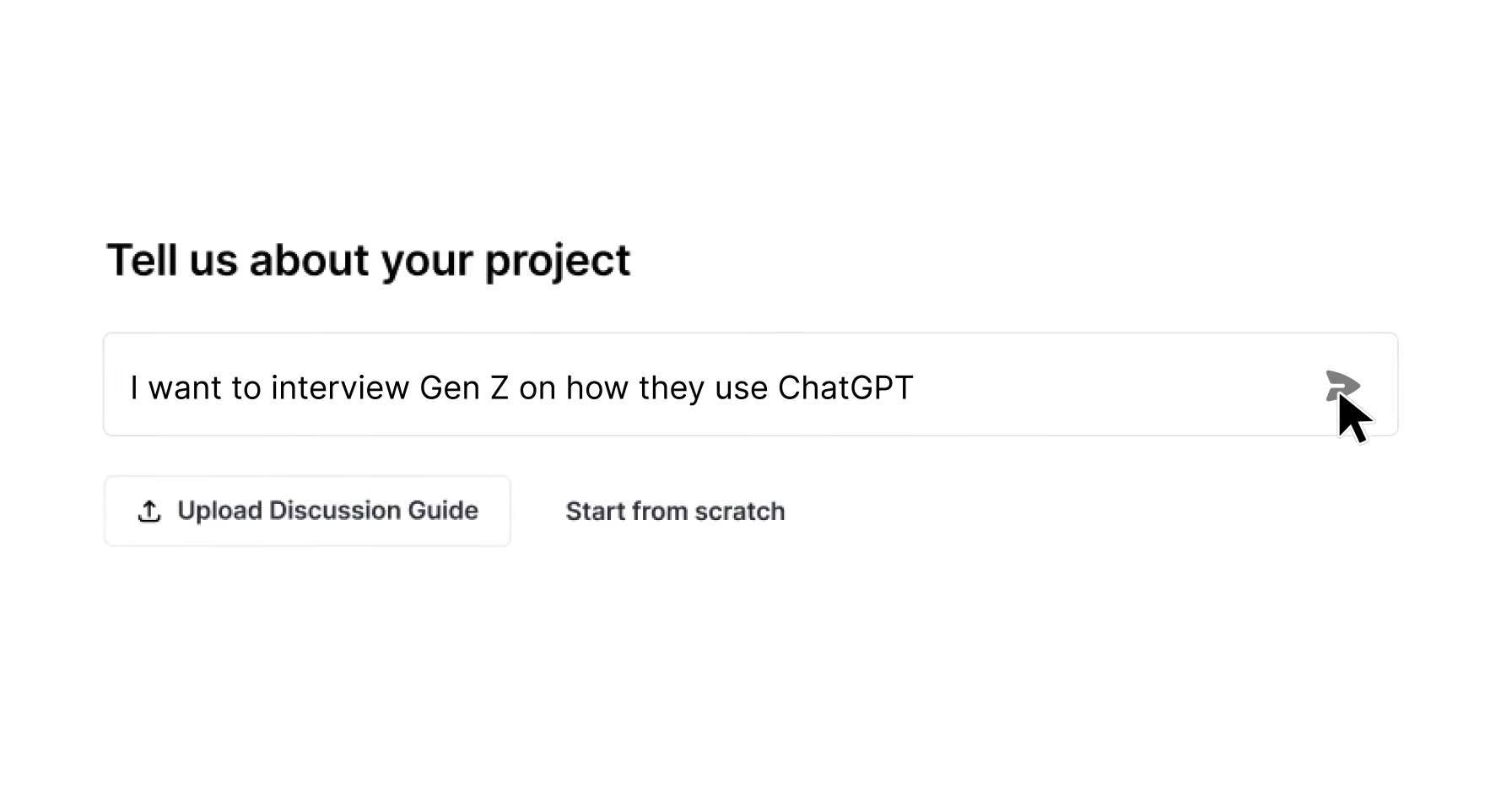
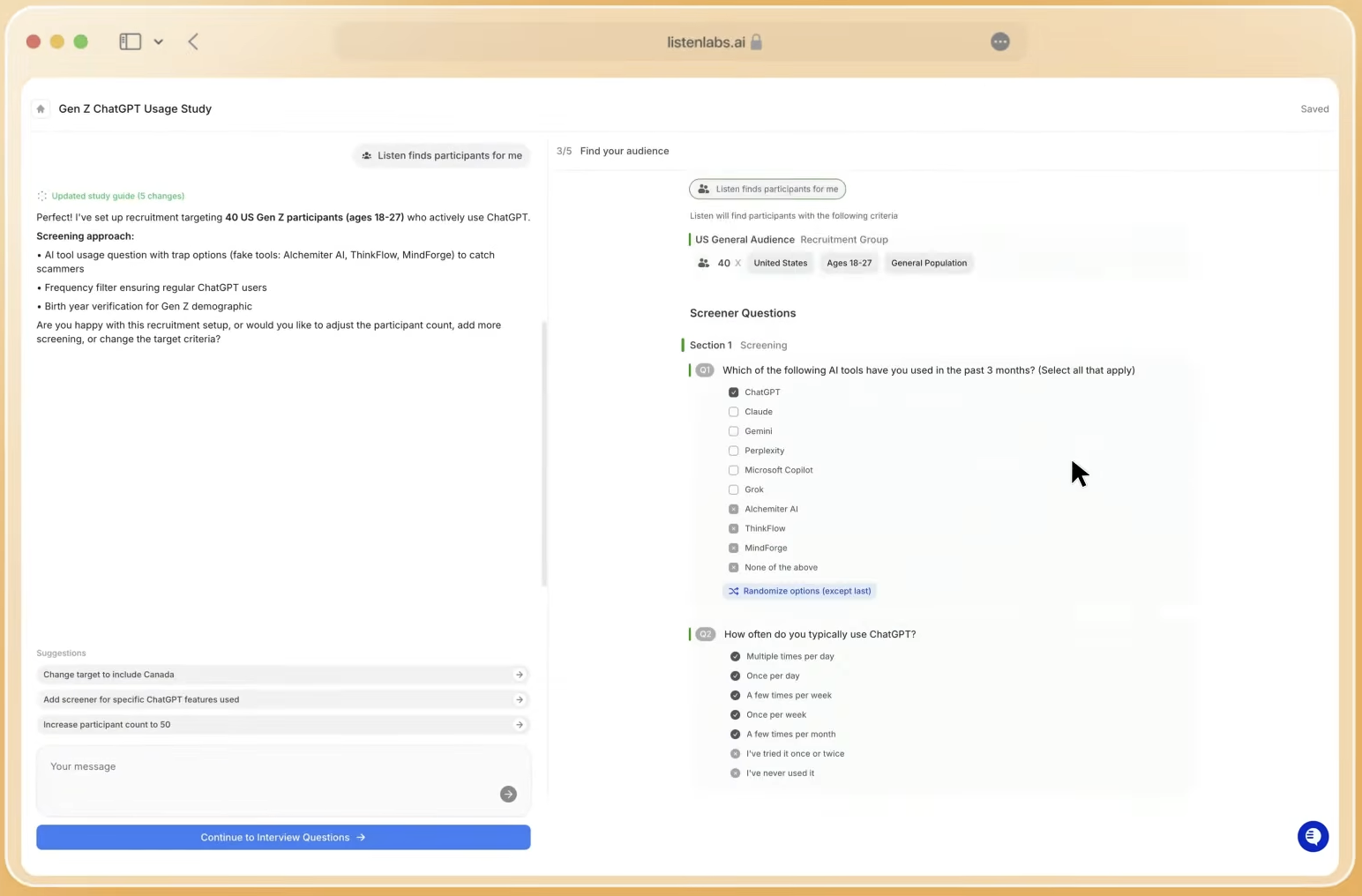
On speed, Listen Labs compresses the full research lifecycle, including study design, recruitment, moderation, analysis, and deliverables, to under 24 hours. Platforms like Listen Labs layer on auto-recruiting, transcription, sentiment tagging, and insight summarization so teams jump from question to findings in hours, not weeks.
Depth and Emotional Intelligence
On depth, Listen Labs’ AI moderator conducts personalized video interviews with dynamic follow-up questions. It probes deeper on short or interesting answers the same way a trained human interviewer would. The Emotional Intelligence layer analyzes tone of voice, word choice, and subconscious micro-expressions to surface emotions that transcripts alone miss. This layer builds on Ekman’s universal emotions framework and works across 50+ languages. Every emotional label is traceable to the exact timestamp, verbatim quote, and reasoning behind it.
Sample Quality, Fraud Controls, and Analysis Effort
On sample quality, Listen Labs’ 30M+ verified respondent network across 45+ countries is governed by Quality Guard, which monitors every interview in real time for fraud, low-effort responses, and repeat respondents. Participants are limited to three studies per month, which removes professional survey-takers. Listen Atlas, the AI orchestration layer, matches participants on behavioral and intent data rather than self-reported demographics alone.
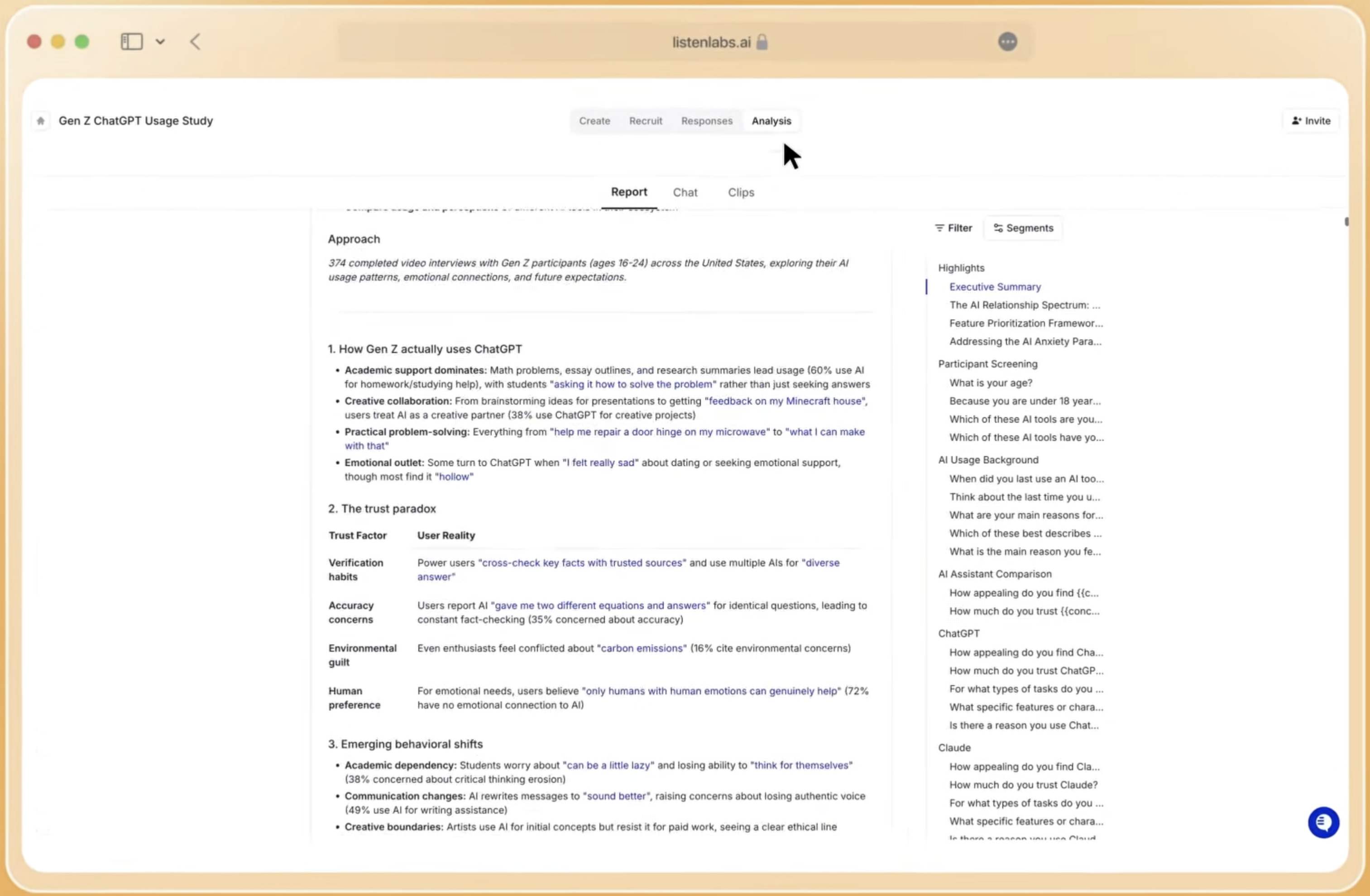
On analysis effort, the Research Agent generates automated key findings, themes, personas, slide decks, memos, highlight reels, and statistical charts in under a minute. Mission Control serves as the organization’s cross-study knowledge base, so teams can query past research in seconds rather than re-running studies on questions already answered.
Security and Compliance for Enterprise F&B
On security and compliance, Listen Labs holds GDPR, SOC 2 Type II, ISO 27001, ISO 27701, and ISO 42001 certifications, with enterprise SSO and 256-bit encryption. Customer data is never used for AI model training.
Best-Fit Listen Labs Use Cases by Team Type
Different F&B team structures map to different research needs, and Listen Labs serves all three primary configurations.
Enterprise consumer insights teams running ongoing global programs, such as multi-market flavor testing, continuous brand health tracking, or annual packaging validation cycles, benefit from Listen Labs’ proven ability to scale across Fortune 500 clients while maintaining lean research teams. The platform runs hundreds of simultaneous interviews across 100+ languages.
Product managers without dedicated research teams who need rapid concept validation for new beverage launches or line extensions can describe their research goals in natural language. Listen Labs then handles study design, recruitment, moderation, and analysis automatically. Qual-at-scale is ideal when research requires large sample sizes or broad geographic reach, as AI tools can engage hundreds or thousands of participants remotely and asynchronously.
Agencies and consultancies managing menu innovation or packaging validation projects within tight client timelines can use Listen Labs to deliver consultant-quality findings in days rather than weeks. The platform’s dedicated recruitment ops team sources even hard-to-reach segments, including QSR heavy users, premium beverage purchasers, or health-motivated snackers below 1% incidence rate, without the weeks of manual panel coordination that agency projects typically require.
Ready to see how Listen Labs fits your team’s specific research workflow? Walk through a live F&B use case with our team.
Operational and Long-Term Considerations for F&B Teams
Adopting any new research platform requires stakeholder alignment across insights, legal, IT, and procurement. Listen Labs’ compliance certifications address the requirements that enterprise legal and security teams raise most frequently. Enterprise SSO integration reduces IT onboarding friction.
Change management for insights teams centers on the shift from sequential, project-based research to continuous, always-on intelligence programs. A growing share of insights teams report running at least one always-on study. Mission Control supports this transition by building institutional knowledge across studies. Each new flavor test or packaging validation adds to a cumulative consumer understanding base rather than existing in isolation.
For global F&B programs, Listen Labs’ 100+ language support and 45+ country coverage remove the sequential market-by-market recruitment delays that extend traditional multi-market studies to 10–16 weeks. Case studies from food and beverage companies suggest that culturally calibrated concept testing using AI-moderated interviews across multiple languages can help reduce international launch failures compared to standardized survey-based testing.
Risks, Limitations, and Common Misconceptions in F&B Research
Several misconceptions shape how F&B teams evaluate research tools in 2026.
The first misconception states that qualitative depth requires small sample sizes. With qual-at-scale, the old trade-off between depth and scale is no longer a barrier. AI moderation runs hundreds of personalized, adaptive conversations simultaneously. This approach delivers both statistical confidence and the nuanced insight of one-on-one interviews.
The second misconception treats free trend tools as a substitute for primary research. Trend tools identify signals in public data; they cannot validate whether a specific concept, claim, or packaging design resonates with a verified sample of target consumers. Best practices for F&B product testing include testing sensory elements early to avoid late-stage reformulation and validating claims with the target audience. These tasks require primary research, not trend aggregation.
The third misconception assumes that AI moderation sacrifices quality for speed. Research indicates that AI-moderated interviews can produce longer and more complete responses with lower interviewer bias than some traditional human-moderated approaches.
The fourth misconception suggests that panel subscriptions alone solve hidden recruitment complexity. Using a panel-only approach for a 20-interview qualitative study, the initial sourcing fee can expand to a total real cost of $6,000–$12,000 once screening, scheduling, moderation, transcription, quality review, and analysis are added, representing a 10–15x multiplier. Listen Labs removes this fragmentation by integrating all steps into a single platform.
Decision Framework and Checklist for F&B Insights Leaders
The following questions help F&B insights leaders match research options to their actual constraints and goals.
- Does the research question require understanding consumer motivations, emotions, or unarticulated needs? If yes, syndicated reports and retail data platforms are insufficient, and primary qualitative research is required.
- Is the decision timeline measured in days or weeks rather than months? If yes, traditional agency qualitative methods and most syndicated custom research cannot meet the deadline.
- Does the study require verified participants screened on behavioral criteria, such as actual category purchasers, specific occasion users, or hard-to-reach segments? If yes, commodity panels and free trend tools introduce unacceptable quality risk.
- Does the program span multiple markets and languages? If yes, platforms without native multilingual moderation and simultaneous multi-market fieldwork will extend timelines non-linearly with each additional market.
- Does the study need to test specific stimuli, such as packaging mock-ups, flavor descriptions, concept boards, or pricing scenarios? If yes, the platform must support advanced stimuli display, monadic or sequential randomization, and branching logic.
- Does the organization require GDPR, SOC 2, ISO 27001, ISO 27701, and ISO 42001 compliance? If yes, verify certifications before procurement, not after.
- Does the team need to build cumulative consumer knowledge across studies rather than treating each project in isolation? If yes, a platform with cross-study knowledge management, like Listen Labs’ Mission Control, becomes a functional requirement, not a nice-to-have.
- Is cost per study a binding constraint? Full-service agency engagements for multiple studies per year can total tens or hundreds of thousands of dollars annually, while AI-moderated platforms can support more frequent research at significantly lower costs. Listen Labs delivers comparable quality at a fraction of agency cost.
Frequently Asked Questions
How does turnaround time for AI-moderated interviews compare to traditional qualitative methods?
Traditional in-depth interview studies of 20 participants in a single market take 6–8 weeks from brief to final deliverable, with recruitment alone consuming 2–3 weeks. Multi-market studies extend to 10–16 weeks due to sequential coordination across markets. Listen Labs compresses the entire lifecycle, including study design, recruitment, moderation, analysis, and deliverables, to under 24 hours. Multi-market studies run simultaneously across all markets rather than sequentially, with fieldwork conducted in 100+ languages in parallel.
How does Listen Labs source and verify participants?
Listen Labs recruits from a network of 30M+ verified respondents across 45+ countries through Listen Atlas, an AI orchestration layer that matches and bids across multiple consumer and B2B panel partners alongside Listen Labs’ proprietary database. Matching is based on behavioral and intent data, not just self-reported demographics. A dedicated recruitment ops team handles hard-to-reach segments, including enterprise decision-makers, healthcare workers, and consumers below 1% incidence rate, through partnerships with niche communities and specialized networks. Organizations can also bring their own participants from their existing user base at reduced cost.
What fraud controls does Listen Labs apply to AI interview platforms?
Quality Guard applies three layers of protection. First, Listen Labs works exclusively with high-quality, non-commodity panel sources, so no professional survey-takers participate. Second, Quality Guard monitors every interview in real time across video, voice, content, and device signals to detect fraud, low-effort responses, AI-generated scripts, and mismatched profiles. Third, participants are limited to three studies per month to prevent panel fatigue and remove incentive-driven gaming. A dedicated recruitment ops team adds a human review layer for studies requiring specialist audiences.
How does AI moderation differ from human moderation for F&B research?
AI moderation conducts personalized, adaptive conversations with dynamic follow-up questions, probing deeper on short or interesting answers the same way a trained human interviewer would. Unlike human moderators, the AI applies consistent probing depth from the first to the three-hundredth interview without fatigue, bias drift, or social desirability amplification. For F&B-specific needs, Listen Labs supports advanced stimuli display, including packaging mock-ups, flavor descriptions, concept boards, images, video, and PDFs, alongside monadic and sequential randomization, branching logic, and mixed-method designs that combine qualitative questions with Likert scales, NPS, sliders, and MaxDiff. The Emotional Intelligence layer adds multimodal signal analysis of tone of voice, word choice, and micro-expressions, capturing what participants feel as well as what they say.
What multilingual research capabilities does Listen Labs offer?
Listen Labs supports interview moderation in 100+ languages with automatic translation and transcription across all supported languages. Emotional Intelligence analysis is available across 50+ languages. Multi-market studies run simultaneously across all target markets rather than sequentially, which removes the coordination delays that extend traditional multi-market qualitative studies. This capability is particularly relevant for global F&B programs testing flavor concepts, packaging designs, or menu innovations across European, APAC, and Latin American markets in a single research cycle.
What security and compliance certifications does Listen Labs hold?
Listen Labs holds SOC 2 Type II, GDPR, ISO 27001, ISO 27701, and ISO 42001 certifications. The platform uses 256-bit encryption, supports enterprise SSO, and maintains a strict policy that customer data is never used for AI model training. These certifications address the requirements that enterprise legal, security, and procurement teams raise most frequently during vendor evaluation for Fortune 500 F&B companies.
How complex is implementation for enterprise F&B teams?
Enterprise teams go through a demo and pilot process that includes hands-on onboarding with Listen Labs’ in-house research team, which brings 50+ years of combined expertise. The platform handles the full research lifecycle, including study design, recruitment, moderation, analysis, and deliverables, within a single environment. This structure removes the multi-vendor coordination that traditional research stacks require. AI-assisted study co-design allows teams to describe research goals in natural language and receive structured objectives, questions, and probing context in seconds. Mission Control builds institutional knowledge across studies from day one, so the platform becomes more valuable with each completed project.
Conclusion: How to Choose the Right F&B Consumer Insights Approach
Syndicated reports deliver category benchmarks but cannot explain why a specific concept, flavor, or packaging design resonates with a target consumer. Retail data platforms track transactions but not motivations. Free trend tools surface public signals but cannot validate them against verified participants. Traditional agency qualitative research delivers depth at timelines and costs that F&B product cycles can no longer absorb.
Listen Labs removes the trade-offs that have historically forced F&B insights teams to choose between speed and depth, scale and quality, or cost and rigor. Switching to Listen Labs AI-moderated interviews lets brands capture hundreds of candid, one-to-one conversations overnight. The platform’s 30M+ verified participant network, Emotional Intelligence layer, Research Agent, and Mission Control deliver end-to-end consumer insights infrastructure that scales with enterprise programs at flat costs.
For VP and Director-level consumer insights leaders managing growing research backlogs, the key issue is not whether AI-moderated interviews can match traditional quality. Many AI-native platform users now run substantially more qualitative interviews per quarter than they did a few years ago. The real question is how many product decisions are being made without the consumer insight that Listen Labs can now deliver overnight.
See how Listen Labs fits your F&B research program, from flavor testing and packaging validation to multi-market menu innovation and ongoing brand health tracking.