Written by: Anish Rao, Head of Growth, Listen Labs
Key Takeaways for CPG Insights Leaders
- Traditional CPG qualitative research often takes 4–8 weeks because of sequential handoffs, recruitment delays, and manual analysis that automation can remove.
- Listen Labs automates the full research lifecycle, including study design, verified shopper recruitment, adaptive AI interviews, emotional analysis, and instant deliverables, while maintaining methodological rigor.
- Three-layer fraud prevention and behavioral data matching protect participant quality far beyond commodity panels, supporting reliable packaging and concept testing at scale.
- Multimodal emotional intelligence captures tone, micro-expressions, and word choice in real time, surfacing insights that transcripts alone cannot reveal for packaging and creative validation.
- See how Listen Labs compresses your research cycle to 24 hours without sacrificing participant quality or analytical depth.
Why Traditional CPG Qual Takes 4–8 Weeks
Traditional qualitative research in CPG runs as a long sequence of dependent steps. A team writes a discussion guide, submits a recruitment brief to a panel vendor, then waits for screener completion and scheduling. Moderated sessions stretch across multiple days. Recordings go to a transcription service. Analysts then manually code themes and write a report.
Each handoff introduces delay, and a single no-show can trigger rescheduling across the schedule. Manual coding also introduces analyst bias and slows synthesis. The result is a process that routinely takes 4–8 weeks for a study that brand and innovation teams often needed answered weeks earlier.
AI can schedule and conduct the interview, analyze the transcripts for themes, and generate insights from those interviews, collapsing all sequential stages into a parallel 24-hour cycle. The five workflow steps below show how that compression works for CPG-specific use cases. Each step removes a traditional bottleneck while preserving research rigor.
Step 1: Turn Objectives Into a Drafted Study Guide
The automated workflow starts with a plain-language objective. An insights leader describes the research goal, for example, “test three packaging claim variants for a new men’s grooming line against a target of 25–45-year-old male shoppers.” Listen Labs’ AI then drafts a structured study guide within seconds.
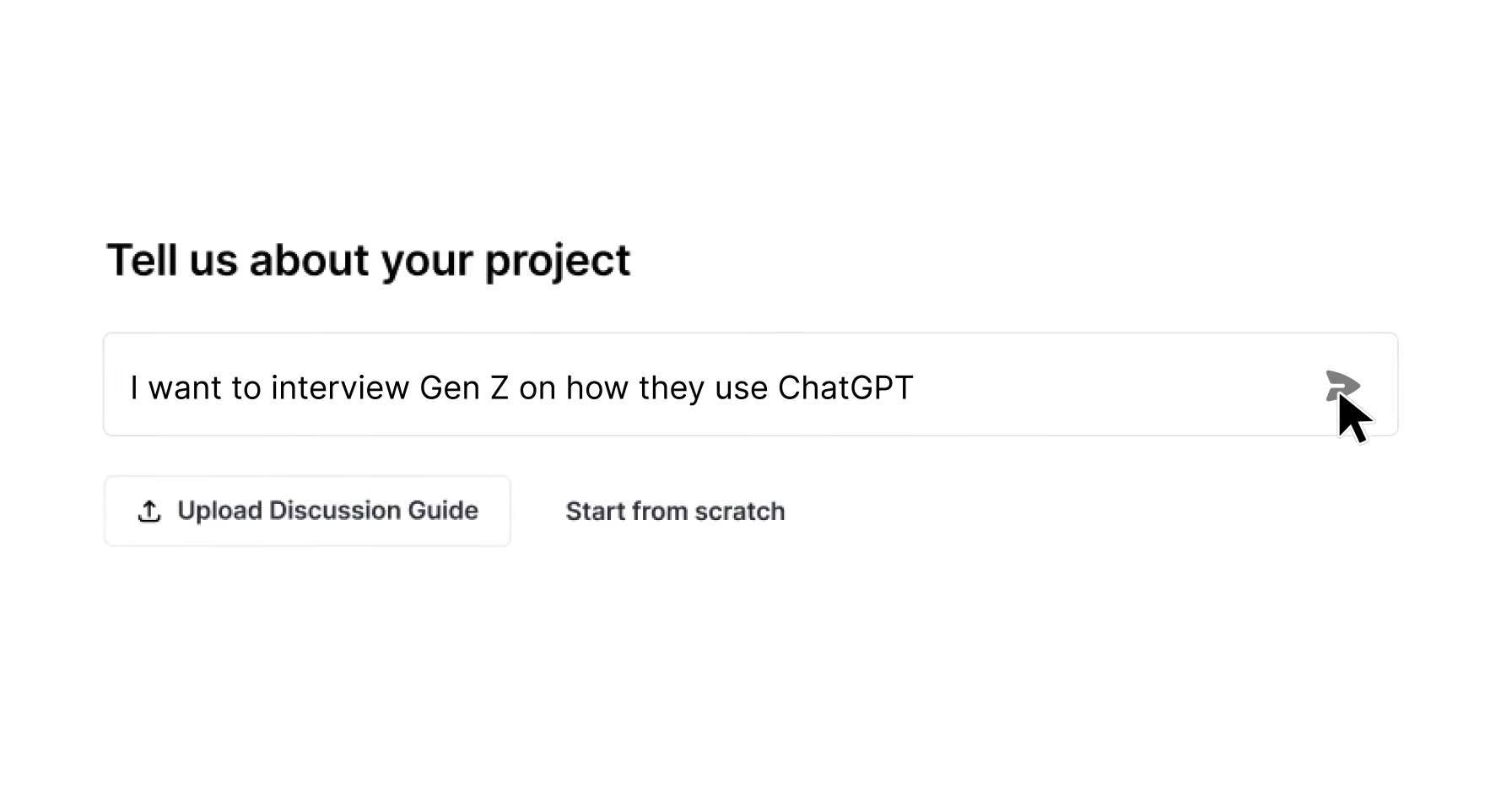
The output includes sequenced question blocks, stimuli display logic for monadic or sequential concept exposure, branching rules, and skip logic tailored to the CPG use case. For packaging claim testing, the guide automatically adds probing questions that reveal whether claims feel credible, differentiated, or exaggerated. For flavor validation, it builds sensory prompts that elicit descriptive responses beyond simple preference ratings.
An auto-QA layer flags ambiguous questions, leading language, or structural issues before launch. This quality check replaces the slow manual review that previously required a senior researcher’s time.
Step 2: Build Screeners and Recruit Verified Shoppers
Participant quality drives the reliability of CPG qualitative research. Commodity panels often include professional survey-takers who focus on incentive completion rather than honest response. Listen Labs addresses this risk through Listen Atlas, an AI orchestration layer that matches participants across behavioral and intent data, not just self-reported demographics.
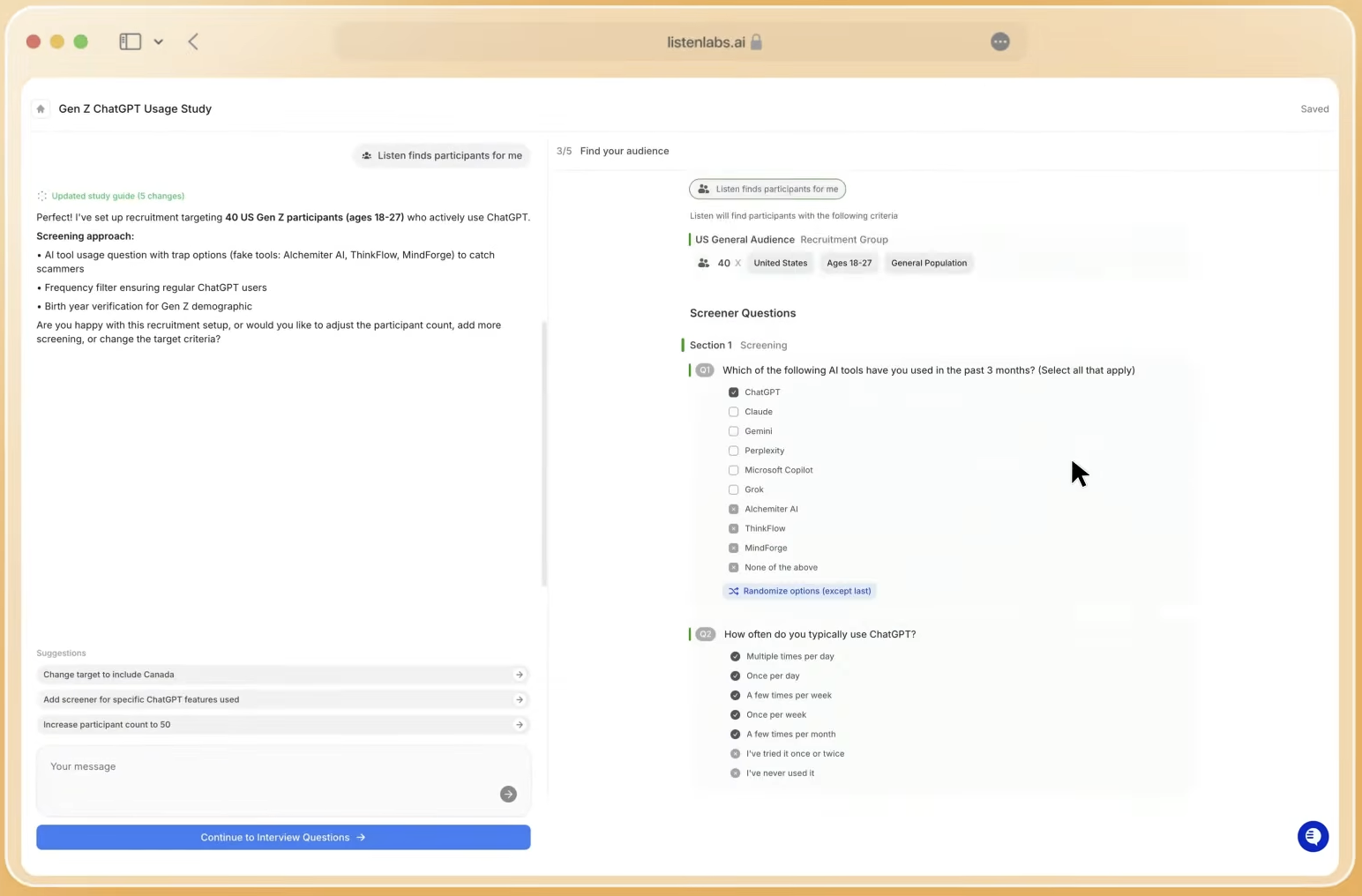
This matching draws from a global network of 30 million verified respondents across more than 45 countries. Three layers of fraud prevention operate simultaneously to ensure participant authenticity. First, behavioral data matching screens for genuine category engagement before recruitment begins.
During the interview, real-time AI monitoring detects low-effort responses, AI-generated scripts, and mismatched profiles as they occur. Finally, frequency caps limit each participant to three studies per month, which removes the repeat-respondent problem that undermines commodity panel data. Verified behavioral matching at scale creates a structural advantage that commodity recruitment cannot replicate.
Step 3: Run Adaptive AI-Moderated Shopper Interviews
Once participants are recruited, Listen Labs runs AI-moderated video interviews simultaneously across the entire sample. Each interview feels personal and adaptive. When a participant gives a short or unexpected answer, the AI follows up with targeted probes based on that specific response.
This behavior mirrors a trained human moderator and applies it consistently across hundreds of concurrent sessions. For CPG teams, a flavor validation study covering five concept variants across three regional markets can run in a single afternoon. Creative pre-testing for a campaign launch can capture candid, one-on-one reactions without the groupthink that distorts focus group data.
The platform supports more than 100 languages for interview moderation. Global CPG studies can run without separate vendor coordination for each market, which shortens timelines and reduces operational overhead.
Step 4: Measure Emotional Signals and Guard Data Quality
Shopper statements and shopper feelings often diverge. A packaging concept may receive positive verbal ratings while still triggering visible confusion or flat affect. These signals often predict in-market failure but never appear in a transcript.
Listen Labs’ Emotional Intelligence layer analyzes three simultaneous signal streams: tone of voice, word choice, and subconscious micro-expressions, using Ekman’s universal emotions framework as the foundation. Every emotional label is quantified per question and per stimulus. Each label is traceable to the exact timestamp, verbatim quote, and reasoning behind the classification.
For packaging and creative testing, an insights leader can see which claim variant triggered the most trust, which created the most confusion, and the precise moment that emotional shift occurred in the video. Quality Guard monitors every interview in real time for fraud indicators, low-effort responses, and device anomalies. This monitoring maintains data integrity across the full sample without slow, manual, post-hoc checks.
Ready to see emotional intelligence applied to your next packaging or concept test? See how Listen Labs captures emotional signals in your research and watch the platform surface insights that transcripts alone miss.
Step 5: Turn Raw Interviews Into Instant Deliverables
Analysis consumes the most time in traditional qualitative research. Manual coding of 50 interview transcripts can take days. Synthesis into a stakeholder-ready report adds more days. Confirmation bias also shapes which themes get elevated and which remain buried.
Research Agent handles the full analysis workflow: from raw data to final output. The AI identifies patterns and themes across all responses objectively, separating signal from noise using proprietary data from tens of thousands of completed studies. One researcher ran a full buying intent analysis across three user segments in under a minute.
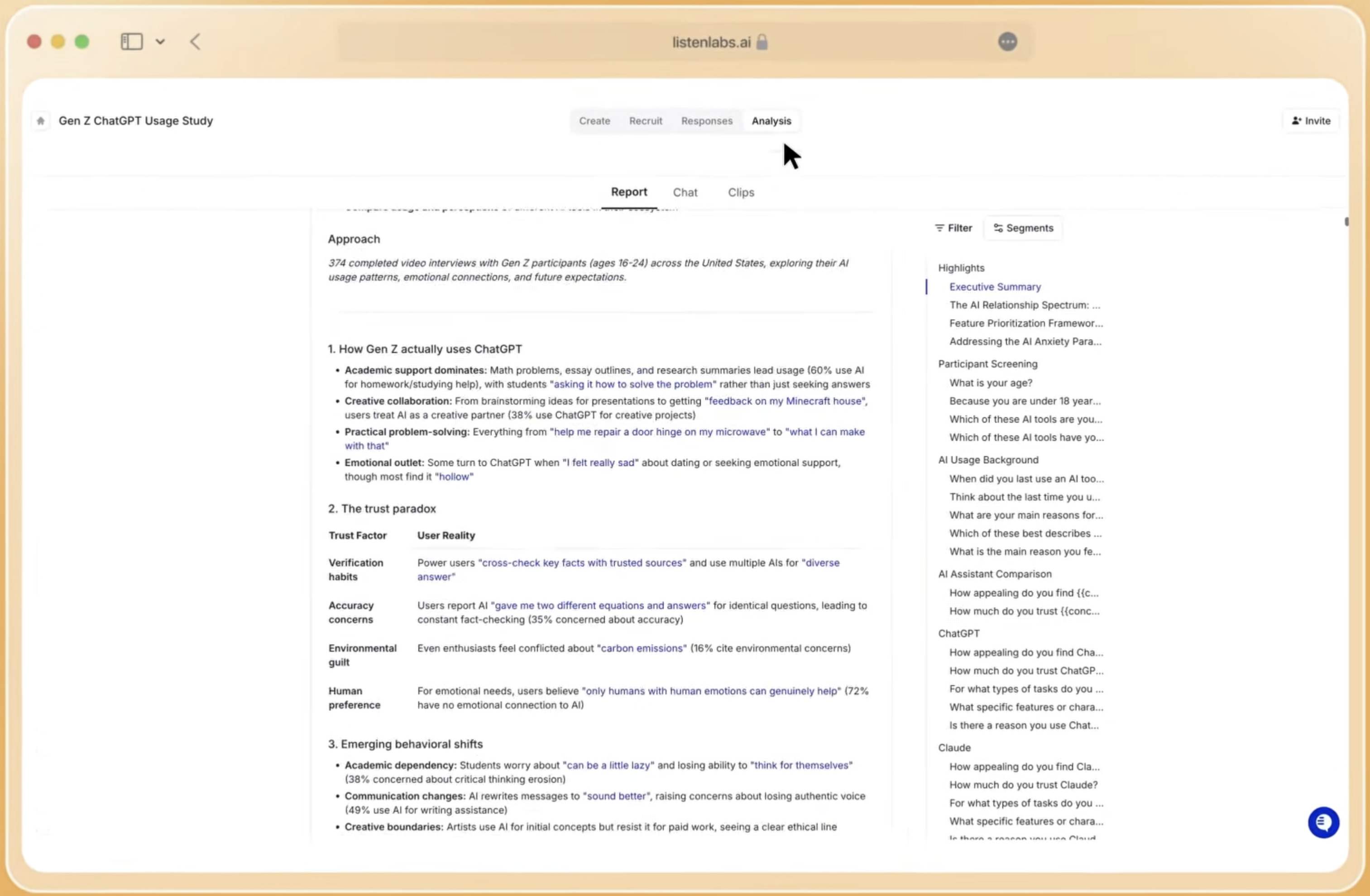
Research Agent generates a slide deck in a company’s branded template and a downloadable report, along with video highlight reels, statistical charts, and segmentation breakdowns. All of these outputs are available within the same 24-hour cycle as the fieldwork.
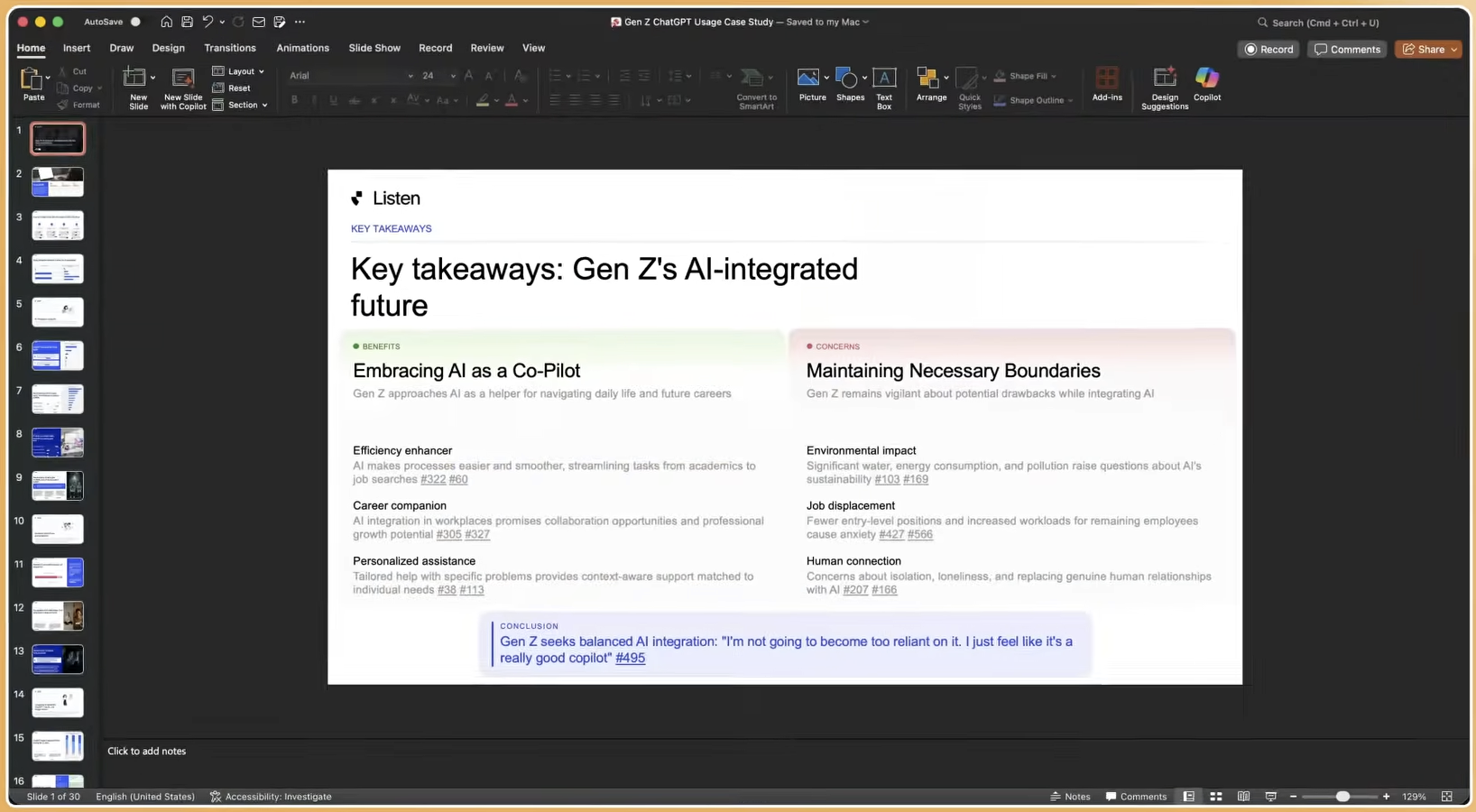
P&G used this workflow to deliver more than 250 interviews with quantified themes and verbatim proof, shaping product and brand strategy in hours rather than weeks. Skims validated campaign direction with thousands of premium consumers overnight, removing weeks of recruiting and panel sourcing and delivering qualitative clarity that secured board-level support.
Keeping Humans in the Loop for Strategic Judgment
Automation handles logistics, while strategic judgment stays with the insights leader. In practice, the VP or Director of Consumer Insights reviews and approves the AI-drafted study guide before launch. This leader also sets quota parameters and audience definitions and interprets findings in the context of broader brand strategy.
The platform flags quality anomalies for human review instead of silently excluding data. Mission Control stores all findings in a cross-queryable knowledge base, so institutional knowledge compounds across studies rather than disappearing into archived slide decks. The research team’s role shifts from operational execution to strategic direction, which multiplies output without adding headcount.
When to Use Synthetic Consumers vs. Verified Humans
Synthetic consumer simulations, which use AI-generated personas trained on demographic and behavioral data, support early-stage CPG ideation. They work well for rapid hypothesis generation before teams commit to primary research. They also help stress-test discussion guides, explore edge-case scenarios, or generate initial concept language when no budget exists for fieldwork.
Verified human panels remain the standard for any research that informs packaging decisions, claim substantiation, product launch sequencing, or creative investment. Emotional responses to physical stimuli, genuine purchase intent signals, and the unexpected insights that reshape strategy all require real shoppers reacting to real concepts. Listen Labs’ recruitment infrastructure is built for verified human research at the speed and scale that CPG innovation cycles demand.
Frequently Asked Questions
How long does a full automated CPG study actually take?
A standard CPG qualitative study on Listen Labs, from study guide finalization through recruitment, AI-moderated interviews, analysis, and deliverable generation, completes in under 24 hours. Study guide drafting with AI assistance takes minutes. Recruitment from the 30-million-respondent network begins immediately after launch.
Interviews run simultaneously across the full sample rather than sequentially. Analysis and deliverable generation through Research Agent add minutes, not days. The 24-hour figure reflects the end-to-end cycle time for a typical concept testing or packaging claim study. Studies that require niche audiences below 1% incidence may take longer for recruitment, but moderation and analysis timelines remain the same.
What are typical cost ranges compared with traditional agency projects?
Traditional qualitative research agency projects, which cover recruitment, moderation, transcription, analysis, and reporting, typically cost significantly more per study than the Listen Labs platform model. Listen Labs operates on a subscription basis. Enterprises pay for platform access, which includes a set number of studies and credits, then spend credits per participant recruited.
Credit cost varies by audience difficulty, with general population studies requiring fewer credits than niche segments. Enterprises running multiple studies per quarter consistently report running more research at roughly one-third of the cost of their previous agency or fragmented-vendor approach. Specific pricing is available through the demo and pilot process for companies with more than 100 employees.
Which data security certifications does the platform hold?
Listen Labs holds SOC 2 Type II, GDPR, ISO 27001, ISO 27701, and ISO 42001 certifications. The platform uses 256-bit encryption and supports enterprise SSO. Customer data is never used for AI model training.
These certifications meet the security and privacy requirements of Fortune 500 CPG procurement and legal teams operating across North America, Europe, and APAC markets.
Can I recruit my own shoppers or reach niche audiences below 1% incidence?
Both options are available. Organizations can self-recruit from their own consumer database or loyalty panel at a reduced credit cost, which is common for CPG brands running studies with existing customers or registered users. For niche audiences, including specific shopper segments, category super-users, or hard-to-reach demographics, Listen Labs’ dedicated recruitment operations team partners with specialized networks and micro-communities.
This team has successfully recruited enterprise decision-makers, healthcare workers, and highly specialized consumer segments that commodity panels cannot reliably reach. The same approach applies to low-incidence CPG shopper profiles.
How does emotional intelligence integrate with packaging and creative testing?
For packaging and creative testing, Emotional Intelligence produces emotion scores per question and per stimulus. The platform quantifies which claim variant triggered the most trust, which created confusion, and the exact moment in the video when the emotional shift occurred, all traceable to the verbatim quote and reasoning.
For creative pre-testing, the system highlights where viewers light up, disengage, or show hesitation that they do not verbalize. These signals feed directly into Research Agent, enabling natural-language queries such as “which concept triggered the most confusion among 35–50-year-old female shoppers” and returning side-by-side emotional breakdowns across stimuli, segments, and markets. Emotional Intelligence supports more than 50 languages, which fits global CPG creative and packaging programs.
Conclusion: Scale Shopper Insights Without Adding Headcount
The five-step workflow described above, covering AI-assisted study design, verified shopper recruitment with three-layer fraud prevention, adaptive AI-moderated interviews, multimodal emotional signal capture, and one-click deliverable generation, compresses a 4–8 week qualitative research cycle into 24 hours. P&G delivered more than 250 interviews with quantified themes in hours. Skims validated a global campaign with premium consumers overnight. The methodology remains the same, but the timeline changes completely.
For VP and Director-level Consumer Insights leaders managing growing backlogs with fixed headcount, user research automation functions as an operational decision available now, not a distant future capability. The research team’s role becomes strategic rather than logistical, and output scales without proportional cost increases.