Written by: Anish Rao, Head of Growth, Listen Labs
Key Takeaways
- Traditional agency-led CPG studies cost $25K–$75K and take 6–12 weeks, which creates a backlog of unanswered questions and slow decisions.
- A repeatable weekly cadence of 15–25 interviews compresses research timelines from weeks to days while keeping data quality high through behavioral screening and AI moderation.
- Owned recruitment through loyalty programs, post-purchase flows, and on-pack QR codes removes third-party fees and delivers verified purchasers instead of professional respondents.
- Layered quality controls, incidence-based sourcing decisions, and AI-driven analysis help teams move from raw transcripts to stakeholder-ready deliverables in under 24 hours.
- Listen Labs lets CPG teams run this entire weekly cadence in one platform. Book a demo to see the workflow in action.
Why a Repeatable Weekly Cadence Changes Outcomes
Replacing episodic agency projects with an owned weekly cadence shortens decision cycles and keeps stakeholders supplied with fresh consumer evidence. Agencies that use AI tools can shrink research cycles on repeat-category clients and support a weekly cadence of 15–25 high-quality conversations without adding headcount.
Three terms anchor this system. Incidence rate is the share of the general population that qualifies for a study. Low incidence under 10% raises recruitment cost and time. A screener is a short pre-interview questionnaire that filters participants to the target profile. Behavioral questions ask what a person actually did, such as last purchase, channel, or frequency. Attitudinal questions ask what they think or feel. CPG interviews use both, and behavioral anchors keep conversations grounded in real decisions instead of hypotheticals.
Step 1: Lock a Monday–Friday Operating Rhythm
A cadence holds when every role has a fixed task on a fixed day. The schedule below distributes work across the week so no single person carries the full load.
- Monday: Insights lead finalizes the screener and discussion guide for the week’s study. The brand manager confirms the business question.
- Tuesday: Recruitment launches via loyalty email, QR code activation, or panel request submitted by 9 a.m.
- Wednesday–Thursday: Interviews field asynchronously or through AI-moderated sessions. Target 15–25 completed interviews.
- Friday: Analysis runs overnight Thursday. The insights lead reviews AI-generated themes by 10 a.m. and sends a one-page summary to stakeholders before noon.
By distributing tasks across fixed days, this rhythm removes bottlenecks that used to stretch studies across weeks. The result is a high volume of consumer conversations per month, a volume that was previously impossible without proportional cost increases because the old trade-off between depth and scale acted as a hard ceiling.
Book a demo to see how Listen Labs structures a weekly cadence for CPG teams inside its end-to-end platform.
Step 2: Build an Owned Participant Pool from Loyalty and Post-Purchase Flows
An owned panel removes third-party recruitment fees for repeat studies and produces verified purchasers rather than self-reported category claimants.
Loyalty program email template (send 3–5 days post-purchase):
- Subject: “Quick question about your recent [Brand] purchase”
- Body: “You recently purchased [Product]. We’d love 15 minutes to hear about your experience. As a thank-you, we’ll add [incentive] to your account.”
- CTA button: “Share my experience” → screener landing page
Post-purchase receipt or confirmation email insert:
- Trigger: order confirmation or ship notification
- Copy: “Help shape [Brand]’s next product. Answer 3 quick questions and qualify for a 15-minute paid conversation.”
- Link: screener URL with UTM tag for source tracking
Recruiting from verified purchasers rather than opt-in panelists who may claim purchases they did not make is the single most effective way to raise data quality in CPG shopper research.
Step 3: Use On-Pack QR Codes and Retailer Data for Recruitment
On-pack QR codes turn every unit sold into a potential recruitment touchpoint. Place the code on the back panel or inside the lid with copy such as “Tell us what you think, earn [reward].” The code should route to a two-question screener that confirms purchase recency and category fit before collecting contact information.
Packaging constraints are real. Regulated categories such as food, OTC, and personal care limit the claims and copy that can appear on-pack. Keep QR recruitment copy factual and incentive-neutral in the on-pack text, then move incentive details to the landing page. When retailers restrict QR codes on shelf displays, use the same flow through the retailer’s post-purchase email program or receipt-based SMS.
When incidence rate is low, such as a premium SKU with narrow distribution, layer retailer loyalty data to pre-qualify buyers before outreach. Quality screening requires verified category purchasers segmented by purchase behavior or demographic to filter professional respondents and ensure depth reveals drivers missed by quantitative data.
Step 4: Write CPG-Specific Screeners and Last-Purchase Behavioral Questions
General UX screeners ask about product usage in the abstract. CPG screeners anchor on a specific, recent, verified transaction.
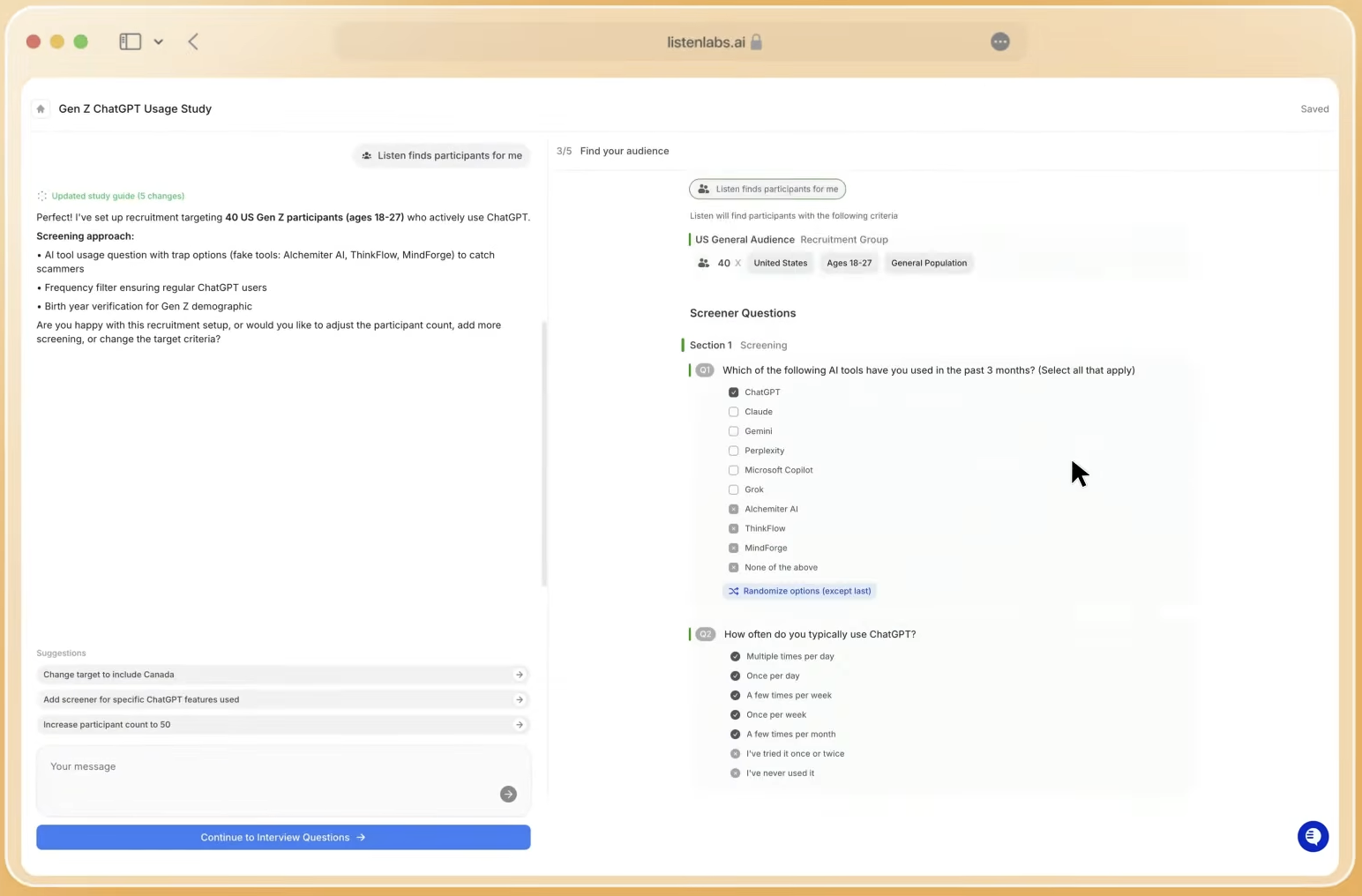
Screener questions (3–4 maximum):
- “In the past 30 days, have you purchased [category] for your household?” (Yes/No qualifier)
- “Where did you most recently buy it?” (Channel check: grocery, mass, club, online, other)
- “Which brand did you buy?” (Open-end or brand list, flags competitor purchasers for a separate quota)
- “How often do you typically buy [category]?” (Frequency filter for heavy vs. light users)
Opening behavioral anchor (use verbatim):
- “I want to understand a specific recent purchase. Think about the last time you bought [product/category]. Can you tell me approximately when that was and where you bought it?”
Purchase trigger and switching probes:
- “What finally tipped it for you?”
- “What role did price play, was it the deciding factor, a constraint, or something else?”
- “If the product you chose had been out of stock, what would you have done?”
- “Is this something you would buy again? What would have to change for you not to?”
Surveys often report price as a top factor. Structured laddering interviews reveal price as the primary driver in 18.1% of cases. The remaining cases use price as a proxy for fairness, control, or brand quality skepticism. Behavioral anchoring surfaces that distinction.
Step 5: Apply Layered Quality Controls
Professional respondents degrade CPG data because their answers reflect panel experience rather than genuine shopper behavior. Exclude participants who show the following signals:
- Completion time under 40% of median for the study length
- Verbatim answers that are generic or copy-paste across questions
- Screener responses inconsistent with interview content, such as a claimed heavy user who describes no brand familiarity
- Participation in more than three studies in the past 30 days on any platform
- Device or IP flags indicating shared or emulated environments
Manually checking each interview against these criteria is not realistic at a weekly cadence. Platforms like Listen Labs automate this layer through Quality Guard, which monitors every interview in real time for fraud, low-effort responses, and mismatched profiles. The platform also adds auto-recruiting, transcription, sentiment tagging, and insight summarization so teams move from questions to findings in hours instead of weeks.
Step 6: Choose External Panels or AI-Moderated Platforms by Incidence Rate
Not every study can be filled from an owned pool. The decision framework below maps incidence rate to the right sourcing approach and helps you decide when self-serve recruitment is enough and when you need dedicated operations support.
- Incidence >20% (broad category buyers): AI-moderated platform with a general consumer panel. The fastest AI studies targeting broad audiences deliver within 24 hours. Cost per interview is lowest in this band.
- Incidence 5–20% (specific SKU or channel buyers): Combine the owned loyalty pool with a verified panel partner. Add behavioral pre-qualification to the screener.
- Incidence <5% (niche segment, premium SKU, or rare usage occasion): Dedicated recruitment operations are required. Listen Labs’ recruitment ops team sources audiences below 1% incidence rate, including segments that standard panels cannot reach.
Time and cost scale with incidence difficulty. AI-moderated asynchronous video customer interviews typically cost $25–50 per interview ($500 for a study of 20) and return results in 24 hours, while traditional one-on-one interviews for agency-commissioned studies can take several weeks. Plan budgets with this curve in mind and reserve agency spend for the lowest-incidence, highest-stakes studies.
Step 7: Move from Raw Transcripts to Stakeholder-Ready Deliverables in Under 24 Hours
Analysis is where most CPG teams lose time. Manual coding of 20 transcripts takes two to three days. At 100 interviews, analysis becomes a multi-week project. AI-moderated platforms remove that bottleneck.
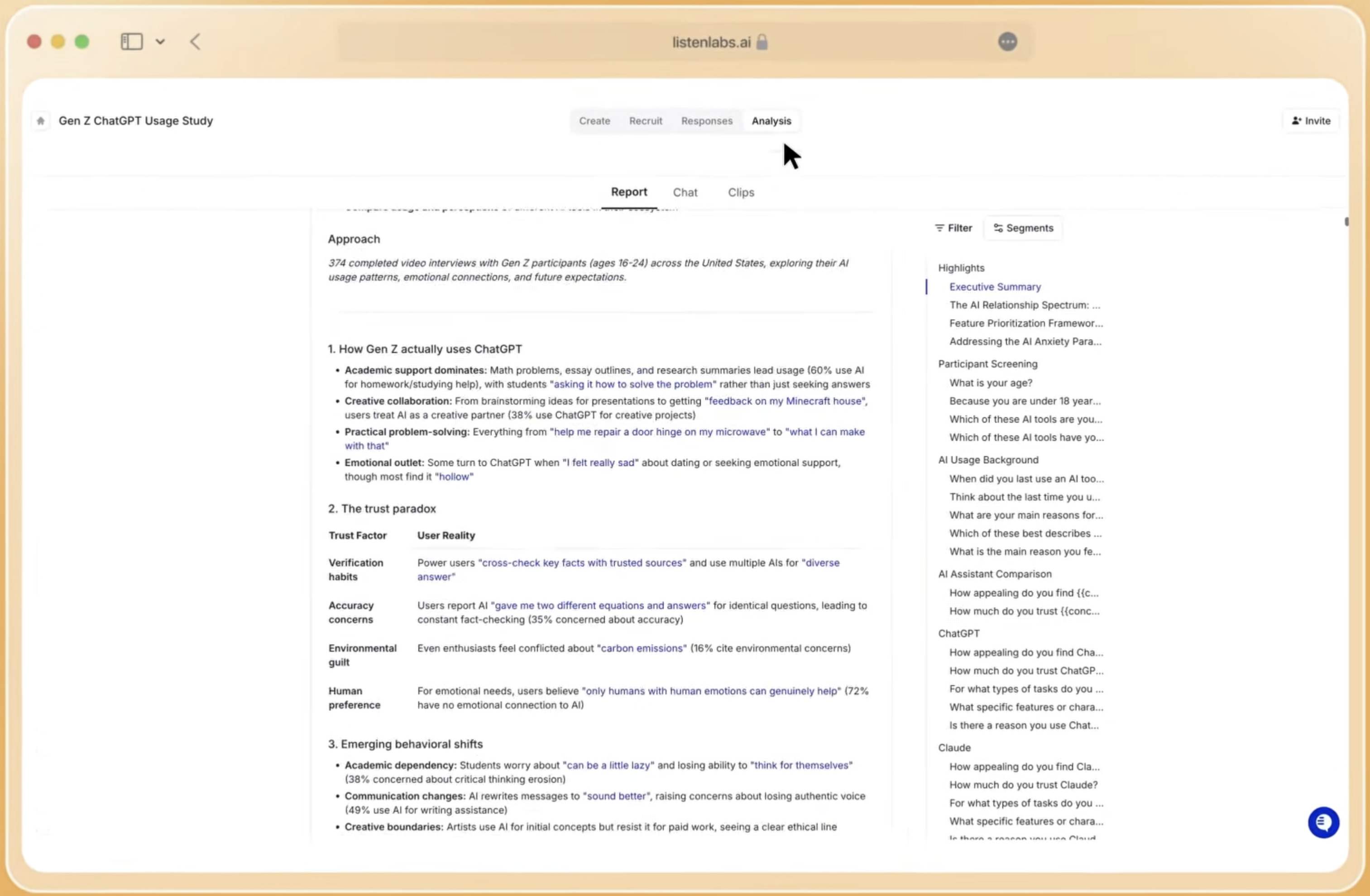
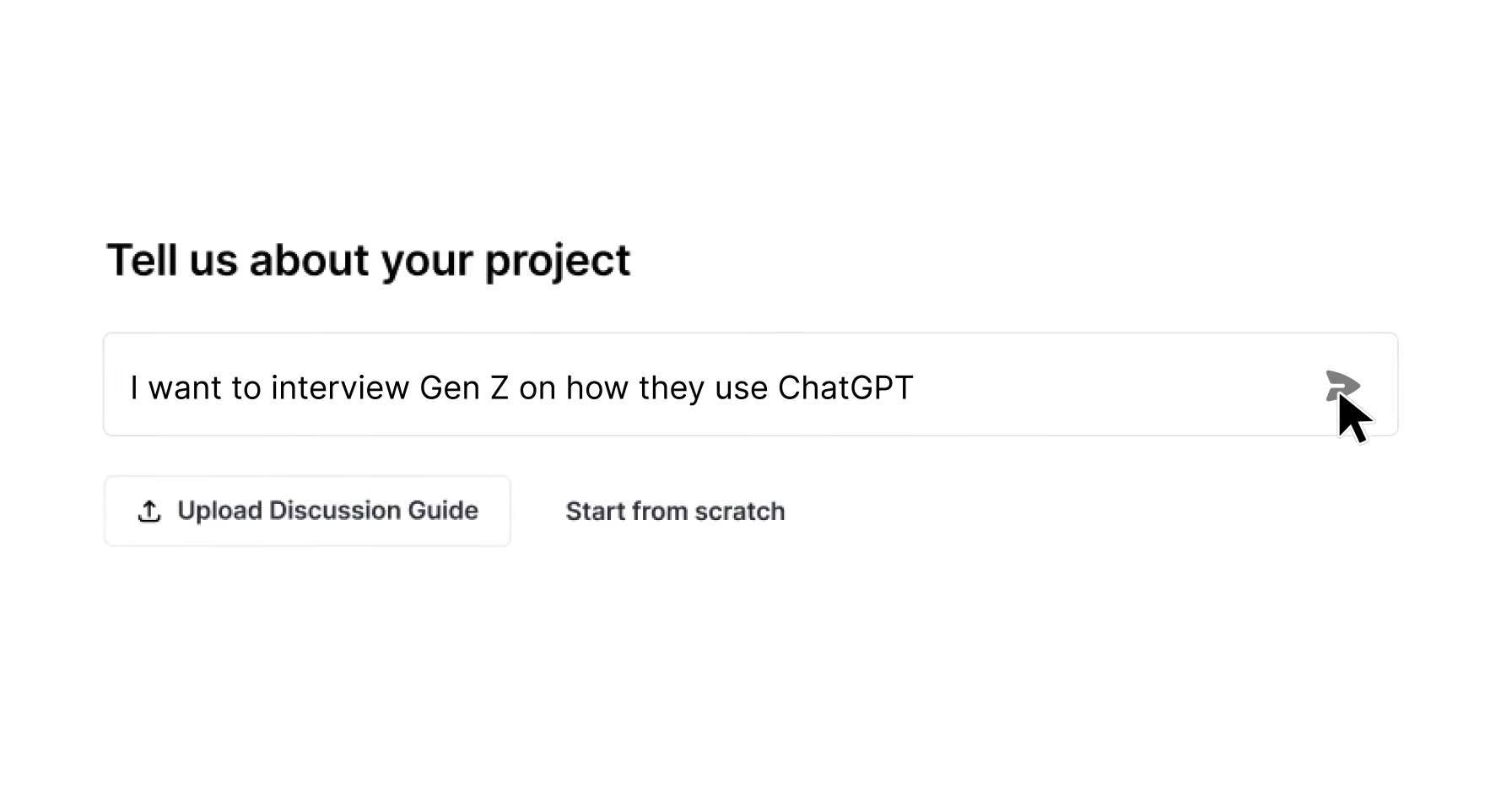
One researcher ran a full buying intent analysis across three user segments in under a minute using Listen Labs’ Research Agent. The tool auto-generates key findings, theme clusters, verbatim evidence, and slide-ready deliverables from raw interview data.
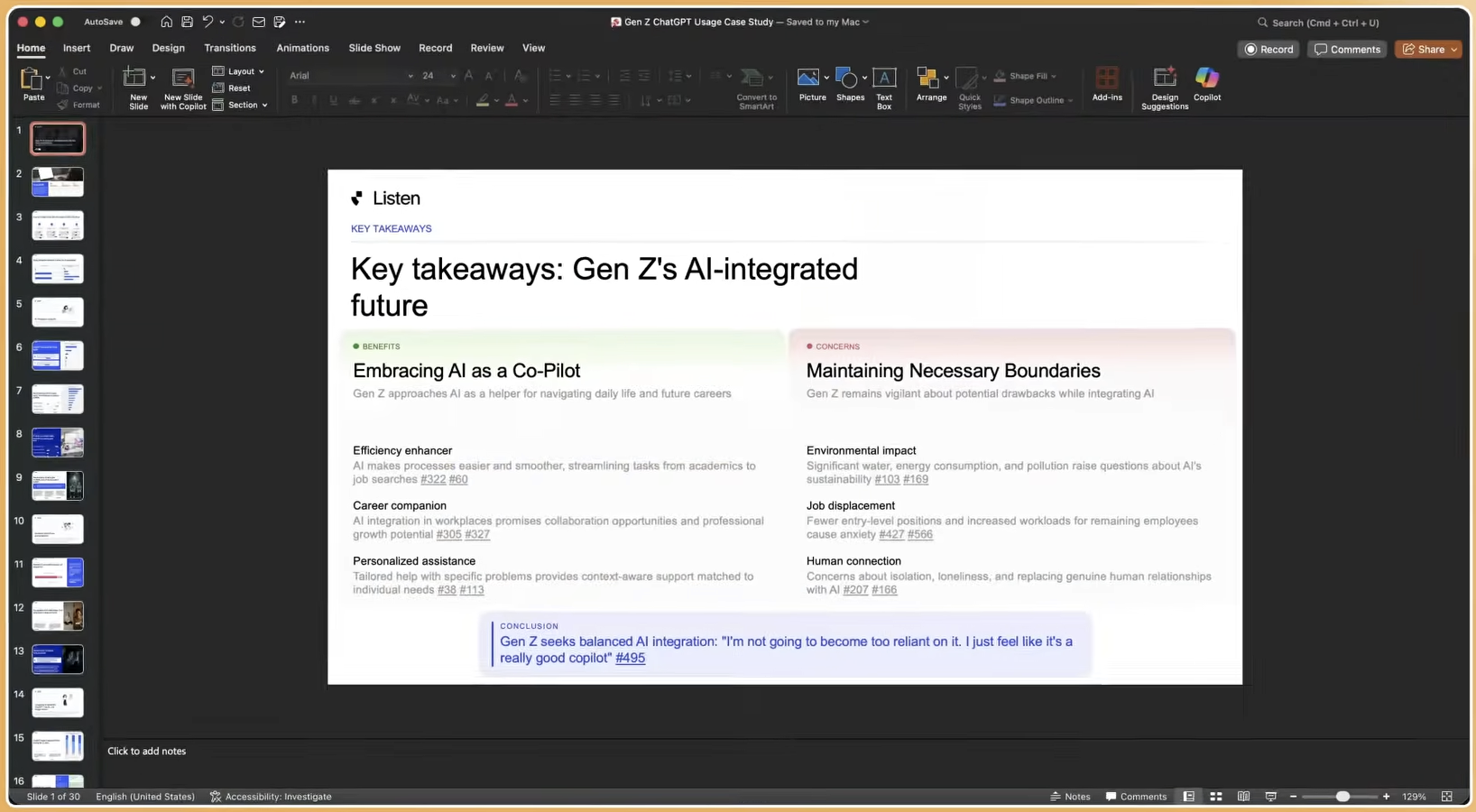
The Friday delivery protocol for a weekly cadence:
- Thursday night: AI analysis runs on completed interviews.
- Friday 8 a.m.: Insights lead reviews auto-generated themes and flags any anomalies.
- Friday 10 a.m.: One-page memo or slide deck goes to brand and marketing stakeholders.
- Friday noon: Decision is logged in Mission Control for cross-study reference.
Teams that want this turnaround can see it live. Book a demo and watch the Research Agent turn CPG interview data into stakeholder-ready deliverables.
Common Challenges and Early-Warning Signals
Low incidence rate: When recruitment stalls below 50% of target by Wednesday noon, the screener is over-filtering. Remove one qualifier or broaden the purchase recency window from 30 to 60 days. When incidence is structurally below 5%, shift to dedicated recruitment operations instead of self-serve panel sourcing.
Packaging constraints: Legal and regulatory review of on-pack QR copy can take longer than the study itself. Maintain a pre-approved copy block such as “Share your feedback, earn rewards” that clears legal once and then reuse it across SKUs. Keep all incentive details on the landing page, not the package.
Internal pushback on cadence frequency: Stakeholders used to quarterly research sometimes question weekly output. Frame weekly interviews as a standing intelligence feed rather than a formal study. Deliver findings as a brief Friday memo instead of a full report to lower expectations for extensive methodology documentation on every cycle.
Objective Success Metrics
- Cycle-time reduction: Target under 5 days from study brief to stakeholder delivery, down from the 6–12 weeks typical of traditional agency-led qualitative studies.
- Monthly interview volume: Aim for 15–25 completed, quality-controlled interviews per week, or 60–100 per month.
- Participation rate from owned pool: Target an 8–12% open-to-complete rate on loyalty and post-purchase recruitment emails.
- Insight-to-decision usage: Track how many weekly findings are cited in brand, innovation, or commercial decisions within 30 days of delivery. This metric justifies the program internally.
Advanced Moves Once the Cadence Is Stable
After three months of consistent weekly output, two expansions become viable. The first is an always-on program. Instead of launching a new study each Monday, maintain a rolling screener that continuously recruits from the loyalty pool and fields a fixed set of brand health and purchase trigger questions. A practical CPG consumer intelligence program includes brand health tracking waves of 200+ interviews, concept testing of 50–100 interviews per concept, and product innovation research of 100–200 interviews.
The second expansion is multi-market studies. Once the domestic cadence is proven, replicate the screener and discussion guide across two or three international markets at the same time. Qual-at-scale tools can engage hundreds or thousands of participants remotely and asynchronously, which makes simultaneous multi-market fielding operationally equivalent to a single-market study. Listen Labs supports 100+ languages with automatic translation and transcription, covering 45+ countries across the Americas, Europe, APAC, and MEA.
When your cadence is ready to scale globally, book a demo to explore how Listen Labs handles multi-market CPG studies within the same turnaround window.
Frequently Asked Questions
How long does it take to set up a weekly CPG interview cadence from scratch?
CPG teams can often run their first study within one week of committing to the cadence. The setup work, including the screener template, discussion guide, loyalty email copy, and QR landing page, fits into a few days. The first study usually completes within a week end-to-end. By week three, the rhythm feels routine and total time investment per cycle drops as templates stabilize.
What incentives work best for CPG consumer interviews?
Loyalty points or account credits outperform cash equivalents for owned-panel recruitment because they reinforce the brand relationship instead of attracting incentive-motivated respondents. For external panel recruitment, cash-equivalent digital rewards are standard. Avoid high-value incentives for short studies because they attract professional respondents who focus on compensation rather than providing genuine feedback.
How do you protect consumer privacy when recruiting from loyalty data?
Recruitment from loyalty data must follow the program’s existing privacy policy and regulations such as GDPR and CCPA. Use opt-in consent language in the recruitment email that clearly states the purpose of the interview, how data will be used, and that participation is voluntary. Store interview data separately from loyalty PII and apply data minimization by collecting only what is needed for the research question. Listen Labs maintains SOC 2 Type II, GDPR, ISO 27001, ISO 27701, and ISO 42001 certifications, and customer data is never used for AI model training.
How many interviews are needed before findings are reliable enough to act on?
For theoretical saturation on a single question, 20–30 interviews are typically needed. This range marks the point at which new interviews stop introducing new themes. Three segments typically require 15–60 interviews to reach saturation, with recommendations ranging from 5–8 to around 20 per segment depending on study goals and population homogeneity. For brand health tracking or launch validation where statistical confidence matters, larger samples are appropriate. The weekly cadence supports directional speed, while larger sample sizes should be reserved for stage-gate or investment decisions.
Can this system work for brands without a loyalty program?
Yes. On-pack QR codes, retailer post-purchase email programs, and receipt-based SMS flows all create owned recruitment touchpoints without a formal loyalty program. Brands can also build a research panel organically by offering a standing invitation on the brand website or in product packaging inserts. For studies that cannot wait for owned-pool recruitment to mature, Listen Labs’ network of 30 million verified respondents across 45+ countries provides immediate access to verified category purchasers at any incidence level.