
Written by: Anish Rao, Head of Growth, Listen Labs
Key Takeaways for Telecom CX and Insights Leaders
- Traditional telecom research methods often take weeks, so teams miss the chance to act on churn and feedback before revenue disappears.
- Modern AI interview platforms remove the depth-versus-scale trade-off by running hundreds of adaptive, emotionally rich interviews in under 24 hours.
- Emotional Intelligence features capture tone, micro-expressions, and word choice that surveys miss, which creates earlier leading indicators of churn risk.
- Telecom-specific use cases such as churn driver identification, pricing validation, and competitive perception tracking now complete overnight instead of over months.
- Listen Labs delivers consultant-quality reports from a 30M+ verified panel with full enterprise compliance, and you can book a demo to compress your research cycle from weeks to hours.
The Problem: Slow, Shallow Research Hurts Telecom Retention
Legacy telecom customer research moves too slowly. A typical qualitative research cycle runs several weeks from study design to final report. In large operators with internal prioritization queues and budget approval layers, that timeline can stretch to six months. Telecom operators lose significant revenue each month to churn, yet the insights needed to intervene arrive long after the window for action has closed.
The depth-versus-scale trade-off makes this worse. Qualitative interviews surface the emotional nuance and behavioral context behind churn, but traditional operations limit sample sizes to 5–15 participants. Quantitative surveys scale but replace conversation with checkboxes, which removes the “why” entirely. Qualitative data methods lack speed and sample size but excel at uncovering nuance and complexity in human decision-making.
This methodological limitation carries direct financial consequences. A 5% increase in retention can boost profits by as much as 95%, and acquiring a new customer costs five to 25 times more than retaining an existing one. Many win-back attempts after a customer has already churned fail. Proactive, timely insight becomes the only viable strategy, and closing the customer feedback loop quickly can have a significant impact on retention.
Traditional platforms also miss emotional signals. Transcripts and NPS scores record what customers say, not what they feel. Emotionally connected customers are up to twice as valuable as highly satisfied customers. No legacy survey tool captures the hesitation, frustration, or delight embedded in a customer's voice and face.
Three Types of Telecom Customer Research Platforms
Syndicated reports, published by firms like Recon Analytics, provide industry-level benchmarks and competitive positioning data. They are fast to procure but offer no operator-specific segmentation, no emotional depth, and no ability to probe a specific product decision or pricing change. They answer “what is the market doing” rather than “why are our subscribers leaving.”
Traditional CXM and survey suites, including Qualtrics and similar platforms, enable operators to deploy NPS surveys, CSAT trackers, and structured questionnaires at scale. Companies that conduct regular relationship surveys can see increases in retention, which confirms that structured feedback programs have measurable value. The limitation is structural. Pre-set questions cannot follow up on unexpected answers, and survey fatigue degrades response quality over time. Integration with network and billing data is possible but requires custom engineering work that most operators have not completed.
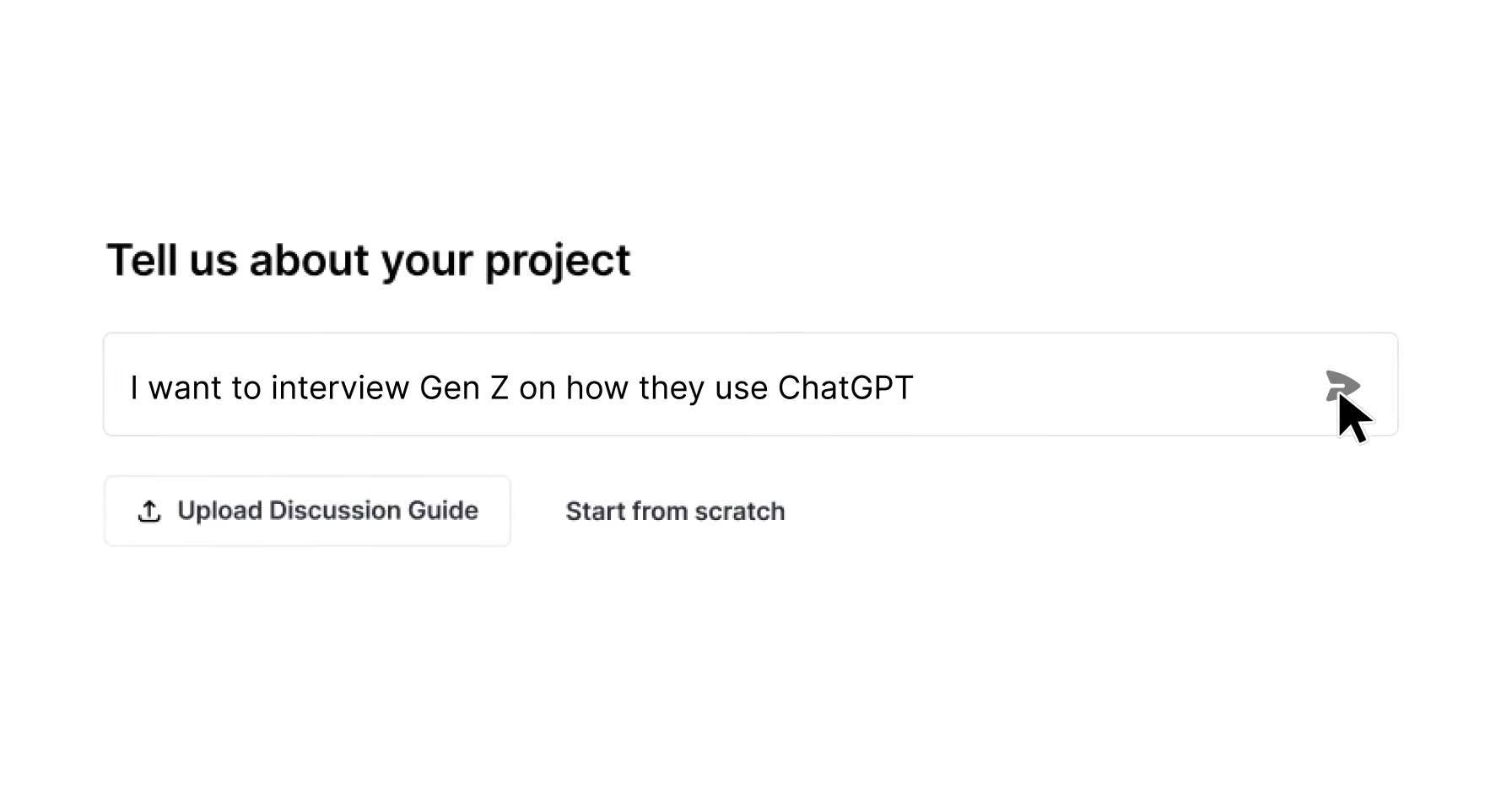
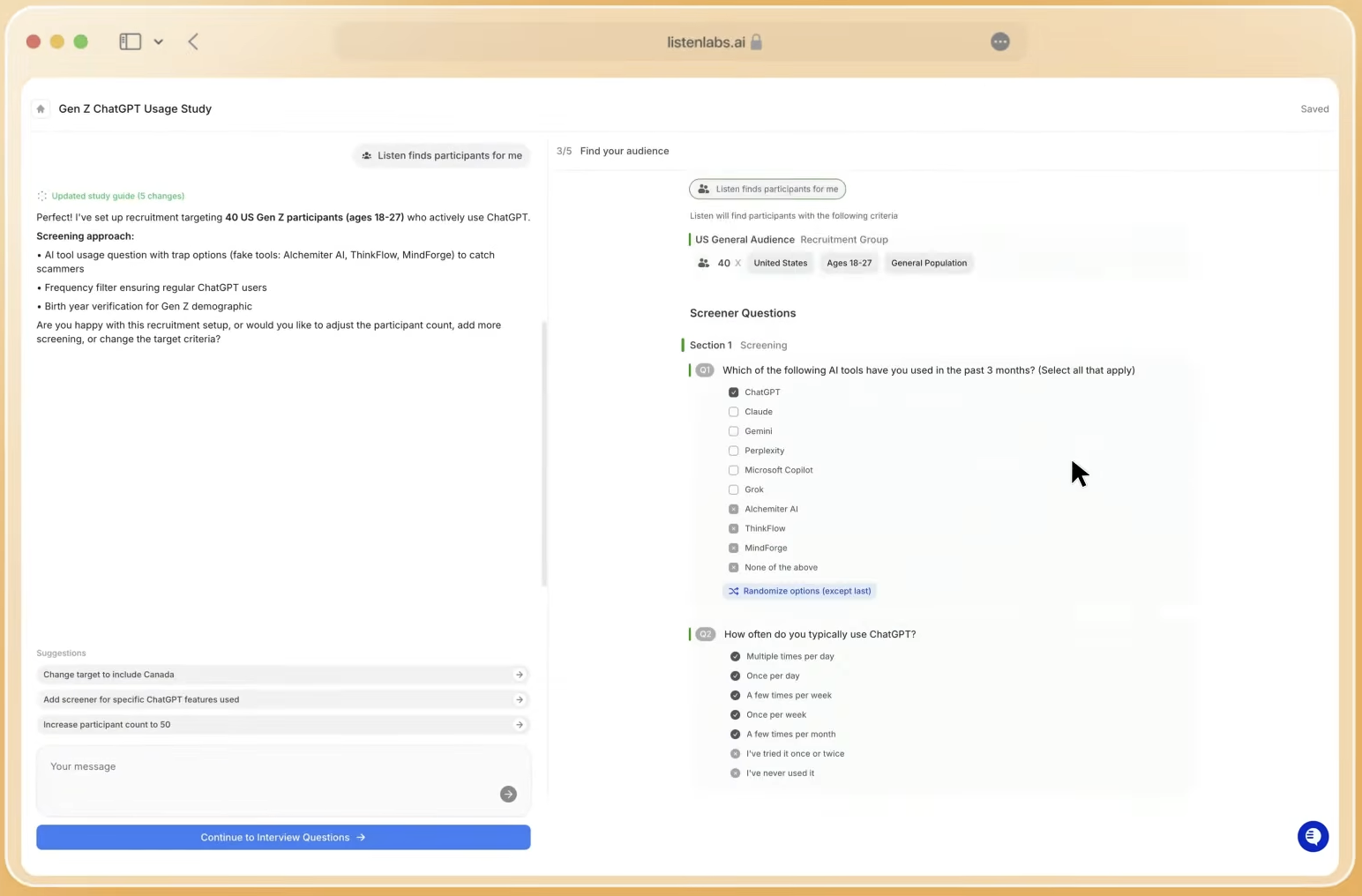
These limitations in both syndicated reports and survey suites have created demand for a third approach. Modern AI interview platforms resolve the core trade-offs that syndicated and survey approaches cannot. With qual-at-scale, the old trade-off between depth and scale no longer blocks progress. AI moderation conducts hundreds of adaptive, one-on-one conversations simultaneously, each with dynamic follow-up questions calibrated to the participant's prior responses. Analysis is automated, deliverables are generated in minutes, and the entire cycle completes in under 24 hours.
Telecom Use Cases You Can Complete Overnight
Churn driver identification. Legacy approaches require recruiting churned subscribers through outbound calling, scheduling interviews across time zones, and manually coding transcripts. This process routinely takes six weeks. By that point, the competitive offer that triggered the churn has already been in market for a month. Listen Labs recruits from its global verified panel, conducts interviews overnight, and delivers a prioritized list of churn drivers with verbatim evidence the following morning. Telecommunications and wireless companies in the U.S. carry an average churn rate of 21%, which demands continuous, not quarterly, intelligence.
Plan and pricing validation. Operators launching new unlimited tiers or convergence bundles need to understand price sensitivity and perceived value before committing to a market rollout. Traditional concept testing with a research agency takes several weeks and costs tens of thousands of dollars per study. Listen Labs delivers hundreds of in-depth interviews in under 24 hours. Pricing teams can iterate before launch rather than after.
Digital self-service usability. App abandonment and IVR drop-off are measurable, but the friction points behind them stay hidden in clickstream data alone. Listen Labs' AI moderator conducts task-based usability sessions with screen recording, capturing the exact moment a subscriber hesitates, backtracks, or gives up. Quality Guard's real-time fraud prevention ensures every session reflects a genuine subscriber experience, not an incentive-driven response.
B2B enterprise decision-maker feedback. Reaching IT directors, procurement leads, and CFOs at enterprise accounts is the hardest recruiting challenge in telecom research. Listen Labs' dedicated recruitment operations team sources niche audiences below 1% incidence rate, including enterprise decision-makers, through partnerships with specialized networks. The 100+ language support means a single study can cover North America, Europe, and APAC simultaneously.
Competitive perception tracking. Many telecom customers say they would have changed their mind about leaving if offered a better service plan. Operators cannot act on that insight without knowing which competitor's plan triggered the comparison. Continuous competitive perception tracking through Listen Labs surfaces those comparisons in real time. Product and marketing teams gain the signal they need to respond within days rather than quarters.
Emotional Intelligence: Turning Signals into Actionable Insight
Survey scores and transcript summaries capture stated opinions but miss subtle emotional cues. They do not record the micro-expression of confusion that crosses a subscriber's face when they encounter a new billing interface. They do not capture the vocal hesitation that precedes a politely positive answer about a plan they intend to cancel. These signals often separate a research finding from an actionable insight.
Listen Labs' Emotional Intelligence feature analyzes three simultaneous data streams: tone of voice, word choice, and subconscious micro-expressions. The framework is built on Paul Ekman's universal emotions model, the same standard used in clinical psychology and UX research. It tracks anger, anticipation, disgust, fear, joy, sadness, trust, and surprise. Every emotion label is quantified per question and concept, and every label is traceable to the exact timestamp, verbatim quote, and the reasoning behind the classification.
Predictive models using AI-powered analytics identify churn risk before satisfaction declines significantly, and emotional signal data provides the earliest leading indicator available. Emotional Intelligence is available across 50+ languages and integrates directly with the Research Agent for natural-language queries, charts, and highlight reels of the most emotionally significant moments in any study.
Book a demo to see Emotional Intelligence applied to a telecom churn or pricing study.
Addressing Common Concerns About AI Research Platforms
“We already have a Qualtrics license.” Qualtrics and comparable survey suites are effective for structured, quantitative feedback programs. They do not conduct adaptive conversations, cannot probe unexpected answers, and do not capture emotional signals. Eighty-two percent of CX leaders say prompt-able analytics now unlock insights in seconds, which requires conversational data rather than survey checkboxes. Listen Labs does not replace a survey program. It fills the qualitative depth gap that surveys structurally cannot address.
“Is AI moderation as good as a human moderator?” Listen Labs' AI moderator is built on a methodology framework developed by an in-house research team with more than 50 combined years of expertise and refined across tens of thousands of completed studies. With AI-moderated interviews, talking to users at scale is no longer the hard part, and the challenge shifts to understanding what they mean. The platform handles both. It provides adaptive moderation that probes deeper on short or interesting answers, and a Research Agent that processes all interview data objectively, separating signal from noise without human confirmation bias. Listen Labs has run over 1 million AI-powered customer interviews for companies including Microsoft, Perplexity, and Sweetgreen, which provides enterprise-scale validation of the moderation quality.
Readiness Checklist for Telecom Operators
Before launching a pilot, telecom CX and insights leaders should confirm readiness across three dimensions, starting with compliance and building toward execution.
- Data governance: First, confirm that participant data handling aligns with GDPR, CCPA, and any operator-specific data residency requirements. Listen Labs holds SOC 2 Type II, ISO 27001, ISO 27701, and ISO 42001 certifications, and customer data is never used for AI model training. This establishes the compliance baseline for any study.
- Stakeholder alignment: With compliance confirmed, identify the two or three use cases, such as churn drivers, pricing validation, or competitive perception, where a sub-24-hour turnaround would change a near-term business decision. Secure commitment from product, CX, and finance stakeholders to act on findings within the same sprint cycle. This alignment ensures insights translate into action.
- Pilot scope: Finally, define a single study with a clear research question, a target audience that Listen Labs can recruit from its panel or from the operator's own subscriber base, and a success metric tied to a business outcome rather than a research deliverable. This focused scope allows you to demonstrate value before expanding.
Frequently Asked Questions
What is a telecom customer research platform?
A telecom customer research platform is any system an operator uses to collect and analyze customer feedback across the subscriber lifecycle. This lifecycle covers acquisition, onboarding, service experience, billing, and churn. The category includes syndicated industry reports, CXM and survey suites, and modern AI interview platforms. The key differentiators are speed to insight, sample quality, depth of findings, emotional signal capture, and enterprise security compliance.
How is AI used in telecom customer research?
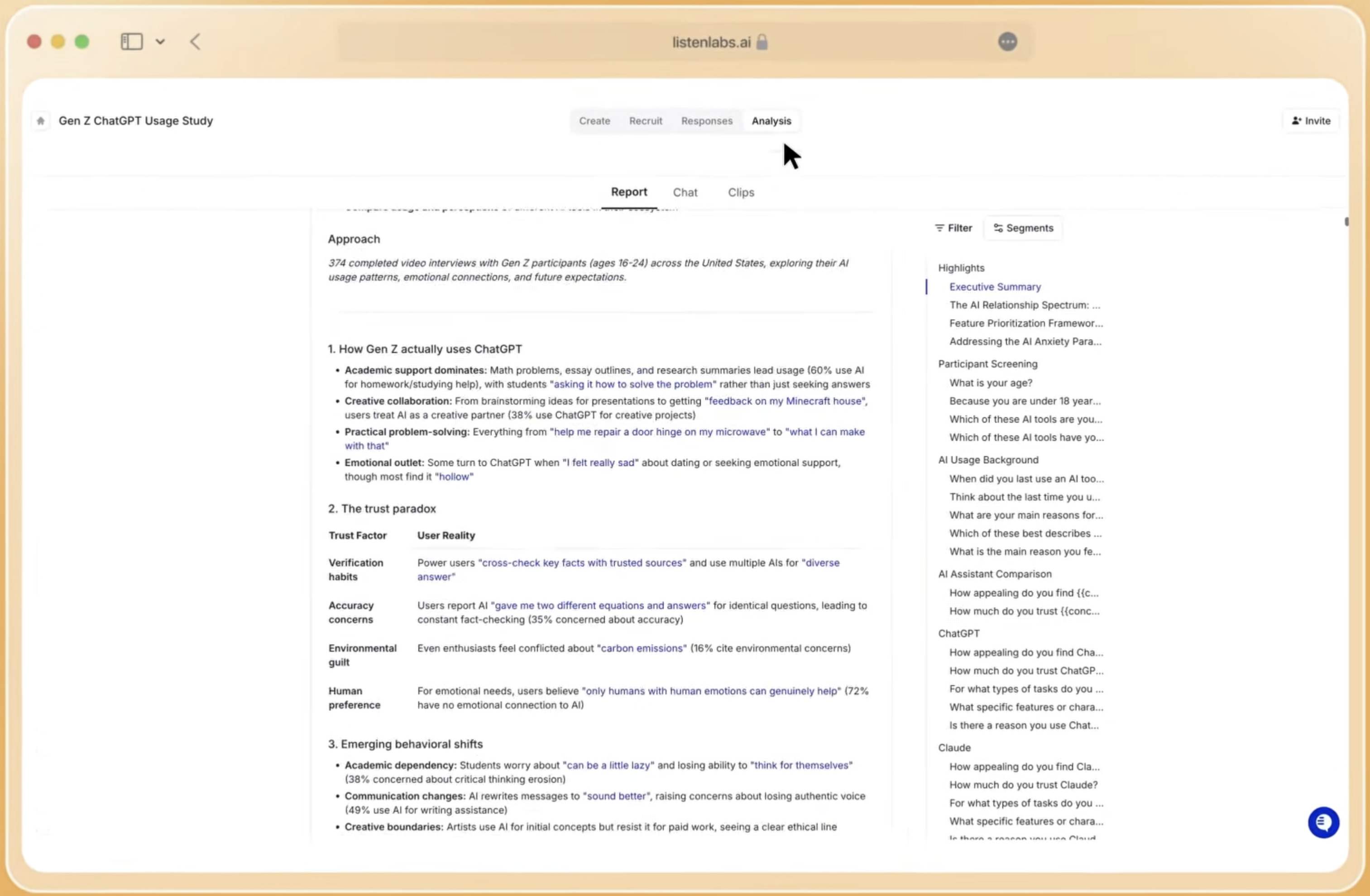
AI now supports the full research lifecycle in telecom. At the study design stage, AI drafts research objectives and interview guides from natural-language briefs. During data collection, AI moderates one-on-one video interviews with dynamic follow-up questions, conducts real-time fraud detection on participant responses, and captures emotional signals through multimodal analysis of tone, word choice, and micro-expressions. At the analysis stage, AI identifies themes, generates segmentations, runs statistical significance tests, and produces slide decks, memos, and video highlight reels, all without manual analyst intervention.
Can an AI interview platform predict or reduce telecom churn?
AI interview platforms do not replace predictive churn models built on network and billing data. They provide the qualitative layer that explains why the model's at-risk segments are at risk. Knowing that 45% of churn traces to network quality complaints, or that a specific competitor's pricing offer is driving comparison shopping among high-value subscribers, gives retention teams the context needed to design targeted interventions. Closing the feedback loop quickly remains critical, and research consistently shows that acting on customer feedback within 48 hours produces the largest measurable impact on retention rates.
What security and compliance standards should a telecom research platform meet?
Telecom operators handling subscriber data require platforms that meet GDPR for European markets, CCPA for U.S. markets, and enterprise security standards including SOC 2 Type II and ISO 27001. Platforms processing AI-generated data should also hold ISO 42001 certification, which covers AI management systems. Listen Labs holds all of these certifications, uses 256-bit encryption, and does not use customer data for AI model training.
How many interviews are needed for statistically meaningful telecom research?
For qualitative research focused on theme saturation and emotional signal capture, 50–150 interviews per audience segment typically surface the full range of perspectives. For studies requiring statistical comparisons across segments, such as comparing churn drivers between prepaid and postpaid subscribers or across geographic markets, 200–400 interviews provide the sample depth needed for significance testing. Listen Labs' Research Agent runs statistical tests automatically across any segmentation, so teams do not need to pre-specify comparisons before fieldwork begins.
Conclusion: Building Continuous Customer Intelligence in Telecom
Telecom operators that outperform on retention and CX in 2026 will replace quarterly research cycles with continuous customer intelligence. Telecommunications led all industries in adoption of agentic AI at 48% in 2026, and many CX leaders say generative AI led their organizations to re-evaluate their customer experience approach entirely. The research infrastructure now has to match that pace.
Listen Labs is the only end-to-end AI interview platform that collapses the depth-versus-scale trade-off, delivering hundreds of emotionally rich, in-depth interviews in under 24 hours from its verified global panel, with full enterprise compliance detailed in the FAQ above and GDPR adherence. One researcher ran a full buying intent analysis across three user segments in under a minute. That is the standard telecom CX and insights leaders should hold their research infrastructure to in 2026.
Book a demo and run your first telecom study in under 24 hours.