
Written by: Anish Rao, Head of Growth, Listen Labs
Key Takeaways
- Traditional retail scan data and syndicated panels reveal what consumers bought but not the motivations behind those decisions.
- AI interview platforms like Listen Labs capture emotional signals through tone, word choice, and micro-expressions using Ekman’s framework.
- Listen Labs completes the full research cycle, from recruitment through reporting, in under 24 hours with enterprise-grade quality and security.
- Leading CPG companies including P&G and Nestlé use Listen Labs for concept testing, claim validation, and brand perception studies that require scale and emotional depth.
- See how Listen Labs replaces fragmented research workflows with a single platform that delivers insights in under 24 hours.
How This Comparison Evaluates AI Interview Platforms
Nine criteria structure every comparison in this article: research speed and turnaround, depth of insight and emotional-signal capture, sample quality and fraud controls, participant sourcing reach, methodological flexibility for concept and brand testing, global and language coverage, analysis effort and bias reduction, reporting transparency and deliverables, and security and compliance. Applying these criteria consistently across platforms allows insights leaders to evaluate trade-offs without relying on vendor-supplied scoring. The first criterion, research speed and turnaround, reveals the sharpest contrast between traditional and AI-powered approaches.
Research Speed and Turnaround Across Leading Platforms
NIQ and GOcxm launched Motivations IQ in May 2026, combining NIQ’s shopper, panel, and syndicated intelligence with GOcxm’s AI-powered motivational model. The platform decodes functional and emotional drivers behind purchase and loyalty. Turnaround depends on the underlying NIQ data infrastructure, which tracks 21.3 million stores and delivers monthly or quarterly reporting cycles. Motivations IQ does not target sub-24-hour study completion.
User Intuition delivers AI-moderated interviews with 5–7 laddering levels in 24 hours using a 4M+ panel. Traditional qualitative firms often require 8–12 weeks and budgets exceeding $100,000 for equivalent volume. User Intuition offers a clear speed advantage, although its panel reach is substantially smaller than Listen Labs.
Numerator tracks 13M+ trips captured monthly and provides ongoing purchase and market share data. Behavioral platforms such as Numerator focus on what shoppers did, not why they behaved that way, and custom study turnaround varies because speed is not the primary design goal.
Quantilope offers structured quantitative testing in 2–5 days with moderate shopper-specific capability. It sits between survey tools and full AI interview platforms on both speed and depth.
Listen Labs compresses the full research cycle, including study design, recruitment, moderation, analysis, and delivery, to under 24 hours. P&G used Listen Labs to evaluate how men respond to new product claims, completing 250+ interviews with quantified themes in hours. AI-moderated research reduces total project cycle time to less than one week for hundreds of interviews versus 6–8 weeks for traditional qualitative research. By 2026, AI-interview maturity supports adaptive, personalized conversations at scale as a standard operating model.
Depth of Insight and Emotional-Signal Capture Across Platforms
NIQ + GOcxm Motivations IQ adds a motivational intelligence layer to transactional data, quantifying emotional drivers such as joy, empathy, and trust alongside functional needs. This approach moves beyond pure scan data, yet the emotional layer comes from behavioral and survey models instead of direct interview signal capture.
User Intuition applies a consistent 5–7 level laddering methodology across every interview, moving beyond stated preferences to uncover emotional and identity-level drivers. A consumer might switch brands because a packaging redesign conflicts with self-image rather than taste or price. Stated responses and emotional context are inferred from conversational depth, not multimodal signal analysis.
Numerator and quantilope operate primarily in the stated-response space. Numerator’s receipt-level data captures what was purchased but not emotional state at the moment of decision. Quantilope’s structured survey formats do not include adaptive probing or emotional signal layers.
Listen Labs captures emotional signals through three simultaneous layers: tone of voice, word choice, and subconscious micro-expressions, built on Ekman’s universal emotions framework, the same standard used in clinical psychology. Every emotion is quantified per question and concept, and each label is traceable to the exact timestamp, verbatim quote, and reasoning. Two concepts may both receive positive stated ratings while triggering measurably different emotional profiles. This distinction matters for CPG claim testing, creative evaluation, and packaging research, where surface-level approval can hide confusion or disengagement.
Sample Quality, Fraud Controls, and Participant Reach
NIQ draws on a large proprietary shopper panel and retail measurement infrastructure. Sample quality for its syndicated products is well-established. For custom motivational studies through Motivations IQ, quality controls depend on the GOcxm methodology layer.
User Intuition applies three layers of sample integrity: qualification screening, behavioral validation, and longitudinal monitoring. Every interview is automatically scored against the research brief on length, depth, and coverage, and clients are not billed for interviews that fail quality checks. Its panel reaches 4M+ participants.
Numerator’s receipt-based panel is large and purchase-verified, which provides strong behavioral validity for transaction data. The panel is not designed for qualitative interview recruitment.
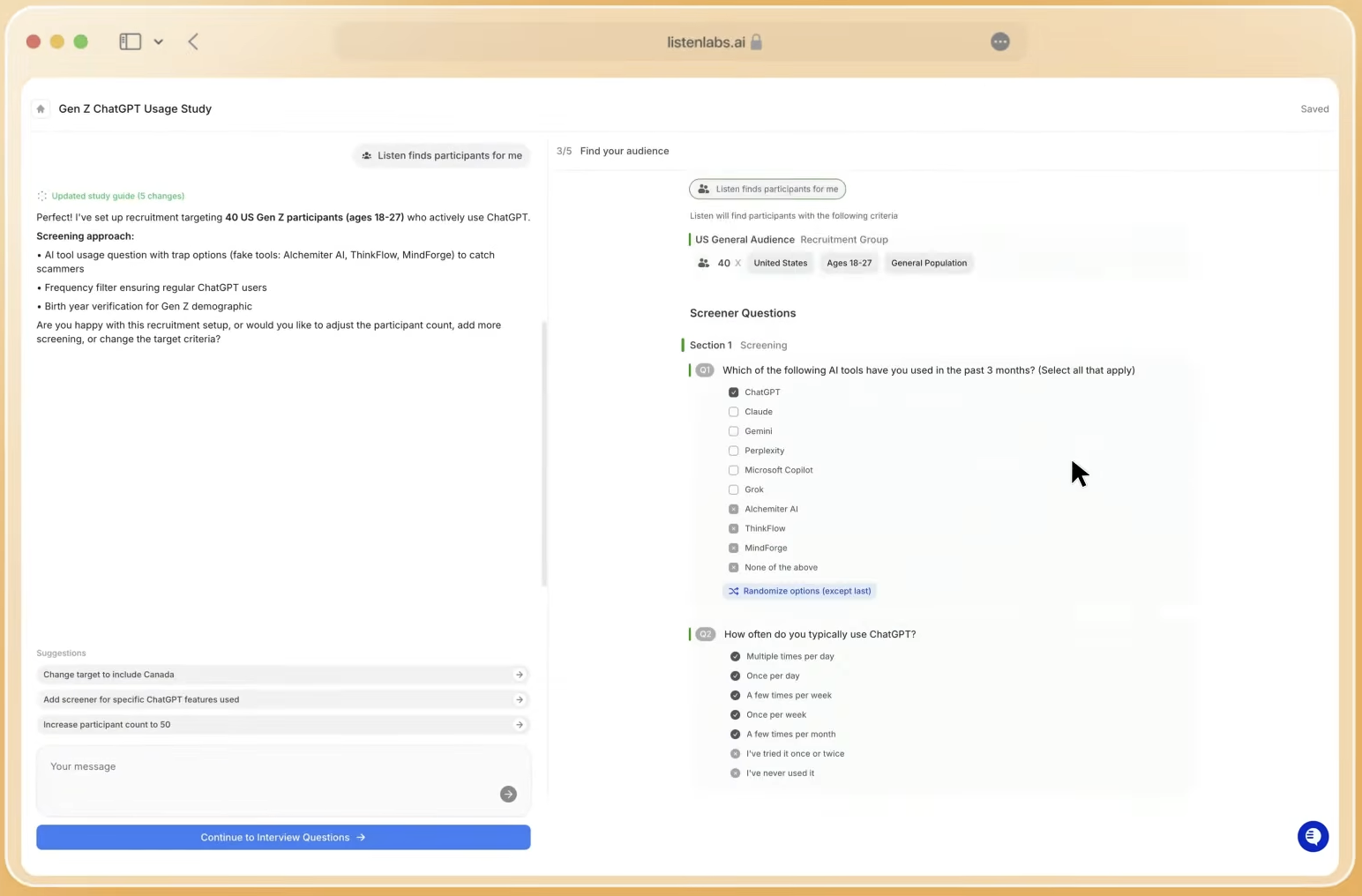
Listen Labs operates Quality Guard, which monitors every interview in real time across video, voice, content, and device signals to flag rushed responses, inconsistent device fingerprints, and scripted language. Participants are limited to three studies per month, which removes professional survey-takers. Listen Labs does not use commodity quantitative panels. Its 30M+ verified respondent network spans 45+ countries, with an AI orchestration layer, Listen Atlas, that matches participants on behavioral and intent data rather than self-reported demographics alone. A dedicated recruitment operations team manages segments below 1% incidence rate, including enterprise decision-makers and healthcare workers.
Method Flexibility, Global Coverage, and Analysis Workflow
NIQ + GOcxm Motivations IQ focuses on purchase motivation and loyalty analysis within NIQ’s existing data infrastructure. It does not function as a general-purpose research platform and does not support custom study design for concept testing or brand perception work outside its defined methodology.
User Intuition specializes in laddering-based shopper interviews. Its methodology is consistent and well-validated for CPG purchase decision research, although it is less flexible for mixed-method studies that combine qualitative and quantitative formats.
Quantilope supports a range of quantitative methods including MaxDiff, conjoint, and implicit association testing. It offers more methodological breadth than basic survey tools but does not conduct adaptive conversational interviews.
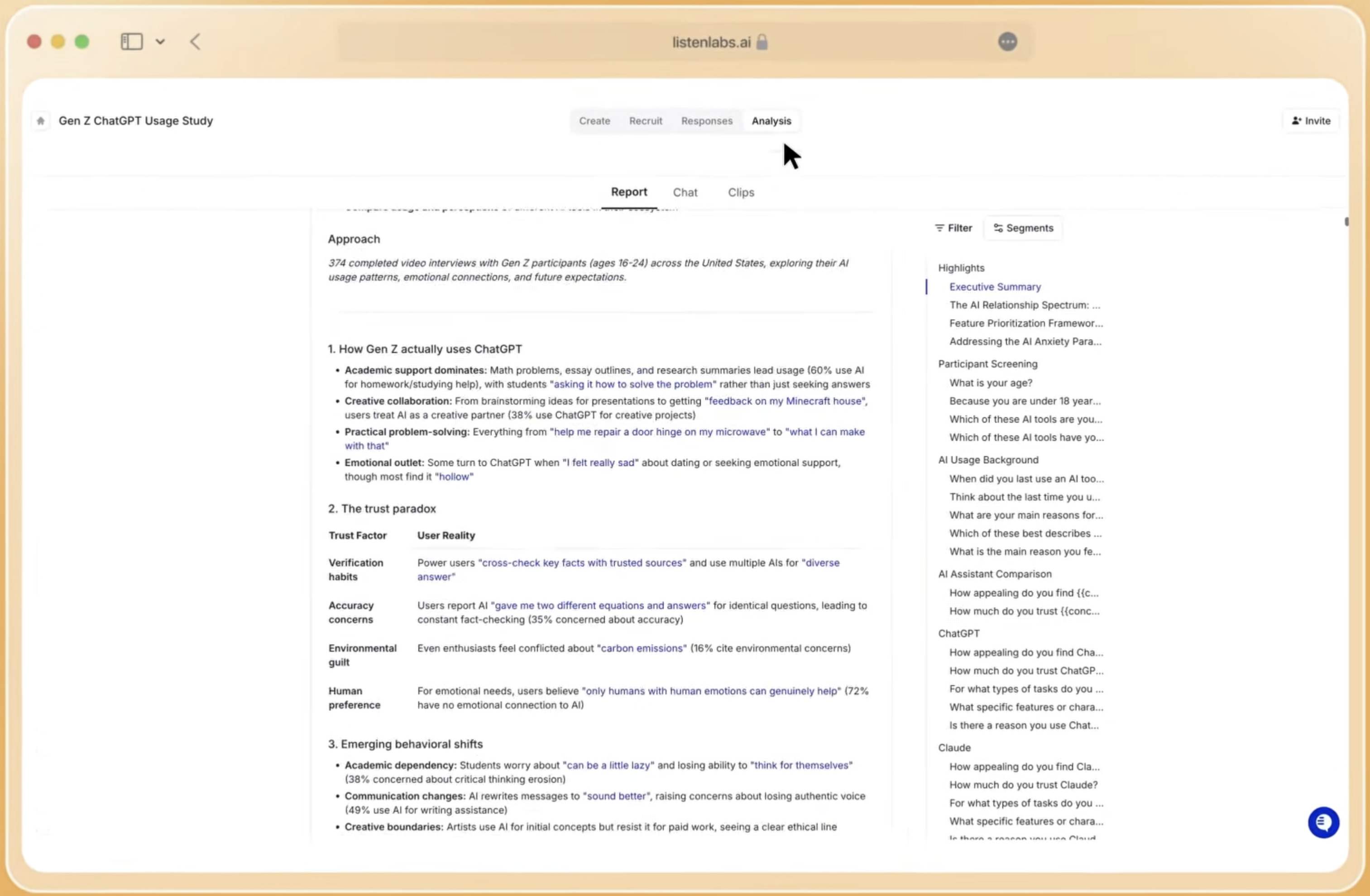
Listen Labs supports free-flowing in-depth interviews, semi-structured interviews, survey-style questionnaires, diaries, ethnography, and task-based testing within a single platform. Studies can incorporate images, video, audio, PDFs, prototypes, and live URLs, with monadic or sequential randomization, quotas, branching, and skip logic. With qual-at-scale, the old trade-off between depth and scale is no longer a barrier. The platform supports 100+ languages for interview moderation, with automatic translation and transcription. The Research Agent handles the full analysis workflow from raw data to final output, cutting analyst time and reducing the confirmation bias that affects manual qualitative coding.
Reporting, Deliverables, and Operational Load
Traditional retail data sources and syndicated platforms deliver standardized dashboards and periodic reports. Custom analysis requires internal analyst time or agency support, and the output rarely includes verbatim consumer language or video evidence. A typical $50,000 traditional agency consumer research project allocates $10,000–$15,000 to analysis and synthesis and $5,000–$8,000 to reporting alone, with a 6–8 week total timeline.
User Intuition delivers thematic synthesis, verbatim highlights, and strategic recommendations within 24 hours. Reporting depth is strong for its core laddering methodology.
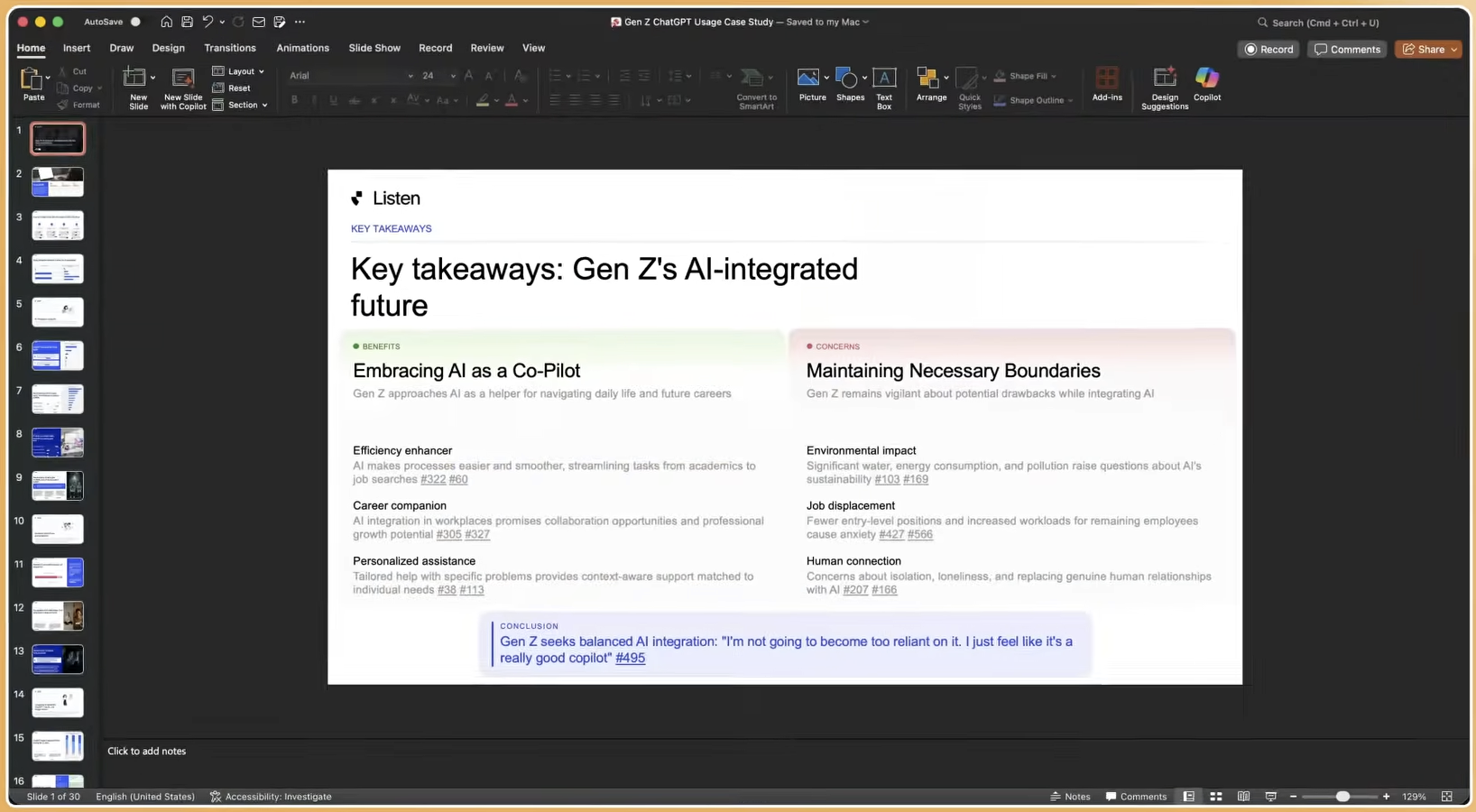
Listen Labs’ Research Agent generates consultant-quality PowerPoint slide decks in branded templates, memo-style reports, video highlight reels, statistical charts, segmentation breakdowns, and custom reports from natural-language queries in under a minute. Research Agent generates a slide deck in your company’s branded template and a downloadable report. Every insight links back to the underlying response data, including timestamped video clips, so findings hold up in stakeholder reviews and procurement audits. Operational burden stays low because the platform replaces separate vendors for recruitment, scheduling, moderation, transcription, analysis, and reporting.
Best-Fit Use Cases for Enterprise CPG Insights Teams
Early-stage innovation testing shows the strongest performance differences between AI interview platforms and retail scan data analytics, because behavioral tools identify winning concepts before full-scale production investment, while scan data only reflects post-launch historical outcomes. Listen Labs fits testing 8–12 product concepts across 200+ consumers in a single week, with emotional signal data highlighting which claims trigger confusion versus genuine interest.
In-store execution validation and brand perception tracking benefit from combining NIQ’s transaction-level infrastructure with a conversational platform that explains the motivations behind observed sales shifts. Teams that combine behavioral data platforms with conversational platforms develop a compounding intelligence advantage by continuously updating understanding of why market patterns occur.
Global brand perception studies that require simultaneous multilingual fieldwork across multiple markets align well with Listen Labs, which supports 100+ languages with no translation surcharges and covers 45+ countries. Listen Labs has run over 1 million AI-powered customer interviews for companies including Microsoft, Perplexity, and Sweetgreen.
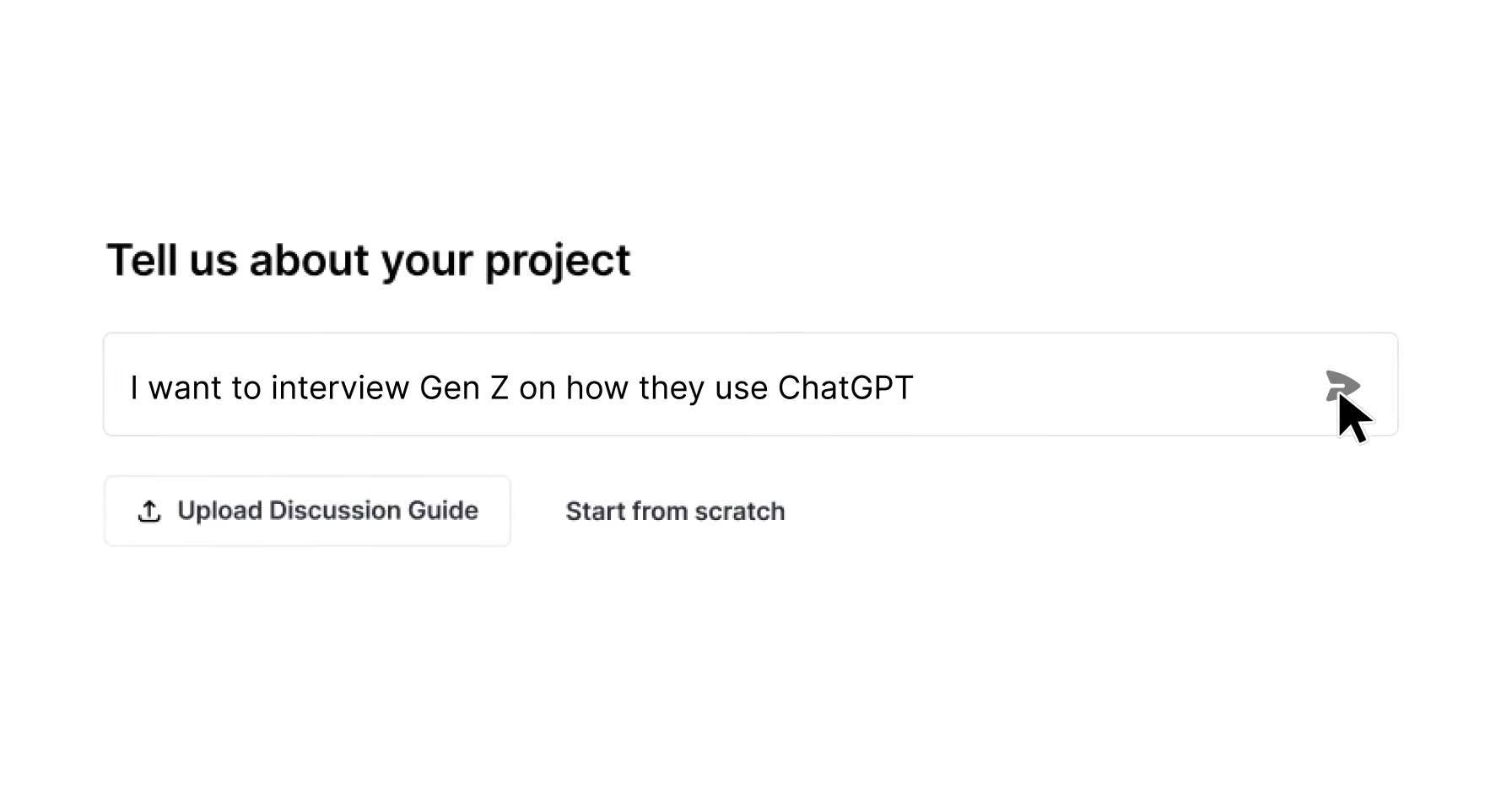
Product and marketing stakeholders without dedicated research support can rely on Listen Labs’ AI-assisted study design. They describe research goals in natural language and receive a structured study guide, recruited participants, moderated interviews, and deliverables without needing research methodology expertise.
Operational Considerations and Risk Management
Stakeholder alignment often represents the most significant implementation risk for any new research platform. Insights leaders should map which study types will migrate to AI-moderated interviews and which will remain with agency partners or syndicated sources, then communicate that distinction clearly to internal clients.
Security and compliance requirements remain non-negotiable for Fortune 500 procurement. Listen Labs holds SOC 2 Type II, GDPR, ISO 27001, ISO 27701, and ISO 42001 certifications. Customer data is not used for AI model training. Buyers are demanding auditable evidence that research data comes from real, verified humans, requiring vendors to document identity verification, AI-generated response detection, and representativeness validation. Listen Labs meets this standard through Quality Guard’s real-time monitoring and its unbroken evidence chain from theme to verbatim quote to timestamped video clip.
Platforms that rely on rigid survey-style question formats risk shallow data even when marketed as behavioral intelligence tools. Depth of insight depends on adaptive probing capability, not the label applied to the methodology. Overestimating automation without a proprietary methodology layer remains a common failure mode when teams evaluate newer entrants in this category.
Repeatability for continuous research programs requires a platform with stable recruitment infrastructure and consistent moderation quality across studies. Listen Labs’ Quality Guard reputation scoring compounds across every interview conducted on the platform, creating a quality flywheel that strengthens over time.
Decision Framework for Matching Tools to Research Goals
Teams that need to understand post-launch market share, distribution, and purchase frequency at scale should continue to rely on NIQ and Numerator as essential infrastructure. These platforms answer what happened in market with statistical precision across millions of transactions.
Teams that need to understand why consumers made those decisions, and need that understanding in hours rather than weeks, should select an AI interview platform with adaptive AI moderation, emotional signal capture, and end-to-end delivery. “Traditional surveys may tell us what people do, but it takes a conversation to understand why.”
Teams evaluating platforms should follow a clear sequence. They should start with sourcing: whether the platform maintains its own verified participant network or relies on commodity panels that increase fraud risk. Next, they should assess depth: whether it captures emotional signals beyond stated responses or only surface-level data. Then they should examine workflow integration: whether it delivers analysis and stakeholder-ready reports in-platform or requires handoffs to separate vendors that add weeks to timelines. Security and compliance come next, because enterprise procurement will block any platform that lacks certifications such as SOC 2 or GDPR. Finally, teams should test scalability to confirm that the platform can handle hundreds of simultaneous interviews without moderation quality degrading.
Listen Labs answers each of these needs with a full-stack platform. Platforms like Listen Labs layer on auto-recruiting, transcription, sentiment tagging, and insight summarization so teams jump from question to findings in hours, not weeks.
Frequently Asked Questions
How long does it take to complete an AI-moderated CPG consumer insights study with Listen Labs?
Listen Labs delivers complete studies in under 24 hours, as noted earlier, including work with hundreds of participants across multiple markets and languages. The platform recruits through its AI orchestration layer, runs interviews in parallel, and removes the scheduling bottleneck that makes traditional qualitative research take 4–6 weeks.
How does Listen Labs source and quality-control participants for CPG studies?
Listen Labs sources participants through Listen Atlas, an AI orchestration layer that matches across behavioral and intent data, not just self-reported demographics, drawing from the verified network mentioned earlier. Quality Guard, described earlier, applies these monitoring layers to every interview, with participants limited to three studies per month to prevent panel fatigue. A dedicated recruitment operations team handles hard-to-reach segments, including consumers below 1% incidence rate. Listen Labs does not use commodity quantitative panels.
How is Listen Labs different from a quantitative survey tool like Qualtrics or SurveyMonkey for CPG research?
Survey tools deliver structured, quantitative data through pre-set questions with no ability to probe deeper or follow up on unexpected responses. Listen Labs conducts adaptive conversational interviews where the AI asks follow-up questions based on each participant’s answers, uncovering emotional nuance, identity-level motivations, and unanticipated findings that surveys cannot reach. Listen Labs also captures emotional signals through tone of voice, word choice, and micro-expression analysis, which do not exist in survey responses. The result combines the statistical confidence of large samples with the qualitative depth of one-on-one interviews.
Which CPG research use cases are the strongest fit for Listen Labs versus traditional retail data sources?
Listen Labs performs strongest for pre-launch use cases such as concept validation, claim testing, packaging research, creative testing, and brand perception studies, where retail scan data has no predictive capability because the product is not yet in market. It also explains why observed market patterns are occurring, such as why a brand is losing share in a specific segment, why a new SKU is underperforming despite strong distribution, or which emotional drivers differentiate a brand from private-label alternatives. Retail scan data from NIQ or Numerator remains the right source for post-launch market share tracking, distribution measurement, and purchase frequency analysis. The two approaches work best in combination.
What security and compliance certifications does Listen Labs hold?
Listen Labs holds SOC 2 Type II, GDPR, ISO 27001, ISO 27701, and ISO 42001 certifications. The platform uses 256-bit encryption, and customer data is never used for AI model training. Enterprise SSO is supported. These certifications meet the procurement and legal requirements of Fortune 500 CPG companies operating across multiple regulatory jurisdictions.
Conclusion: Selecting a Platform That Removes the Depth-Versus-Scale Trade-Off
Traditional retail and quantitative data sources remain valuable for tracking what happened in market. They do not explain why consumers made the decisions that produced those outcomes, and they cannot validate concepts, test claims, or capture emotional responses before a product reaches shelf. The depth-versus-scale trade-off that has constrained CPG consumer insights for decades, forcing teams to choose between rich qualitative understanding and statistically meaningful sample sizes, is now resolved by AI-moderated interview platforms that conduct hundreds of adaptive conversations simultaneously.
Listen Labs is the end-to-end platform built for this purpose. It sources verified participants from its global network, conducts thousands of AI-moderated interviews with adaptive probing and Ekman-framework emotional analysis, and delivers consultant-quality reports, slide decks, and video highlight reels in under 24 hours at a fraction of the cost of traditional agency research. P&G, Nestlé, and other leading CPG enterprises use Listen Labs to make faster, better-evidenced decisions on claims, concepts, and brand strategy.