
Written by: Anish Rao, Head of Growth, Listen Labs
Key Takeaways
- Traditional validation methods like surveys and beta testing often fail to confirm real traveler demand or willingness to pay before launch.
- A structured, interview-first process that tests problem, concept, and pricing sequentially reduces the risk of building products without market fit.
- AI-moderated interviews combined with mixed-methods analysis deliver consistent, scalable insights across 50+ participants in hours rather than weeks.
- Clear hypotheses, verified participant sourcing, and pre-defined go/no-go criteria are essential to avoid vague objectives and low-quality data.
- Integrated AI-native platforms can compress the entire validation cycle, from recruitment to deliverables, to under 24 hours.
Core Validation Terms and Travel Research Context
This guide uses several research terms in a specific way for travel product validation.
- Qualitative interview: An open-ended, conversational session that uncovers motivations, behaviors, and emotional responses rather than counting responses to fixed options.
- Sample frame: The defined population from which interview participants are drawn, such as frequent leisure travelers aged 28–45 who book independently.
- Incidence rate: The proportion of the general population that qualifies for a study. Low-incidence audiences, such as solo female adventure travelers or corporate travel managers at companies with 500+ employees, require specialized recruitment.
- Screener: A short questionnaire used before the interview to confirm that a participant matches the target sample frame.
- AI-moderated conversation: An interview conducted by an AI system that asks follow-up questions dynamically based on participant responses, replicating the adaptive quality of a skilled human moderator at scale.
- Emotional signals: Non-verbal and tonal cues, including micro-expressions, hesitation, and voice intonation, that indicate how a traveler actually feels about a concept, independent of what they say.
The broader research context shapes how these tools work together. Traditional surveys tell us what people do, but it takes a conversation to understand why. The shift from slow, fragmented research to continuous, AI-enabled consumer intelligence is now well underway. Technology-enabled research is a fast-growing segment of the global market research sector. AI-moderated platforms have collapsed the historical trade-off between depth and scale, making it possible to run hundreds of qualitative interviews simultaneously without sacrificing the richness of one-on-one conversation.
This technological foundation supports a structured validation approach rather than ad hoc interviews. The frameworks below organize that approach so AI-powered conversations produce clear decisions instead of scattered insights.
The Validation Funnel and Mixed-Methods Matrix for Travel Products
Two frameworks structure the six steps that follow. The first is the validation funnel, which sequences the research questions in order of investment risk. Problem validation comes first and confirms that the pain is real, frequent, and severe enough to justify a solution. Concept validation comes second and tests whether the proposed solution resonates and is clearly understood. Pricing validation comes third and establishes willingness to pay before committing to a price architecture. Teams that skip or reverse these stages often spend heavily on validation without resolving basic market-fit questions.
The second framework is the mixed-methods matrix, which layers quantitative scales inside qualitative interviews. Instead of running a separate survey after interviews, the matrix embeds structured measures, such as a 1–10 pain severity rating, a likelihood-to-buy score, or a Van Westendorp price sensitivity sequence, directly into the interview guide. AI-moderated interviews deliver consistent, neutral depth probing across 50–200+ willingness-to-pay conversations in 24–48 hours at roughly $20 per interview, eliminating moderator variability and human bias in price reactions. The matrix makes it possible to quantify themes and segment findings without running a second study.
Step 1: Clarify the Validation Hypothesis and Traveler Segment
Action: Write a single falsifiable hypothesis that names the traveler segment, the problem, and the expected behavior. Example: “Independent leisure travelers aged 28–40 who book trips at least twice per year experience significant friction when comparing accommodation options across devices, and would pay for a tool that consolidates that comparison in one place.”
Required inputs: Existing analytics, booking data, or prior survey results, a working definition of the target segment, and a list of assumptions ranked by risk.
Typical stakeholders: Product manager, consumer insights lead, and a travel-domain subject-matter expert.
Decision point: If the hypothesis cannot be written in one sentence with a named segment, the scope is too broad. This clarity requirement becomes even more important when validating across multiple traveler types. Teams should limit themselves to two or three segments maximum to avoid serving no one effectively.
Realistic timeline: Half a day for an experienced team with existing data, one to two days if secondary research is needed.
Hypothetical examples: A travel gear brand hypothesizes that ultralight backpackers aged 25–35 will pay a premium for a modular rain system. A travel app team hypothesizes that business travelers on trips of three or more nights find expense reconciliation more painful than itinerary management. A document services company hypothesizes that families traveling internationally with minors face avoidable delays due to consent documentation gaps.
Step 2: Design the Interview Guide Around Problem, Concept, and Price
Action: Build a structured guide that follows the validation funnel sequence. Start with behavioral context questions, move to problem exploration, introduce the concept only after the problem is confirmed, and close with willingness-to-pay probes.
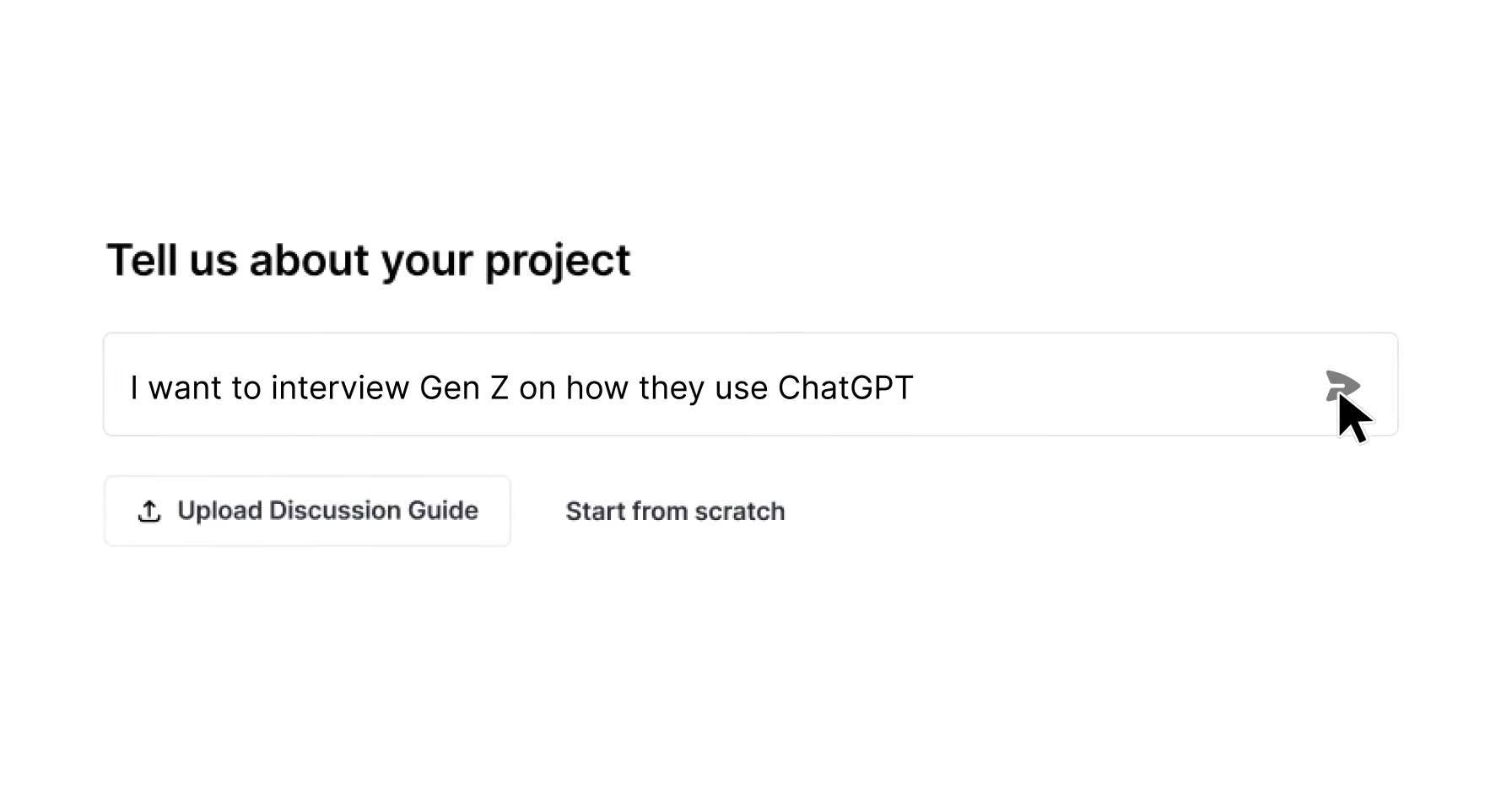
Required inputs: The validated hypothesis from Step 1, a list of the riskiest assumptions, and any existing concept materials such as mockups, prototypes, or product descriptions.
Typical stakeholders: UX researcher or consumer insights lead to write and review the guide, and a product manager to confirm the decision questions.
Decision point: Every question in the guide must connect to a decision. Questions that cannot be mapped to a go/no-go criterion should be removed. Harvard Business School’s market validation framework requires focusing on real behavior rather than hypothetical questions like “Would you use this?”
Realistic timeline: Two to four hours to draft, followed by one review cycle of one to two hours.
Hypothetical examples: A travel app team opens with “Tell me about the last trip you planned. Walk me through how you chose your accommodation.” A gear brand asks “What do you currently carry for rain protection on multi-day trips, and what frustrates you about it?” Willingness-to-pay probes follow the mixed-methods matrix: “What do you currently spend on solving this problem?” followed by “If a solution like this existed today and cost $X per month, what would your reaction be?” Asking customers what they have done in the past, such as listing current subscriptions and their prices, produces more reliable data than asking what they would hypothetically pay.
Step 3: Source and Screen Participants from a Verified Global Network
Action: Define the screener criteria precisely, then recruit from a verified panel that matches behavioral and intent signals, not just self-reported demographics. For travel product validation, this means screening for recent travel behavior, trip type, booking method, and relevant gear or app usage, not just age and income.
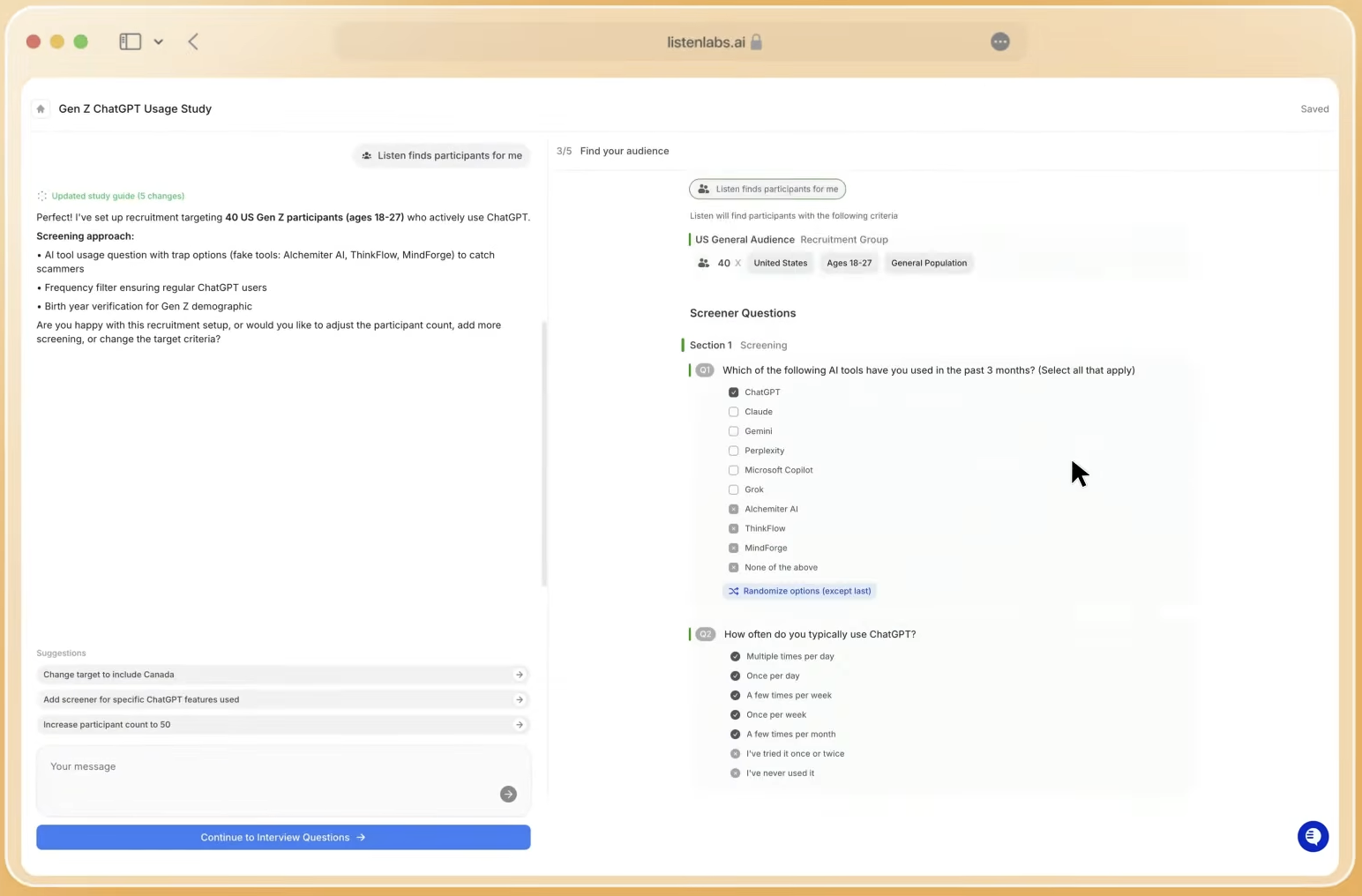
Required inputs: The sample frame from Step 1, a screener questionnaire of five to eight questions, target sample size by segment, and any geographic or language requirements.
Typical stakeholders: Research operations or a recruitment platform, with a consumer insights lead to approve screener logic.
Decision point: Low incidence rates require specialist recruitment. Credible quantitative market segmentation generally requires a sample size of approximately 70 times the number of segmentation variables, while qualitative persona segmentation typically needs only 5–10 participants per segment. For early-stage problem validation, 5–12 interviews per segment provide sufficient pattern recognition.
Realistic timeline: With a verified global panel, recruitment and screening can be completed in hours. Traditional recruitment via separate vendors takes one to two weeks.
Hypothetical examples: A travel tech startup screens for travelers who have booked at least two international trips in the past 12 months using an OTA. A gear brand screens for hikers who have completed at least one multi-day trail in the past year and currently own a rain jacket above $100. A document services company screens for parents who have traveled internationally with children under 18 in the past 24 months.
Listen Labs sources participants from a network of 30 million verified respondents across 45+ countries and 100+ languages. Quality Guard monitors every interview in real time for fraud, low-effort responses, and repeat respondents, and participants are limited to three studies per month. Listen Labs has run over one million AI-powered customer interviews for companies including Microsoft, Perplexity, and Sweetgreen.
Book a demo to see how Listen Labs recruits verified travelers for your specific segment in hours, not weeks.
Step 4: Run AI-Moderated Video Interviews That Adapt in Real Time
Action: Deploy the interview guide through an AI-moderated video platform that probes deeper on short or unexpected answers, maintains consistent question sequencing, and captures video, audio, and text simultaneously.
Required inputs: The finalized interview guide from Step 2, recruited and screened participants from Step 3, and any stimuli such as concept images, prototype URLs, or product videos to be shown during the session.
Typical stakeholders: The research platform handles moderation, while a product manager or insights lead monitors incoming responses in real time.
Decision point: If early responses reveal that the screener missed a key qualifier, the study can be paused and the screener adjusted before the full sample completes. This control requires a platform that provides real-time visibility into incoming data.
Realistic timeline: AI-moderated interviews run asynchronously, so all participants can complete their sessions simultaneously. An accelerated AI-powered approach compresses customer discovery to two to three weeks, with one week to collect 30–50 responses with automated analysis. On Listen Labs, the full interview collection phase for a 50-person study typically completes within hours.
Hypothetical examples: A travel app team shows a prototype booking flow mid-interview and asks participants to think aloud while navigating it. A gear brand shows three product configurations and asks participants to react to each before the willingness-to-pay sequence. The AI moderator probes any response rated below 5 on the pain severity scale with “Can you tell me more about why you rated it that way?”
Step 5: Analyze Themes, Emotions, and Willingness-to-Pay Signals
Action: Run automated theme analysis across all transcripts, layer in emotional signal data from facial expression and tone analysis, and extract willingness-to-pay distributions by segment.
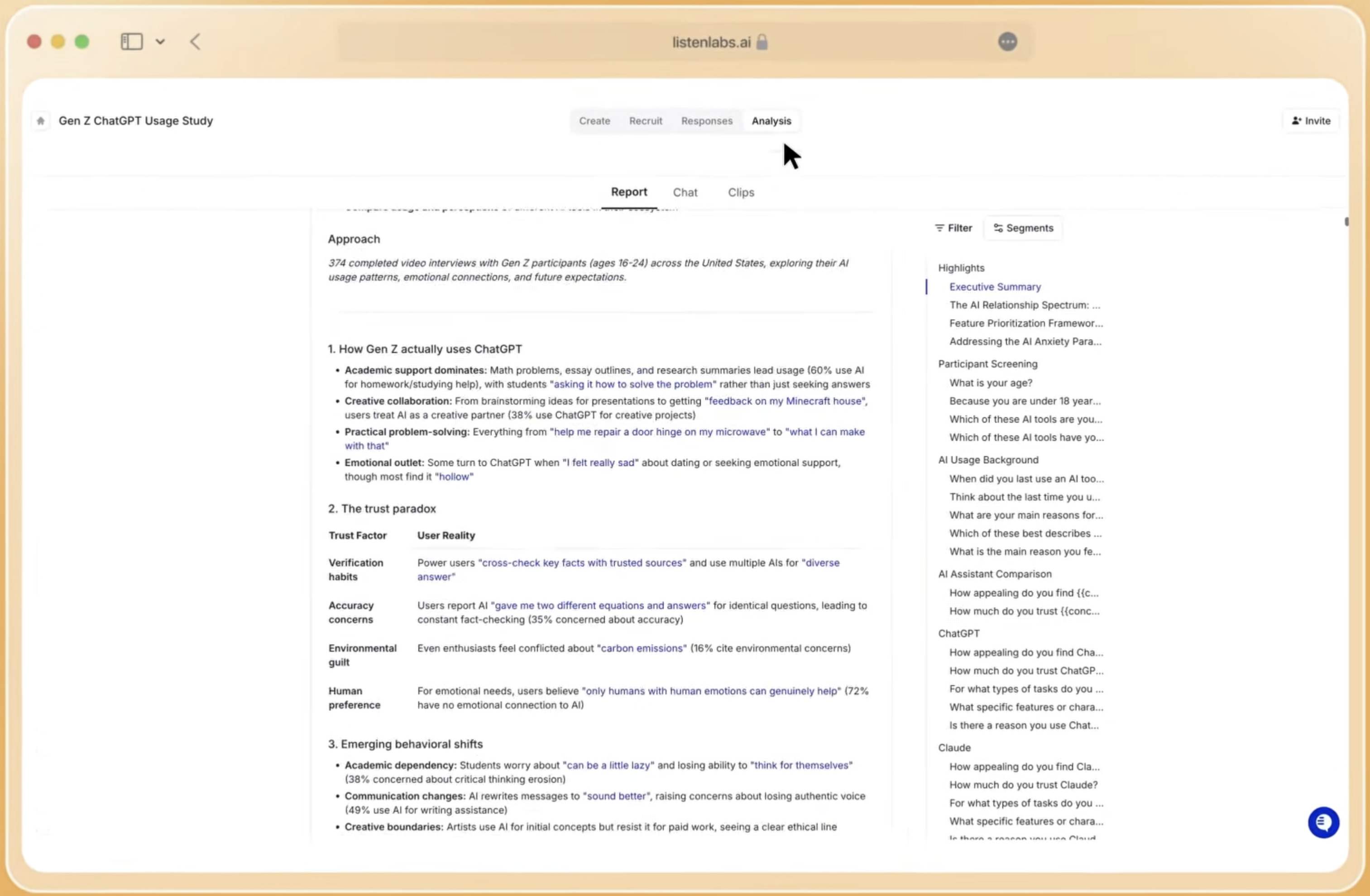
Required inputs: Completed interview recordings and transcripts, the original hypothesis and decision questions from Steps 1 and 2, and pre-defined convergence thresholds.
Typical stakeholders: A consumer insights lead reviews AI-generated themes, and a product manager validates that the findings map to the original decision questions.
Decision point: Problem validation is confirmed when a majority of interviewees report having the problem regularly, rate the pain highly, find current solutions inadequate, and are actively seeking alternatives. Willingness-to-pay validation must account for hypothetical bias in stated-preference research to better approximate actual purchasing behavior.
Realistic timeline: On an AI-native platform, theme analysis, emotional signal quantification, and willingness-to-pay segmentation are generated automatically as interviews complete. Manual analysis of the same dataset would require two to three weeks.
Hypothetical examples: Analysis of 50 travel app interviews reveals that 74% of participants describe the same friction point, using nearly identical language, when switching between devices during the booking process. Emotional intelligence analysis flags a consistent spike in frustration expressions at the payment confirmation screen. Willingness-to-pay data shows a median acceptable price range of $8–$14 per month, with a sharp drop-off above $15.
Step 6: Turn Findings into Go/No-Go Decisions and Next Steps
Action: Map the findings from Step 5 against the pre-defined go/no-go criteria established in Step 1. Produce a structured output that includes a clear recommendation, the evidence supporting it, the confidence level, and the specific next steps for each outcome.
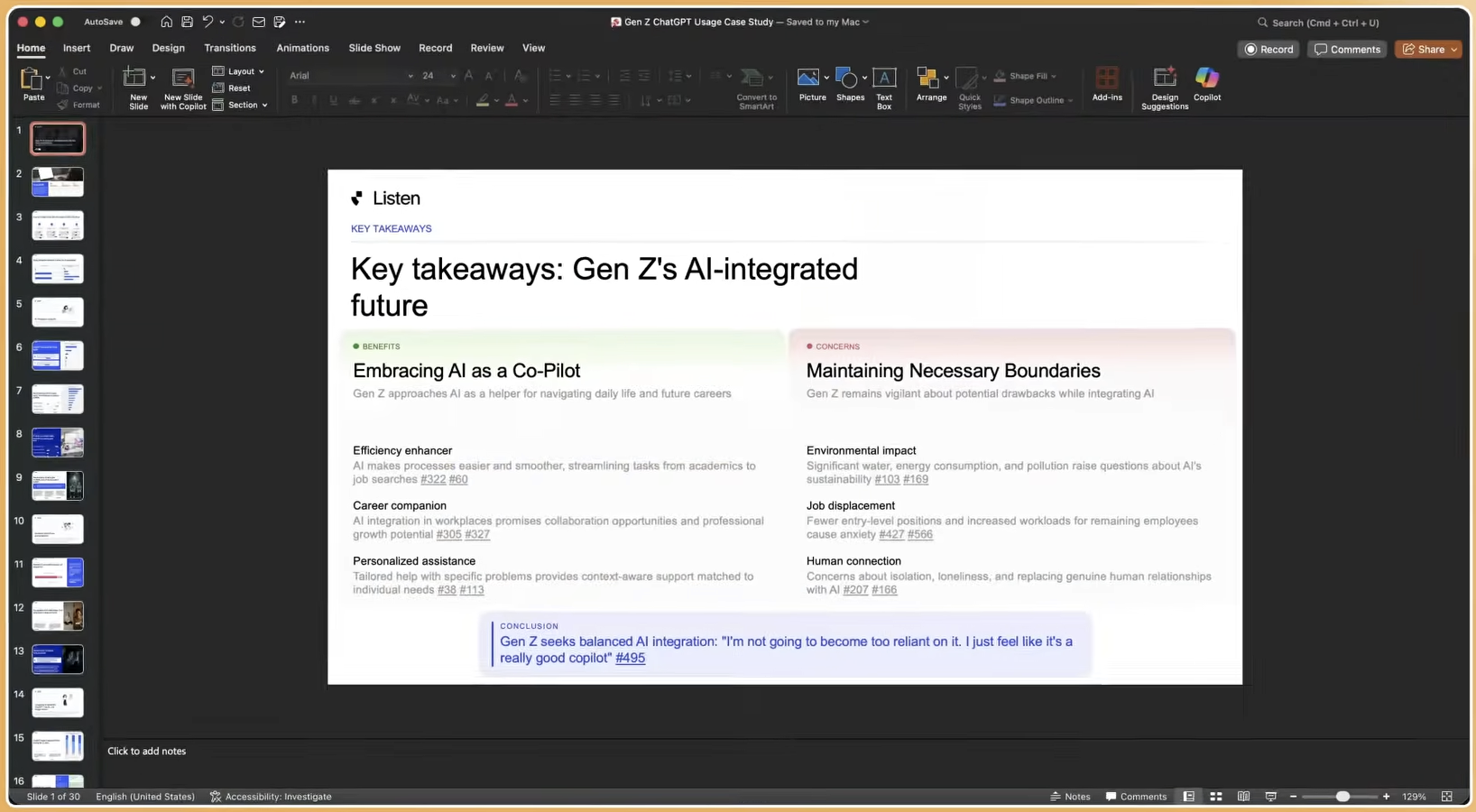
Required inputs: Analyzed findings from Step 5, the original hypothesis and success thresholds, and stakeholder decision context.
Typical stakeholders: A consumer insights lead presents findings, and product, design, and commercial stakeholders make the go/no-go call.
Decision point: Three outcomes are possible. A go decision proceeds to concept refinement or MVP development. A conditional go identifies the specific changes required before proceeding. A no-go redirects the team to a different problem, segment, or price architecture. After several customer interviews, a strong demand signal appears when multiple people describe the same pain point, have tried to solve it, and express active interest. Limited recognition of the problem can serve as a kill signal.
Realistic timeline: With AI-generated deliverables, the synthesis report, slide deck, and highlight reel are available within minutes of analysis completion. Stakeholder review and decision typically take one to two business days.
Hypothetical examples: A travel gear brand finds that 68% of participants rate the rain protection problem at 8 or above, but only 31% would pay the planned retail price. The recommendation is a conditional go: redesign the pricing architecture around a modular entry point before proceeding to production. A travel app team finds strong problem confirmation but low concept clarity scores, indicating that the solution needs repositioning before a second validation round.
Common Pitfalls and Early-Warning Signals
Four failure modes account for the majority of failed travel product validation studies.
Vague objectives: Studies that begin without a falsifiable hypothesis produce findings that cannot drive a decision. The fix is to write the go/no-go criteria before recruiting a single participant, which forces the team to define success in concrete terms. If the team cannot agree on what a pass looks like during this criteria exercise, that disagreement signals that the study is not ready to launch.
Low-quality respondents: Commodity panels filled with professional survey-takers produce data that systematically overestimates demand and willingness to pay. This say-do gap, noted in the interview design section, becomes even larger when panels rely on respondents who treat surveys as a side job. Research shows a significant say-do gap where stated purchase intent often overstates actual purchases. Verified behavioral matching and real-time fraud detection form the foundation of valid data rather than optional quality add-ons.
Analysis bottlenecks: Manual thematic analysis of 50 interviews takes two to three weeks and introduces confirmation bias. Under human moderation, the time from study kickoff to first usable insight often spans several weeks, much of which is spent on recruiting, scheduling, transcription, and logistics rather than analysis. AI-native analysis removes this bottleneck by automating the slowest steps.
Stakeholder misalignment: Findings that arrive without a pre-agreed decision framework are reinterpreted to fit existing roadmap commitments. The fix is to circulate the hypothesis, success thresholds, and go/no-go criteria to all decision-makers before the study launches, not after results arrive.
Success Metrics for Travel Product Validation
Four metrics define a successful travel product validation study.
- Study cycle time under 24 hours: From participant recruitment to final deliverable. This benchmark, introduced earlier, separates AI-native platforms from traditional research workflows. Platforms like Listen Labs layer on auto-recruiting, transcription, sentiment tagging, and insight summarization so teams jump from question to findings in hours, not weeks.
- Interview completion rate above 85%: Low completion rates indicate screener misalignment, poor participant quality, or an interview guide that is too long or unclear. A completion rate above 85% confirms that the recruited sample matches the target segment and that the guide is well-calibrated.
- Consistent themes across at least 50 interviews: Research suggests that a small number of interviews can surface the majority of customer needs in a well-defined segment. Fifty interviews per segment provide the statistical confidence needed for cross-segment comparison and pricing segmentation.
- Measurable lift in stakeholder confidence or product roadmap decisions: The ultimate output of validation is a decision, not a report. Track whether the study produced a documented go/no-go call, a roadmap change, or a pricing architecture revision within two weeks of delivery.
Advanced Validation Strategies for Travel Teams
Teams that have completed one validation cycle can extend the framework in four directions.
Always-on research programs: Rather than running validation as a one-off project, leading travel product teams embed continuous interview cycles into their product development cadence. This produces a compounding knowledge base where each study builds on prior findings rather than starting from scratch. Mondelez has conducted research projects across 29+ markets, treating research as a compounding intelligence asset rather than standalone projects.
Multi-market segmentation: Travel products that serve multiple geographies require segment-specific validation. Price sensitivity, emotional triggers, and problem framing vary significantly across markets. A hotel chain operating across Singapore found that some traveler groups became highly price sensitive once pricing crossed certain thresholds while others responded positively to bundled packages with flexible cancellation or breakfast benefits. Multi-market studies require a platform that supports simultaneous interviews across languages without separate fieldwork trips.
Emotional intelligence overlays: Transcript analysis captures what travelers say. Emotional intelligence analysis captures what they feel. Listen Labs’ Emotional Intelligence feature analyzes tone of voice, word choice, and subconscious micro-expressions across 50+ languages, built on Ekman’s universal emotions framework. Every emotion is quantified per question and traceable to the exact timestamp and verbatim quote.
Cross-study trend tracking: Organizations that run validation studies repeatedly can track how traveler sentiment, pain point severity, and willingness-to-pay thresholds shift over time. This is particularly valuable in travel, where macroeconomic conditions, seasonal patterns, and competitive dynamics move quickly.
Frequently Asked Questions
How many interviews are needed to validate a travel product idea?
The number depends on the validation stage and the number of segments being studied. For problem validation, 15–20 interviews per segment are sufficient to identify whether a pain point is real and frequent. For concept and pricing validation, 30–50 interviews per segment provide the statistical confidence needed to segment findings by traveler type, geography, or booking behavior. If the study needs to support cross-segment comparison, a minimum of 50 interviews per cell is the reliable threshold. Studies with fewer than 15 interviews per segment cannot separate signal from noise and should not be used to make go/no-go decisions.
How long does a full validation cycle take with Listen Labs?
Listen Labs compresses the entire research cycle, from study design through participant recruitment, AI-moderated interviews, analysis, and final deliverables, to under 24 hours. Traditional qualitative research for the same scope takes four to six weeks, and in enterprise settings with internal prioritization and budget approval processes, the timeline can stretch to six months. This 24-hour cycle reflects a shift from sequential, manual handoffs to a fully integrated AI-native platform that runs recruitment, moderation, and analysis in parallel.
Can Listen Labs reach niche traveler segments, such as luxury adventure travelers or corporate travel managers?
Yes. Listen Labs’ dedicated recruitment operations team partners with niche communities, micro-creators, and specialized networks to source participants below 1% incidence rate. This includes enterprise travel managers, frequent business travelers at specific company sizes, adventure travelers with defined gear profiles, and family travelers with specific documentation requirements. The Listen Atlas AI orchestration layer matches participants across behavioral and intent data, not just self-reported demographics, which significantly improves match quality for low-incidence segments compared to commodity panel sourcing.
How does Listen Labs handle data privacy and security for travel product research?
Listen Labs maintains enterprise-grade security with 256-bit encryption, and customer data is never used for AI model training. The platform holds SOC 2 Type II, GDPR, ISO 27001, ISO 27701, and ISO 42001 certifications. For global travel product research involving participants across multiple jurisdictions, these certifications cover the primary regulatory frameworks in the Americas, Europe, APAC, and MEA. Organizations can also bring their own participants, such as existing customers or loyalty program members, at a reduced cost, with the same security and privacy protections applied.
When should a travel product team rerun a validation study?
A validation study should be rerun when any of the following conditions apply: the product concept has changed materially since the last study, the target traveler segment has shifted due to market conditions or competitive dynamics, pricing architecture is being revised, the product is entering a new geographic market, or more than six months have passed since the last study in a category with high seasonal or macroeconomic sensitivity. Always-on research programs address this by embedding regular interview cycles into the product development cadence, so revalidation becomes a scheduled activity rather than a reactive response to launch failures.
Conclusion
Travel product teams that skip direct conversations with real travelers are making go/no-go decisions on incomplete data. The six-step process outlined here, from hypothesis clarification through go/no-go synthesis, provides the missing validation layer. It follows the validation funnel from problem to concept to pricing, uses the mixed-methods matrix to embed quantitative signals inside qualitative interviews, and produces findings against pre-defined success criteria: study cycle time under 24 hours, completion rate above 85%, consistent themes across at least 50 interviews, and a documented product roadmap decision within two weeks of delivery.
Switching to AI-moderated interviews lets teams capture hundreds of candid, one-to-one conversations overnight, at a fraction of the cost and time of traditional research. As Listen Labs CEO Alfred Wahlforss notes, the platform’s ability to run hundreds of one-on-one interviews simultaneously enables companies to make large decisions with confidence based on direct customer input. The process is repeatable, the timelines are measurable, and the decision criteria are defined before a single interview begins.
Book a demo to see how Listen Labs delivers verified traveler interviews, AI-powered analysis, and consultant-quality deliverables for your next travel product validation study.