
Written by: Anish Rao, Head of Growth, Listen Labs
Key Takeaways
- AI replaces slow, periodic studies with continuous, AI-moderated qualitative interviews that deliver consultant-quality results in under 24 hours.
- Traditional research cycles of 4–6 weeks shrink to hours through parallel recruitment, moderation, and automated analysis that remove handoff delays.
- End-to-end AI platforms run hundreds of adaptive, in-depth interviews at once while maintaining quality through verified panels, real-time fraud detection, and emotional intelligence analysis beyond transcripts.
- Automated analysis reduces human bias, surfaces themes and statistical comparisons in under a minute, and builds a persistent institutional knowledge layer that compounds value across studies.
- Listen Labs delivers this full-stack capability. See the end-to-end workflow in action by booking a demo and learn how enterprises like Microsoft and Anthropic now complete research in hours instead of weeks.
The Problem: Why Traditional Market Research Falls Behind Decisions
A typical qualitative research cycle runs 4–6 weeks from study design to final report. In large enterprises, internal prioritization queues and budget approvals can stretch that to six months. By the time findings land, product and marketing decisions have already moved forward.
The problem breaks across five connected dimensions, each compounding the others. Speed: every handoff between recruitment vendors, scheduling tools, transcription services, and analysis platforms adds days to the timeline. Scale: qualitative interviews deliver nuance but cap out at 5–15 participants per study, while surveys scale but lose the depth that makes qualitative research valuable. Quality: commodity panels carry professional survey-takers and fraudulent profiles that erode data integrity. Analysis burden: researchers spend most of their time finding patterns, quantifying insights, testing significance, and formatting results for stakeholders who each need something different. Knowledge loss: findings from past studies scatter across slide decks and individual memories, so teams repeatedly re-research questions they have already answered.
End-to-End AI Research Platforms: A New Category for Continuous Insight
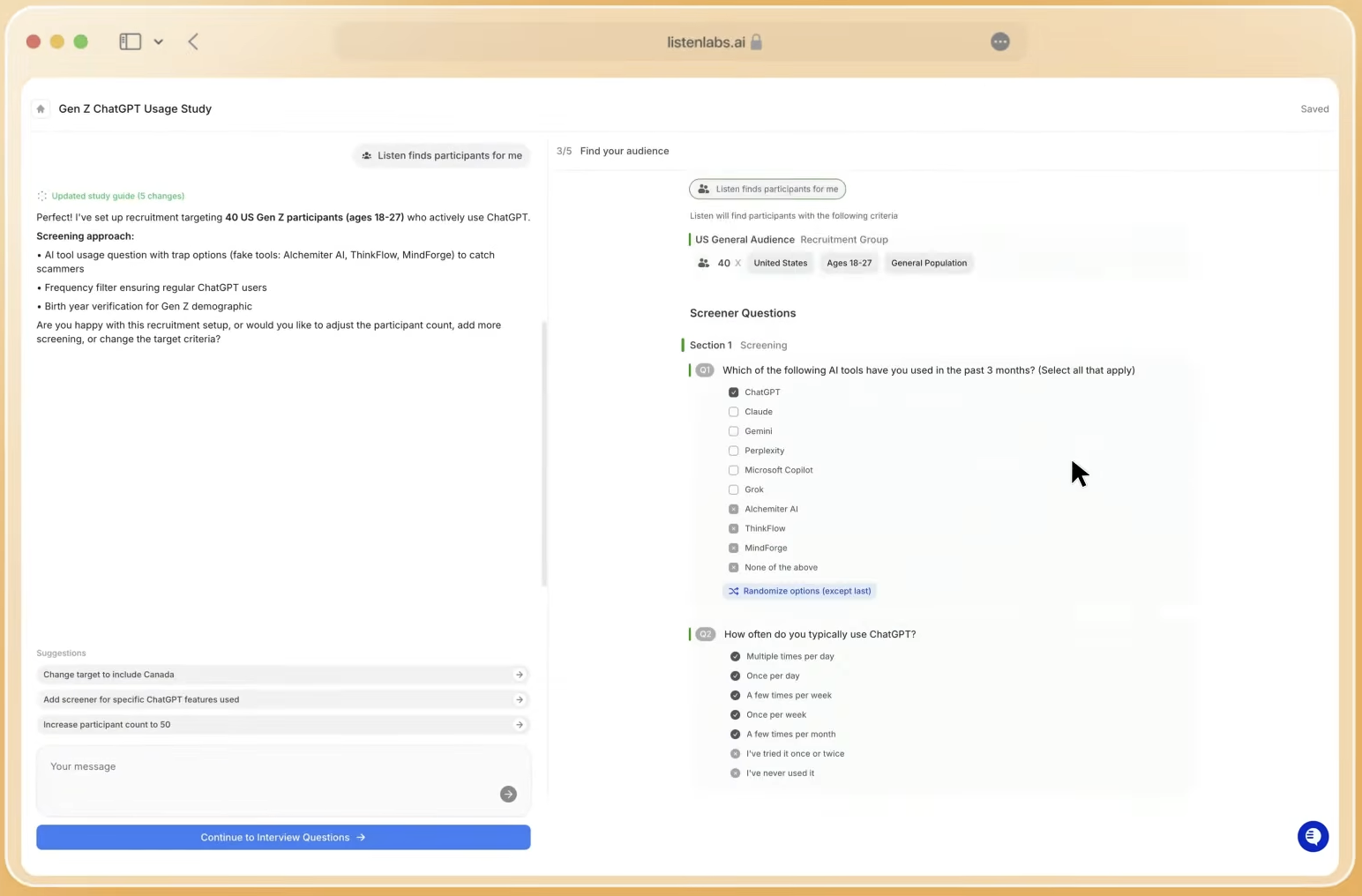
End-to-end AI research platforms replace the fragmented vendor stack with a single workflow. The model spans five stages. AI-assisted study design converts a plain-language brief into structured objectives and questions. Global participant recruitment taps a verified panel network. AI-moderated video interviews use dynamic follow-up questions. Automated analysis surfaces themes, segments, and statistical comparisons. A persistent knowledge layer stores every finding for future cross-study queries.
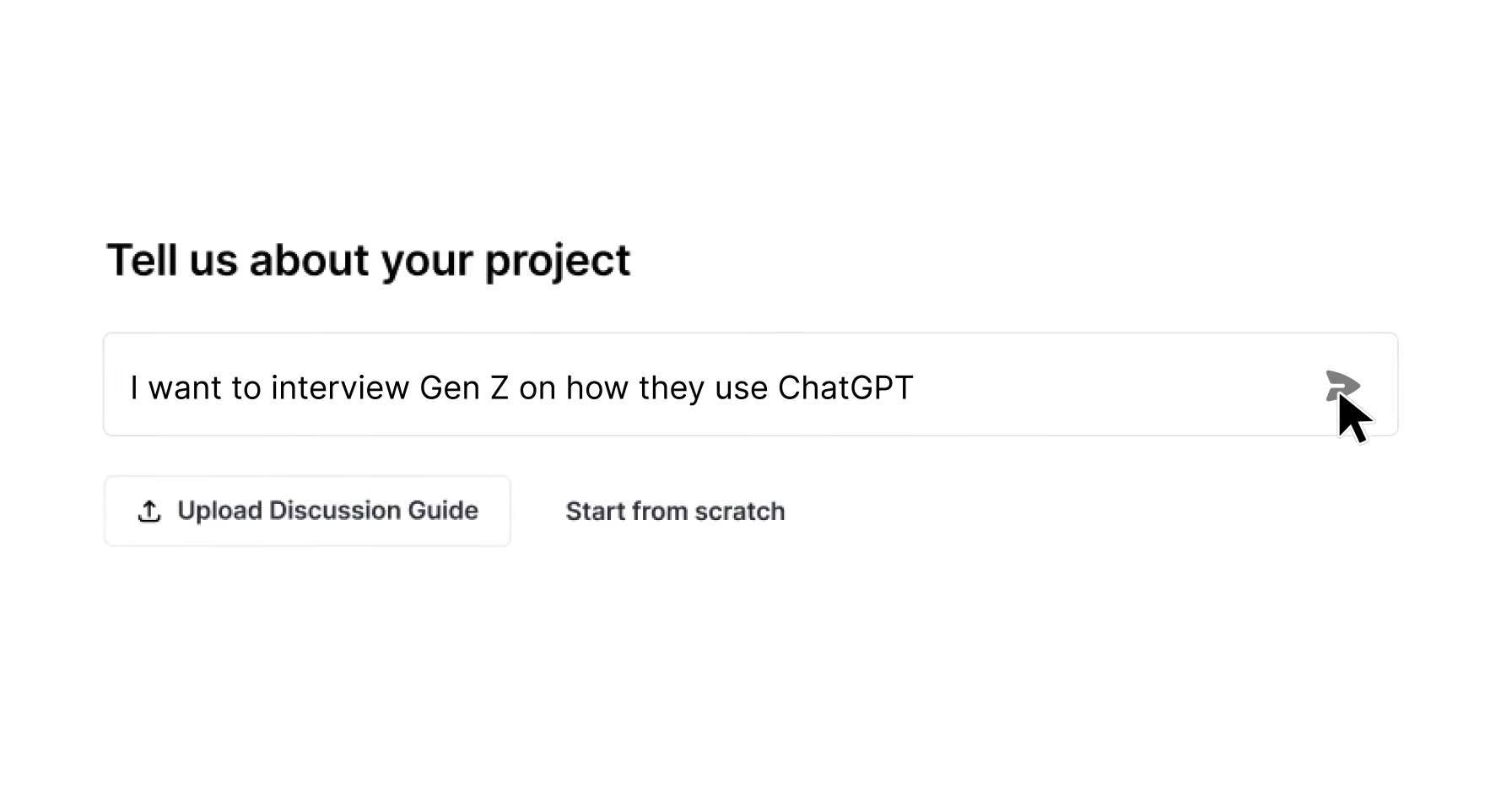
This category differs from survey tools, which scale but cannot probe, and from analysis repositories, which organize existing research but do not conduct new studies. It also differs from human-moderated platforms, where session throughput is capped by moderator availability. The defining characteristic is a closed loop: one platform handles every step, eliminating handoff delays and data loss between tools. The following sections show how this integrated approach reshapes each dimension of the research process, starting with speed.
See the end-to-end workflow in action by booking a demo.
Speed: Collapsing 4–6 Week Cycles into Hours
Traditional focus groups take 3–5 weeks and $4,000–$12,000 per 90-minute session. Recruitment consumes a significant share of that timeline, followed by scheduling, moderation, transcription, and manual report writing. Each step happens in sequence, so a delay at any stage cascades forward.
AI platforms run those steps in parallel. Recruitment matches against a verified panel in minutes. Interviews run asynchronously, so 300 participants can complete sessions overnight. One researcher ran a full buying intent analysis across three user segments in under a minute. Microsoft used this model to collect global customer video stories for its 50th anniversary celebration in a single day, a process that previously required 6–8 weeks.
Scale: Running Hundreds of In-Depth Interviews at Once
Qualitative data methods lag in speed and sample size but excel at uncovering nuance and complexity in human decision-making. The historical constraint was logistical because a human moderator can conduct only one interview at a time. AI removes that ceiling and keeps the depth.
Qual-at-scale works best when research requires large sample sizes or broad geographic reach, since AI tools can engage hundreds or thousands of participants remotely and asynchronously. Each conversation remains adaptive. The AI probes short answers, follows unexpected threads, and adjusts question framing based on prior responses. Anthropic used this capability to complete 300+ user interviews in 48 hours, surface churn drivers five times faster than previous methods, and deliver a prioritized list of ten must-fix product items.
Quality: Reliable Participants and Layered Fraud Controls
Participant quality often determines whether research budgets produce signal or noise. Commodity panels introduce professional survey-takers who chase incentives, repeat respondents, and AI-generated scripts that pass basic screening but add little insight.
Purpose-built recruitment infrastructure addresses this through layered controls that work in sequence. Behavioral matching selects participants on intent and past actions rather than self-reported demographics, so the right people enter the pool. Real-time monitoring then acts as a second filter, flagging fraudulent responses during the interview across video, voice, content, and device signals. Participant frequency limits cap each person at three studies per month to prevent panel fatigue. For hard-to-reach segments, including enterprise decision-makers, healthcare workers, and audiences below one percent incidence rate, a dedicated recruitment operations team adds human review.
Analysis: Reducing Bias and Accelerating Insight Extraction
Human analysis of qualitative data takes time and often reflects confirmation bias. Analysts may overweight findings that support existing hypotheses while overlooking signals that challenge them.
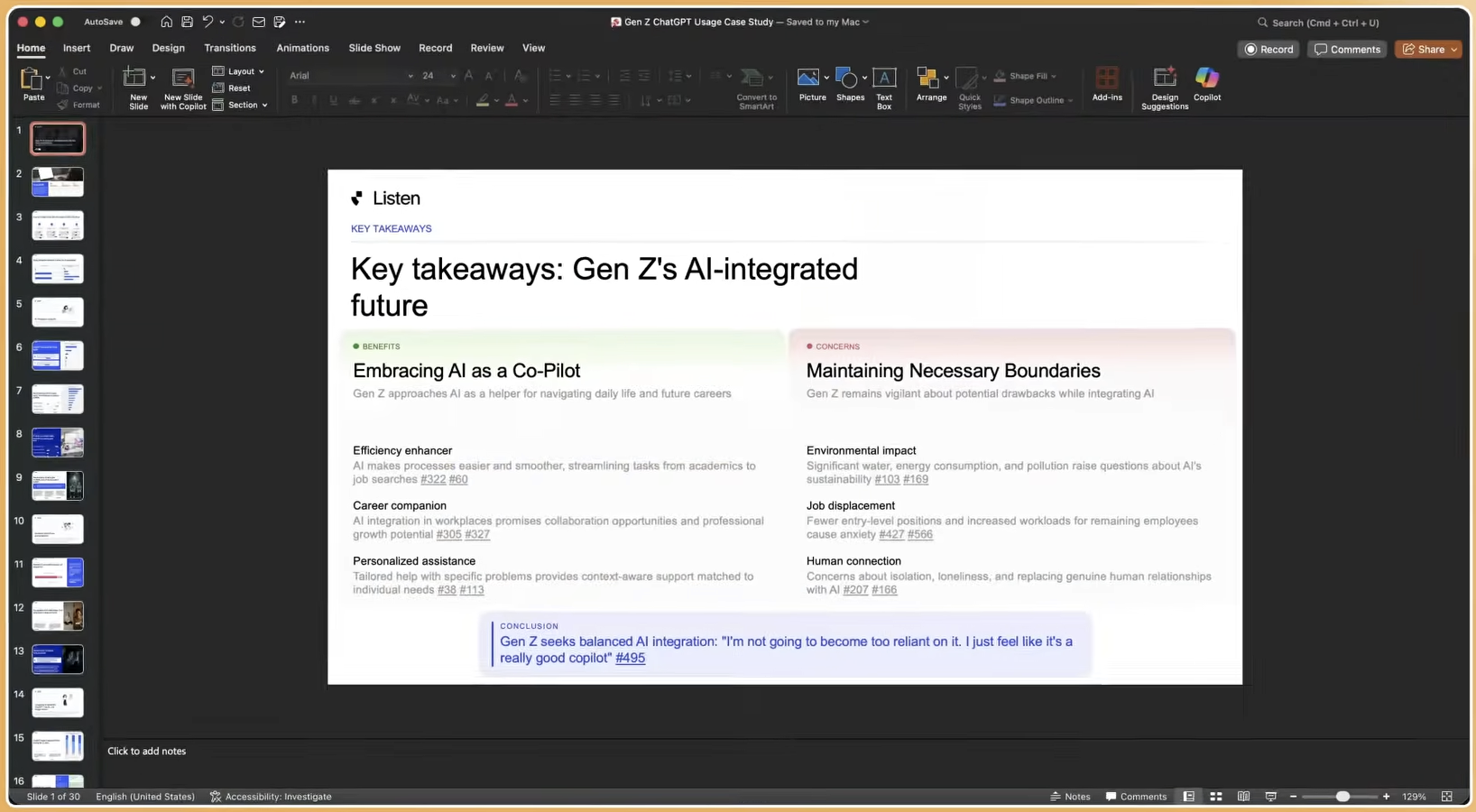
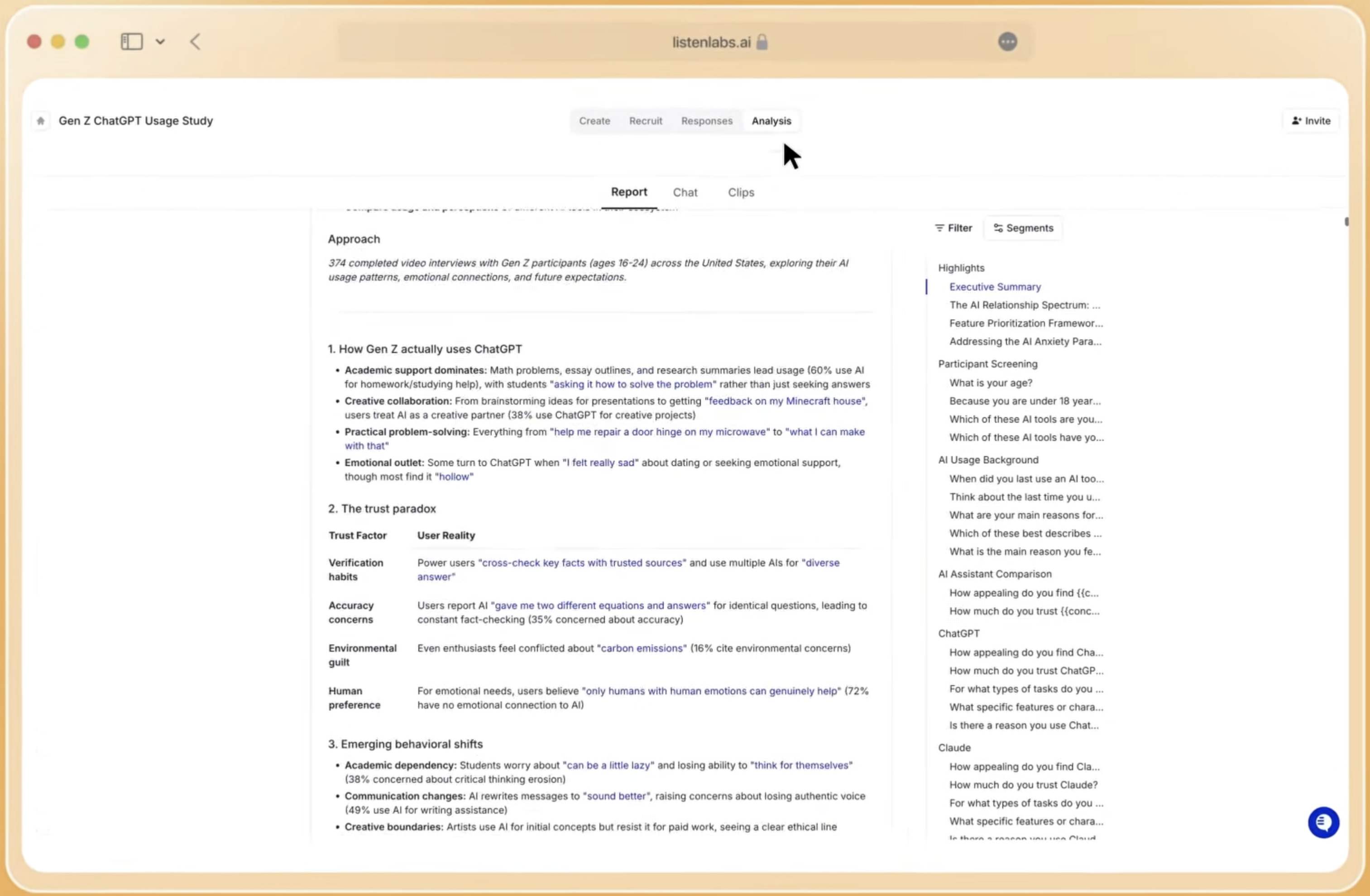
The Research Agent handles the full analysis workflow, from raw data to final output. It processes all interview data objectively, identifying patterns and themes across hundreds of responses without the anchoring effects that affect human reviewers. Outputs include automated key findings, segmentation breakdowns, statistical significance tests, branded slide decks, memo-style reports, and video highlight reels, all generated in under a minute. Every insight links back to the underlying response, preserving the audit trail that enterprise stakeholders require.
Emotional Intelligence: Capturing What Transcripts Miss
Transcripts record what participants say but not how they feel. They miss a frown during a product demo, a pause before a pricing answer, or the flat expression that follows a supposedly positive rating. Two concepts can receive identical verbal scores while triggering very different emotional responses.
Emotional Intelligence analyzes three layers of signal, including tone of voice, word choice, and subconscious micro expressions, to surface nuanced emotions that transcripts alone miss. The system is built on Ekman's universal six emotions framework, the same standard used in clinical psychology and UX research: anger, disgust, fear, happiness, sadness, and surprise. Every emotion is quantified per question and concept, with every label traceable to the exact timestamp, verbatim quote, and AI reasoning behind it. The capability works across 50+ languages and connects directly with the Research Agent for natural-language queries, charts, and highlight reels of emotionally significant moments.
Institutional Knowledge: Turning Projects into a Living Source of Truth
Research findings from past studies often live in scattered PowerPoint decks, shared drives, and individual researchers' memories. Organizations repeatedly commission studies on questions they have already answered because no system connects historical findings to current requests.
Mission Control functions as a persistent knowledge layer across all studies conducted on the platform. Teams query past research in natural language and receive answers in seconds. Trend tracking surfaces how customer sentiment, needs, and pain points shift over time. Each new study compounds the knowledge base rather than existing in isolation, so one-off research projects become part of a continuous intelligence program.
Hybrid Workflows and Bias Mitigation in AI-Moderated Research
Ninety-two percent of participants report top comfort levels for both human and AI moderated sessions, and many prefer AI moderation for sensitive topics such as politics, religion, personal finances, and mental health. Some contexts still benefit from human moderators, including complex medical discussions, topics requiring deep empathy, and studies where relationship-building drives data quality.
Bias mitigation operates at multiple levels. AI analysis processes all responses without the anchoring effects of human reviewers. Quality Guard removes low-effort and fraudulent responses before they enter the analysis pool. Study design tools flag methodological issues before launch. For most enterprise research programs, the strongest model is human-AI collaboration. AI handles logistics, moderation, and analysis at scale while research leads focus on strategic interpretation and stakeholder communication.
AI Market Research Capabilities: Timeline and Cost Impact
AI research platforms collapse traditional timelines from weeks to hours. AI platforms deliver results in under 24 hours, collapsing the multi-week cycles described earlier. Cost per study often drops significantly compared to traditional focus group pricing while expanding from small participant groups to hundreds of simultaneous qualitative interviews. Analysis that once required days of manual coding now completes in under a minute, with full segment breakdowns and statistical significance testing generated automatically.
Enterprise Proof Points (2025–2026)
Microsoft cut research wait times from 6–8 weeks to under 24 hours, collecting global customer video stories for its 50th anniversary in a single day. The Director of Data Science at Microsoft noted, "I can reach out to hundreds of users at one third of the cost."
Anthropic completed 300+ user interviews in 48 hours to understand Claude subscription churn, identified where former users migrated, and delivered a prioritized list of ten must-fix items. The Director of Product Strategy described it as clarity and speed the team had never had before.
P&G ran 250+ interviews to evaluate how men respond to new product claims before market launch. The team surfaced where claims felt exaggerated and confirmed that comfort and reliability outrank novelty, shaping product and brand strategy in hours rather than weeks.
Skims validated campaign direction with thousands of high-income buyers overnight, eliminating weeks of recruiting and enabling board-level buy-in before launch. Robinhood used AI-moderated interviews to identify that users who view prediction markets as entertainment drive 2.4x higher weekly re-engagement, with integration flows boosting uptake 30–40%.
How Gen AI Reshapes the Research Lifecycle
Generative AI transforms market research across the full study lifecycle. At the design stage, natural-language input produces structured objectives, question sets, and probing context in seconds. During recruitment, AI orchestration layers match and bid across panel partners simultaneously, reaching verified participants across 45+ countries and 100+ languages.
In moderation, AI schedules and conducts interviews, analyzes transcripts for themes, and generates quantitative insights from qualitative conversations, all without human scheduling overhead. At the analysis stage, automated theme extraction, significance testing, and segmentation replace weeks of manual coding. The knowledge storage layer then converts individual study outputs into a compounding institutional asset.
The net effect is structural change. Gen AI shifts research from project-based to continuous, from siloed to integrated, and from depth-or-scale to depth-and-scale.
Experience these capabilities firsthand by booking a demo with Listen Labs.
Frequently Asked Questions
How is AI market research different from traditional qualitative methods?
Traditional qualitative research relies on human moderators conducting sequential interviews or focus groups, with manual transcription and analysis following each session. The process stays linear because one step must complete before the next begins. AI market research runs recruitment, moderation, and analysis in parallel. Hundreds of adaptive, one-on-one interviews execute simultaneously, and analysis begins as responses arrive. Themes, segments, statistical comparisons, slide decks, and video highlight reels become available within hours of study launch rather than weeks after the final session. Qualitative depth is preserved because each AI-moderated conversation includes dynamic follow-up questions that probe short or unexpected answers, similar to a trained human interviewer.
What types of studies are best suited to AI-moderated research?
AI-moderated research works well for concept and prototype testing, creative and ad testing, brand perception studies, consumer journey mapping, usability testing with screen sharing, pricing research, multi-market segmentation, and churn analysis. It performs best when studies require large sample sizes, broad geographic reach, or fast turnaround, conditions where human moderation creates a throughput bottleneck. Studies requiring deep empathy, complex medical discussions, or relationship-dependent data collection often benefit from a hybrid approach that combines AI moderation with human oversight at key stages.
How does the platform ensure participant quality?
Participant quality is maintained through three independent layers. First, the platform works exclusively with high-quality, non-commodity panel sources, avoiding professional survey-takers from incentive-driven commodity panels. Second, Quality Guard monitors every interview in real time across video, voice, content, and device signals, detecting fraud, low-effort responses, AI-generated scripts, and mismatched profiles before they enter the analysis pool. Third, a dedicated recruitment operations team adds human review for hard-to-reach segments, and participants are limited to three studies per month to prevent panel fatigue and eliminate repeat respondents. Behavioral matching selects participants on intent and past actions rather than self-reported demographics alone.
What deliverables does an AI research platform produce?
A full-stack AI research platform delivers automated key findings and theme analysis, consultant-quality PowerPoint slide decks, memo-style reports, video highlight reels of the most significant interview moments, statistical charts and significance tests, segmentation breakdowns by demographics or custom cohorts, and responses to any natural-language question posed against the full dataset. Every insight links back to the underlying participant response, preserving the audit trail that enterprise stakeholders and compliance teams require. Deliverables generate in under a minute after study completion rather than requiring days of manual formatting.
How does the platform handle data security and privacy compliance?
Enterprise-grade security includes 256-bit encryption, and customer data never trains AI models. The platform holds SOC 2 Type II, GDPR, ISO 27001, ISO 27701, and ISO 42001 certifications. Enterprise SSO is supported. These certifications cover data handling, privacy management, and AI governance, the three compliance dimensions most commonly required by Fortune 500 procurement and legal teams before deploying a research platform at scale.
Choosing the Right AI Research Platform for Your Team
Evaluating an AI research platform requires assessing coverage across the full research lifecycle, not just one stage. Relevant criteria include end-to-end capability from study design through knowledge storage, verified panel reach across the markets and languages that matter to the business, real-time quality controls that operate during interviews rather than after, emotional signal capture beyond transcripts, and a persistent knowledge layer that compounds value across studies over time. Platforms that address only recruitment, only analysis, or only moderation require additional vendor integrations that reintroduce the fragmentation and delay that AI is meant to remove.
Listen Labs is the end-to-end AI research platform that delivers every capability described in this guide. It provides AI-assisted study design, a 30M-verified-respondent global panel across 45+ countries, AI-moderated interviews in 100+ languages, Quality Guard fraud detection, Emotional Intelligence built on Ekman's framework, the Research Agent for automated deliverables, and Mission Control for cross-study institutional knowledge. Enterprises including Microsoft, Google, P&G, Anthropic, Skims, Robinhood, Sony, Levi's, and Nestlé use Listen Labs to run research that previously took weeks in under 24 hours. Ready to compress your research cycle from weeks to hours? Book a demo to see Listen Labs in action.