
Written by: Anish Rao, Head of Growth, Listen Labs
Key Takeaways
- AI recruitment platforms shorten UX research cycles from 4–6 weeks to hours through behavioral matching, real-time fraud checks, and automated scheduling.
- Listen Labs offers 30M+ verified participants across 45+ countries, a zero-fraud guarantee, and workflows that run from recruitment to AI-generated reports.
- Traditional tools like User Interviews and Respondent.io handle recruitment only, so teams still juggle separate tools for interviews and analysis that slow projects down.
- End-to-end AI platforms support qual-at-scale studies with 100+ participants, parallel video interviews, and instant deliverables for sprint validation and prototype testing.
- Enterprise teams reach 24-hour global insights with Listen Labs; book a demo to cut recruitment time and expand qualitative research.
How AI Speeds Up UX Research Recruitment
AI removes the slowest steps in UX research recruitment through five connected capabilities that replace manual work.
1. Instant Behavioral Matching: AI algorithms match participants based on real behaviors and intent data, not just demographics. This precise targeting reduces screening time compared to manual qualification and improves fit for specialized UX studies.
2. Real-Time Fraud Detection: AI screening tools achieve 89–94% accuracy rates in detecting fraudulent profiles. Automated checks across video, voice, and device signals block professional survey-takers and AI-generated responses before they enter your study.
3. Adaptive Screening and Scheduling: After AI identifies qualified participants, smart algorithms adjust screening criteria based on response rates. The system manages time zone detection, calendar syncing, and reminders, so teams avoid manual scheduling back-and-forth.
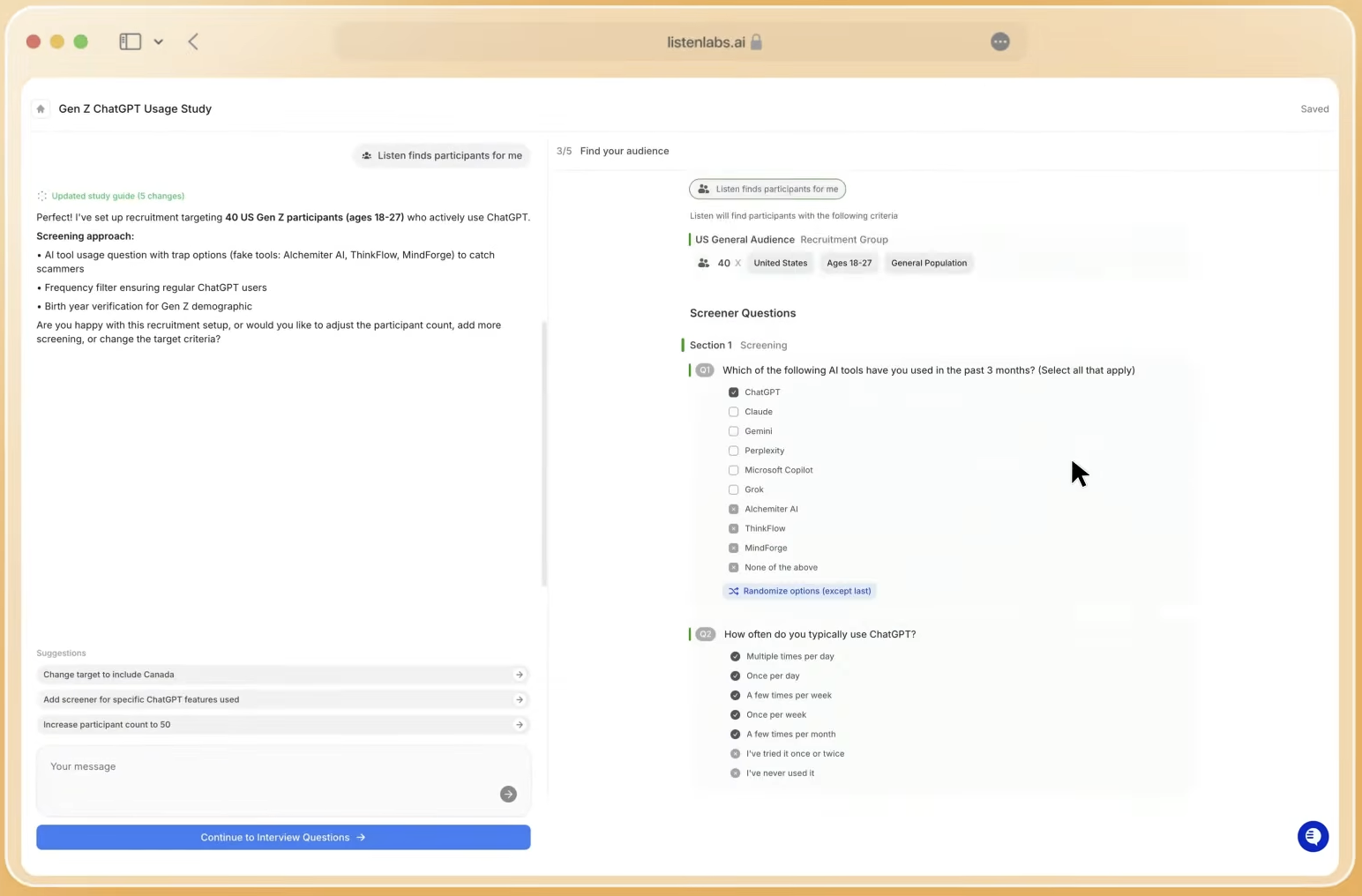
4. Automated Payouts and Incentives: Once sessions are scheduled, AI handles participant compensation, compliance tracking, and follow-up communication. This automation removes administrative tasks that often add days to recruitment cycles.
5. Predictive No-Show Reduction: Even with strong scheduling and incentives, some participants will not attend. Machine learning models flag participants likely to miss sessions and automatically over-recruit or send targeted reminders, which protects sample quality.
Traditional recruitment-only platforms like User Interviews and Respondent.io lack these integrated capabilities, so teams must stitch together multiple vendors and manage handoffs that introduce delays. These limitations highlight why platform choice directly affects recruitment speed and research throughput.
Top AI Platforms for Fast UX Research Recruitment in 2026
1. Listen Labs leads the market with a full end-to-end stack. The Listen Atlas network offers 30M+ verified participants across 45+ countries and 100+ languages. Quality Guard technology delivers a zero-fraud guarantee through multi-layer verification and limits participants to three studies per month to prevent panel fatigue. The platform runs AI-moderated video interviews with dynamic follow-up questions, supports screen-sharing for usability testing, and records mobile screens for in-context feedback. Listen Labs has conducted over 1 million AI-powered customer interviews for enterprises like Microsoft and Anthropic, including 300+ participant studies completed in 48 hours. The Research Agent generates slide decks, reports, and video highlights within minutes, while Mission Control builds institutional knowledge across studies.
2. User Interviews focuses on recruitment with a 4M+ participant panel. Teams value the sourcing reach, yet they still need separate tools for moderation and analysis, which extends total research timelines. Screening relies heavily on self-reported demographics instead of behavioral data, which can reduce participant quality for complex UX work.
3. Respondent.io specializes in B2B recruitment and offers strong access to enterprise decision-makers. The platform operates as recruitment-only, so teams must manage interviews and analysis elsewhere. Turnaround times average 1.5 days to fill a study because of manual screening and limited automation.
4. UserTesting combines recruitment with human-moderated sessions. This model supports nuanced conversations but depends on human moderators, which creates scheduling bottlenecks and caps parallel session volume. The platform performs well for smaller, complex studies but struggles with rapid timelines and large samples.
5. Prolific delivers academic-grade participant quality and excels at quantitative research. Qualitative interview capabilities remain limited, and weaker verification systems increase fraud risk. The panel skews toward Western markets, which restricts global UX coverage.
Generative user research platforms differ based on automation depth in recruitment, AI-moderated interviews, and qualitative analysis. Listen Labs stands out by combining these layers into a single enterprise-ready solution. Once you select a platform with this level of integration, the way you structure your workflow will determine whether you achieve 24-hour insights or fall back into multi-week cycles.
Five-Step End-to-End Workflow for Fast UX Research
Modern fast UX research AI recruitment follows a streamlined five-step workflow that delivers the rapid timelines discussed earlier through automated recruiting, transcription, sentiment tagging, and insight summarization.
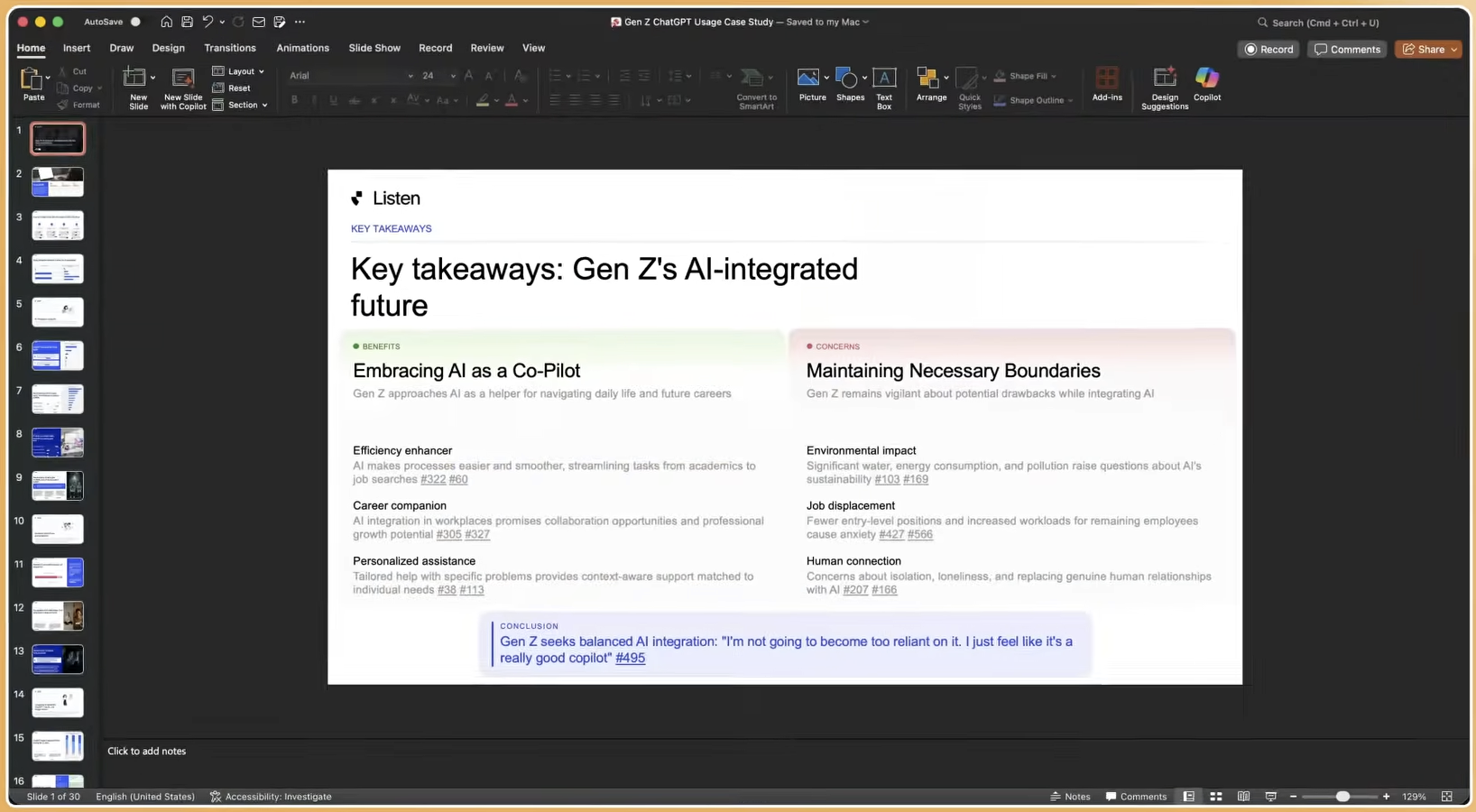
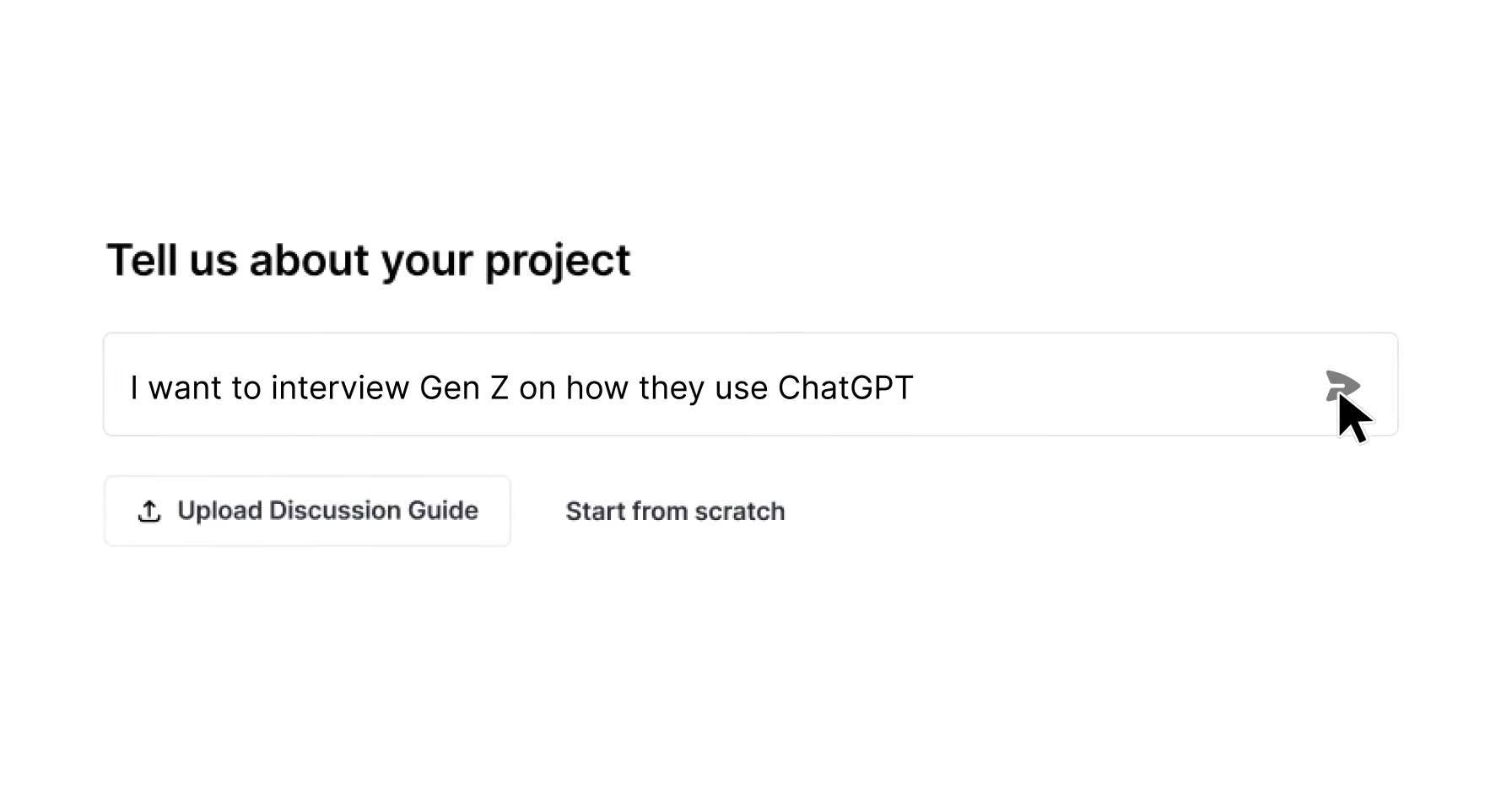
Step 1: AI-Assisted Study Design – Platforms like Listen Labs turn natural language briefs into structured objectives, questions, and probing logic. Teams can support prototype testing, usability studies, and concept validation with built-in randomization and branching.
Step 2: Global Panel Recruitment – AI orchestration layers match and bid across multiple panel sources. The system manages screening, scheduling, and compliance while enforcing quality standards through behavioral verification.
Step 3: AI-Moderated Interviews – Parallel video sessions run with dynamic follow-up questions, screen-sharing, and real-time quality monitoring. This structure removes scheduling bottlenecks and still captures rich qualitative data.
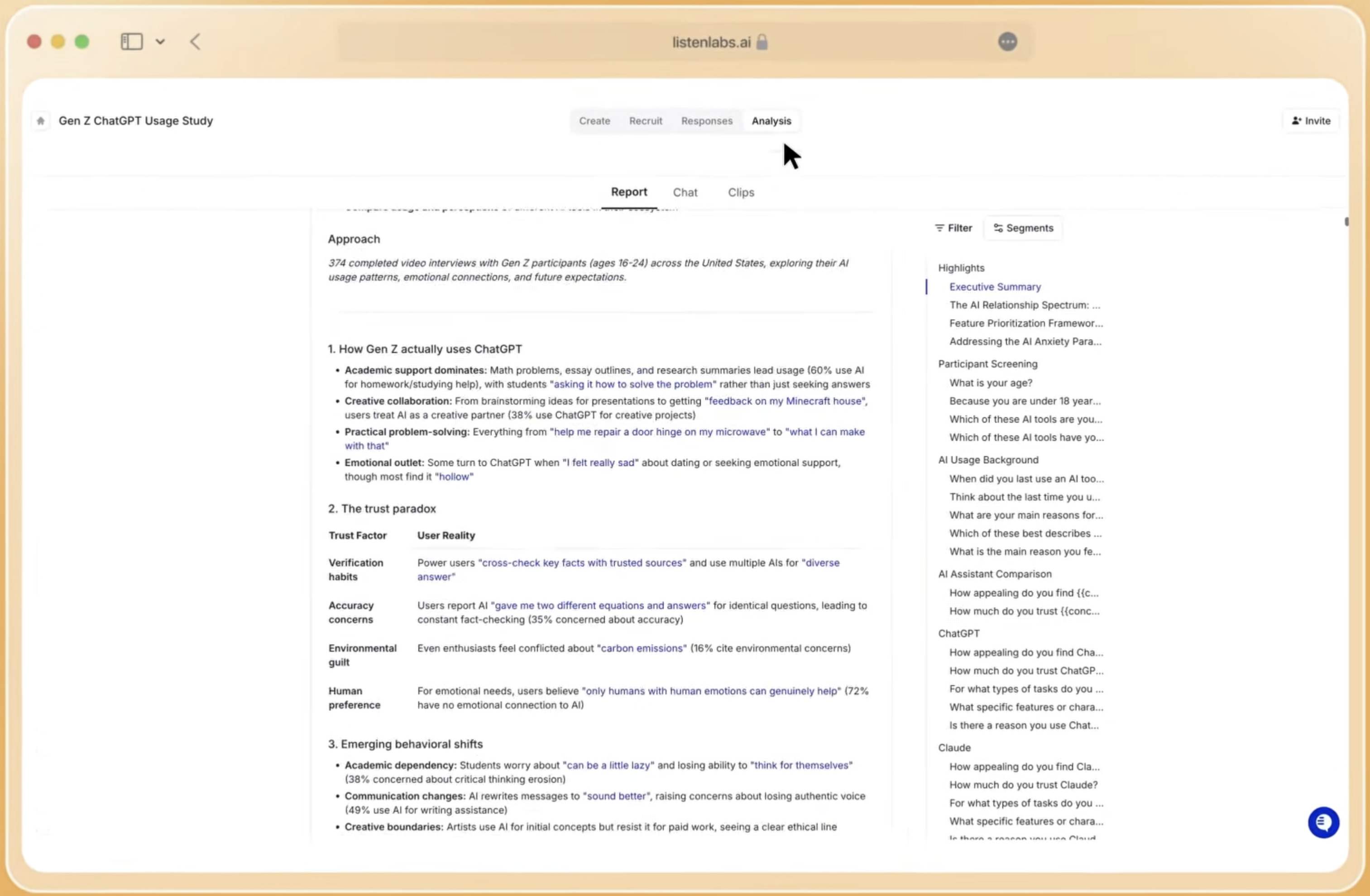
Step 4: Automated Analysis – AI engines process interviews for themes, sentiment, and key insights without introducing human bias. Teams receive quantified emotional responses and segment-level comparisons that support clear decisions.
Step 5: Instant Deliverables – Research agents create slide decks, highlight reels, and executive summaries within minutes. Mission Control systems store findings and clips, so future studies build on a shared knowledge base.
Best practices for 2026 keep humans in charge of strategy while AI handles volume and speed. Teams avoid over-reliance on general-purpose tools like ChatGPT that lack research-specific training data and instead use platforms tuned for UX. Participant quotas protect panels from fatigue. Qual-at-scale approaches enable deeper insights at larger scales without traditional barriers of cost and time when teams follow these guardrails.
High-Impact Use Cases for UX Teams
Fast UX research AI recruitment shines in scenarios where timelines are tight and traditional methods cannot keep up.
Sprint Validation Studies need 50–100 participants within 24–48 hours to validate concepts before development sprints end. The platform enables enterprise teams to collect global customer stories within a day, while traditional recruitment would miss sprint deadlines entirely, the same capability that allows the Microsoft teams mentioned earlier to validate concepts within sprint cycles.
Prototype Testing at Scale benefits from parallel usability sessions with screen-sharing. Teams can test with hundreds of users at once instead of the usual 5–10 participants, which creates statistical confidence for design decisions.
Global Localization Research uses AI’s multilingual capabilities to run studies across 45+ countries at the same time. P&G uses Listen Labs to evaluate product claims across diverse markets and uncover cultural nuances that would take months with traditional methods.
The scale advantage is clear. Traditional UX research often limits teams to small samples because of logistics, while AI platforms support large, qualitative studies that combine interview depth with the reliability of bigger samples.
Managing Risks and Limitations in AI Recruitment
AI-powered recruitment introduces three main concerns, and leading platforms address each with targeted safeguards.
Depth vs. Automation Trade-offs: Some teams worry that AI interviews lack human empathy and nuance. Listen Labs embeds 50+ years of combined research expertise into its methodology so AI moderators can probe on interesting responses and still keep a natural conversation flow.
Fraud and Quality Control: Commodity panels attract professional survey-takers and low-quality responses. Quality Guard technology monitors multiple signals in real time, while participant limits and behavioral matching make gaming the system difficult.
Over-Automation Risks: Teams may lean too heavily on AI and weaken strategic thinking. Best-in-class platforms keep human researchers involved in methodology design and interpretation. They also provide traceable insights that link every finding to specific responses and timestamps.
Compared to competitors, Listen Labs addresses these risks with dedicated recruitment operations teams, transparent AI reasoning, and enterprise-grade security and compliance standards.
Decision Framework for Choosing a Platform in 2026
Choose your fast UX research AI recruitment platform by working through three priority questions in sequence.
First, define your scale requirements. Decide whether you need 24-hour global access to 30M+ participants or if a smaller, regional panel is enough. This answer clarifies whether you require enterprise-grade infrastructure.
Second, assess your workflow integration needs. Decide if your team needs end-to-end automation from recruitment through analysis or can manage handoffs between separate tools. This choice affects both speed and data continuity.
Third, evaluate your tolerance for fragmentation. Decide whether recruitment-only solutions that require separate moderation tools are acceptable or if those handoffs create delays your team cannot absorb.
For enterprise teams that prioritize speed, scale, and quality, Listen Labs offers the most comprehensive fit. Book a demo to experience fast UX research AI recruitment that delivers insights in hours, not weeks.
Frequently Asked Questions
How does AI ensure participant quality in UX research recruitment?
AI quality assurance uses multiple verification layers that outperform traditional screening. Behavioral matching algorithms analyze real user actions and intent data instead of relying on self-reported demographics. Real-time fraud detection monitors video, voice, content, and device signals during interviews to flag professional survey-takers or AI-generated responses. Listen Labs’ Quality Guard system limits participants to three studies per month and builds reputation scores across every interaction. Each study strengthens the overall network, which creates a compounding quality advantage.
What is the difference between Listen Labs and UserTesting for recruitment speed?
Listen Labs delivers 24-hour end-to-end research cycles through AI-moderated interviews that run in parallel, while UserTesting depends on human moderators who create scheduling bottlenecks. Listen Labs can run hundreds of simultaneous sessions across global time zones, whereas UserTesting’s human-led model limits concurrent capacity. The AI-driven approach removes coordination delays and triggers automated analysis as soon as interviews end. UserTesting offers strong human nuance for some complex studies, yet Listen Labs matches this quality while delivering much faster turnaround for most UX needs.
What are the main limitations of AI in UX research recruitment?
AI recruitment has three main limitations that teams should keep in mind. AI may miss subtle cultural nuances or emotional cues that experienced researchers would catch, although this gap continues to narrow. Over-automation can weaken strategic thinking if teams rely on AI for study design and insight interpretation without human review. Models trained on narrow datasets can also reinforce bias or overlook new behaviors. Leading platforms respond with hybrid workflows that pair AI efficiency with human expertise, transparent reasoning that shows how conclusions were reached, and continuous model updates based on research outcomes.
Can AI recruitment platforms handle specialized UX audiences like enterprise decision-makers?
Advanced AI recruitment platforms can reach niche audiences when they combine automation with dedicated sourcing operations. Listen Labs’ recruitment ops team partners with specialized networks to find enterprise decision-makers, engineers, healthcare workers, and other segments with incidence rates below 1%. AI orchestration layers bid across multiple panel sources and behavioral databases to locate qualified participants faster than manual outreach. The most reliable results come from platforms that blend AI automation with human expertise instead of relying on commodity panels alone.
How do end-to-end AI platforms compare to separate recruitment and analysis tools?
Integrated platforms remove the handoffs and delays that fragmented toolchains create. Separate recruitment tools like User Interviews require teams to export participant data, manage scheduling in other systems, run interviews in third-party platforms, and then move transcripts again for analysis. Each step adds risk, delay, and potential data loss. End-to-end platforms like Listen Labs maintain data continuity from recruitment through final deliverables. They support real-time quality monitoring, kick off automated analysis during interviews, and build institutional knowledge across studies. This integrated approach reduces total research time and improves both data quality and team efficiency.