
Written by: Anish Rao, Head of Growth, Listen Labs | Last updated: July 4, 2026
Key Takeaways
- Enterprise research leaders face growing backlogs and faster sprint cycles, so four-to-six-week traditional timelines no longer work for Fortune 500 teams.
- End-to-end AI platforms beat traditional agencies and fragmented point solutions by delivering full research cycles, from design to deliverables, in under 24 hours while preserving methodological rigor.
- Listen Labs combines adaptive AI moderation, real-time fraud prevention, emotional intelligence analysis, and a complete enterprise certification stack to satisfy Fortune 500 security and compliance standards.
- The platform scales qualitative depth across a global network of verified respondents, removing recruitment delays even for sub-1% incidence audiences.
- Teams that want shorter timelines without sacrificing quality or compliance can book a demo with Listen Labs.
Nine Criteria for Evaluating Enterprise AI Qualitative Platforms
Enterprise buyers evaluate AI qualitative research platforms against nine concrete criteria. These include research cycle time from brief to deliverable and the ability to achieve depth and scale at the same time. They also include participant quality and fraud prevention, methodological rigor and human oversight, and enterprise security and compliance certifications. Global and multilingual reach, transparency and traceability of findings, and total cost of ownership across tools, headcount, and vendor fees matter as well. Long-term knowledge retention across studies completes the list, and each comparison section below maps to one or more of these criteria.
Study Setup and Design: Manual Drafting vs AI Co-Design
Traditional agency and point-solution approach. Study design in traditional workflows relies on manual, iterative drafting. Agencies create discussion guides through multiple rounds of stakeholder review. Point-solution users configure studies in tools without embedded methodological guardrails, so errors often surface only after fielding begins. Slow qualitative methods and manual setup compound delays before the first interview even starts.
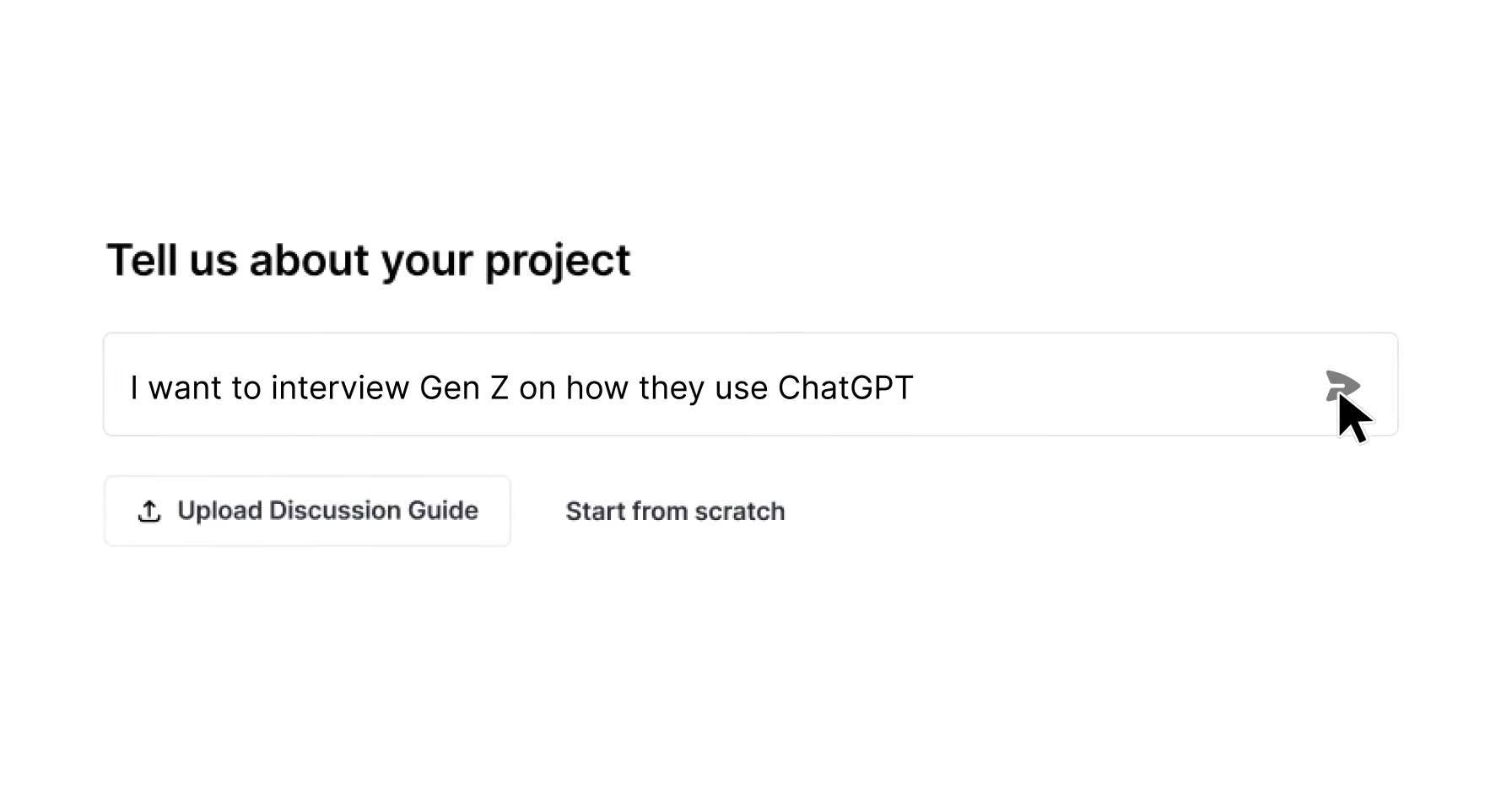
Listen Labs approach. Researchers state goals in natural language, and the AI co-designs structured objectives, questions, and probing context in seconds. The platform supports in-depth interviews, semi-structured formats, diary studies, ethnography, and task-based UX testing. It handles images, video, audio, PDFs, prototypes, and live URLs with built-in randomization, quotas, branching, skip logic, and piping. Auto-QA flags guide issues before launch. Clone functionality lets teams reuse and adapt past studies quickly instead of rebuilding from scratch.
Recruitment Infrastructure: Panels vs Listen Atlas Orchestration
Traditional agency and point-solution approach. Traditional agencies depend on proprietary panels with limited geographic coverage and uneven quality controls. Point-solution stacks require separate recruitment vendors such as Prolific, User Interviews, or Respondent, which adds handoffs, contracts, and delays. Sub-1% incidence audiences often demand weeks of manual sourcing with no guarantee of success.
Listen Labs approach. Listen Labs has run over 1 million AI-powered customer interviews for companies including Microsoft, Perplexity, and Sweetgreen, drawing on a large global network of verified respondents. Listen Atlas, the AI orchestration layer, automatically matches and bids across multiple consumer and B2B panel partners alongside Listen Labs’ proprietary database, using behavioral and intent data instead of only self-reported demographics. A dedicated recruitment operations team manages sub-1% incidence audiences such as enterprise decision-makers, healthcare workers, and engineers without adding weeks to the schedule. Organizations can also bring their own participants at reduced cost.
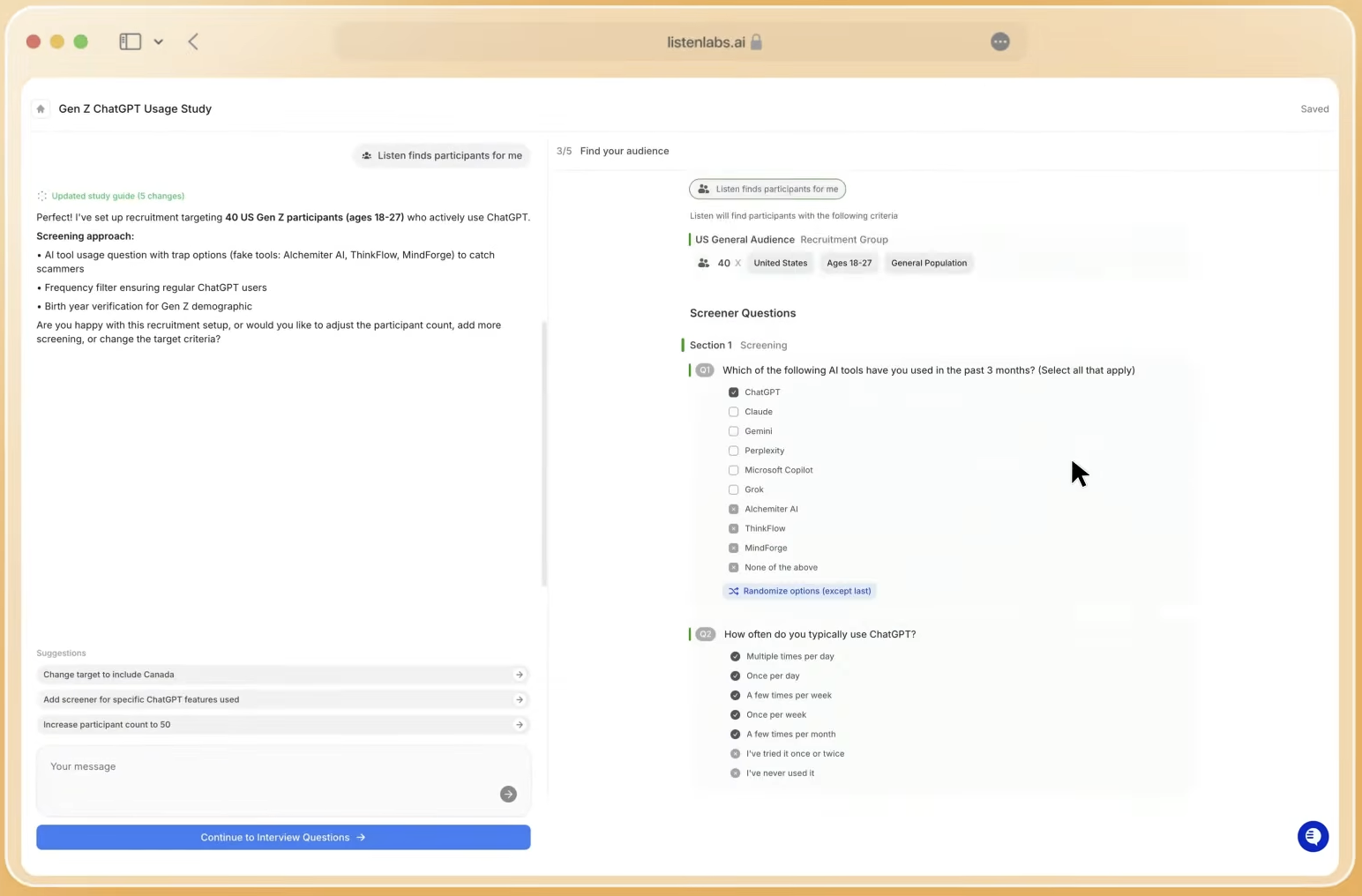
See recruitment at full speed. Book a demo to watch Listen Atlas source niche audiences in real time.
Moderation Approach: Human Variability vs Adaptive AI Interviewing
Traditional agency and point-solution approach. Human moderation quality varies widely by interviewer. Scripted AI tools in point solutions follow rigid question sequences with no adaptive follow-up, so transcripts miss the unexpected turns where the strongest insights appear. Human moderation still fits early-stage exploratory work, sensitive topics, and executive-level participants expecting peer engagement, but it cannot scale to hundreds of simultaneous sessions.
Listen Labs approach. The AI interviewer supports hundreds of one-on-one interviews running in parallel. The AI probes deeper on interesting or short answers the way a trained human interviewer would, using dynamic follow-up questions across more than 100 languages. Every session captures video, audio, text, and screen recordings, including mobile iOS screen recording. Mixed-method designs combine qualitative questions with Likert scales, NPS, sliders, grids, and MaxDiff in a single study.
Data Quality and Fraud Prevention: Commodity Panels vs Quality Guard
Traditional agency and point-solution approach. Commodity panels carry known risks such as professional survey-takers, repeat respondents, and incentive-driven low-effort answers. Post-hoc quality checks catch some fraud but cannot repair data already collected from mismatched profiles. Any AI system needs the option for human intervention, yet many point solutions lack real-time monitoring that enables action while fielding is live.
Listen Labs approach. Quality Guard applies three layers of protection at once. Listen Labs works only with high-quality, non-commodity panel sources. Real-time AI monitoring across video, voice, content, and device signals detects fraud, low-effort responses, AI-generated scripts, and mismatched profiles during the interview. A dedicated recruitment operations team adds human review, and participants are capped at three studies per month to prevent panel fatigue. This system supports a zero-fraud guarantee backed by a reputation scoring flywheel that improves with every study.
Qualitative Depth and Emotional Intelligence: Transcripts vs Multimodal Signals
Traditional agency and point-solution approach. Most research tools capture only what participants say. Transcripts, survey responses, and self-reported ratings miss the frown during a product demo, the hesitation before a pricing answer, or the widened pupils that signal real surprise. Two concepts can receive identical ratings while triggering very different emotional responses.
Listen Labs approach. Listen Labs’ Emotional Intelligence analyzes tone of voice, word choice, and subconscious micro-expressions at the same time to reveal emotions that transcripts alone miss. It builds on Ekman’s universal emotions framework, the standard used in clinical psychology and UX research. Every emotion is quantified per question and concept, and each label links to the exact timestamp, verbatim quote, and reasoning. Emotional Intelligence works across more than 50 languages and connects directly to the Research Agent for natural-language queries, charts, and highlight reels of emotionally significant moments.
Analysis and Deliverables: Manual Coding vs Research Agent Automation
Traditional agency and point-solution approach. Researchers spend most of their time on analysis, including pattern finding, quantification, significance testing, macro context, and formatting results for different stakeholders. Manual analysis introduces confirmation bias, inconsistency across analysts, and timelines measured in weeks.
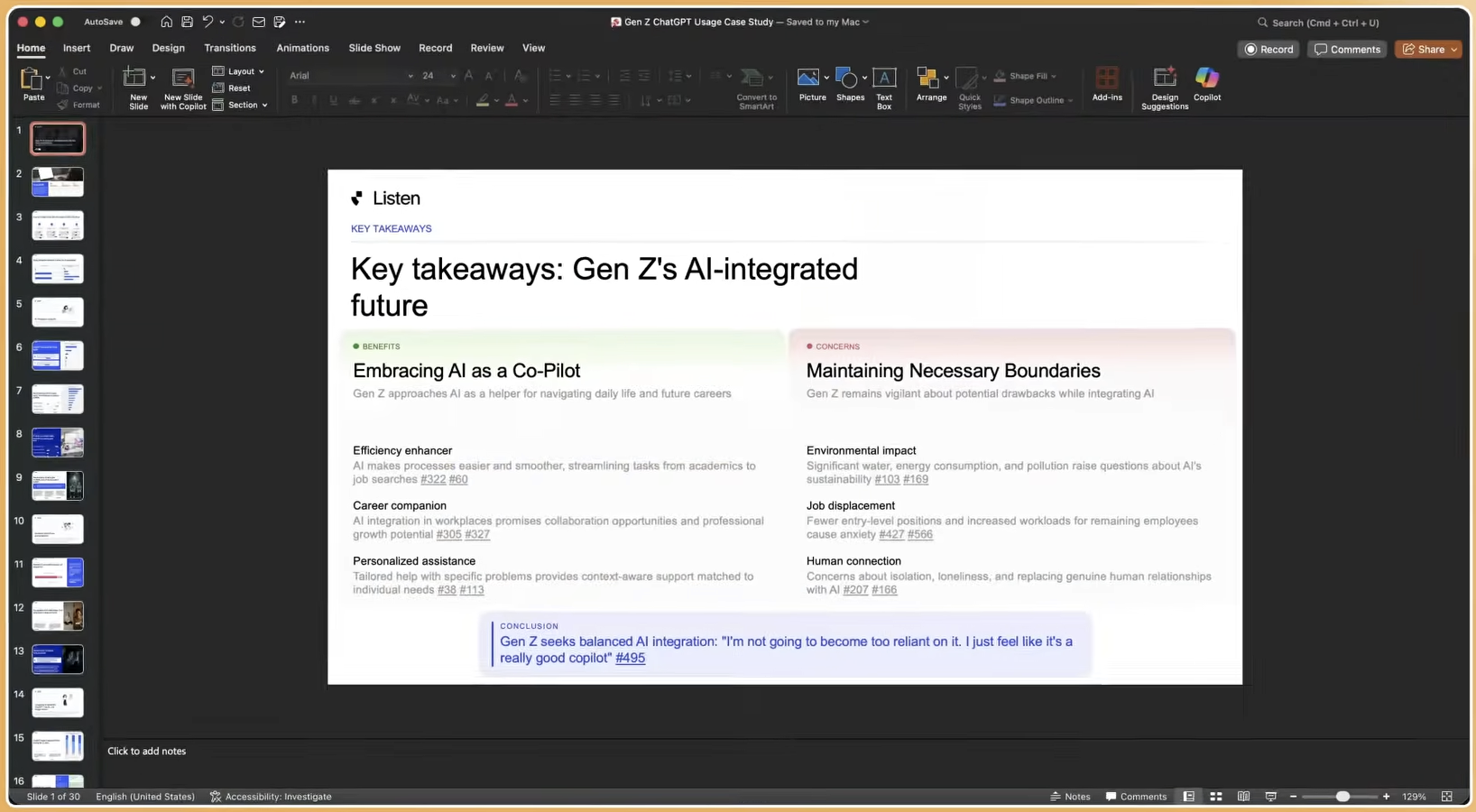
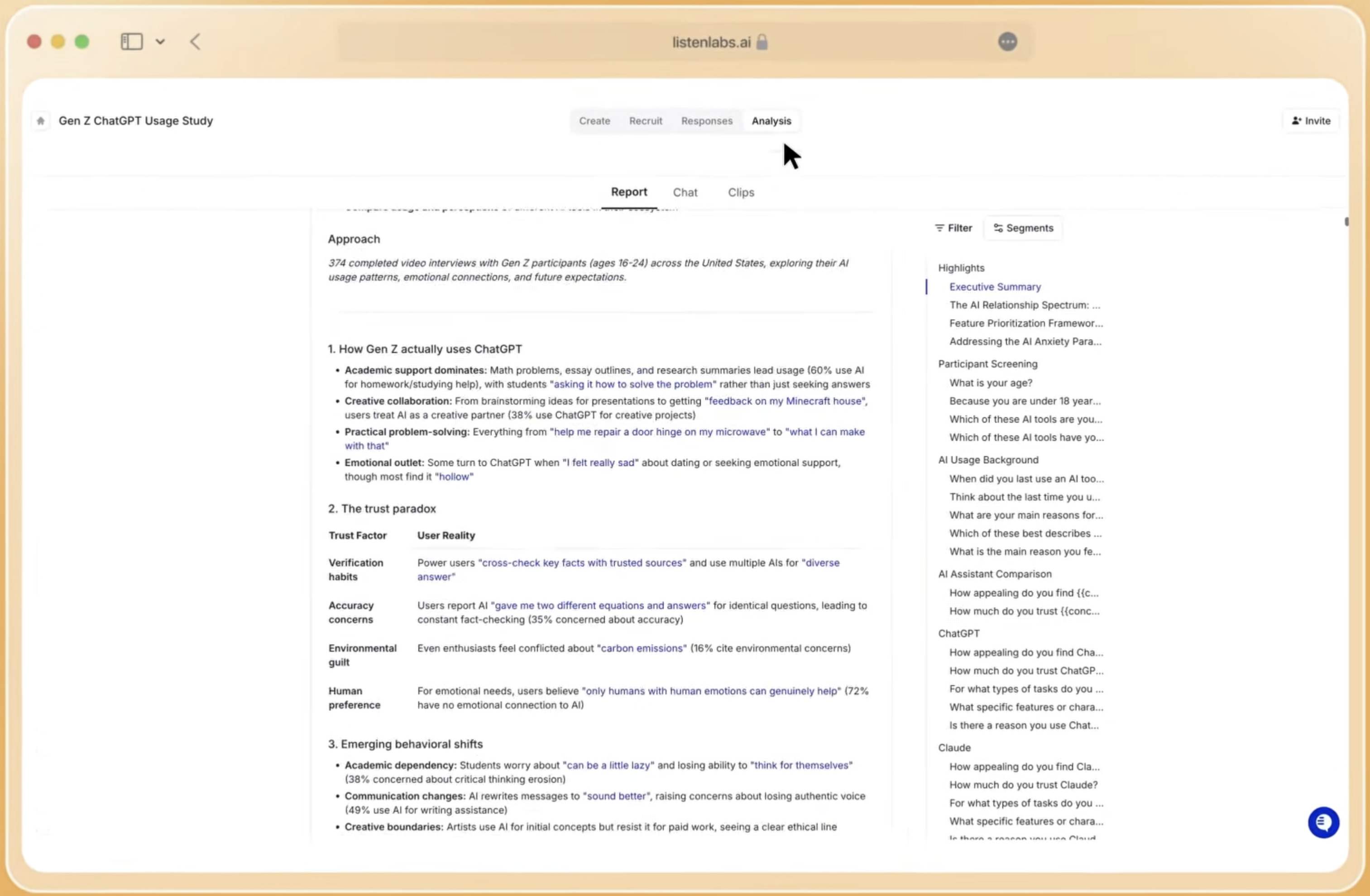
Listen Labs approach. Research Agent automates the full analysis workflow from raw data to final output. It generates key findings, themes, and personas from interview data. Chat-based analysis lets researchers ask questions in natural language and receive answers, charts, statistical tests, and segmentations. Research Agent also produces a slide deck in the company’s branded template and a downloadable report, along with video highlight reels, memos, and custom segmentation breakdowns, in under a minute.
Cross-Study Knowledge: Scattered Decks vs Mission Control
Traditional agency and point-solution approach. Research findings often live in scattered slide decks, agency folders, and individual memories. Organizations repeatedly commission studies on questions already answered because institutional knowledge remains hard to access when decisions are made.
Listen Labs approach. Mission Control serves as the single source of truth for everything learned from customers across all studies. Cross-study natural-language queries return answers from past research in seconds. Trend tracking monitors sentiment, needs, and pain points over time. Each new study compounds the knowledge base instead of adding to an archive that no one searches.
Enterprise Security and Compliance: Partial Coverage vs Full Certification Stack
Traditional agency and point-solution approach. SOC 2 Type II and ISO 27001 form the minimum compliance gates for enterprise procurement of AI research platforms, and vendors without both are often excluded before methodology is reviewed. Many point solutions and emerging AI tools hold only partial certification stacks, which slows procurement and increases legal risk for buyers.
Listen Labs approach. Listen Labs holds a complete enterprise certification stack that includes SOC 2 Type II, ISO 27001, ISO 27701, ISO 42001, and GDPR compliance. ISO 42001 defines requirements for AI management systems, including ethics, transparency, and continuous learning, which directly addresses enterprise AI governance concerns. Enterprise SSO and role-based access controls integrate with existing identity providers. Customer data is never used for AI model training, and 256-bit encryption protects data in transit and at rest. AI-moderated research generates biometric data classified as Special Category data under GDPR, and Listen Labs’ consent workflows satisfy those heightened obligations across jurisdictions.
Best-Fit Use Cases for Listen Labs
Consumer Insights teams at Fortune 500 enterprises manage growing backlogs with limited headcount. Listen Labs multiplies research output without proportional cost increases, compressing traditional four-to-six-week cycles to under 24 hours while preserving the methodological standards that internal and external stakeholders expect. Platforms like Listen Labs add auto-recruiting, transcription, sentiment tagging, and insight summarization so teams move from question to findings in hours.
UX research groups need faster feedback loops to match sprint cycles. Listen Labs supports screen sharing, usability testing, prototype evaluation, and concept testing with 50 to more than 100 participants instead of the five to ten that manual scheduling allows.
Product and marketing teams without dedicated researchers can describe goals in natural language and let the platform handle study design, recruitment, moderation, and analysis automatically, without formal methodology training.
Agencies and consultancies working under tight client deadlines benefit from global reach, niche audience sourcing, and sub-24-hour turnaround for engagements where weeks of traditional fieldwork are impossible.
Operational and Long-Term Impact of Adopting Listen Labs
Adopting an enterprise AI qualitative research platform requires change management beyond the technology choice itself. The most important shift involves moving research teams from logistics execution toward strategic synthesis. A hybrid human-AI workflow lets UX teams run three to four times more studies without losing interpretive quality by redirecting time from scheduling and first-pass coding to study design, anomaly investigation, and strategic synthesis. This reallocation of effort changes how teams plan roadmaps and support stakeholders.
Internal stakeholder alignment with legal, procurement, and IT also becomes easier when the platform arrives with a complete certification stack instead of requiring buyers to assemble a compliance case. Repeatability and scaling from one-off projects to continuous intelligence programs depend on infrastructure that gains value with every study. Mission Control provides that compounding effect by turning each project into reusable institutional knowledge.
Risks and Limitations of AI-Driven Qualitative Research
Shallow, rigid AI moderation that cannot adapt to participant responses produces transcripts that resemble survey open-ends, which are fast to collect but weak on insight. Slow manual workflows inside point-solution stacks erase the speed advantage of AI while keeping the fragmentation of traditional approaches. Hidden recruitment complexity, especially for sub-1% incidence audiences, can stall studies that looked simple at the design stage. Fraud risk in commodity panels persists even when moderation is AI-powered and requires purpose-built quality infrastructure.
Researchers still need to review AI-generated codebooks for missing codes, over-merged codes, and training biases. Faster tools therefore do not automatically produce better research unless human oversight sits inside the workflow.
Decision Framework and Practical Checklist
Teams should match their approach to the research goal, constraints, audience, and internal capabilities using a simple checklist. Studies that need adaptive follow-up and emotional signal capture call for conversational AI interviews, while highly structured work may fit a survey. Hard-to-reach audiences that sit outside general population panels require dedicated sourcing and orchestration. Enterprises with strict legal and procurement processes often need a single vendor that carries the full certification stack already described. Product and campaign deadlines may demand deliverables in hours rather than weeks, and long-term strategy often depends on querying findings against past studies months later. When most of these conditions apply, a full-lifecycle AI platform with enterprise-grade compliance becomes the practical choice.
See how Listen Labs aligns with your criteria. Book a demo and review your checklist live with the team.
Frequently Asked Questions
How long does it actually take to get results with an enterprise AI qualitative research platform?
Listen Labs compresses the full research lifecycle, including study design, recruitment, moderation, analysis, and deliverable generation, to under 24 hours for most studies. A Microsoft team collected global customer video stories for the company’s 50th anniversary within a single day. Anthropic’s Claude Code team received more than 300 user interviews surfacing churn drivers within 48 hours. Traditional qualitative research cycles often run four to six weeks from brief to final report, and in large enterprises with internal queues, timelines can stretch to six months. The 24-hour benchmark reflects the standard operating model rather than a rare best case.
How does Listen Labs prevent fraudulent or low-quality participants from entering a study?
Quality Guard applies real-time multimodal monitoring across video, voice, content, and device signals during every interview, instead of relying on checks after data collection. Listen Labs works only with high-quality, non-commodity panel sources and caps each participant at three studies per month to prevent professional survey-taking. Listen Atlas matches participants on behavioral and intent data rather than only self-reported demographics. A dedicated recruitment operations team adds human review for hard-to-reach segments. Together, these elements support a zero-fraud guarantee backed by a reputation scoring flywheel that strengthens as the platform scales.
What security certifications does Listen Labs hold, and how do they address enterprise procurement requirements?
Listen Labs holds SOC 2 Type II, ISO 27001, ISO 27701, ISO 42001, and GDPR certifications. SOC 2 Type II confirms independently tested security controls over time. ISO 27001 requires a certified information security management system with ongoing audits, and ISO 27701 extends that system to privacy information management. ISO 42001 governs AI management systems and covers ethics, transparency, and continuous improvement, which are central to AI governance reviews. GDPR compliance addresses the heightened obligations associated with biometric data such as voice recordings and video footage, which qualify as Special Category data under European law. Enterprise SSO, role-based access controls, 256-bit encryption, and a policy that excludes customer data from AI model training complete the security posture.
Can Listen Labs reach niche or low-incidence audiences that traditional panels cannot source?
Yes. The recruitment operations team partners with niche communities, micro-creators, and specialized networks to source audiences below a 1% incidence rate, including enterprise decision-makers, engineers, healthcare workers, and highly specialized consumer segments. Listen Atlas orchestrates across multiple consumer and B2B panel partners, including NewtonX for B2B audiences, alongside Listen Labs’ proprietary respondent database. Organizations can also bring their own participants or panel providers and plug them into the same moderation and analysis workflow.
What deliverables does Listen Labs produce, and how are they generated?
Research Agent automatically generates consultant-quality PowerPoint slide decks in the company’s branded template, memo-style reports, video highlight reels, statistical charts and comparisons, and segmentation breakdowns by demographics or custom cohorts. It also answers natural-language questions about the data. Every insight links back to the underlying participant response, timestamp, and verbatim quote, which keeps findings traceable for stakeholder review. Deliverables are available in under a minute after analysis completes. Mission Control then stores all findings in a queryable knowledge base so past studies remain available for cross-study analysis.
Conclusion: Why End-to-End AI Platforms Win for Enterprise Qualitative
The evaluation criteria that matter to Fortune 500 consumer insights and UX leaders, including cycle time, depth at scale, participant quality, methodological rigor, security posture, global reach, finding transparency, total cost of ownership, and institutional knowledge retention, all point toward end-to-end AI qualitative research platforms. Within that category, Listen Labs stands out as the only platform that combines sub-24-hour cycles with a complete enterprise certification stack, a large verified global respondent network, and integrated deliverable and knowledge management capabilities in one system. Listen Labs raised $69 million in a Series B funding round led by Ribbit Capital, reaching a valuation above $500 million, with enterprise clients such as Microsoft, Google, Sony, Anthropic, Procter & Gamble, Skims, Levi’s, and Nestlé validating performance at global scale. Traditional agencies and point-solution stacks still force trade-offs between speed and depth, scale and quality, and capability and compliance. Listen Labs removes those trade-offs by unifying the full lifecycle in a single enterprise-ready platform.
Evaluate Listen Labs against your nine criteria in a live session. Book a demo with the Listen Labs team today.