Written by: Anish Rao, Head of Growth, Listen Labs | Last updated: June 30, 2026
Key Takeaways for Product Teams
- AI research tools for product managers automate the qualitative research lifecycle, from study design to synthesized deliverables, cutting timelines from weeks to hours.
- The four-step workflow of AI-assisted study design, participant sourcing with quality control, AI-moderated interviewing with emotional intelligence, and automated analysis removes fragmentation and supports research at scale.
- Emotional Intelligence capabilities analyze tone, word choice, and micro-expressions across 50+ languages to surface insights participants never verbalize, improving creative, concept, and usability testing.
- Enterprise results from Microsoft, Anthropic, P&G, Skims, and Robinhood show 3–5x faster research cycles with statistically robust samples and traceable, board-ready outputs.
- Listen Labs delivers this end-to-end platform; book a demo to see the full workflow running live on your research objectives.
AI Research Workflow for Product Managers
Now explore how this workflow operates in practice. The AI research workflow for product managers follows four sequential steps that mirror the traditional research lifecycle while removing its bottlenecks. Step 1 covers AI-assisted study design. Step 2 addresses participant sourcing and quality control. Step 3 executes AI-moderated interviewing with emotional intelligence. Step 4 delivers automated analysis and stakeholder-ready outputs.
Each step feeds directly into the next on a single platform, which removes the fragmentation that forces teams to stitch together separate recruitment, moderation, transcription, and analysis tools. With qual-at-scale, the old trade-off between depth and scale is no longer a barrier, so this workflow becomes the practical standard for qualitative research for PMs in 2026.
Step 1: Study Design with AI-Assisted Customer Interview Tools for Product Teams
Study design starts with a natural-language prompt. A product manager describes research goals in plain language, and the platform drafts structured objectives, interview questions, and probing context in seconds. Templates cover concept testing, usability studies, brand perception, creative testing, pricing research, and consumer journey mapping, among others.
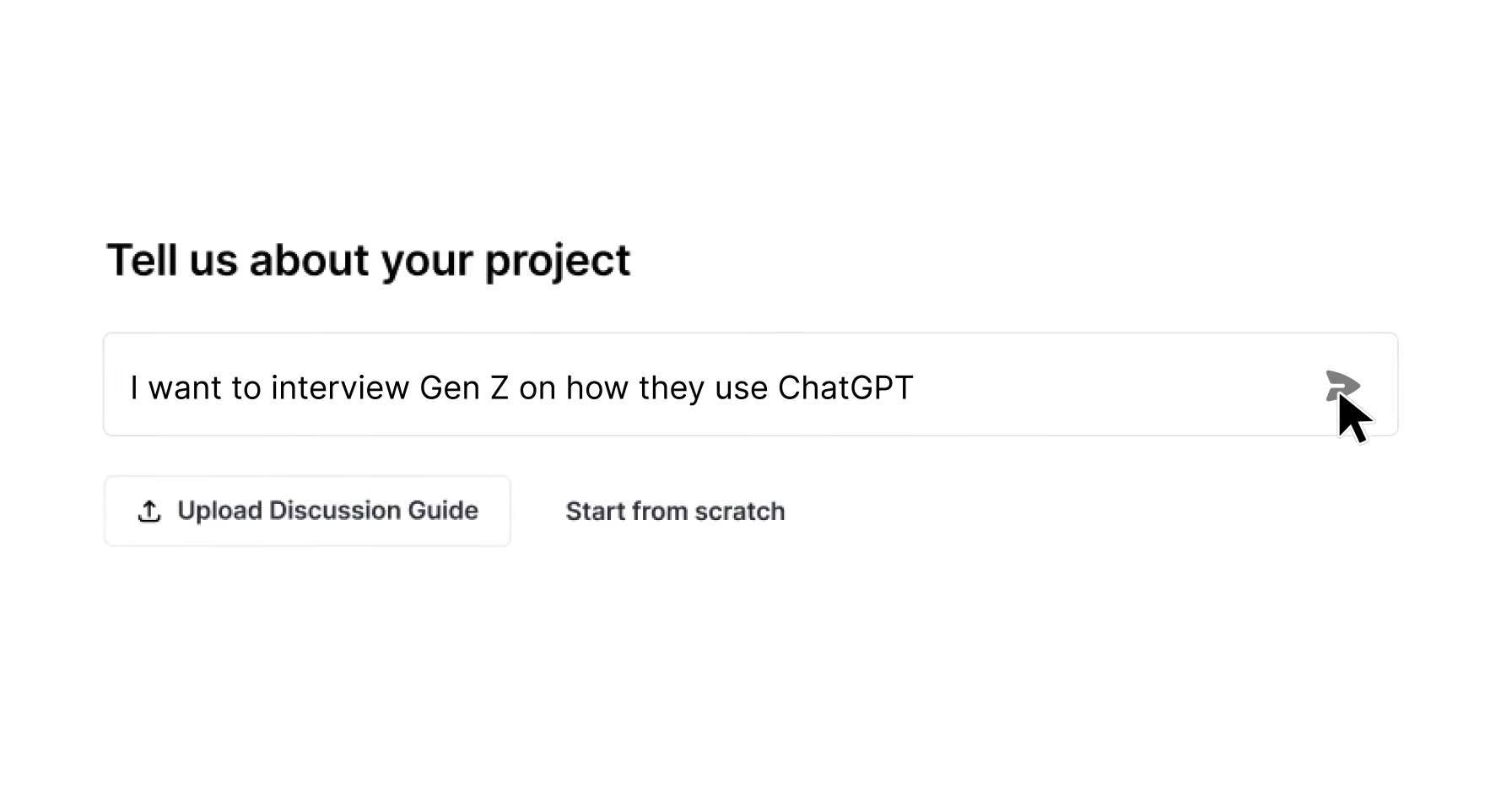
These templates support advanced stimuli including images, video, audio, PDFs, live URLs, and interactive prototypes, so product teams test with the same assets they plan to ship. To handle complex research designs, logic controls such as branching, skip logic, quotas, monadic or sequential randomization, and piping are configured without engineering support. Before launch, an auto-QA layer flags ambiguous questions, leading language, and structural issues, which prevents design errors that can invalidate data downstream.
Step 2: Participant Sourcing and Quality Control for Global Qualitative Research
Participant sourcing runs through Listen Atlas, an AI orchestration layer that matches and bids across a global network of 30 million verified respondents spanning 45+ countries and 100+ languages. Matching uses behavioral and intent data rather than self-reported demographics alone, which produces samples that reflect actual consumer behavior. Quality Guard monitors every session in real time across video, voice, content, and device signals to detect fraud, AI-generated scripts, low-effort responses, and mismatched profiles.
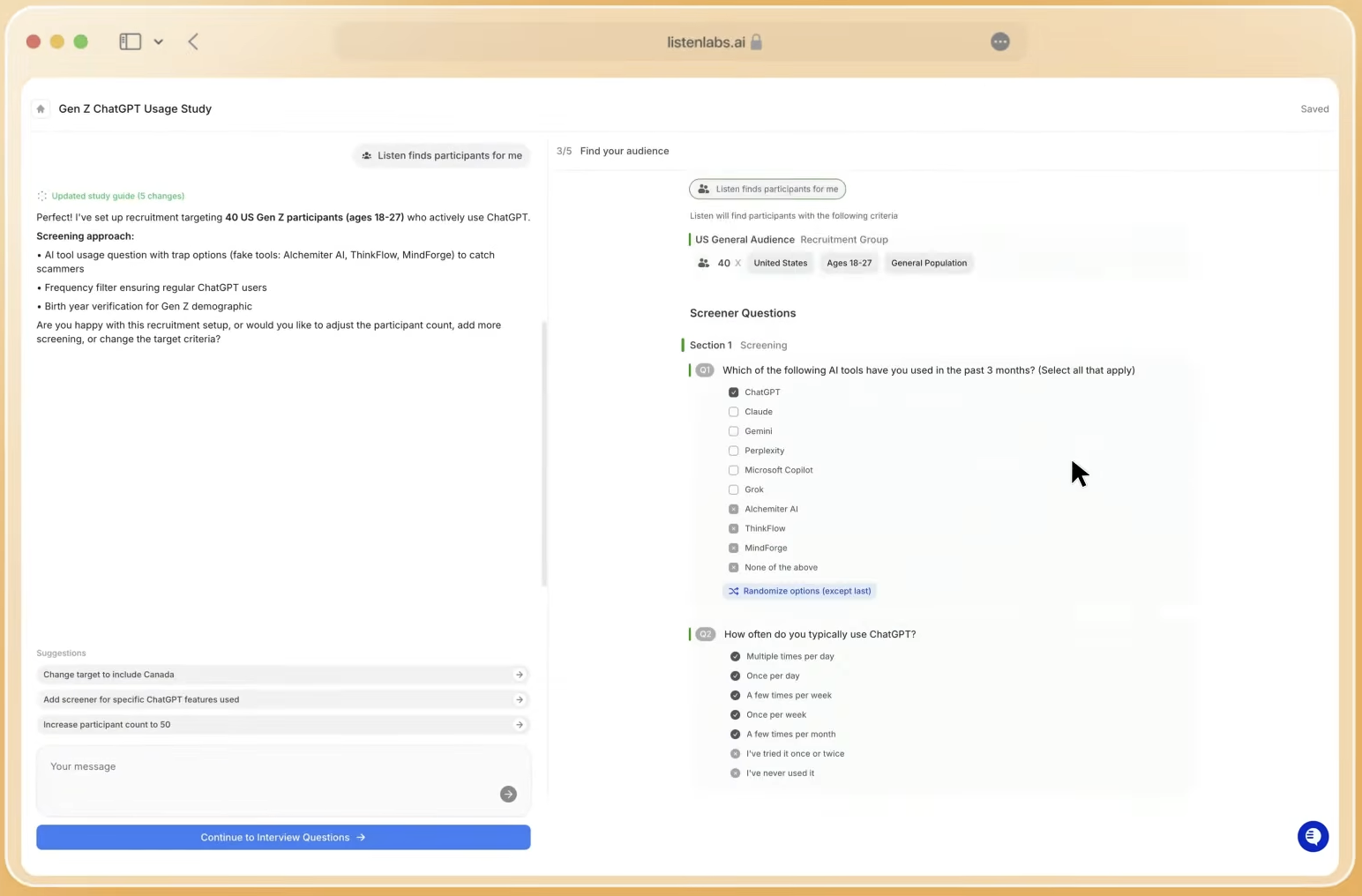
Participants are capped at three studies per month, which removes professional survey-takers and reduces panel fatigue. A dedicated recruitment operations team handles hard-to-reach segments such as enterprise decision-makers, healthcare workers, engineers, and audiences below 1% incidence rate, adding a human review layer that commodity panels cannot match. Organizations can also self-recruit from their own user base at reduced cost, keeping strategic audiences in-house while still benefiting from automated quality controls.
Step 3: AI-Moderated Interviewing with Emotional Intelligence
The AI interviewer runs personalized video conversations with dynamic follow-up questions and probes deeper on short or unexpected answers the same way a trained human moderator would. As noted earlier, participant comfort in AI-moderated sessions matches human-moderated levels, which means response quality holds steady even as interview volume increases.
Emotional Intelligence captures what transcripts alone miss by analyzing three signal layers: tone of voice, word choice, and subconscious micro expressions. The framework is built on Ekman's universal emotions model, the same standard used in clinical psychology and UX research, tracking anger, anticipation, disgust, fear, joy, sadness, trust, and surprise. Every emotion is quantified per question and concept, with each label traceable to the exact timestamp, verbatim quote, and AI reasoning behind it.
Product teams apply this capability to creative testing to pinpoint where audiences disengage. They use it for concept comparison to surface confusion across stimuli and markets. They rely on it for usability testing to catch hesitation and frustration that participants never verbalize. Emotional Intelligence is available across 50+ languages and connects directly to the Research Agent for natural-language queries and highlight reels of emotionally significant moments.
Step 4: Automated Analysis and Deliverables for Stakeholders
Once interviews close, the Research Agent handles the full analysis workflow from raw data to final output. It generates automated key findings, thematic clusters, personas, and segmentation breakdowns. Chat-based analysis accepts natural-language questions and returns answers, charts, statistical significance tests, and cohort comparisons.
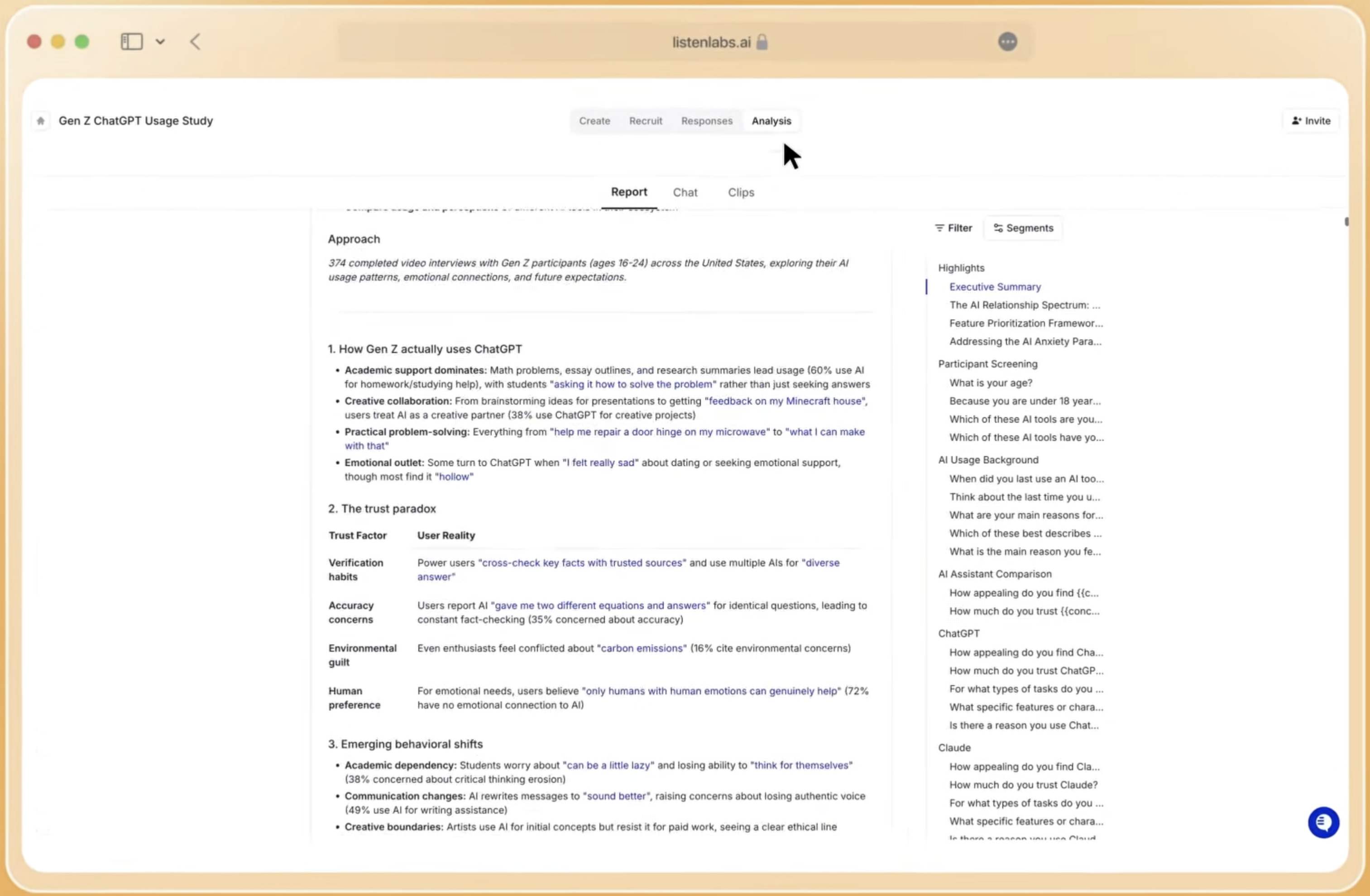
One researcher ran a full buying intent analysis across three user segments in under a minute. The Research Agent generates a slide deck in a company's branded template and a downloadable report, alongside video highlight reels and memo-style summaries. Every insight links directly to the underlying response data, which maintains the traceability that enterprise stakeholders expect.
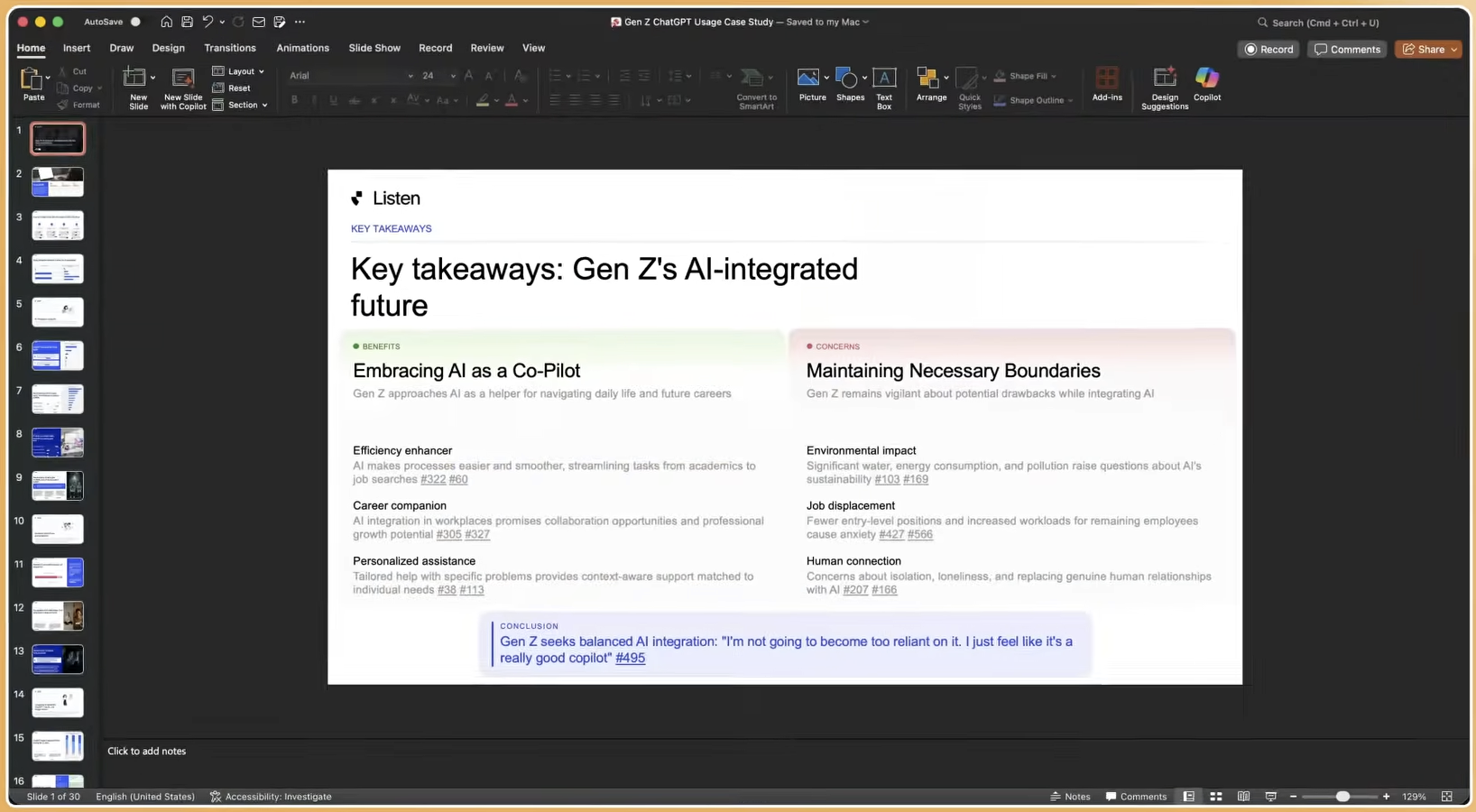
All outputs feed into Mission Control, a persistent knowledge base that supports cross-study queries and trend tracking so teams stop re-researching questions already answered in prior studies.
Enterprise Proof Points: 2026 Results with Listen Labs
Listen Labs has conducted over one million AI-powered customer interviews for companies including Microsoft, Perplexity, and Sweetgreen. Microsoft's Director of Data Science collected global user video stories for the company's 50th anniversary within a single day, reaching hundreds of users at one-third the cost of traditional methods. Anthropic's Director of Product Strategy surfaced Claude churn drivers through 300+ user interviews in 48 hours, five times faster than prior approaches, and received a prioritized list of ten must-fix items alongside a mapped view of where former users migrated.
Procter & Gamble completed 250+ interviews with quantified themes and verbatim proof in hours, identified where product claims felt exaggerated before they reached market, and confirmed that comfort, safety, and reliability outweigh novelty in purchase decisions. Skims validated campaign direction with thousands of high-income buyers overnight, removed weeks of panel sourcing, and secured board-level buy-in with qualitative clarity. Robinhood's qualitative interviews revealed that users who view prediction markets as entertainment rather than income drive 2.4x higher weekly re-engagement, and integration flows boosted uptake 30–40%, delivered five times faster than the team's previous research cycle.
Frequently Asked Questions
Does AI-moderated research produce data quality comparable to human-led interviews?
For the vast majority of product research objectives, AI-moderated interviews deliver quality comparable to human-led sessions. Listen Labs maintains the same methodological rigor as an experienced in-house research team. The platform's in-house researchers, with over 50 years of combined expertise, continuously review and refine the interview methodology.
Participant comfort levels in AI sessions match those in human sessions, and the adaptive follow-up logic probes unexpected answers the same way a trained moderator would. The primary difference is speed and scale, because the AI conducts hundreds of simultaneous interviews without the scheduling, no-show, and consistency issues that affect human moderation.
How does Listen Labs prevent fraudulent or low-quality participants?
Three independent layers address fraud and quality. First, Listen Labs sources exclusively from high-quality, non-commodity panels, so professional survey-takers are excluded. Second, Quality Guard applies real-time AI monitoring across video, voice, content, and device signals to detect fraud, AI-generated scripts, low-effort responses, and profile mismatches during every session.
Third, a dedicated recruitment operations team adds human review, and participants are limited to three studies per month to reduce panel fatigue and incentive-driven behavior. Behavioral and intent matching further ensures that participants reflect actual consumer behavior rather than only self-reported demographics.
What security and compliance certifications does Listen Labs hold?
Listen Labs holds SOC 2 Type II, GDPR, ISO 27001, ISO 27701, and ISO 42001 certifications. The platform uses 256-bit encryption, and customer data is never used for AI model training. Enterprise SSO is supported. These certifications cover information security management, privacy information management, and AI management systems, which meets the compliance requirements of Fortune 500 procurement and legal teams across the Americas, Europe, APAC, and MEA.
Will Listen Labs replace the existing research team?
Listen Labs acts as a force multiplier for existing research teams, not a replacement. The platform removes logistics such as recruiting, scheduling, moderating, transcribing, and manually coding, so researchers focus on strategic interpretation and stakeholder influence. Teams that previously ran a limited number of studies per quarter because of backlog constraints can multiply their output with the same headcount.
For product managers and marketing leaders without a dedicated research function, the platform handles study design, recruitment, moderation, and analysis automatically, which removes the methodology expertise barrier entirely.
What study types does the platform support?
Listen Labs supports concept and prototype testing, usability testing with screen sharing and mobile screen recording, creative testing, brand perception studies, consumer journey mapping, multi-market segmentation and localization studies, ad testing, pricing research, and survey open-end analysis. Studies can combine qualitative interview questions with quantitative formats including Likert scales, NPS, sliders, grids, and MaxDiff. The platform supports both one-off studies and continuous customer intelligence programs running across 100+ languages.
Conclusion: Start Scaling Customer Research This Quarter
The four-step AI research workflow of study design, participant sourcing and quality control, AI-moderated interviewing with emotional intelligence, and automated analysis and deliverables compresses a process that traditionally takes 4–6 weeks into less than 24 hours. Platforms like Listen Labs layer on auto-recruiting, transcription, sentiment tagging, and insight summarization so teams jump from question to findings in hours, not weeks. The result is qualitative research that delivers the statistical confidence of large samples alongside the emotional depth of one-on-one interviews, without hiring a research team or stitching together fragmented tools.
Product managers and marketing leaders at mid-to-large companies can run their first study this week. Book a demo to start a pilot and see consultant-quality deliverables from your own customer interviews in under 24 hours.