
Written by: Anish Rao, Head of Growth, Listen Labs
Key Takeaways
- Traditional telecom qualitative studies take 4–6 weeks and cost $104,000–$208,000, while AI-moderated studies of the same scale deliver results in 2–7 days for $2,000–$11,000.
- The six-step workflow covers objective definition, adaptive interview design, verified participant sourcing, AI-moderated video interviews, multimodal emotional analysis, and instant stakeholder deliverables.
- Listen Labs’ Emotional Intelligence feature captures tone, word choice, and micro-expressions to surface emotions that transcripts alone miss, which is critical for pricing and churn research.
- Quality Guard and Listen Atlas ensure participant authenticity through behavioral matching, real-time fraud detection, and frequency caps, eliminating low-quality responses at scale.
- Listen Labs enables telecom teams to run hundreds of AI-moderated interviews and receive consultant-quality deliverables in under 24 hours—Book a demo.
Prerequisites and Context for Telecom Qual Research at Scale
Shared vocabulary keeps the workflow focused and prevents scope drift. Qualitative research captures the “why” behind behavior through open-ended conversation, while quantitative research measures the “how many” through structured, closed-ended instruments. A sample frame defines the population eligible for a study, such as postpaid mobile subscribers on unlimited plans in the US, UK, and Germany. Incidence rate is the share of the general population that qualifies; telecom churn studies targeting recent switchers often run below 15% incidence, which raises recruitment cost and time in traditional models. A panel is a pre-recruited pool of respondents, and a screener filters that pool to the target profile. Moderation is the act of guiding an interview through questions and follow-ups. Analysis frameworks, including thematic coding, sentiment scoring, and emotional tagging, convert raw transcripts into structured insight.
With the vocabulary established, the next step is understanding why this workflow matters now. Two macro shifts make this workflow timely. First, with qual-at-scale, the old trade-off between depth and scale is no longer a barrier. Second, many consumers feel low loyalty to their telecom providers with notable churn rates, which drives demand for continuous qualitative intelligence rather than one-off annual studies.
Step 1: Define the Research Objective and Success Metrics
Clear objectives keep the study focused and make findings actionable. Every study begins with a single, testable objective. A well-formed objective names the decision it will inform, the audience it covers, and the timeframe for action.
Consider a concrete 2026 example. A Tier-1 carrier is evaluating an unlimited-plan concept that bundles 5G home internet, mobile, and a streaming add-on at a flat monthly price. The research objective is to understand which plan elements drive perceived value versus which trigger price resistance among postpaid subscribers in the US, UK, and Germany. The pricing team then uses these findings to finalize the launch price before a Q3 board review.
Success metrics for this study include theme saturation across three regional segments, a ranked list of value drivers and friction points, and emotional response scores per plan element. Only 54% of customers see telco services as good value for money even as ARPU declines, so emotional resonance, not just stated preference, becomes a critical output metric.
The main design decision is depth versus scale. For a concept test across three regions, a limited number of interviews per segment provides segment-level analytical confidence. 5-8 interviews per segment is typically recommended for segment-level qualitative analysis such as comparing customer personas or plan tiers.
Step 2: Design the Interview Guide with Adaptive Logic
Guide design must encode probing and branching rules clearly so the AI moderator can behave like a skilled human interviewer. An AI-moderated interview guide differs from a traditional discussion guide in one critical way: it must encode probing logic explicitly, because the AI moderator executes branching and follow-up based on the instructions embedded in the guide rather than on real-time human judgment.
Effective guide design for the unlimited-plan concept test balances structured stimulus exposure with adaptive probing to capture both rational evaluation and emotional response. The guide includes:
- A warm-up section establishing current plan satisfaction and switching history
- Unprompted reaction to the concept before showing pricing
- Structured stimulus exposure with monadic randomization across three price points
- Explicit probe instructions that request 2–3 follow-ups per main question targeting specific examples and emotional reactions
- Branching logic that routes recent switchers to a churn-driver module
- A closing NPS-style quantitative item for mixed-method output
AI-moderated interviews produce participant responses 2.5 to 8 times longer than equivalent static surveys due to dynamic dialogue. Keep the guide concise, use literal phrasing that avoids ambiguity, and include only one concept per question to maintain consistent coding across 150+ sessions.
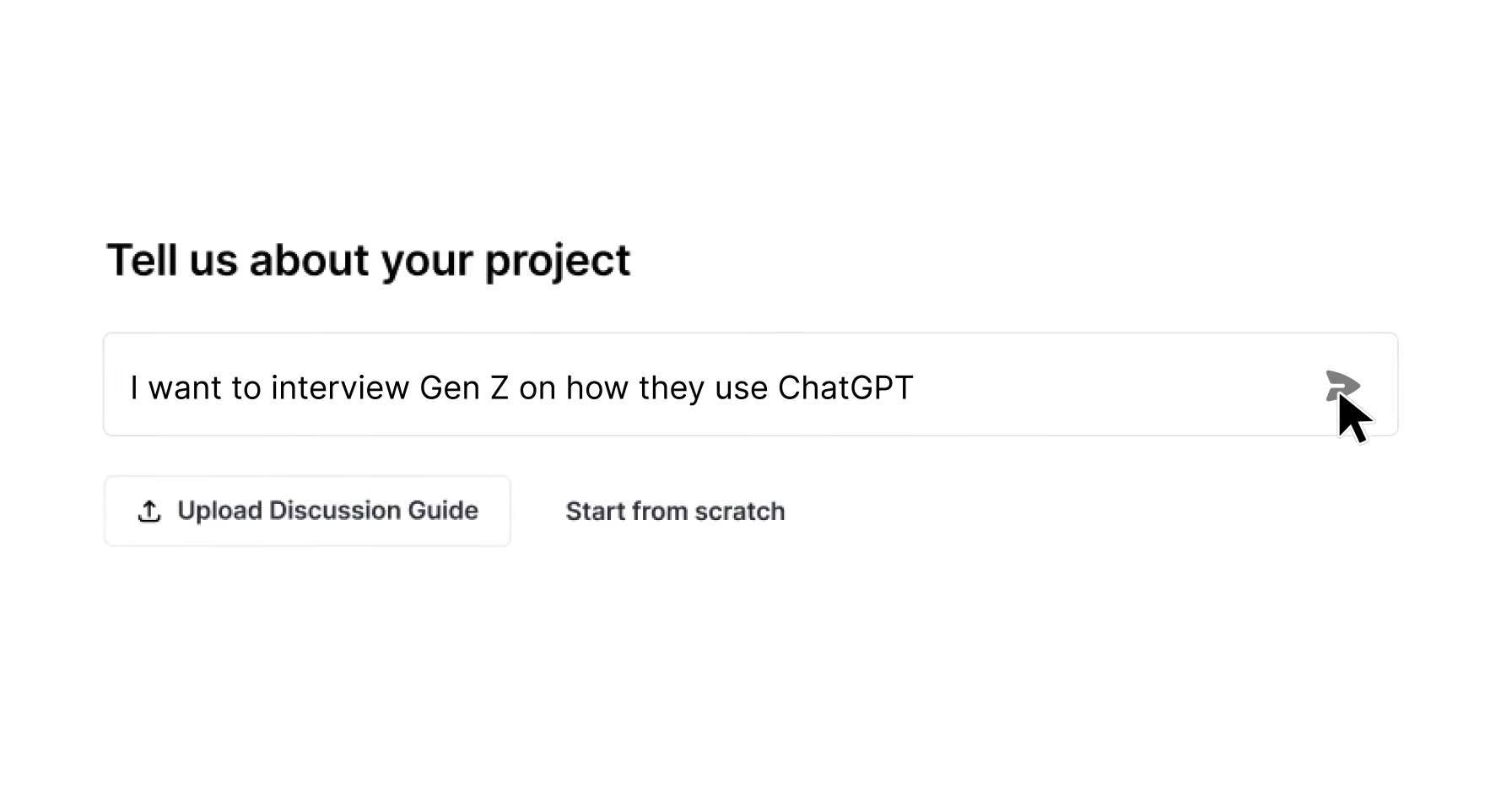
Listen Labs’ AI-assisted study co-design drafts structured objectives, questions, and probing context from a natural-language brief in seconds, and Auto-QA flags guide issues before launch.
Step 3: Source and Screen Participants from a High-Quality Global Pool
High-quality participants protect the study from wasted sessions and unreliable findings. Participant quality is the single largest risk factor in scaled AI-moderated research. The most expensive mistake in AI interview research is running 50 sessions and discarding 30 because participants were unverified or off-profile.
For the unlimited-plan concept test, the screener targets postpaid mobile subscribers aged 25–54 who are the primary decision-maker for their household’s mobile plan, have considered switching carriers in the past 12 months, and reside in the US, UK, or Germany. This profile carries an estimated incidence rate below 20%, which traditional recruitment handles poorly.
Listen Labs’ Listen Atlas panel of 30M+ verified respondents across 45+ countries handles this profile through an AI orchestration layer that matches and bids across multiple panel partners and a proprietary database. Quality Guard adds three enforcement layers that work together to eliminate fraud and low-effort responses before they contaminate the dataset:
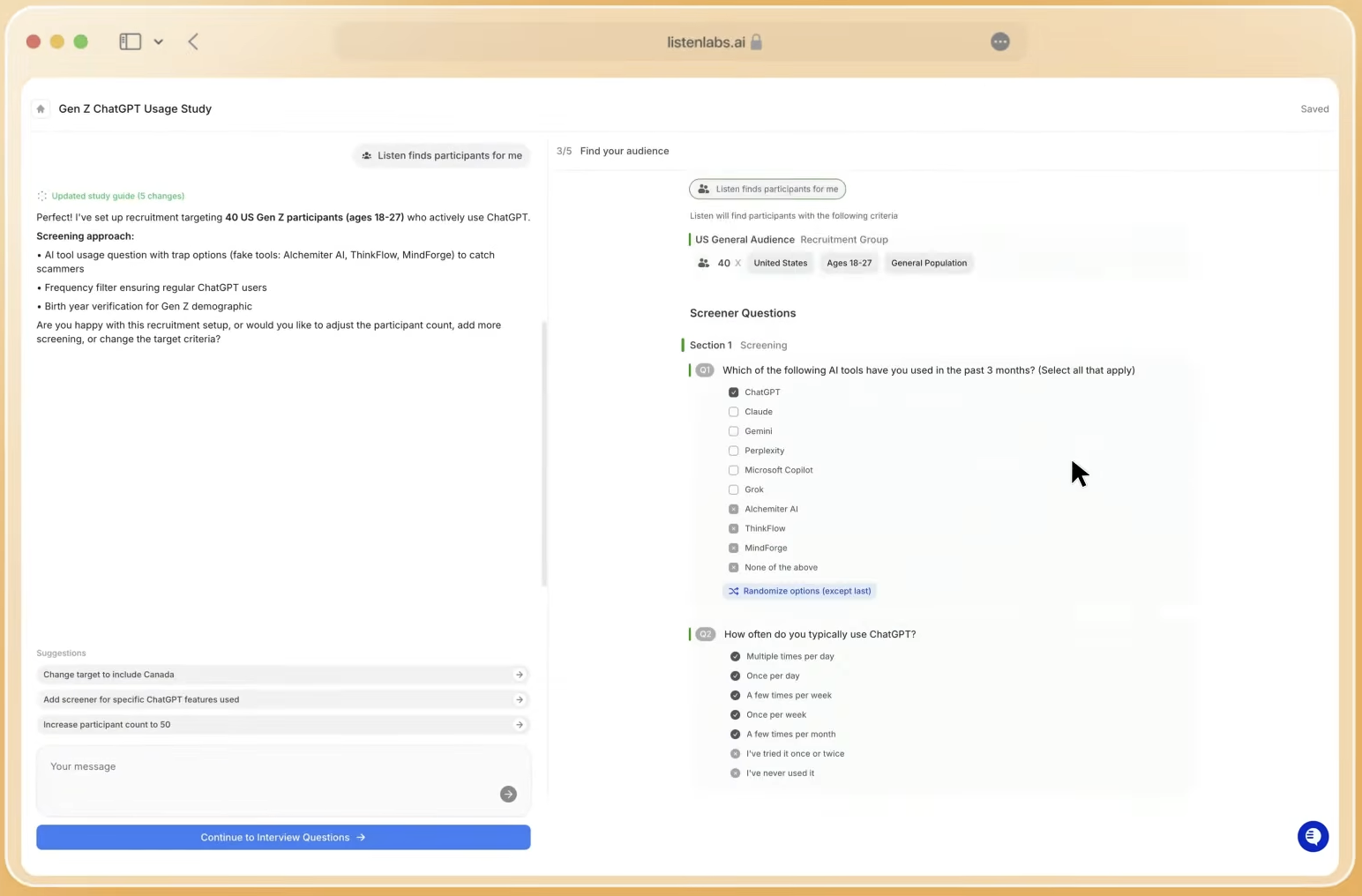
- Behavioral matching on intent and past actions, not just self-reported demographics
- Real-time AI monitoring across video, voice, content, and device signals to detect fraud and low-effort responses
- A participant frequency cap of three studies per month, eliminating professional survey-takers
Beyond quality controls, recruitment velocity depends on participant motivation. Incentives can significantly raise completion rates for online interviews, supporting scalable async recruitment while maintaining the sample quality that Quality Guard enforces.
See how Listen Atlas sources verified telecom subscribers across 45+ countries in under 24 hours
Step 4: Conduct AI-Moderated Video Interviews with Dynamic Follow-Ups
Once participants are recruited and screened, the workflow shifts from setup to conversation. The AI moderator conducts personalized video interviews in parallel, and all 150 sessions can run simultaneously with no scheduling bottleneck. Platforms like Listen Labs layer on auto-recruiting, transcription, sentiment tagging, and insight summarization so teams jump from question to findings in hours, not weeks.
The AI moderator probes deeper on short or vague answers, follows up on specific mentions such as a competitor’s name or a pricing objection, and stays on-topic during tangents. These behaviors mirror what a trained human interviewer would do. Across 500+ hours of benchmarked sessions, AI conversations averaged 3.2x more probe-driven follow-ups than scripted human-moderated equivalents.
Teams should validate this behavior before scaling. Before running the full 150 sessions, run a pilot of 10–20 sessions and manually review every transcript. A practical 2026 playbook recommends starting with a pilot of 10–20 sessions, manually reviewing every transcript to identify where the AI probes effectively versus where it misses nuance, and measuring completion rates with a target of 80%+ before expanding recruitment.
Listen Labs supports video, audio, text, and screen recordings across 100+ languages, with built-in localization and translation. This capability enables the US, UK, and Germany segments to run in a single coordinated fielding wave.
Step 5: Analyze Transcripts, Tone, and Micro-Expressions for Themes and Emotion
Analysis becomes the main bottleneck once interviews complete, especially at scale. Traditional analysis of 150 qualitative transcripts requires weeks of manual coding. With AI-moderated interviews, talking to users at scale is no longer the hard part. The challenge is understanding what they mean.
Listen Labs’ Research Agent processes all interview data objectively, identifying patterns and themes across all responses without human confirmation bias. For the unlimited-plan concept test, the analysis engine surfaces outputs that move directly into pricing and product decisions:
- Ranked value drivers and friction points per region
- Segment-level differences between recent switchers and loyal subscribers
- Emotional response scores per plan element, quantified by question
- Verbatim quotes linked to timestamps for stakeholder evidence
Listen Labs’ Emotional Intelligence feature adds a multimodal layer. It analyzes tone of voice, word choice, and subconscious micro-expressions to surface emotions that transcripts alone miss. Built on Ekman’s universal emotions framework, the same standard used in clinical psychology, it tracks anger, anticipation, disgust, fear, joy, sadness, trust, and surprise. Every emotion label is traceable to the exact timestamp, verbatim quote, and reasoning behind it. For a concept test where two price points may receive identical stated ratings but very different emotional responses, this distinction is decision-critical.
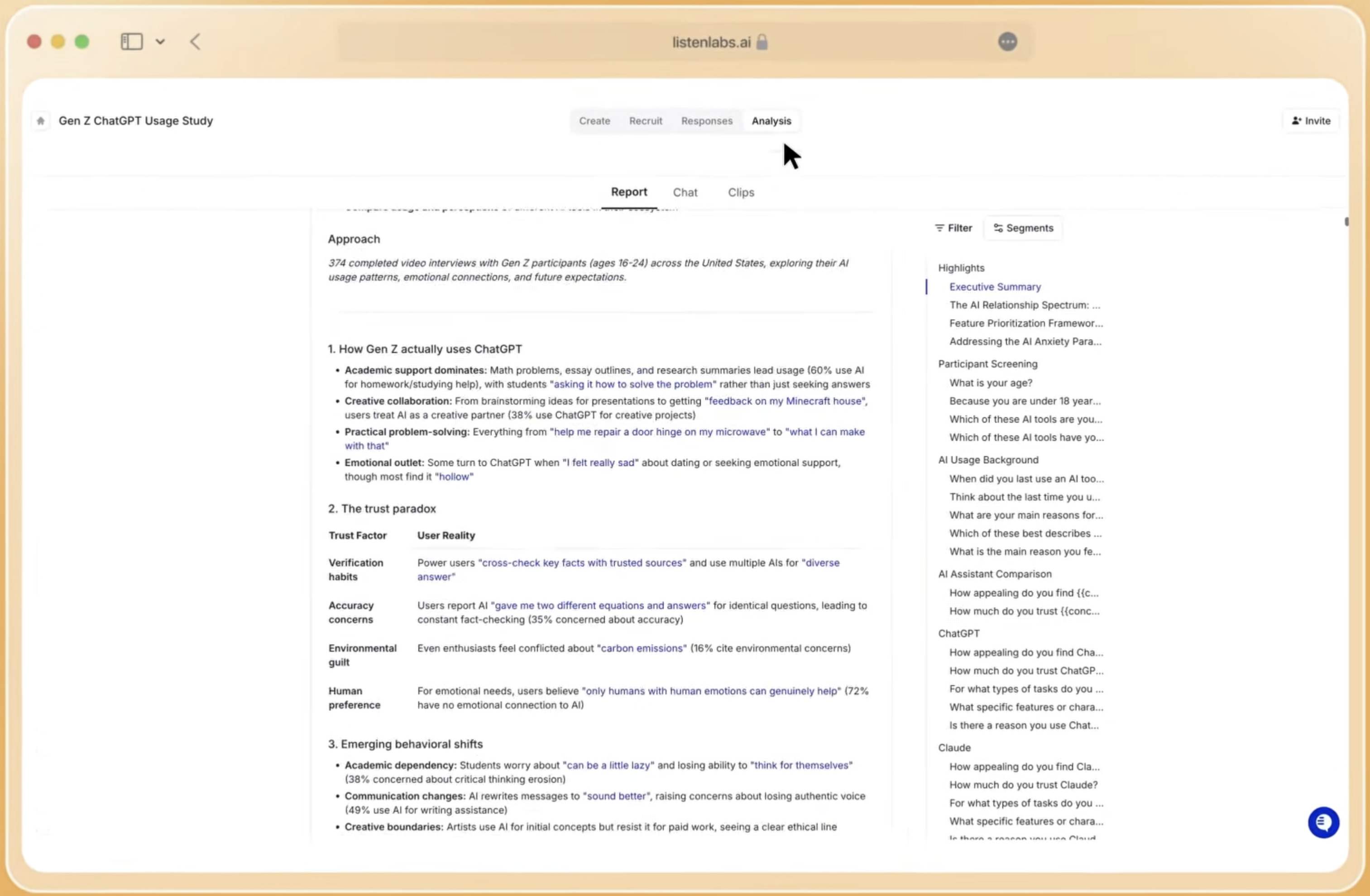
One researcher ran a full buying intent analysis across three user segments in under a minute using the Research Agent’s chat-based interface.
Step 6: Generate and Socialize Deliverables That Drive Decisions
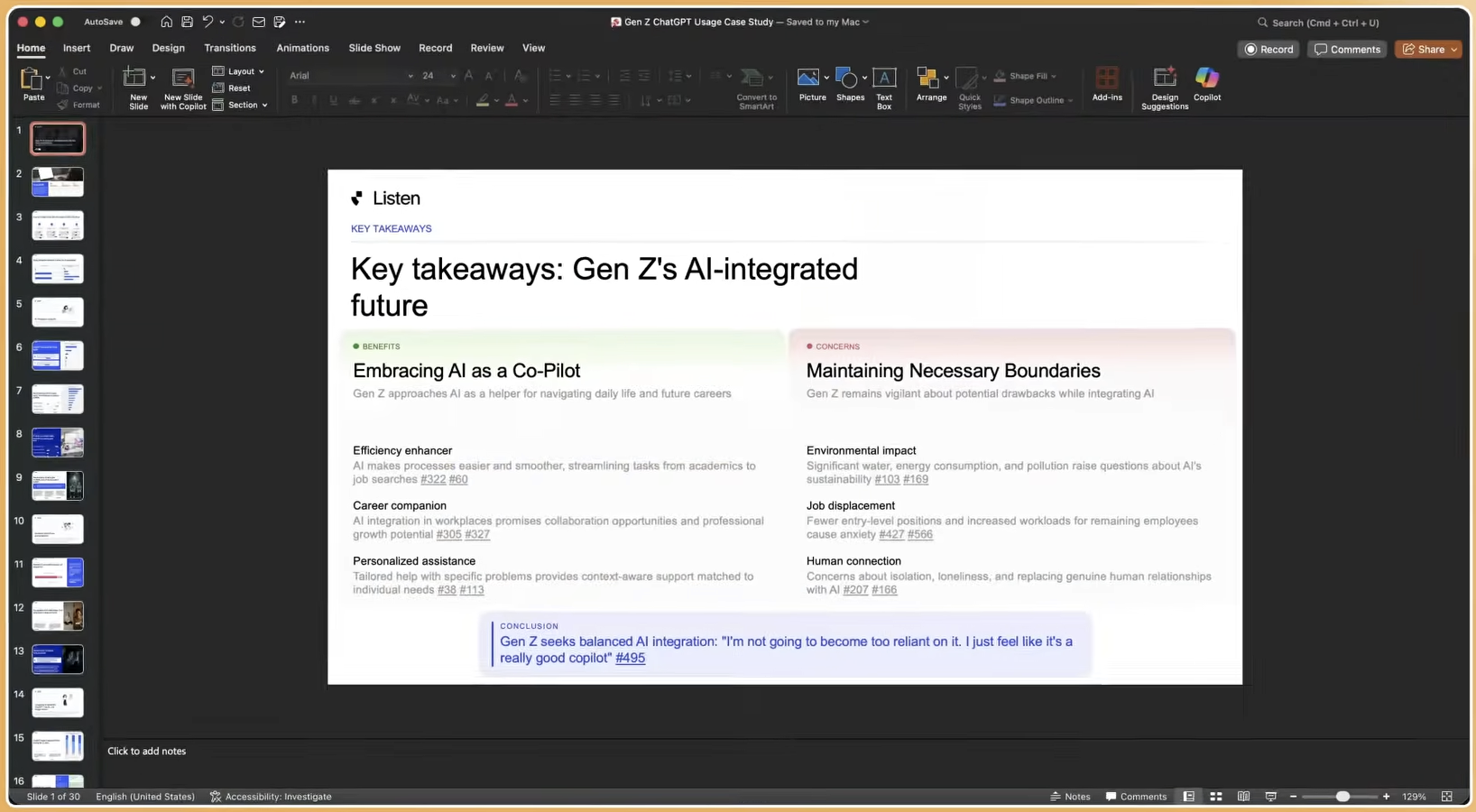
Insights only create value when stakeholders see and use them. The Research Agent generates consultant-quality deliverables in under a minute, including slide decks, memo-style reports, video highlight reels, statistical charts, segmentation breakdowns, and custom reports based on any natural-language query.
For the unlimited-plan concept test, the standard deliverable package includes a regional comparison deck, a prioritized list of “must-fix” friction points by segment, emotionally significant video clips from interviews, and a stat-tested ranking of plan elements by perceived value. Mission Control stores all outputs as a permanent, queryable knowledge base. When the pricing team revisits the question six months later, they retrieve prior findings in seconds rather than re-running the study.
Request sample deliverables from a live telecom concept test
Frameworks and Telecom Use Cases for AI-Moderated Research
The research funnel for telecom consumer insights typically moves from broad discovery, such as why subscribers consider switching, to focused evaluation, such as which plan elements resolve the switching trigger, and then to validation, such as whether the proposed solution tests positively across segments. AI-moderated interviews operate effectively at all three levels, though the guide design and sample size differ by stage.
Mixed-methods designs combine qualitative interview questions with quantitative formats such as Likert scales, NPS, and MaxDiff within a single session. This approach removes the sequential handoff between a qual phase and a quant phase that traditionally adds 2–3 weeks to a study cycle.
Quota sampling ensures proportional representation across segments. For a three-region telecom study, quotas by country, plan type such as prepaid versus postpaid, and switching recency prevent any single segment from dominating the findings.
Two 2026 telecom examples illustrate the insight-to-action workflow:
- Churn diagnostics: Flanker brands account for a growing share of revenues and subscribers for major Canadian carriers as operators use them to retain price-sensitive segments. An AI-moderated churn study across 200 recent switchers can identify which flanker positioning elements reduce switching intent, delivered in 48 hours rather than six weeks.
- 5G adoption: 5G global subscriptions passed 3 billion after adding 162 million subscriptions in Q1 2026, yet adoption barriers remain behavioral as much as technical. AI-moderated interviews surface the specific use-case narratives that convert awareness into upgrade intent at the scale needed for regional segmentation.
Common Challenges and Troubleshooting Patterns
Scaled AI-moderated telecom research tends to fail in predictable ways, and each pattern has early signals and clear mitigations. Recognizing these patterns early keeps studies on track.
Unclear objectives produce unfocused guides and unactionable findings. The early signal is a brief that names a topic such as “understand churn” without naming a decision. The mitigation is requiring the brief to answer what will change if the finding is X versus Y.
Poor recruitment fit yields off-profile transcripts. Researchers should confirm screener-to-interview consistency by checking whether a participant’s described role, tools, and experience level in the interview match what was provided in the screener; a failure rate above 5% indicates a need to revisit screener design.
Low response quality appears as short completions and surface-level answers. Completion times under 40% of the expected interview duration signal rushing, low effort, or bot behavior; transcripts at these extremes should be flagged for manual review.
Analysis bottlenecks occur when teams treat AI output as a black box. Forrester 2025 research benchmarking shows that teams implementing all three quality control layers, including pilot, in-flight monitoring, and post-study validation, produce AI-moderated research findings with 2–3x higher stakeholder trust than teams treating AI outputs as a black box.
Stakeholder misalignment surfaces when deliverables do not map to the original decision. The mitigation is confirming the decision-maker, the decision timeline, and the required evidence format before fielding begins, not after analysis is complete.
Discuss your telecom study design with a Listen Labs researcher
Measuring Success Across Process and Outcomes
Success for an AI-moderated telecom study shows up both in how the work runs and in what it changes. Study-level success metrics fall into two categories: process metrics and outcome metrics.
Process metrics include:
- Cycle time from brief to deliverable, with a target under 24 hours for standard studies
- Participant completion rate, with a target of 80%+ for a well-designed 15-minute session
- AI coding accuracy against a manual review sample, with a target of 75–85% alignment
- Screener-to-interview consistency rate, with a target of fewer than 5% mismatches
Outcome metrics focus on business impact and knowledge reuse. These metrics include:
- Stakeholder usage rate, which tracks whether the findings reached the decision-maker before the decision was made
- Downstream impact, which tracks whether the pricing, product, or churn-prevention decision changed based on the findings
- Knowledge base growth, which tracks whether findings are stored in Mission Control and retrieved in subsequent studies
Short-term signals such as completion rates and cycle time are visible within 24 hours of fielding. Long-term signals such as downstream business impact and institutional knowledge accumulation require a quarterly review cadence tied to the decisions the research was designed to inform.
Advanced Programs and Iteration for Telecom Teams
Teams that have completed two or more studies on the workflow above can move into more advanced configurations. These programs extend the same core workflow into continuous and global use cases.
Always-on programs replace one-off studies with continuous pulse research. High-performing research organizations using AI-moderated workflows can achieve substantial increases in the number of studies per researcher per quarter at constant headcount, which enables a shift to a continuous discovery cadence. For telecom teams tracking churn sentiment monthly or 5G adoption by market, this cadence is now operationally achievable.
Global multi-market studies run simultaneously across regions with automatic translation and localization. Listen Labs supports 100+ languages for interview moderation, which enables a single study design to field across the Americas, Europe, APAC, and MEA without separate field firms or translation delays.
Behavioral data integration combines AI-moderated interview findings with CRM churn signals, network usage data, or billing event triggers. When a subscriber’s data usage drops 40% in a billing cycle, a known pre-churn signal, an automated interview invitation can capture the qualitative “why” before the subscriber churns, feeding both the insights team and the retention operations team in real time.
Readiness criteria for advanced programs include completion of at least two studies using the six-step workflow, an established QA sampling protocol, and confirmed data export formats and stakeholder delivery expectations. A safe pilot approach runs a 50-session always-on pulse before committing to a full continuous program.
Explore always-on telecom consumer intelligence with Listen Labs
Frequently Asked Questions
How long does a full AI-moderated telecom study take from brief to deliverable?
Listen Labs compresses the entire research lifecycle, including study design, participant recruitment, AI-moderated interviews, analysis, and deliverable generation, to under 24 hours for standard studies. A 150-interview concept test across three regions can field and deliver findings within a single business day, compared to the 4–6 week timeline mentioned earlier for traditional methods. Complex studies requiring hard-to-reach audiences or very low incidence rates may extend to 48–72 hours for recruitment, but analysis and deliverable generation remain automated and fast.
How does Listen Labs ensure participant quality for telecom-specific audiences like recent carrier switchers or 5G early adopters?
Listen Labs uses three enforcement layers to protect participant quality. First, Listen Atlas matches participants from a 30M+ verified respondent network using behavioral and intent data, not just self-reported demographics, so a screener targeting recent switchers draws from participants with documented switching behavior, not just those who claim it. Second, Quality Guard monitors every interview in real time for fraud signals, low-effort responses, and device anomalies. Third, a dedicated recruitment ops team handles segments below 1% incidence rate, including enterprise telecom decision-makers and niche consumer profiles, through partnerships with specialized networks. Participants are capped at three studies per month, which eliminates professional survey-takers.
Can AI-moderated interviews capture the emotional nuance needed for churn and pricing research?
Yes, through multimodal signal analysis. Listen Labs’ Emotional Intelligence feature described earlier captures not just what a subscriber says about a price increase, but also whether their response registers frustration, resignation, or surprise. For churn research, these distinctions shape retention strategy differently. Every emotion label is traceable to the exact timestamp and verbatim quote, so findings are auditable by stakeholders. The feature is available across 50+ languages, which supports multi-market telecom studies.
What compliance and data security standards does Listen Labs meet for enterprise telecom clients?
Listen Labs holds SOC 2 Type II, GDPR, ISO 27001, ISO 27701, and ISO 42001 certifications. The platform uses 256-bit encryption, and customer data is never used for AI model training. Enterprise SSO is supported. For telecom clients operating across multiple regulatory jurisdictions, the platform’s compliance posture covers the Americas, Europe, APAC, and MEA markets where Listen Labs operates.
When should a telecom insights team use AI-moderated interviews versus traditional human-moderated IDIs?
AI-moderated interviews are the appropriate method for structured studies with a defined question set, large sample requirements, multi-market fielding, recurring pulse programs, and studies where methodological consistency across hundreds of sessions is critical. These studies include churn diagnostics, 5G adoption concept tests, pricing sensitivity research, and enterprise buying journey mapping. Human moderation remains preferable for deeply exploratory research where the right questions are genuinely unknown, for studies involving highly sensitive personal disclosures that require extended rapport-building, and for co-design sessions requiring real-time improvisation. A practical hybrid approach runs 100–150 AI-moderated interviews to surface themes and segment respondents, then conducts 5–10 human IDIs with the most insightful participants to recover depth on ambiguous findings.
Conclusion
The six-step workflow, which includes defining the objective, designing the guide with adaptive logic, sourcing verified participants, conducting AI-moderated video interviews, analyzing transcripts and emotional signals, and generating stakeholder-ready deliverables, collapses the traditional 4–6 week telecom research cycle to under 24 hours. This speed does not sacrifice the qualitative depth that pricing, churn-prevention, and 5G feature decisions require.
Around 30% of telecom customers say they are likely to switch provider, with pressure most visible in premium and mid-market segments and loyalty program participation can raise customer lifetime value by 20%. The insights that drive those outcomes require speed, scale, and emotional depth simultaneously. That combination is now available in a single platform.
Run your first AI-moderated telecom consumer insights study in under 24 hours