
Written by: Anish Rao, Head of Growth, Listen Labs | Last updated: June 17, 2026
Key Takeaways for Research Leaders in 2026
- AI conversational interviews deliver adaptive, in-depth data compared to the fixed structure of traditional qualitative surveys, which results in higher completion rates and more actionable insights in 2026.
- AI platforms cut study design and setup times from weeks or months to a same-day cycle, often moving from brief to report in under 24 hours.
- AI-moderated interviews improve participant quality through verified sourcing, real-time fraud detection, and fraud prevention layers that commodity survey panels cannot match.
- Conversational AI uses dynamic follow-up probing and emotional intelligence analysis to uncover deeper motivations and emotions that static surveys miss while still maintaining high participant comfort.
- Ready to transform your research program with scalable AI interviews? See how Listen Labs delivers these outcomes in your first pilot study.
Study Design and Setup: From Weeks of Surveys to Same-Day AI Interviews
Traditional qualitative survey cycles, from internal brief to live instrument, routinely consume multiple weeks. Stakeholder alignment, questionnaire design, pilot testing, and panel procurement each add sequential delays. In large enterprises, internal prioritization and budget approval can stretch the pre-launch phase alone to several months.
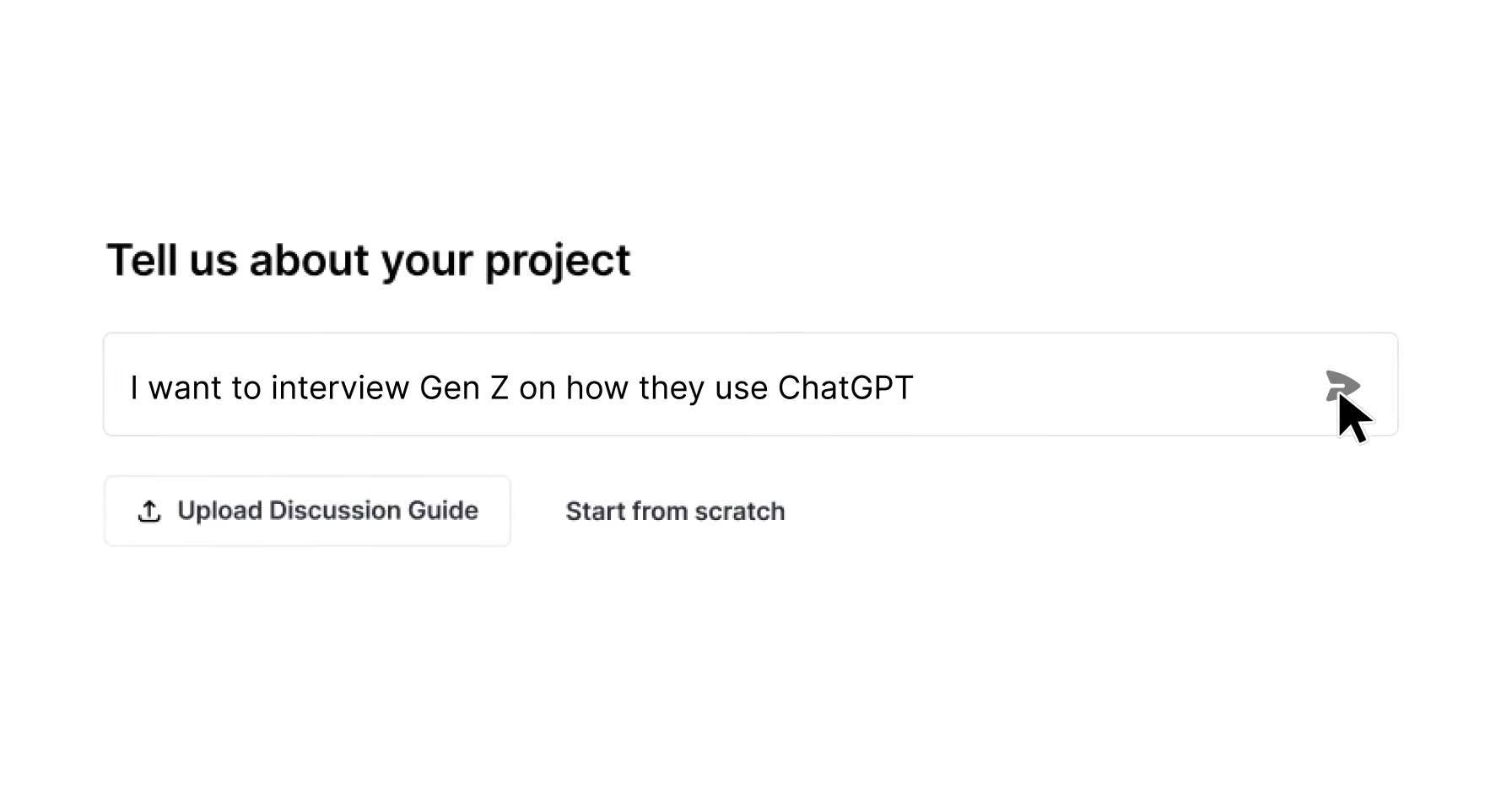
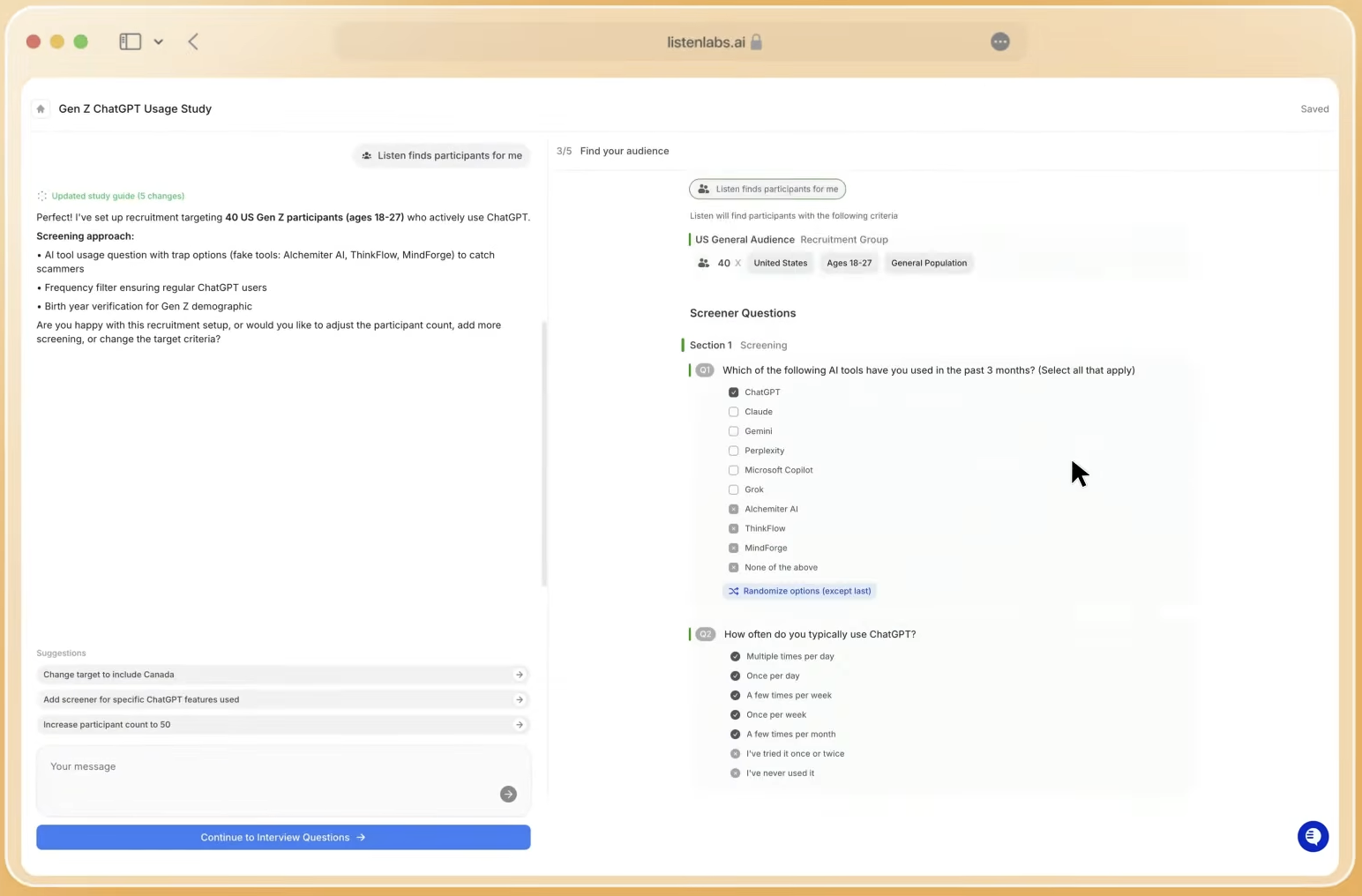
AI-assisted study co-design collapses that timeline. On Listen Labs, a researcher describes research goals in natural language and the platform drafts structured objectives, questions, and probing context in seconds. A template library covers concept testing, brand perception, usability, and more. An auto-QA layer flags issues in the study guide before launch, which removes a manual review cycle. Platforms like Listen Labs layer on auto-recruiting, transcription, sentiment tagging, and insight summarization so teams jump from question to findings in hours, not weeks. The full research cycle, from design through delivered report, often completes within a single day.
Participant Sourcing, Scale, and Fraud Prevention with AI Interviews
Commodity survey panels carry well-documented quality risks. Online survey completion rates have declined since the mid-2010s, with average response rates dropping to 20–30% in 2026 (as low as 13–16% for B2C). Professional survey-takers who optimize for incentives degrade data integrity further.
Listen Labs sources participants from a verified network of 30 million respondents across 45+ countries and 100+ languages. The Listen Atlas AI orchestration layer matches and bids on participants using behavioral and intent data, not just self-reported demographics. Quality Guard monitors every interview in real time across video, voice, content, and device signals to detect fraud, low-effort responses, AI-generated scripts, and mismatched profiles. Participants are capped at three studies per month, which removes the professional survey-taker problem entirely. A dedicated recruitment operations team handles hard-to-reach segments such as enterprise decision-makers, healthcare workers, and audiences below 1% incidence rate that commodity panels cannot reliably supply.
Ready to see how Listen Labs sources and verifies participants at enterprise scale? Walk through a Quality Guard session with our team to see real-time fraud detection in action.
Moderation Quality and Adaptive Follow-Up in AI Conversations
Surveys are structurally incapable of follow-up. Every respondent receives the same fixed questions in the same sequence, regardless of what they reveal. Traditional surveys may tell us what people do, but it takes a conversation to understand why. That structural limitation produces shallow data even when sample sizes are large.
AI-moderated interviews probe dynamically. When a participant gives a short or unexpected answer, the AI asks a follow-up, the same way a trained human moderator would. Conversational AI platforms ladder 5–7 levels deep on every interview using systematic probing techniques to uncover underlying motivations. The depth differential appears directly in response data, and AI interviews can produce significantly more words per response than traditional surveys.
Listen Labs adds an Emotional Intelligence layer that analyzes tone of voice, word choice, and subconscious micro-expressions to surface emotions that transcripts alone miss. This quantification is built on Ekman's universal emotions framework, which makes every emotion traceable to the exact timestamp, verbatim quote, and reasoning behind it. 100% of participants report top comfort levels in AI-moderated sessions, so this depth of analysis does not introduce discomfort that would suppress honest disclosure.
Data Quality Controls and Bias Reduction with AI Interviews
Research from the American Association for Public Opinion Research shows respondent fatigue produces satisficing, straight-lining, and early termination, with studies estimating 20–40% of survey responses in long instruments exhibiting satisficing patterns. Gibberish or low-quality responses appear more frequently in survey submissions than in AI interviews. The structural cause is survey length, and surveys exceeding ten minutes tend to see increased dropout rates among remaining respondents.
AI interviews reduce satisficing by maintaining conversational engagement. The conversational format reduces cognitive load by allowing participants to answer one question at a time in a flowing dialogue, often yielding more thoughtful responses. On the analysis side, Listen Labs' AI engine processes all interview data without the confirmation bias that affects human analysts. It identifies patterns and themes across hundreds of responses objectively. The Research Agent separates signal from noise using proprietary data from tens of thousands of studies conducted on the platform, a dataset no general-purpose LLM or survey tool can replicate.
Balancing Qualitative Depth with Quantitative Scale
Qualitative data methods lack in speed and sample size, but they make up for it tenfold in their ability to uncover nuance and complexity in human decision-making. The historical answer to this tension was to run surveys for scale and interviews for depth, which meant two separate studies, two separate budgets, and two separate timelines.
With qual-at-scale, the old trade-off between depth and scale is no longer a barrier. Listen Labs conducts hundreds of AI-moderated qualitative interviews simultaneously, and each one remains personalized and adaptive. Mixed-method support, including Likert scales, NPS, sliders, MaxDiff, and open-ended conversation, within a single instrument means quantitative and qualitative data arrive together from the same participants in a single rapid window. Listen Labs has conducted over one million AI-powered customer interviews, which demonstrates that this model holds at enterprise volume.
Analysis Workflow, Reporting, and Knowledge Retention with AI
Survey analysis typically produces frequency distributions and cross-tabs. Open-ended responses require manual coding, which is a slow and subjective process that introduces analyst bias and limits the volume of verbatims that can be meaningfully reviewed. Reports are delivered as static documents that become siloed artifacts within weeks of publication.
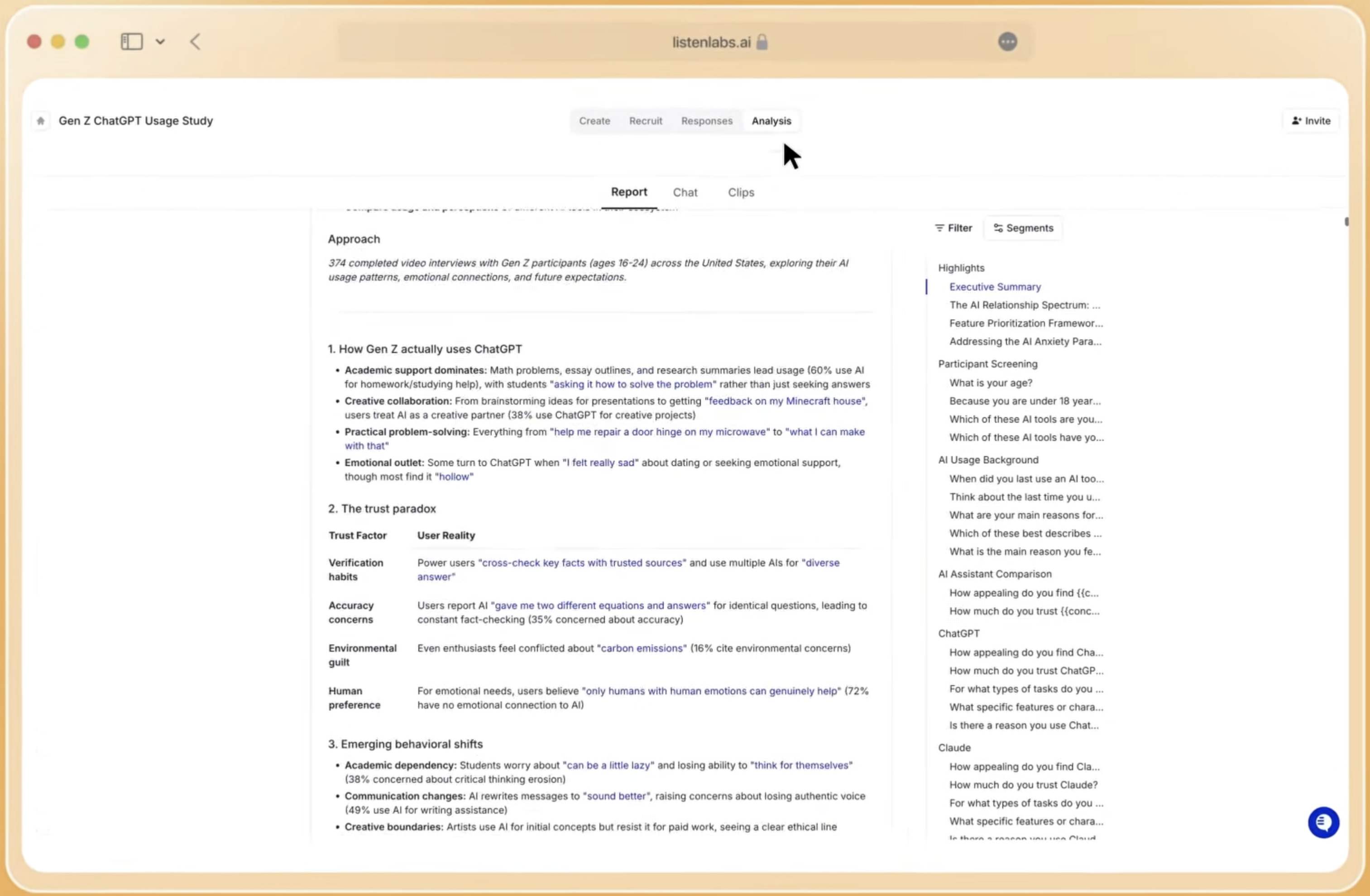
Listen Labs' Research Agent automates key findings, theme identification, and persona generation from interview data. Any question can be asked in natural language and returns answers, charts, statistical tests, and segmentations in under a minute. One-click deliverables include consultant-quality slide decks, memos, video highlight reels, and custom reports. Mission Control serves as the organization's persistent source of truth. Every study grows the knowledge base, which enables cross-study queries and trend tracking so teams stop re-researching questions already answered in prior work. McKinsey reports that digital leaders typically run four times faster than other companies.
Use Cases and Teams that Gain the Most from AI Interviews
Consumer insights leaders at large enterprises face a research backlog that grows faster than headcount can absorb. The promise of compressing a 4–6 week cycle to a same-day insight rhythm, while multiplying study volume without proportional cost increases, directly addresses that constraint. Microsoft used Listen Labs to collect global customer stories for its 50th anniversary within a single day. Anthropic surfaced churn drivers across 300+ user interviews in 48 hours, which was five times faster than prior methods. P&G delivered 250+ interviews with quantified themes in hours to shape product and brand strategy before market launch.
UX research leads benefit from the ability to test with 50–100+ participants instead of 5–10, with screen-sharing and mobile screen recording built in. Product managers and brand managers without dedicated research teams can describe goals in natural language and receive a complete study, including design, recruitment, moderation, analysis, and deliverables, without methodology expertise. Consultancies and agencies running client engagements on compressed timelines gain access to niche audiences globally without bespoke recruitment operations.
See how teams like yours are running more research in less time. Request a walkthrough tailored to your team's research backlog and timeline constraints.
Operational, Compliance, and Risk Considerations for AI Interviews
When AI is used for generative data work such as conducting interviews or adaptive probing, outputs require traceability to source recordings or transcripts plus visible human review of probes, participant experience, and resulting data characteristics before any analytic claims are made. Listen Labs addresses this through full timestamp-level traceability on every emotional and thematic label, human oversight from a research team with 50+ years of combined expertise, and an in-house methodology framework reviewed continuously against platform outputs.
On security and compliance, Listen Labs holds SOC 2 Type II, GDPR, ISO 27001, ISO 27701, and ISO 42001 certifications. Customer data is never used for AI model training. Enterprise SSO is supported. Organizations can self-recruit from their own user base at reduced cost, and the platform supports bring-your-own-panel configurations for teams with existing supplier relationships.
Surveys remain appropriate for narrow use cases such as tracking studies requiring strict longitudinal comparability with historical survey data, regulatory submissions requiring pre-specified closed-ended instruments, and contexts where participant internet bandwidth or device access makes video interviews impractical. Outside those constraints, the performance differential favors AI interviews on every evaluated criterion.
Decision Framework: When an AI Interview Platform Fits Best
An AI interview platform is the stronger choice when the research objective requires understanding the reasoning, emotion, or context behind a behavior, not just its frequency. It fits when the team needs results in days rather than weeks, when sample sizes above 30 are needed for qualitative work, when fraud and satisficing in commodity panels have degraded data confidence, when analysis backlogs are delaying decisions, or when the organization wants a persistent knowledge base rather than siloed reports.
A traditional survey instrument remains defensible when the study design must replicate a historical instrument exactly for trend continuity, when the research question is purely distributional and requires no follow-up, or when participant access constraints rule out video. For every other scenario, including concept testing, brand research, usability, creative testing, churn analysis, segmentation, pricing, and go-to-market validation, the depth, speed, and quality advantages of AI-moderated interviews are decisive.
Frequently Asked Questions
Is an AI interviewer as effective as a trained human moderator?
For the vast majority of research objectives, AI moderation performs on par with expert human moderators. Listen Labs' AI moderator applies the same methodological rigor as an experienced in-house researcher, probing on short or unexpected answers, maintaining consistent tone, and avoiding leading questions while conducting hundreds of sessions simultaneously. The platform is built and continuously refined by a research team with over 50 years of combined expertise. Human moderators retain an advantage in highly sensitive clinical contexts or studies requiring complex relationship-building over multiple sessions, but for consumer insights, UX research, and product research, AI moderation delivers comparable quality at dramatically greater speed and scale.
How does Listen Labs ensure participant quality at scale?
Three independent layers protect data quality. First, Listen Labs works exclusively with high-quality, non-commodity panel sources, so professional survey-takers are excluded. Second, Quality Guard applies real-time AI monitoring across video, voice, content, and device signals to detect fraud, low-effort responses, AI-generated scripts, and mismatched profiles. Third, a dedicated recruitment operations team adds human review, and participants are limited to three studies per month to prevent panel fatigue. Reputation scoring compounds across every interview conducted on the platform, which means audience quality improves continuously as the network grows.
What does Listen Labs cost at enterprise scale?
Listen Labs uses a subscription model. Enterprises pay for platform access, which includes a set number of studies and credits, and then spend credits per participant recruited. Credit cost varies by audience difficulty, so general population studies require fewer credits than niche or hard-to-reach segments. Enterprises running research at scale consistently report costs at roughly one-third of equivalent traditional research approaches, reflecting the elimination of separate vendors for recruitment, moderation, transcription, analysis, and report writing. Companies with over 100 employees go through a demo and pilot process to size the right configuration.
Can Listen Labs conduct research in multiple languages and markets simultaneously?
Yes. The platform supports 100+ languages for interview moderation, with automatic translation and transcription across all supported languages. Emotional Intelligence is available across 50+ languages. The participant network spans 45+ countries across the Americas, Europe, APAC, and MEA. Multi-market studies can run in parallel, with findings delivered in a unified analysis that supports cross-market comparison, which enables global consumer insights programs that would require months of coordination under traditional research models.
What security certifications does Listen Labs hold, and can organizations use their own participants?
Listen Labs maintains enterprise-grade security certifications, detailed in the operational considerations section above, with 256-bit encryption and a strict policy against using customer data for AI model training. Enterprise SSO is supported. Organizations can self-recruit from their own customer or user base at a reduced credit cost, and bring-your-own-panel configurations are supported for teams with existing supplier relationships. The platform is designed to integrate into enterprise security and procurement requirements without custom engineering work.
Conclusion: Moving from Survey Cycles to Same-Day Insight
Across every evaluated criterion, including setup time, participant quality, moderation depth, data integrity, scale, analysis speed, and knowledge retention, AI-moderated conversational interviews outperform traditional qualitative surveys for organizations that need both statistical confidence and emotional depth. The depth-versus-scale trade-off that defined qualitative research for decades reflects a platform constraint rather than a methodological inevitability. Listen Labs removes that constraint by handling the entire research lifecycle, from study design and global recruitment through AI-moderated interviews, automated analysis, and consultant-quality deliverables, while preserving the cost savings enterprise teams expect from consolidated platforms.
Microsoft, P&G, Anthropic, Skims, and Robinhood have already replaced weeks-long research cycles with a same-day insight cycle. The question for consumer insights leaders in 2026 is not whether AI interviews outperform surveys, because the data is unambiguous. The question is how quickly your program can make the shift. See a live Listen Labs study go from brief to delivered report in under 24 hours, and schedule your walkthrough now.