
Written by: Anish Rao, Head of Growth, Listen Labs
Key Takeaways
-
Listen Labs leads AI research tools for PMs in 2026, delivering full-cycle automation from study design to emotional intelligence analysis in under 24 hours.
-
Traditional tools like Dovetail, UserTesting, and Prolific cover only slices of the research process, which creates fragmented workflows and delays.
-
Listen Labs uses a large, verified global participant network for scalable qualitative research trusted by companies such as Microsoft, Anthropic, and Robinhood.
-
AI research platforms can cut qualitative analysis time by about 80%, which accelerates product roadmaps and sprint cycles while reducing costs.
-
Product managers can upgrade their research stack with Listen Labs—see 24-hour research-to-roadmap in action.
Best AI Research Platform for PMs in 2026
Listen Labs stands out as the leading AI research tool for PMs because it covers the entire research lifecycle in one platform. Point solutions focus on narrow tasks, such as analysis in Dovetail or slower human-moderated sessions in UserTesting. Listen Labs instead manages AI-assisted study design, global participant recruitment through its verified network, AI-moderated video interviews with emotional intelligence analysis, and automated deliverable generation.
Research Agent handles the full analysis workflow from raw data to final output, while Mission Control serves as your organization’s research knowledge base so insights stay accessible across teams. Enterprise deployments, including Microsoft’s customer story collection and Anthropic’s 48-hour churn analysis across 300+ users, demonstrate the platform’s readiness at scale.
Top 10 AI Research Tools for PMs: In-Depth Reviews
1. Listen Labs
Listen Labs combines verified global participants, AI-moderated interviews with screen sharing, emotional intelligence analysis, and sub-24-hour deliverables in one integrated system. Pros: Complete research lifecycle automation backed by enterprise-grade security (SOC2, ISO compliant), which enables proven ROI at scale. Client results include P&G’s global product testing, Skims’ customer segmentation, and Robinhood’s 2.4x higher weekly re-engagement for users who view betting as entertainment. Cons: Enterprise-focused pricing requires a demo consultation to scope usage. Best for: Product teams that need qualitative insights at scale for churn analysis, prototype testing, and roadmap validation, while maintaining emotional depth.
2. Dovetail
Dovetail focuses on analysis and excels at theme clustering and insight organization. Pros: Users report saving an average of 30 hours per week through automated tagging and sentiment analysis. Cons: The platform does not handle participant recruitment or interview moderation, so teams must add separate tools to run a full research cycle. Best for: Teams with existing interview data that need better organization and thematic analysis capabilities.
3. UserTesting
UserTesting offers a human-moderated usability testing platform with a long-standing enterprise presence. Pros: Strong support for traditional usability studies and prototype testing with live moderators. Cons: Human-dependent workflows create scheduling bottlenecks and limit scale, which makes it difficult to run hundreds of parallel interviews. Best for: Teams that prioritize human moderation and classic usability testing over maximum speed and volume.
4. Prolific
Prolific specializes in participant sourcing, particularly for academic-style research. Pros: Reliable participant panels with quality controls for structured studies. Cons: The platform focuses only on recruitment and does not provide moderation, analysis, or deliverable generation, so researchers must assemble their own toolchain. Best for: Researchers comfortable managing multiple tools for interview execution and downstream analysis.
5. Qualtrics
Qualtrics is an enterprise survey platform built for quantitative research. Pros: Massive scale for structured surveys, advanced logic, and statistical analysis. Cons: Limited qualitative depth because it does not support conversational interviews or emotional intelligence analysis. Best for: Large-scale quantitative studies where structured responses matter more than open-ended exploration.
6. Amplitude
Amplitude provides product analytics that track user behavior and engagement metrics. Pros: Excellent for quantitative user behavior analysis, funnel optimization, and cohort tracking. Cons: No qualitative interviews or emotional insights, since it focuses purely on behavioral data. Best for: Product teams that want to understand what users do, then pair those insights with separate tools for understanding why.
7. Gong and Fireflies
Gong and Fireflies record and analyze sales and customer calls. Pros: Fireflies provides 95% accurate transcriptions in over 100 languages with automated summaries that speed up call reviews. Cons: These tools focus on post-hoc analysis of existing calls and do not offer proactive participant recruitment or structured research design. Best for: Teams that want to mine existing customer conversations rather than run dedicated research studies.
8. Otter.ai and Grain
Otter.ai and Grain support meeting transcription and note-taking with AI summarization. Pros: Real-time transcription, speaker identification, and AI-generated summaries help document customer interviews and internal discussions. Cons: These tools do not recruit participants or enforce structured research methodology, so they function primarily as transcription utilities. Best for: Teams that need reliable interview documentation and quick summaries.
9. Perplexity and NotebookLM
Perplexity and NotebookLM act as general-purpose AI research assistants for information synthesis. Pros: Perplexity’s Research mode gathers data from multiple sources with citations, which supports market validation and desk research. Cons: They do not provide participant panels, interview capabilities, or formal research methodology. Best for: Secondary research, competitive analysis, and synthesizing existing information.
10. ChatGPT
ChatGPT serves as a free general-purpose AI for basic research tasks and light analysis. Pros: Helpful for survey analysis, drafting discussion guides, and initial insight synthesis. Cons: Lacks proprietary research data, participant access, and specialized methodology, since it functions as a general AI assistant. Best for: Budget-conscious teams with minimal research needs or early-stage experimentation.
PM Workflow Blueprint: 24-Hour Research-to-Roadmap with Listen Labs
Product managers often spend two to three weeks on a single research cycle, from recruiting participants to turning insights into roadmap decisions. Listen Labs compresses this timeline into roughly 24 hours through a connected four-step workflow that moves smoothly from questions to decisions.
-
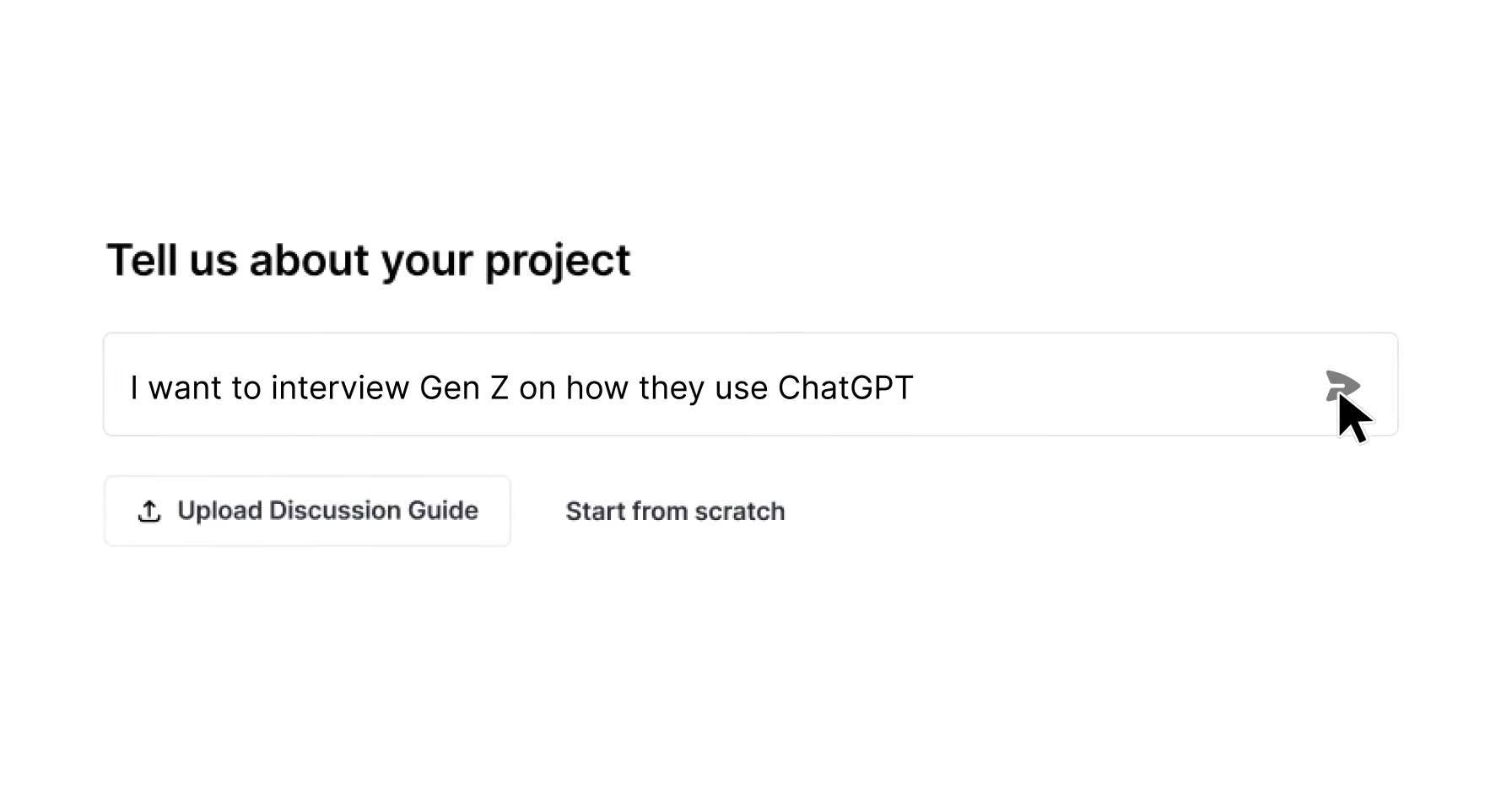
Describe research goals in natural language. You state your product questions in plain language, and the platform drafts study objectives and interview guides tailored to those questions.
-
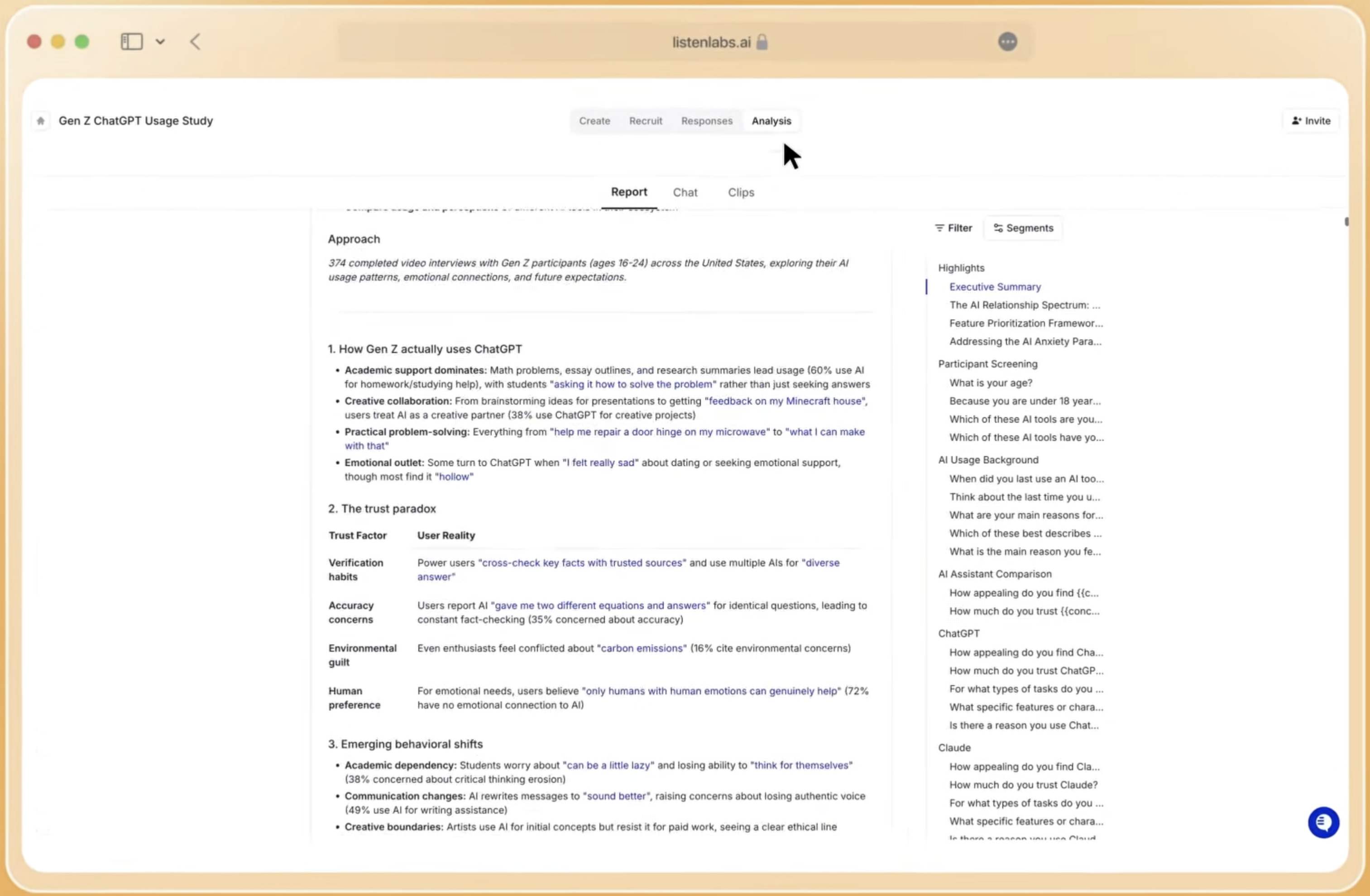
Recruit from the verified global network. These objectives drive auto-recruitment from Listen Labs’ verified global participant pool across 45+ countries, using behavioral matching to find people who have experienced the problems you are investigating.
-
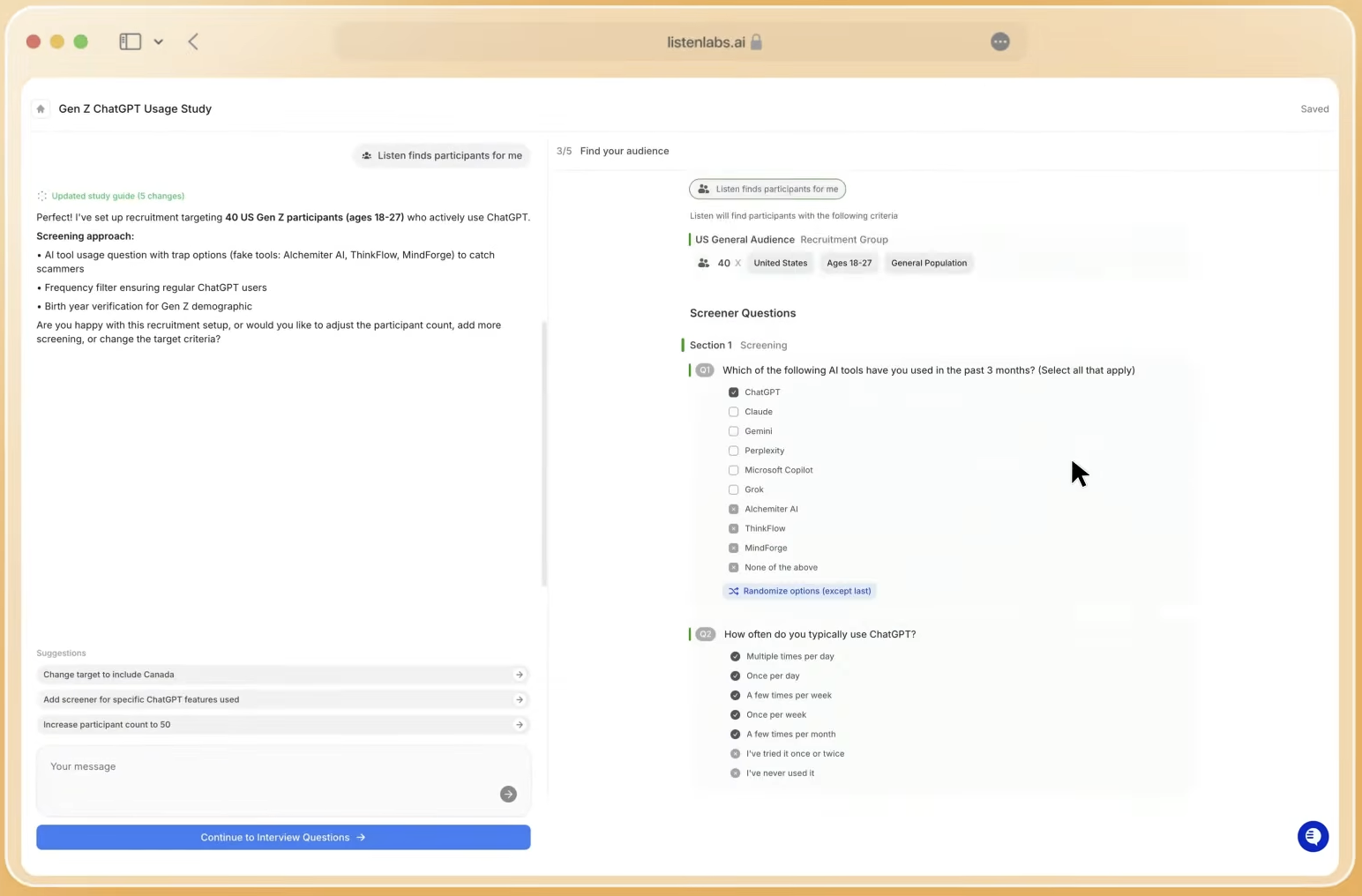
Run parallel AI-moderated video interviews. Matched participants join parallel AI-moderated video sessions with dynamic follow-ups that adapt to each response and emotional intelligence analysis that captures sentiment and nuance.
-
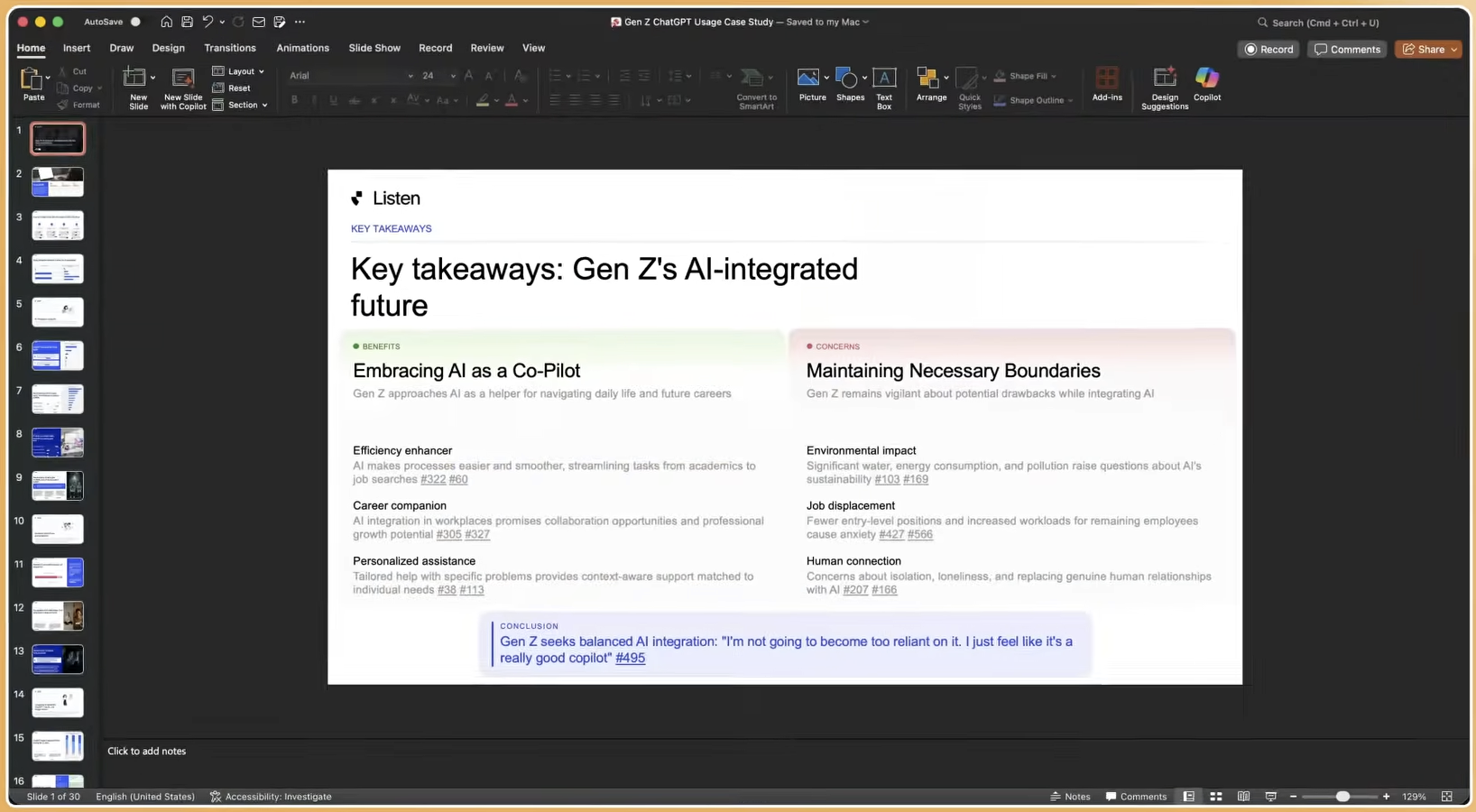
Generate findings and deliverables automatically. Research Agent generates automated key findings, themes, and consultant-quality slide decks in under a minute, which feeds directly into roadmap discussions.
See this workflow accelerate your next product decision.
FAQ: AI Research Tools for Product Managers
Does AI Replace Human Insight in Product Research?
AI extends PM capabilities instead of replacing human judgment. AI market research tools cut qualitative analysis time by up to 80%, which frees product managers to focus on strategic decisions and interpreting nuance. Leading platforms such as Listen Labs maintain methodological rigor while automating repetitive work like recruitment, moderation, and first-pass analysis, so humans stay in control of framing questions and acting on insights.
How Do AI Tools Ensure Participant Quality for PM Research?
Modern platforms use several layers of quality control to protect data integrity. Listen Labs applies behavioral matching beyond demographics, real-time fraud detection across video and voice signals, reputation scoring that improves with each interview, and participant frequency limits that cap involvement at three studies per month. These safeguards reduce professional survey-takers and support authentic responses for product decisions.
What Enterprise Security Features Do AI Research Tools Provide?
Enterprise-grade AI research platforms maintain SOC2 Type II, ISO 27001, ISO 27701, and ISO 42001 certifications with 256-bit encryption. Customer data does not train AI models, and all research data remains inside secure, compliant environments. This structure allows product teams at Fortune 500 companies to run sensitive research programs without introducing new security risks.
Are There Free AI Research Tools for Product Managers?
Free tools such as ChatGPT and Otter.ai support basic transcription and light analysis but lack specialized research capabilities. They cannot recruit participants, conduct structured interviews, or enforce the rigor needed for high-stakes product decisions. Professional platforms like Listen Labs offer pilot programs for teams that are ready to move beyond the limitations of free utilities.
How Do AI Research Tools Speed Up PM Roadmaps?
Qual-at-scale collapses the traditional trade-off between depth and scale by enabling validation with hundreds of users in hours instead of weeks. AI automation handles recruitment, moderation, and analysis in one flow, which delivers faster insights that align with agile development cycles and rising competitive pressure.
Build Your 2026 PM Stack Around Listen Labs
A modern product manager’s AI stack works best when each tool plays a clear role. Listen Labs anchors customer research, while Amplitude covers behavioral analytics, Figma supports prototype testing, and Productboard manages roadmap prioritization. Listen Labs has run over 1 million AI-powered customer interviews for companies including Microsoft, Perplexity, and Sweetgreen, which shows its maturity as a research foundation in this broader stack.
Conclusion: Claim Your Research Edge
The leading AI research tool for PMs in 2026 transforms how product teams understand customers, not just how fast they run studies. Listen Labs drives this shift with integrated automation, enterprise-grade quality, and proven results at Microsoft, Anthropic, and hundreds of other companies. Point solutions require juggling multiple tools and handoffs, while Listen Labs delivers complete research cycles in under 24 hours. Experience the future of product research.