
Written by: Anish Rao, Head of Growth, Listen Labs
Key Takeaways
- AI research assistants compress traditional 4-6 week customer research cycles to hours through end-to-end automation of study design, recruitment, interviews, and analysis.
- Platforms like Listen Labs run qual-at-scale, delivering conversational depth from hundreds of AI-moderated interviews with global reach across 45+ countries and 100+ languages.
- Emotional intelligence features analyze tone, micro-expressions, and sentiment to uncover nuanced user emotions that transcripts miss, which powers better product decisions.
- Research Agent automates analysis into consultant-quality deliverables like slide decks and video reels, reduces human bias, and builds institutional knowledge via Mission Control.
- Product managers at Microsoft, Anthropic, and P&G use Listen Labs to slash costs by 66% and boost research output 10x; see how your team can achieve similar gains.
PM Research Pains: Traditional vs. AI Research Assistants
Traditional qualitative research creates systematic bottlenecks for product managers. Fuel Cycle's 2026 market research report documents that research cycles that once took weeks can now be completed in hours or days. These processes often fragment across multiple vendors, including recruitment platforms like Prolific for participant sourcing, separate scheduling systems, human moderators for interviews, transcription services, and analysis tools like Dovetail for organizing past data.
The depth versus scale trade-off forces product managers into difficult choices. Qualitative interviews deliver rich insights but limit sample sizes to 5-15 participants because of logistics and costs. Quantitative surveys scale to hundreds of respondents but sacrifice conversational depth and the ability to probe unexpected findings. No-show rates compound these challenges, with traditional recruitment suffering 20-30% participant dropout that biases samples and wastes preparation time.
AI research assistants remove these trade-offs through parallel processing and automation. Modern platforms conduct hundreds of AI-moderated market research interviews simultaneously, with adaptive follow-up questions and personalized conversation flows for each participant. Platforms like Listen Labs layer on auto-recruiting, transcription, sentiment tagging, and insight summarization so teams jump from question to findings in hours, not weeks. This qual-at-scale approach delivers statistical confidence from large samples while maintaining the conversational depth that surveys cannot capture.
Study Design and Recruitment: How Listen Labs Unifies the Workflow
Traditional research workflows require product managers to navigate multiple disconnected platforms. Prolific and similar recruitment services handle participant sourcing but offer limited targeting beyond basic demographics. Manual study design demands research methodology expertise that many product managers do not have, which leads to poorly structured interviews that miss critical insights or introduce bias through leading questions.
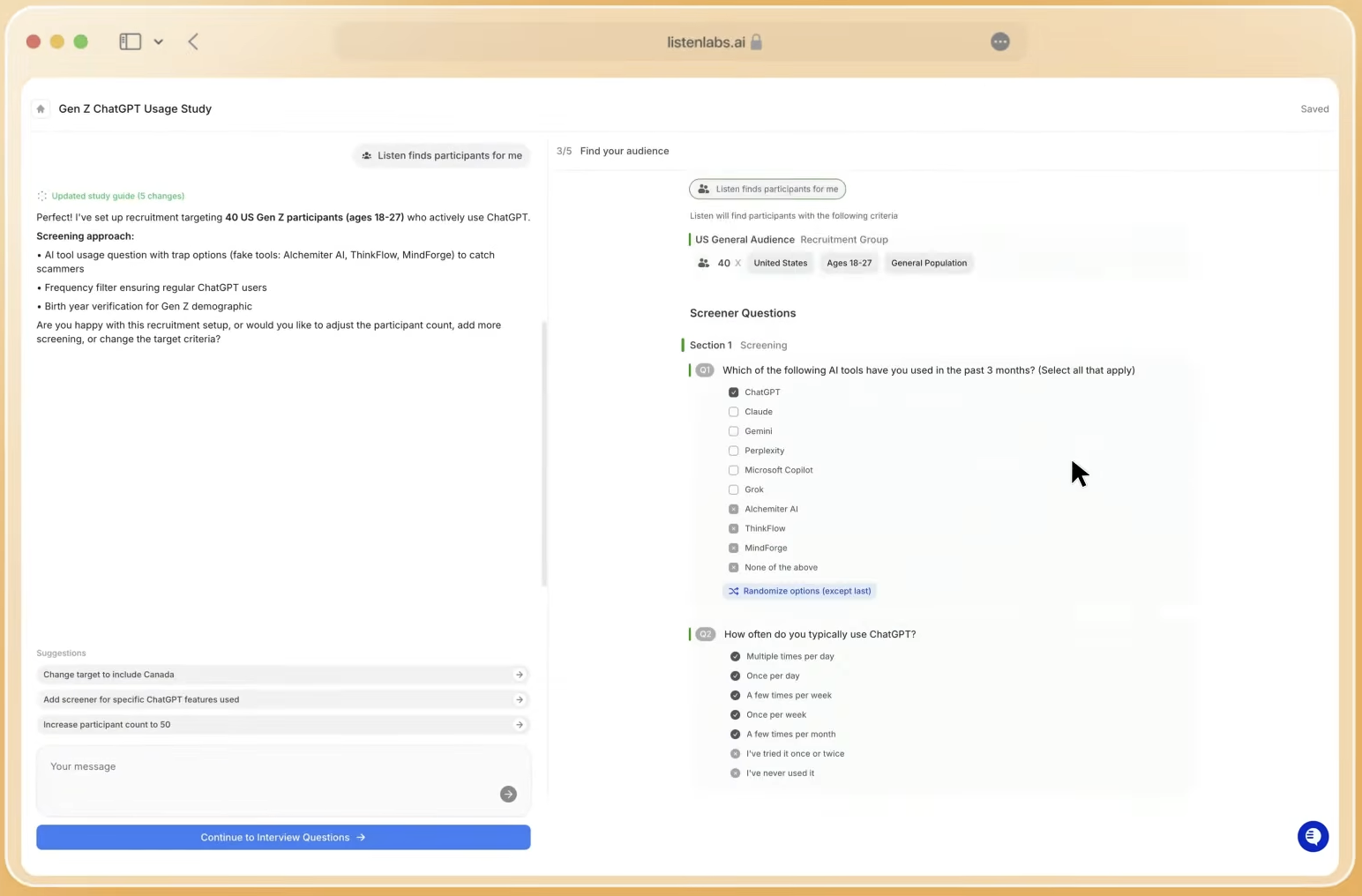
Listen Labs transforms study design through AI co-design capabilities that convert natural language research goals into structured interview guides within seconds. This automation extends to participant sourcing through the platform's 30M Atlas panel, which spans 45+ countries and uses behavioral matching to target participants based on actual intent and past actions, not just demographics. For segments that even this large panel cannot reach, a dedicated recruitment operations team handles custom sourcing for hard-to-reach audiences including enterprise decision-makers, healthcare workers, and consumers below 1% incidence rates.
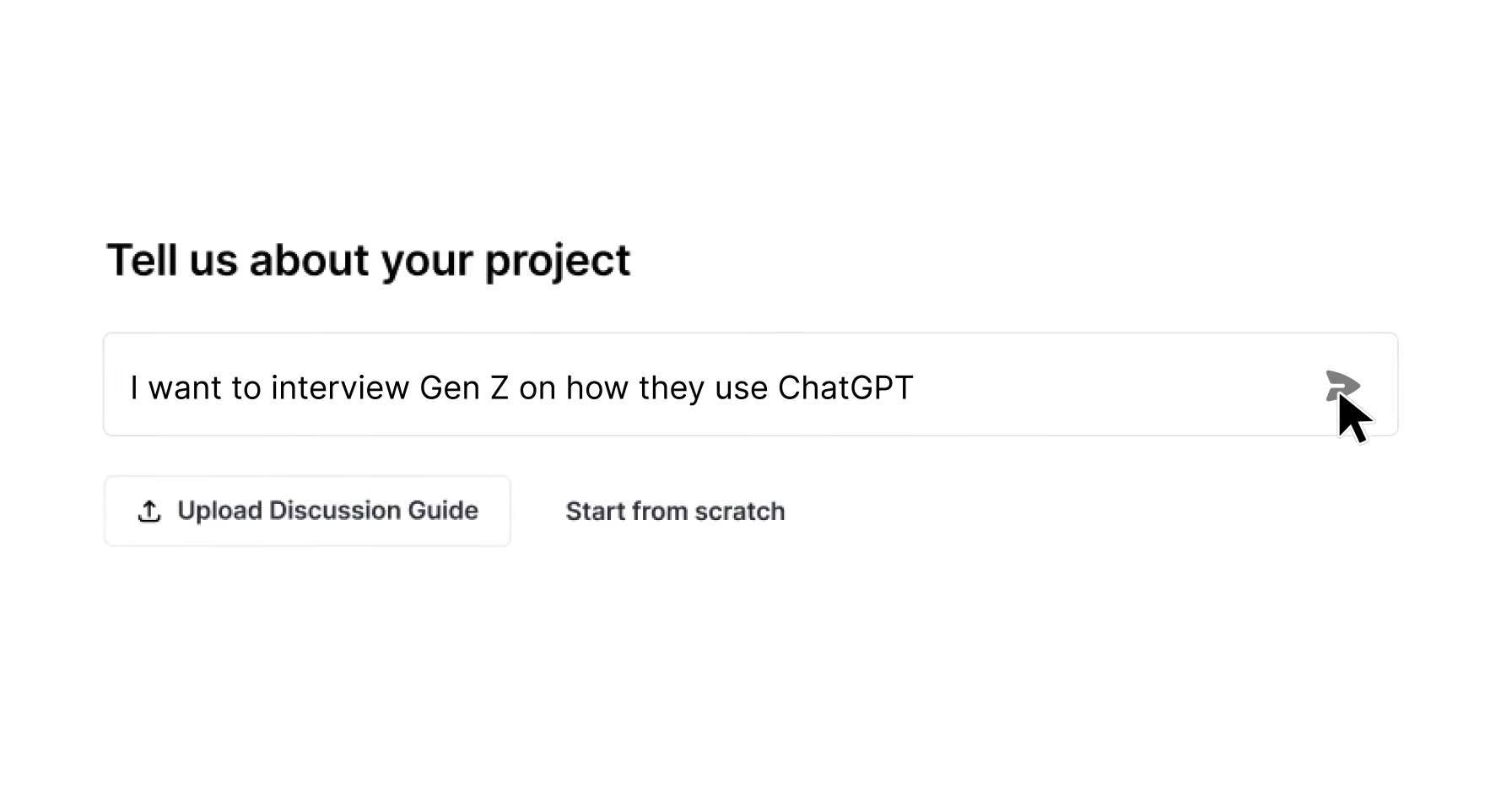
The recruitment advantage also covers speed and quality. Traditional platforms often require days or weeks to source qualified participants, while Listen Labs delivers 24-hour study cycles from launch to completed interviews. Quality Guard technology monitors every interaction in real time, which removes fraudulent responses and professional survey-takers that plague commodity panels. This integrated approach removes the handoffs and delays that fragment traditional research workflows.
AI Moderation and Emotional Intelligence: Moving Beyond UserTesting and Surveys
UserTesting relies on human-dependent moderation that creates scalability bottlenecks and inconsistent interview quality. Human moderators vary in skill level, introduce personal biases, and cannot conduct hundreds of parallel sessions. Traditional surveys capture only surface-level responses through pre-set questions, with no ability to probe deeper when participants provide interesting or unexpected answers.
Listen Labs' AI moderation technology conducts personalized conversations with dynamic follow-up questions that adapt based on participant responses. The platform's Emotional Intelligence capabilities analyze tone of voice, word choice, and subconscious micro-expressions to surface emotions that transcripts alone miss. By conducting hundreds of parallel AI-moderated interviews, Listen Labs achieves the scale advantages discussed earlier without sacrificing conversational depth.
The emotional intelligence features prove particularly valuable for product managers testing concepts, prototypes, or messaging. Built on Ekman's universal emotions framework, the system quantifies emotions including joy, confusion, frustration, and trust across 50+ languages. Every emotion label traces back to specific timestamps and verbatim quotes, which enables product teams to pinpoint exactly where users experience friction or delight during product interactions.
Analysis and Mission Control: From Raw Interviews to a Living Insight Hub
Dovetail serves as a repository for organizing past research but cannot conduct new studies or recruit participants. Generic LLMs like ChatGPT assist with analysis but lack the proprietary data and research methodology expertise needed for reliable insights. Manual analysis introduces human and confirmation bias, where analysts unconsciously emphasize findings that support existing hypotheses while overlooking contradictory evidence.
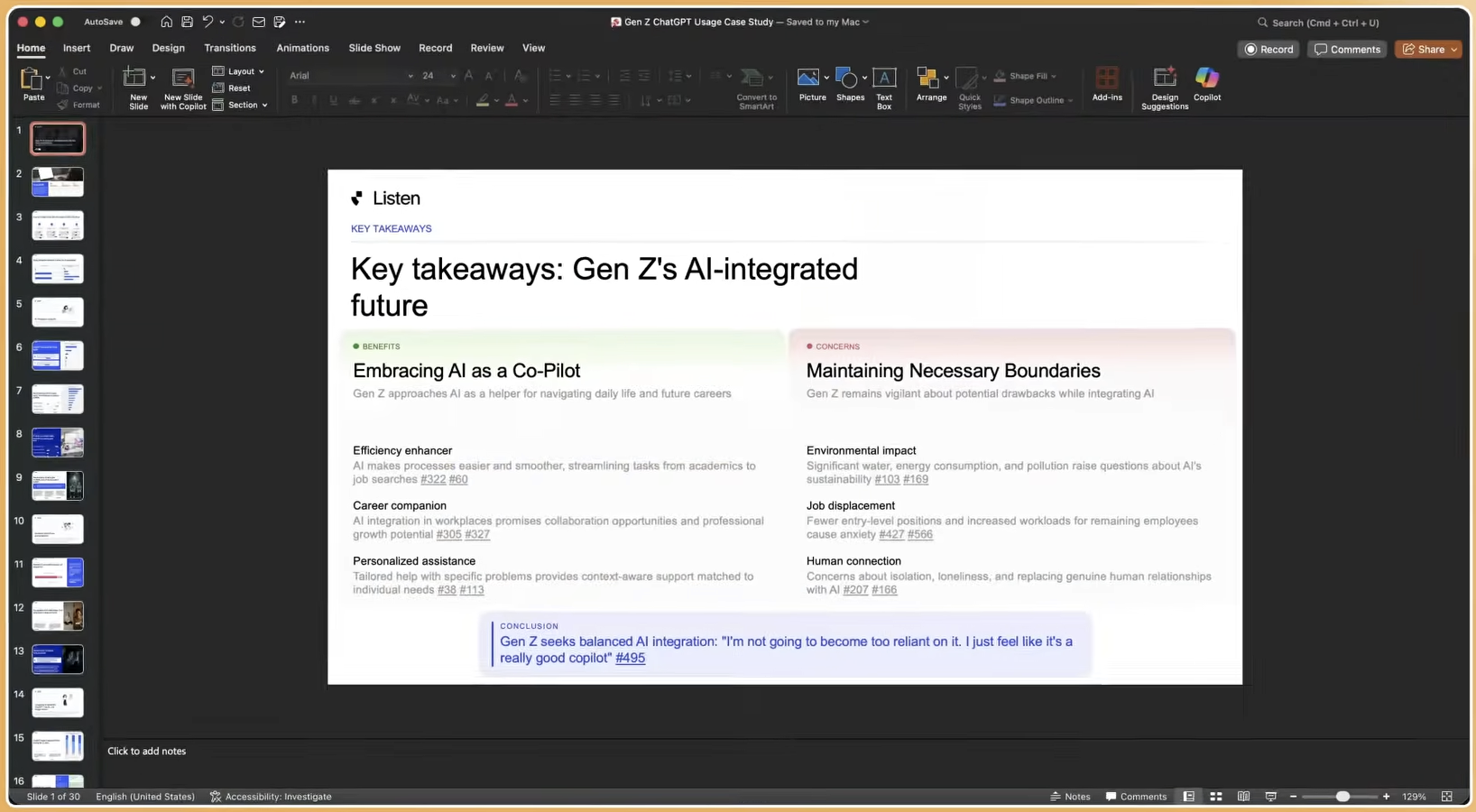
Listen Labs' Research Agent automates the complete analysis workflow from raw interview data to stakeholder-ready deliverables. Every insight links directly to the underlying response data, with one researcher running a full buying intent analysis across three user segments in under a minute. The system generates branded slide decks, statistical comparisons, video highlight reels, and custom reports based on natural language queries.
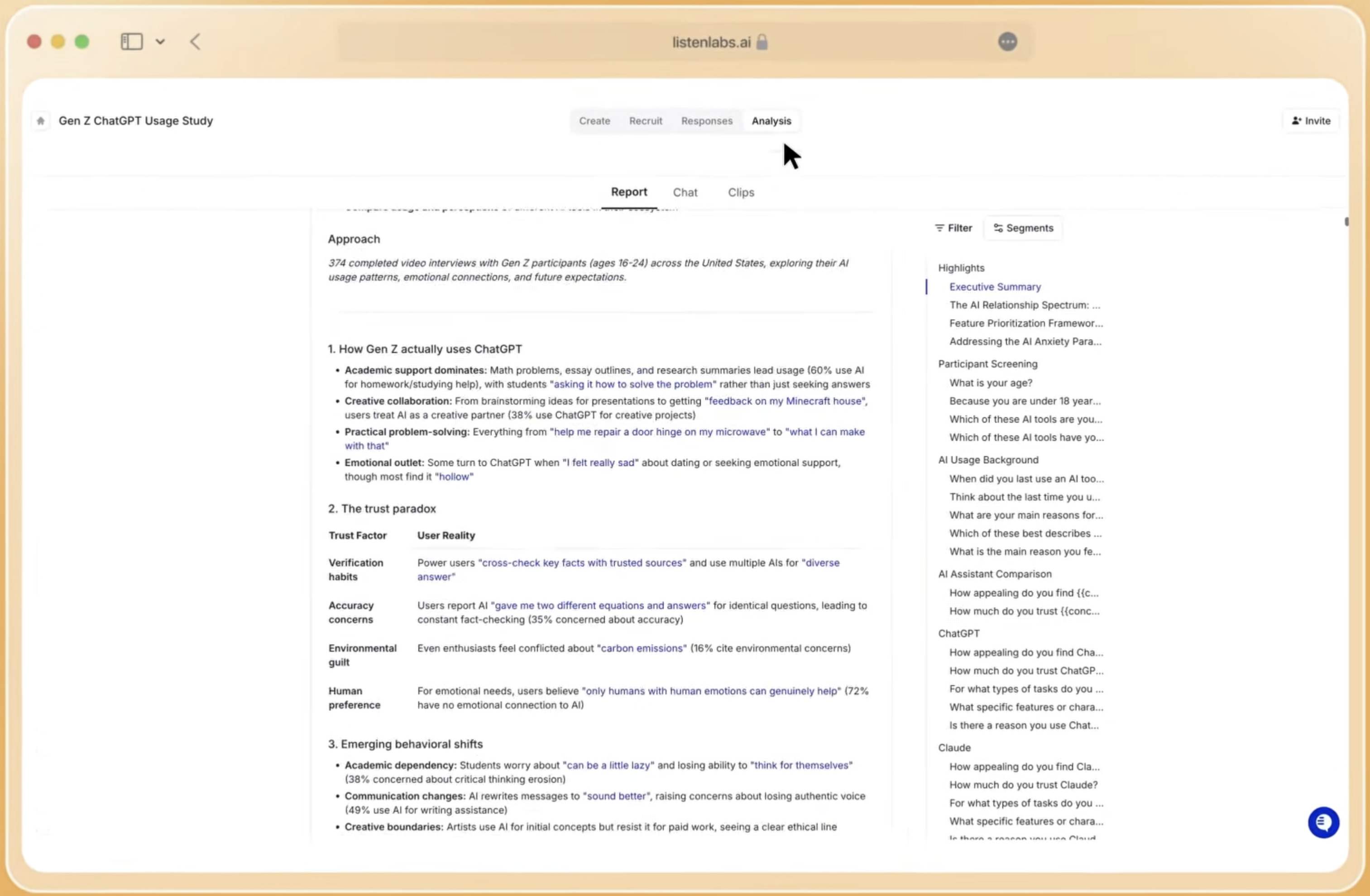
Mission Control extends beyond single-study analysis to serve as the organization's source of truth for customer intelligence. Each completed study grows the institutional knowledge base, which enables cross-study queries and trend tracking that prevent teams from repeatedly researching the same questions. Microsoft used this capability to collect global customer stories for their 50th anniversary celebration, with leadership praising both the speed and scale that Listen Labs enabled at one-third traditional costs.
Why Listen Labs Stands Out as an AI Research Assistant for PMs
Listen Labs establishes itself as a leading end-to-end AI research platform through several key differentiators. The platform handles the complete research lifecycle. Product managers describe research goals in natural language, AI co-designs the study guide, Atlas recruitment sources verified participants from a 30M global network, AI moderators conduct video interviews with adaptive follow-up questions, and the Research Agent delivers insights within 24 hours.
The data flywheel creates a defensible moat that competitors cannot replicate. Tens of thousands of completed studies continuously inform study design improvements, question quality, and analysis accuracy, which creates a self-reinforcing cycle where each new study makes the platform smarter. This accumulated intelligence also powers Quality Guard's three-layer fraud prevention system, which combines behavioral matching, real-time monitoring, and human review to deliver a zero fraud guarantee while commodity panels struggle with professional survey-takers and fake profiles.
Enterprise adoption validates the platform's reliability and scale. Microsoft cut research wait times from weeks to hours, using Listen Labs to collect hundreds of global customer stories overnight. Anthropic conducted 300+ user interviews in 48 hours to understand Claude subscription churn, surfacing insights 5x faster than traditional methods. Procter & Gamble tested product claims with 250+ interviews, which delivered quantified themes and verbatim proof that directly shaped product and brand strategy.
The platform's technical capabilities extend beyond basic interview automation. Emotional Intelligence analyzes multimodal signals across video, audio, and text to quantify emotions with timestamp-level precision. Screen sharing and mobile recording support usability testing workflows. Integration with enterprise systems including SSO, GDPR compliance, and SOC 2 certification maintains security standards for Fortune 500 deployments.
Listen Labs' pricing model uses subscription access plus credit-based participant recruitment, delivering the cost savings Microsoft and other enterprises have experienced while removing the need for multiple vendors, tools, and specialized headcount. The self-serve platform enables product managers without research expertise to launch studies independently, while the dedicated recruitment operations team handles complex audience sourcing that other platforms cannot reach.
PM Use Cases, ROI and Operations: How Teams See Value
Product managers deploy AI research assistants across multiple high-impact use cases. Sprint usability testing scales from traditional 5-10 user samples to 50-100+ participants, which provides statistical confidence for design decisions. Concept validation studies reach global audiences overnight, so teams can test ideas across multiple markets before committing development resources. Feature prioritization research surfaces user pain points and desired capabilities that inform roadmap decisions with quantified demand signals.
ROI metrics demonstrate substantial productivity gains and cost savings. A survey of 1,750 product professionals by Lenny Rachitsky found that 63% of product managers say AI tools save them four or more hours every week, while a McKinsey study of 40 product managers found that generative AI tools improved productivity by 40% across core tasks. Organizations avoid hiring $300K+ research specialists by enabling existing product teams to conduct research independently at scale.
Operational integration stays straightforward for product teams. Saee Abhyankar, product manager at Builder.io, uses AI tools to categorize themes from hundreds of biweekly user feedback comments, saving a couple of hours per analysis. Self-serve study launch removes research team bottlenecks, while bring-your-own-participant options reduce costs for teams with existing user bases. Enterprise SSO and security compliance enable deployment without lengthy IT approval cycles.
Skims validated premium consumer campaigns overnight, identifying and qualifying thousands of high-income buyers to de-risk global launch decisions. The SVP of Data, Insights, and Loyalty noted that Listen Labs solved their persistent challenge of understanding the "why" behind customer behaviors. Explore how AI research assistants can 10x your research output and see how they transform product development workflows.
Future Trends, Risks and FAQ: What Comes Next for AI Research
The 2026 landscape shows accelerating adoption of agentic AI in product management workflows. A 2026 Deloitte survey found workforce access to AI reached around 60% of workers after a 50% yearly increase from fewer than 40%, with workers equipped with sanctioned AI tools. Product managers now evolve into AI orchestrators who direct autonomous agents rather than execute tasks directly. Emotional intelligence capabilities represent a key differentiator, because they enable teams to capture nuanced user sentiment that traditional transcripts miss.
Synthetic user research emerges as a controversial but growing trend, where AI-generated personas simulate customer behaviors for rapid concept testing. Industry consensus suggests synthetic data works best as high-fidelity validation rather than replacement for human research, since AI responses often lack the messy truths and contextual frustrations that drive real user behavior.
Is AI interview quality as good as humans?
AI-moderated interviews achieve comparable quality to experienced human researchers while delivering superior consistency and scale. Listen Labs' AI interviewer maintains the same methodological rigor as a 50+ year experienced research team, which removes the variability and bias that human moderators introduce. The platform conducts thousands of parallel interviews with identical quality standards, something impossible with human-dependent approaches.
How do you prevent fraud and ensure participant quality?
Quality Guard implements three layers of fraud prevention that exceed commodity panel standards. Behavioral matching targets participants based on actual intent and actions rather than self-reported demographics. Real-time monitoring analyzes video, voice, content, and device signals to detect fraudulent responses during interviews. Human recruitment operations teams add review layers for complex audience sourcing, while participant frequency limits prevent professional survey-takers.
What advantages do AI interviews have over surveys?
AI interviews deliver conversational depth that surveys cannot match through adaptive follow-up questions and personalized conversation flows. Surveys capture structured responses to pre-set questions, while AI interviews probe deeper when participants provide interesting answers, which uncovers unexpected insights and emotional nuance. The qual-at-scale approach provides statistical confidence from large samples while maintaining qualitative richness.
How does pricing compare to traditional research?
AI research assistants deliver results at approximately one-third the cost of traditional research by removing multiple vendors, specialized headcount, and manual processes. Subscription models with credit-based participant recruitment provide predictable costs while scaling research output dramatically. Organizations save on research team hiring, external agency fees, and the opportunity costs of delayed insights.
Conclusion: 5-Step PM Playbook for AI Research Assistants
Listen Labs emerges as a leading AI research assistant for product managers through its end-to-end platform, enterprise-grade security, and proven ROI across Fortune 500 deployments. The five-step implementation playbook enables immediate productivity gains:
- Define research goals in natural language using AI co-design capabilities.
- Launch studies with automated recruitment from verified global panels.
- Query insights through the Research Agent's natural language interface.
- Integrate findings into product roadmaps using branded deliverables and video highlights.
- Scale research operations through Mission Control's institutional knowledge building.
The platform's competitive advantages, including the data flywheel from tens of thousands of studies, Quality Guard fraud prevention, and full-stack automation, create defensible moats that fragmented tools cannot replicate. Product managers gain the ability to conduct research at the speed of product development, eliminating the multi-week bottlenecks mentioned earlier that delay launches and reduce competitive advantage.
Start transforming your research cycles today and see how Listen Labs compresses weeks of work into hours while maintaining the depth and quality that drive successful product decisions.
Frequently Asked Questions
Can AI research assistants replace traditional market research entirely for product managers?
AI research assistants excel at the majority of product research needs including concept validation, usability testing, feature prioritization, and customer journey mapping. They deliver comparable quality to experienced human researchers while providing superior speed, scale, and consistency. They work best as force multipliers for existing research capabilities rather than complete replacements. Complex strategic research that requires deep industry expertise or highly sensitive topics may still benefit from human oversight, while AI handles the execution and analysis efficiently.
What types of product decisions can AI research assistants inform most effectively?
AI research assistants prove most valuable for decisions that require rapid customer feedback at scale. Sprint usability testing benefits from 50-100+ user samples versus traditional 5-10 participant studies. Concept validation across multiple markets happens overnight rather than over weeks. Feature prioritization research quantifies user pain points and desired capabilities with statistical confidence. Pricing research, messaging testing, competitive analysis, and customer journey optimization all benefit from the qual-at-scale advantages that AI platforms provide.
How do AI research assistants integrate with existing product management workflows and tools?
Modern AI research platforms integrate with product management ecosystems through enterprise SSO, API connections, and familiar deliverable formats. Self-serve study launch removes research team bottlenecks while maintaining quality standards. Automated deliverables including slide decks, video highlights, and statistical reports fit directly into existing stakeholder communication workflows. Mission Control capabilities build institutional knowledge that prevents duplicate research efforts and enables cross-study trend analysis.
What security and compliance considerations apply to AI research assistants in enterprise environments?
Enterprise-grade AI research platforms maintain SOC 2 Type II, GDPR, ISO 27001, ISO 27701, and ISO 42001 certifications to meet Fortune 500 security requirements. Data encryption, participant privacy protection, and secure data handling ensure compliance with global regulations. Customer data remains isolated and is never used for AI model training. Enterprise SSO integration and audit trail capabilities support internal governance requirements while enabling rapid deployment across product teams.
How can product managers measure ROI and success metrics when implementing AI research assistants?
ROI measurement focuses on time savings, cost reduction, and decision quality improvements. Teams track research cycle compression from weeks to hours, cost per insight compared to traditional methods, and research volume increases with existing team capacity. Quality metrics include decision confidence levels, feature adoption rates based on research-informed launches, and reduced post-launch iteration cycles. Productivity gains typically show 40% improvement across core product management tasks, with teams conducting 5-10x more research studies annually while maintaining or improving insight quality.