
Written by: Anish Rao, Head of Growth, Listen Labs | Last updated: June 26, 2026
Key Takeaways for Enterprise Research Leaders
- Fortune 500 research teams face multi-month backlogs because traditional qualitative studies take 4–6 weeks and require multiple vendors for recruitment, moderation, and analysis.
- Listen Labs replaces fragmented workflows with an end-to-end AI platform that sources participants, conducts adaptive video interviews, and delivers consultant-quality reports in under 24 hours.
- The platform combines qualitative depth with quantitative formats, uses Emotional Intelligence analysis, and maintains enterprise-grade compliance through SOC 2 Type II, ISO, and GDPR certifications.
- Listen Labs serves 20% of the Fortune 500, including Microsoft, P&G, Anthropic, Google, and Sony, while cutting costs by two-thirds and eliminating moderator variability.
- Teams ready to compress research cycles from weeks to hours can see the platform in action with Listen Labs today.
The Problem: Traditional Research Slows Fortune 500 Decisions
A typical qualitative research cycle runs 4–6 weeks from study design to final report. In large enterprises, internal prioritization queues, budget approvals, and vendor coordination routinely push that timeline to six months. Traditional focus groups alone cost $4,000–$12,000 per 90-minute session and take 3–5 weeks to execute, before a single slide is written. The process is fragmented, with separate vendors handling recruitment, scheduling, moderation, transcription, and analysis, and each handoff introduces delay, cost, and quality risk.
Quantitative survey tools scale but capture only surface-level data through pre-set questions with no follow-up capability. Panel platforms solve sourcing but leave moderation and analysis entirely to the client. The result is a research function that can only run a limited number of studies per quarter and operates as an internal bottleneck. Teams face a binary choice between depth and scale that neither agencies nor survey tools can resolve.
Listen Labs removes that trade-off by replacing the fragmented vendor model with an integrated AI platform. The platform unifies recruitment, moderation, analysis, and reporting so enterprise teams can move from question to findings in hours instead of weeks.
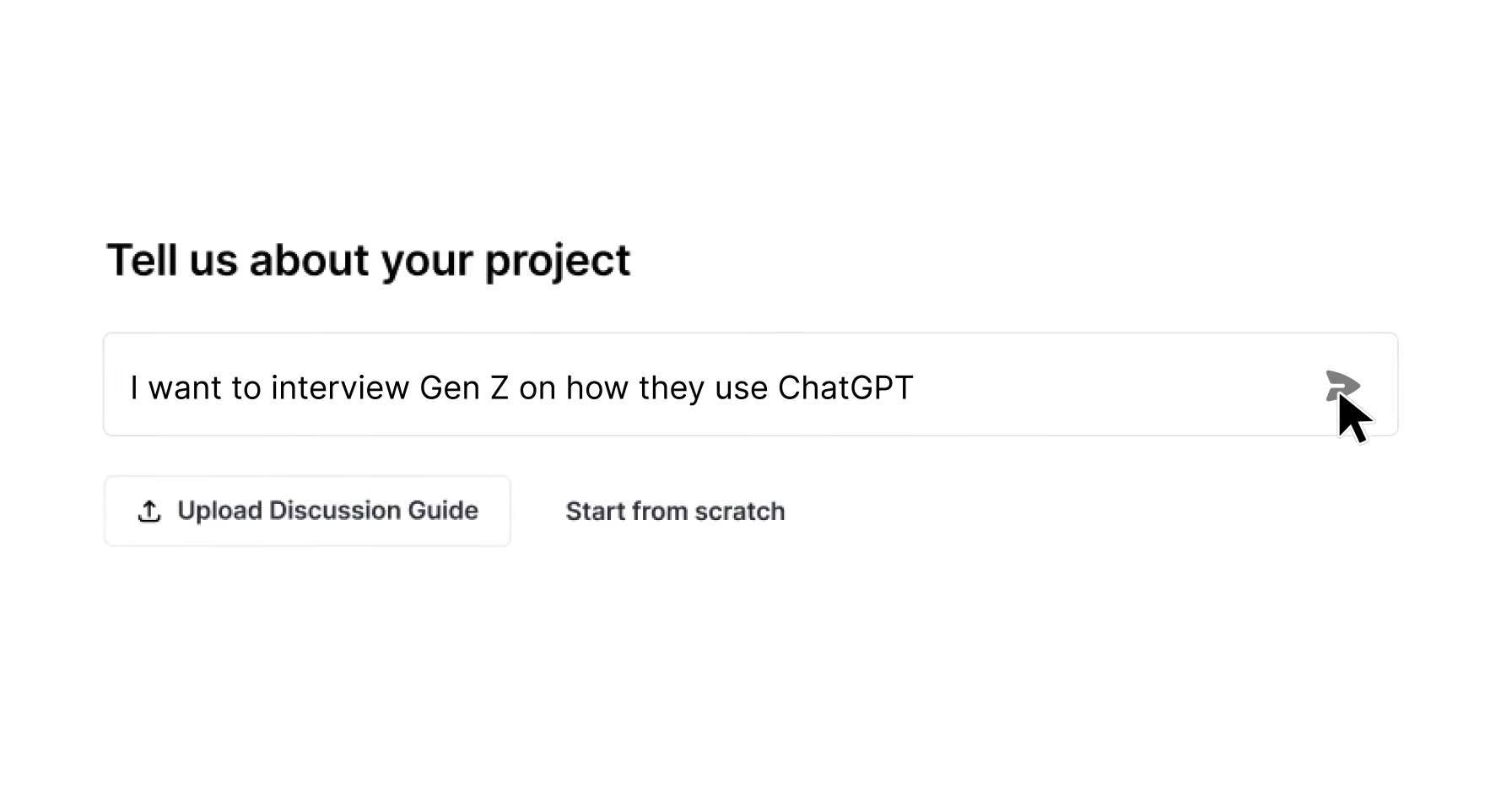
Listen Labs vs Traditional Research Agencies: Depth Without the Delay
Traditional research agencies deliver experienced moderation and polished deliverables, but the model does not scale for the volume of questions a Fortune 500 insights team generates. Agency engagements follow the same multi-week timeline described earlier and carry costs that restrict most enterprises to a handful of studies per year. Moderator quality varies by individual, and deliverables require manual report writing that adds days to an already long cycle.
Listen Labs compresses that same cycle to under 24 hours by eliminating the vendor handoffs that slow traditional research. The platform’s Fortune 500 client base includes Microsoft and Sweetgreen, supported by an AI agent capable of conducting thousands of simultaneous voice interviews from a 30M-person audience at roughly one third of typical agency costs. AI moderation is consistent across every interview, with no variance between moderators, no scheduling dependencies, and no manual transcription.
This consistency extends to deliverable creation. The Research Agent generates slide decks, memos, highlight reels, and statistical charts in under a minute, removing the manual report-writing step that often adds days. The combined effect shows up clearly in customer results. A Director of Data Science at Microsoft noted, “I can reach out to hundreds of users at one third of the cost,” and collected global customer stories for Microsoft’s 50th anniversary within a single day.
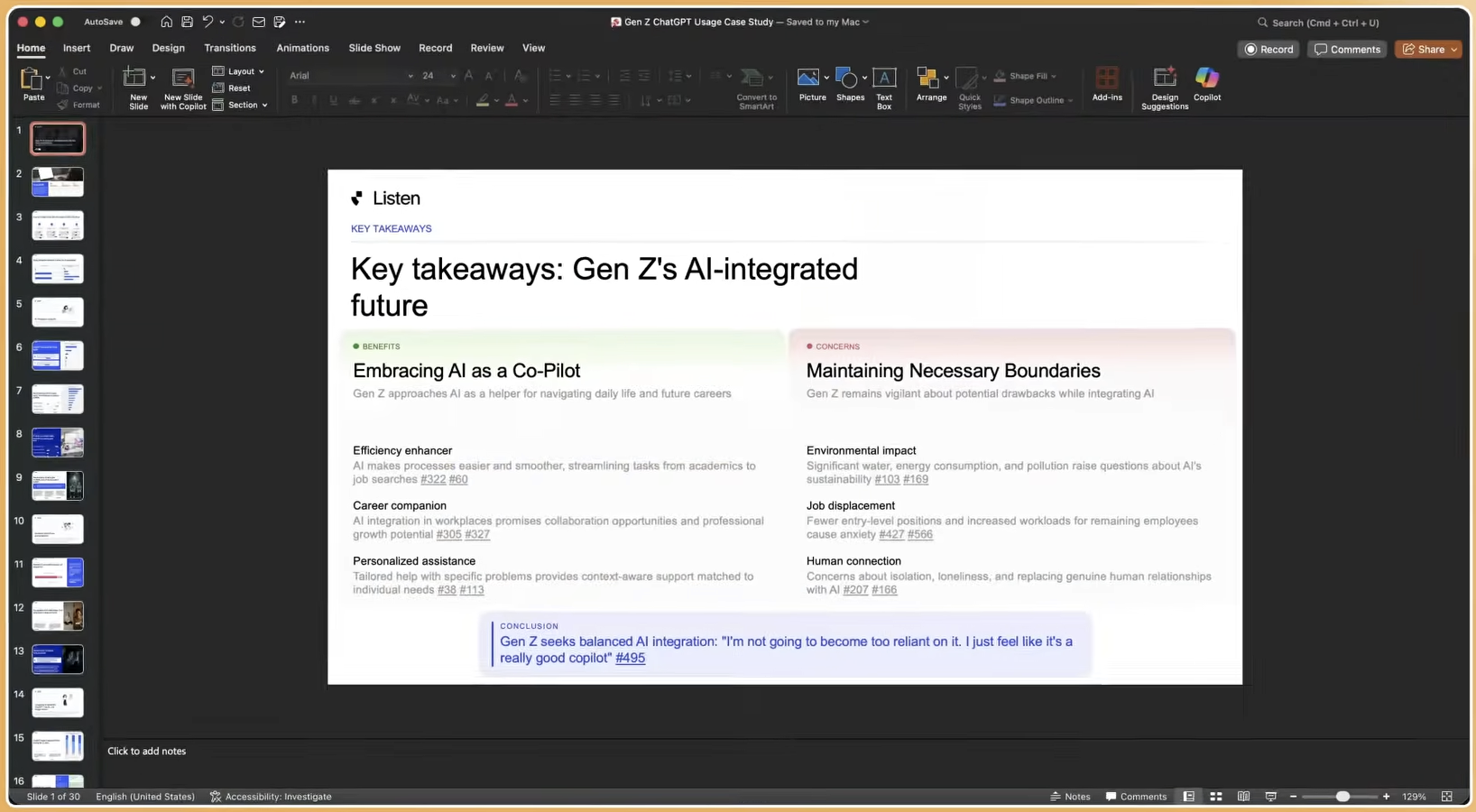
Listen Labs vs Quantitative Survey Tools: Qualitative Depth at Quant Scale
Survey platforms like SurveyMonkey and Qualtrics provide statistical scale through pre-set question formats. They cannot probe an unexpected answer, follow a thread of reasoning, or capture the hesitation before a response. Every insight is bounded by the questions the researcher thought to ask in advance, which means unknown unknowns remain unknown.
AI-moderated interviews can engage hundreds or thousands of participants remotely and asynchronously, while each conversation remains adaptive. When a participant gives a short or surprising answer, Listen Labs’ AI probes deeper in real time, mirroring the behavior of a trained human interviewer. The platform also combines qualitative depth with quantitative formats such as Likert scales, NPS, and MaxDiff in a single study. Teams avoid running separate qual and quant tracks and no longer need to reconcile conflicting data sets afterward.
Listen Labs vs Panel and Recruitment Platforms: Built-In Quality at Scale
Platforms such as Prolific, User Interviews, and Respondent solve the sourcing problem. They do not conduct interviews, analyze responses, or generate deliverables. Clients still need separate tools for every downstream step, and commodity panels carry well-documented risks: professional survey-takers, incentive-driven responses, and fraudulent profiles that undermine data quality.
Listen Labs integrates recruitment directly into the platform through Listen Atlas, an AI orchestration layer that matches participants across behavioral and intent data, not just self-reported demographics, within a network of 30M verified respondents across 45+ countries. Quality Guard monitors every interview in real time across video, voice, content, and device signals to detect fraud, low-effort responses, and repeat participants. To prevent the panel fatigue that undermines even verified respondents, participants are capped at three studies per month, which removes professional survey-takers from the pool. For segments where scale alone is not enough, such as enterprise decision-makers, healthcare workers, and audiences below 1% incidence rate, a dedicated recruitment operations team adds human judgment on top of the automated quality layer.
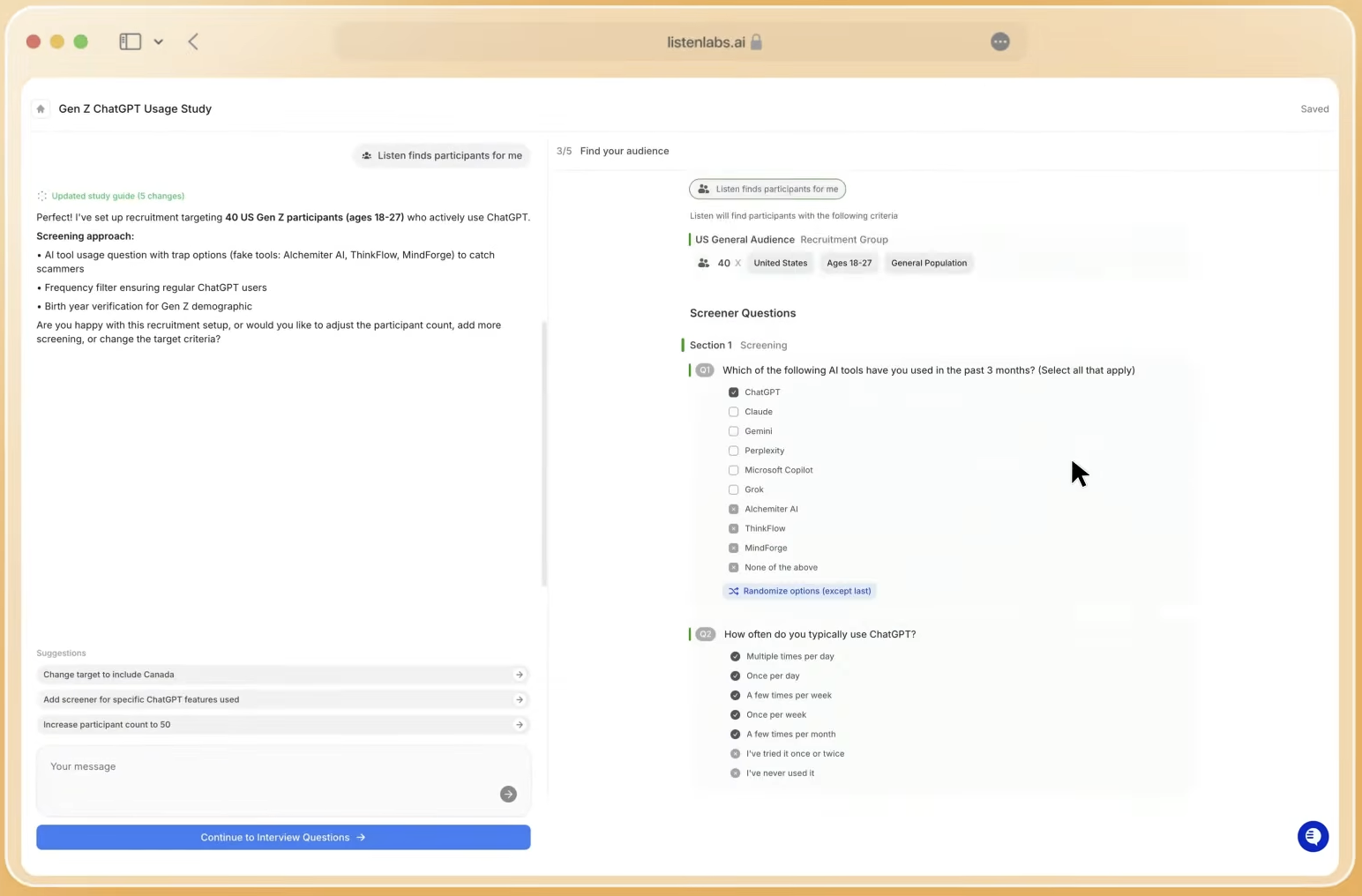
See Quality Guard and Listen Atlas in action for your next study.
Listen Labs vs Other AI Interview Tools: Methodology, Lifecycle, and Emotion
The emerging category of AI interview platforms varies significantly in depth and enterprise readiness. Many tools are built by software teams without embedded research methodology expertise, which produces products that automate the mechanics of an interview without the rigor that makes findings actionable. Narrower platforms also lack proprietary recruitment infrastructure, forcing clients back to third-party panels and the fraud risks that accompany them.
Listen Labs is differentiated by three structural advantages. First, the platform is built on 50+ years of combined in-house research expertise, with a methodology team that works directly alongside engineering so question design, probing logic, and analysis frameworks reflect best-in-class research practice. Second, AI can schedule and conduct interviews, analyze transcripts for themes, and generate quantitative insights from qualitative data within a single platform that covers the full research lifecycle. Third, Listen Labs’ Emotional Intelligence feature analyzes tone of voice, word choice, and subconscious micro-expressions using Ekman’s universal emotions framework, surfacing emotional signals that transcripts alone miss.
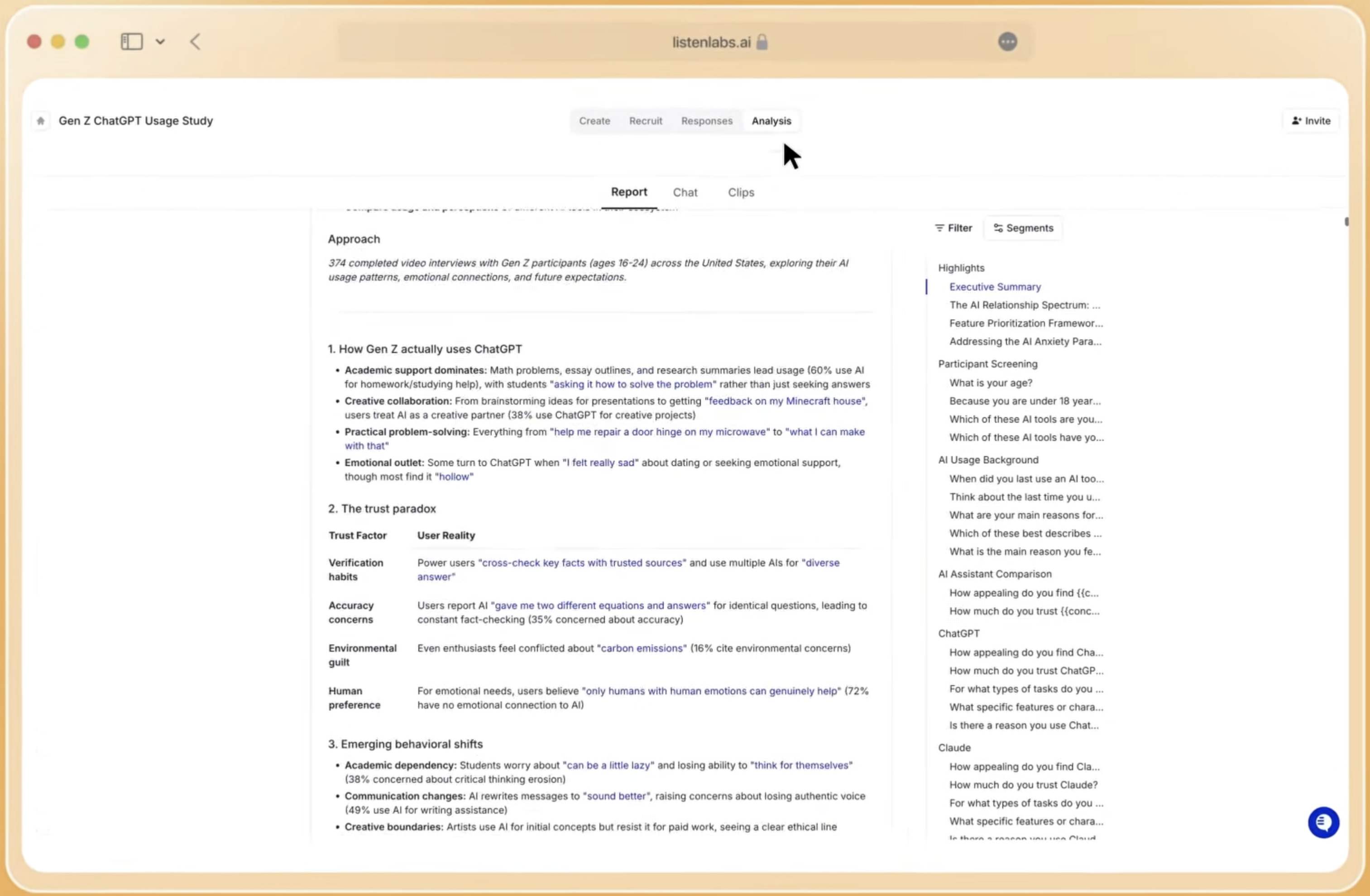
Every emotion label is traceable to the exact timestamp, verbatim quote, and reasoning behind it, and this capability is available across 50+ languages. This AI interviewer enables hundreds of one-on-one interviews to run at scale with emotional depth that competing tools do not capture.
Enterprise Compliance and Mission Control for Knowledge Retention
Fortune 500 procurement and legal teams require verifiable security and privacy standards before any platform touches customer data. Listen Labs holds SOC 2 Type II, ISO 27001, ISO 27701, and ISO 42001 certifications and operates in full GDPR compliance. Customer data is never used for AI model training. Enterprise SSO is supported, and all data is protected with 256-bit encryption.
Beyond certifications, Listen Labs addresses the institutional knowledge problem that plagues large research functions. Mission Control serves as a cross-study repository where every completed study grows a searchable knowledge base. Teams can query past research in seconds rather than re-running studies on questions that have already been answered. This compounding effect means each study makes the next one faster, reduces duplicated effort, and preserves institutional memory across team transitions.
Scenario-Based Guidance for Core Enterprise Teams
Consumer insights departments managing a growing backlog use Listen Labs as a force multiplier. The same team can run significantly more studies per quarter without adding headcount, clearing the queue of requests from product, brand, and marketing stakeholders. Anthropic’s Director of Product Strategy described the result: “Listen Labs lets us understand user churn with a level of clarity and speed we’ve never had before,” with 300+ user interviews completed in 48 hours and churn drivers surfaced five times faster than prior methods.
The same scalability advantages apply to specialized research functions with different methodological needs. For UX research leads, the platform supports screen sharing, mobile screen recording on iOS, and task-based study designs that enable usability testing at 50–100+ participants rather than the 5–10 typical of manually scheduled sessions. For product managers and marketing leaders without dedicated research staff, AI-assisted study co-design translates a plain-language research goal into a structured study guide, while recruitment, moderation, and analysis run automatically. P&G used Listen Labs to evaluate how men respond to new product claims, completing 250+ interviews with quantified themes in hours and shaping product and brand strategy before market launch.
Frequently Asked Questions
How does Listen Labs ensure participant quality at Fortune 500 scale?
Listen Labs applies three layers of quality control. The platform works exclusively with high-quality, non-commodity panel sources, avoiding professional survey-takers from incentive-driven commodity pools. Quality Guard runs real-time monitoring across video, voice, content, and device signals during every interview, detecting fraud, AI-generated scripts, low-effort responses, and mismatched profiles before they enter the data set. A dedicated recruitment operations team adds a human review layer for hard-to-reach audiences.
Participants are also limited to three studies per month across the platform, which prevents panel fatigue and repeat-respondent bias. This multi-layer system builds a reputation score across every interview and creates a compounding quality advantage that strengthens as the platform scales.
Can AI-moderated interviews match the depth of human researchers?
For the vast majority of enterprise research needs, Listen Labs delivers comparable methodological rigor to an experienced in-house research team and significantly better consistency than an under-resourced one. The AI probes short or unexpected answers in real time, adapts follow-up questions based on participant responses, and captures video, audio, and text simultaneously. The platform’s Emotional Intelligence layer adds a dimension that even skilled human moderators cannot systematically capture, including quantified micro-expression analysis, tone-of-voice signals, and word-choice patterns mapped to Ekman’s universal emotions framework at timestamp-level precision.
The in-house research team, with 50+ years of combined expertise, continuously reviews and refines the methodology. This oversight ensures the AI reflects best-in-class research practice rather than generic conversational AI behavior.
What compliance standards does Listen Labs meet for global enterprise data?
Listen Labs holds SOC 2 Type II, ISO 27001, ISO 27701, and ISO 42001 certifications and operates in full GDPR compliance. All data is protected with 256-bit encryption. Customer data is never used to train AI models. Enterprise SSO is supported for identity management. The platform covers 45+ countries across the Americas, Europe, APAC, and MEA, with interview moderation available in 100+ languages, which makes it suitable for global research programs that must meet varying regional data privacy requirements.
Will Listen Labs replace existing research teams?
Listen Labs functions as a force multiplier for existing research functions, not a replacement. The platform handles logistics-intensive work such as recruitment, scheduling, moderation, transcription, and initial analysis, which frees researchers to focus on strategic interpretation, stakeholder communication, and study design. Teams that previously ran a limited number of studies per quarter due to capacity constraints can scale their output significantly without adding headcount.
The platform’s Mission Control repository also preserves institutional knowledge across team changes. This reduces the dependency on individual researchers’ memories and files and keeps insights accessible long after a project ends.
Conclusion: Enterprise-Grade Qualitative Research in Hours
The depth-versus-scale trade-off that has defined enterprise customer research for decades comes from fragmented tooling and manual processes, not from any inherent limitation of qualitative methods. Listen Labs layers auto-recruiting, transcription, sentiment tagging, and insight summarization so teams move from question to findings in hours, not weeks. With SOC 2 Type II, ISO 27001/27701/42001, and GDPR certifications, a 30M-respondent verified network, real-time fraud detection, and Emotional Intelligence analysis built on Ekman’s framework, Listen Labs is an end-to-end AI research platform purpose-built for Fortune 500 scale.
The same companies mentioned throughout this article, including Microsoft, P&G, Anthropic, Google, Sony, and Nestlé, chose Listen Labs for a reason. See how Listen Labs delivers enterprise-grade qualitative research at scale and compresses your research cycle to under 24 hours.