Written by: Anish Rao, Head of Growth, Listen Labs
Key Takeaways for 2026 Media Insights Buyers
- Traditional qualitative research projects take 6–12 weeks, while AI-moderated platforms like Listen Labs deliver results in under 24 hours.
- AI-first platforms reduce costs by approximately two-thirds compared to traditional agencies while maintaining or improving insight depth and quality.
- Listen Labs stands out with adaptive AI interviews, emotional intelligence analysis across tone, language, and micro-expressions, and automated reporting capabilities.
- Enterprise clients including Microsoft, Anthropic, and P&G have achieved measurable impact through sub-24-hour turnaround and scalable qualitative research at a fraction of traditional costs.
- Listen Labs offers enterprise-grade media consumer insights services with SOC 2 Type II and ISO certifications; book a demo to experience the platform.
How to Evaluate Media Consumer Insights Partners
Set a clear evaluation framework before you compare vendors. The following criteria apply across every category of research partner and will appear throughout this guide.
- Research speed and time-to-insight
- Depth of insight and qualitative richness
- Sample quality and fraud prevention
- Participant sourcing and global reach
- Methodological flexibility across study types
- Language and geographic coverage
- Analysis effort required from internal teams
- Reporting transparency and traceability
- Governance, security, and compliance certifications
- Scalability and total operational burden
Every comparison in this guide maps back to these criteria, from pricing and AI capabilities to vendor types and operational models. Vendors that excel on only a few dimensions create trade-offs that compound over time, especially for teams with growing research backlogs.
Media Consumer Insights Pricing Across Methods
Media consumer insights costs vary widely by methodology and vendor type. Full-service research agencies charge $20,000–$75,000 per qualitative consumer insights study for end-to-end management including recruiting, screening, moderation, analysis, and reporting, with typical turnaround of 6–12 weeks. Within that range, traditional human-moderated in-depth interviews cost $500–$1,500 per 60-minute session, with a standard 20-interview study running $15,000–$30,000 including recruitment, incentives, moderation, transcription, and analysis. A single round of four focus groups across two cities commonly runs tens of thousands of dollars before travel or translation costs.
Panel-based quantitative approaches sit in the middle tier on both cost and depth. Online panel surveys with 1,000 completes from general population audiences cost $15,000–$50,000, with targeted or complex audiences pushing costs higher. Conjoint or MaxDiff studies typically add further cost for design, programming, and analysis.
AI-moderated platforms represent a structural cost reduction rather than a quality compromise. Unlike traditional agencies that bundle high-touch human labor into every price point, AI-moderated research platforms charge competitive rates per interview while delivering similar depth through adaptive technology. Listen Labs prices interviews at competitive rates per participant, so a 200-interview study runs at roughly one-third of a comparable traditional qualitative engagement and completes in under 24 hours instead of six to twelve weeks. At scale, traditional agency research for 100 interviews can exceed $150,000, while AI-moderated equivalents cost substantially less even when analysis and reporting are included.
Hidden costs in traditional research widen the gap further. Recruitment and screening represent 20–30% of qualitative budgets for a typical 10-interview project. Internal time spent on logistics, vendor management, and manual analysis adds additional, often untracked, expense.
AI Capabilities That Matter for Media Consumer Insights
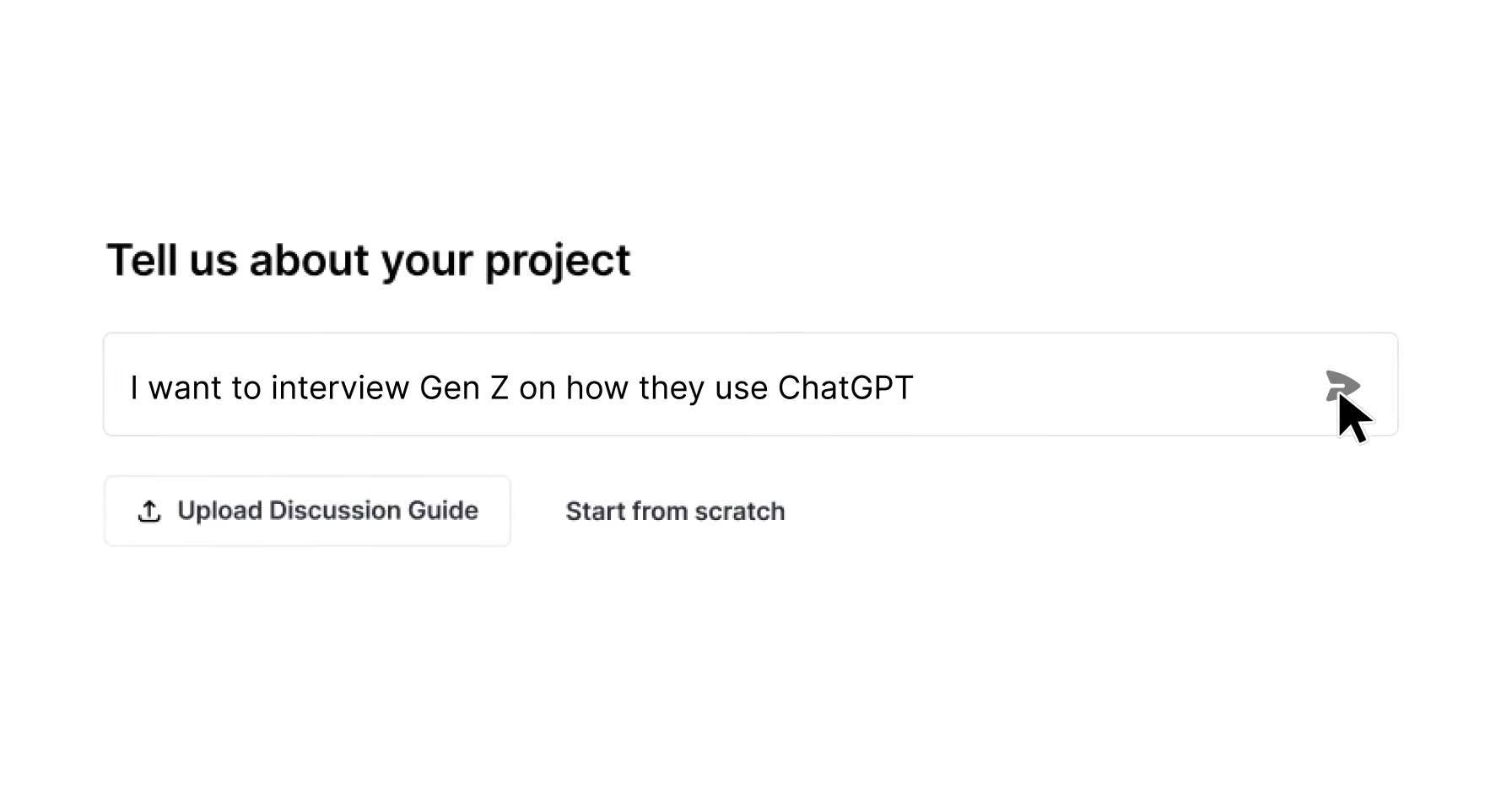
The strongest AI platforms for consumer insights share a set of concrete capabilities that change both speed and depth. Adaptive conversational interviews form the foundation. Rather than presenting fixed questions, the AI probes deeper based on each participant's responses and mirrors the behavior of a trained human moderator. AI can schedule and conduct the interview, analyze the transcripts for themes, and generate quantitative insights from those interviews, all within a single workflow that reduces analysis effort for internal teams.
Listen Labs extends this foundation with an Emotional Intelligence layer that analyzes three simultaneous signal streams: tone of voice, word choice, and subconscious micro-expressions. Built on Ekman's universal emotions framework, the same standard used in clinical psychology, every emotional label is quantified per question and traceable to the exact timestamp, verbatim quote, and reasoning behind it. This distinction matters because what people say and what people feel represent different data points. Two concepts may both receive positive verbal ratings while triggering entirely different emotional responses that shape real-world behavior.
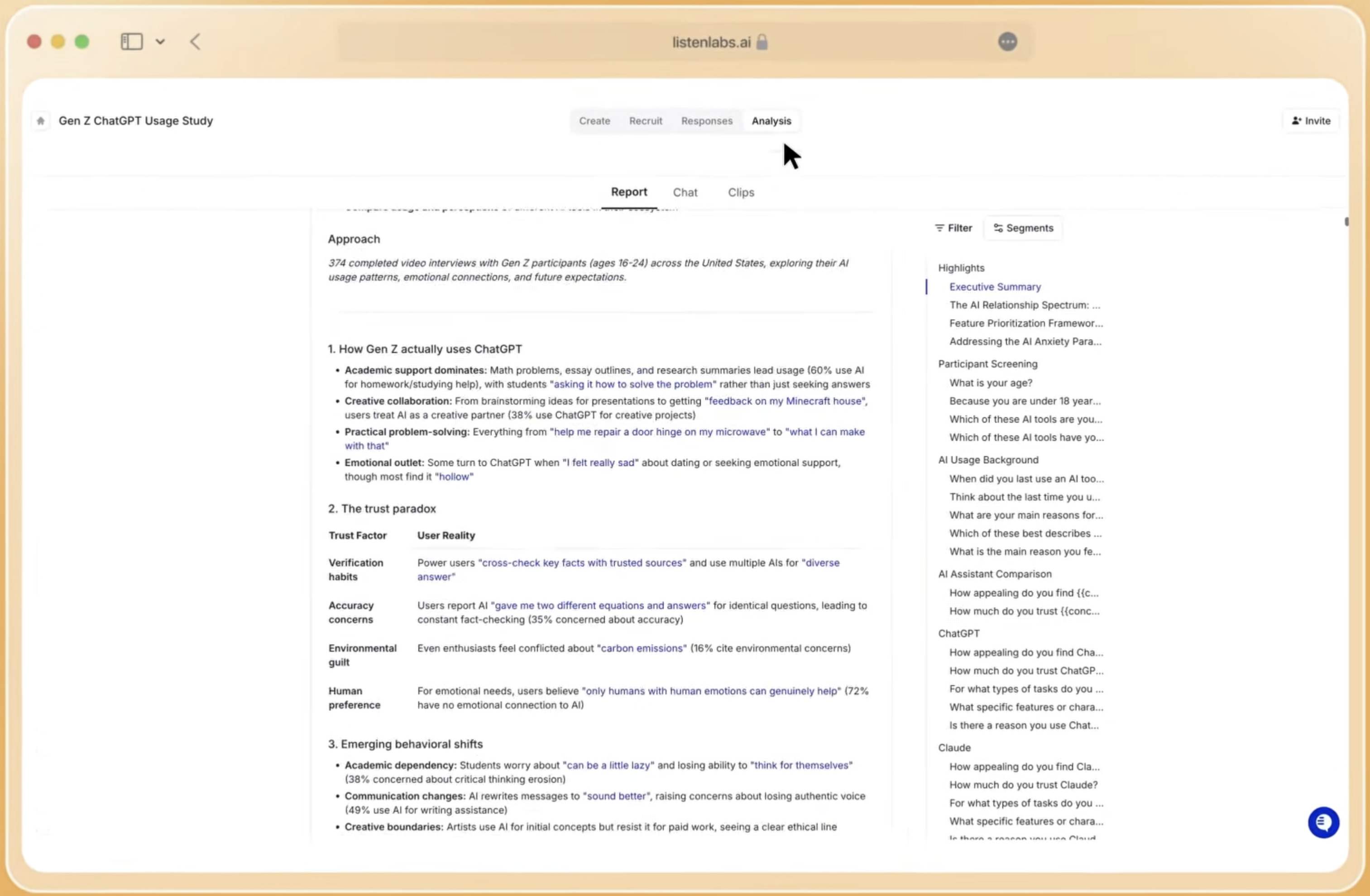
Parallel execution most directly addresses the depth-versus-scale trade-off discussed in the evaluation criteria. Qual-at-scale becomes viable when research requires large sample sizes or broad geographic reach because AI tools can engage hundreds or thousands of participants remotely and asynchronously. Listen Labs uses this parallel capacity to run hundreds of adaptive interviews at the same time, and because interviews complete together rather than sequentially, the Research Agent can generate automated key findings, themes, personas, slide decks, memos, video highlight reels, and statistical charts in under a minute from the full dataset. This speed creates a secondary advantage for long-term scalability and knowledge management. Mission Control stores every study in a searchable institutional knowledge base, enabling cross-study queries and trend tracking without digging through old reports.
Leading Media Consumer Insights Providers in 2026
Traditional agencies such as Kantar, Ipsos, and Nielsen deliver methodological rigor and deep category expertise. Kantar offers brand monitoring, creative testing, and custom quantitative and qualitative research. Ipsos delivers global studies spanning brand health, customer experience, and behavioral science across 90-plus countries. These agencies excel at complex, high-stakes engagements such as executive interviews, ethnographic fieldwork, and court-defensible studies where human presence and credibility are non-negotiable. Their limitation is structural and ties back to time-to-insight and operational burden. Sequential workflows mean most projects run 4–12 weeks, and in practice, many traditional agency research projects extend beyond stated benchmarks.
Panel and recruitment platforms such as Prolific, User Interviews, and Respondent focus on participant sourcing. They do not conduct interviews, analyze responses, or produce deliverables. Teams using these platforms still need separate tools for moderation, transcription, coding, and reporting. Each handoff introduces delay, coordination overhead, and potential quality risk across multiple tools and teams.
Quantitative survey tools such as SurveyMonkey and Qualtrics scale efficiently but sacrifice depth and adaptive probing. Pre-set questions with no follow-up cannot uncover unexpected findings, emotional nuance, or the reasons behind stated preferences. Analysis tools like Dovetail organize past research but do not conduct new studies, so they address reporting transparency and knowledge management rather than speed or sample quality.
Listen Labs leads the end-to-end AI interview category and aligns strongly with the evaluation criteria across speed, depth, sample quality, and scalability. Listen Labs has run over 1 million AI-powered customer interviews for companies including Microsoft, Perplexity, and Sweetgreen, and raised $69 million in a Series B funding round led by Ribbit Capital at a valuation over $500 million as of January 2026. The platform covers the entire research lifecycle in a single system, including study design, global recruitment, AI-moderated interviews, emotional analysis, automated reporting, and institutional knowledge management.
Traditional vs. AI-First: Timelines and Quality Controls
Now that the major vendor categories are clear, the next step is understanding how their operating models affect outcomes. Traditional qualitative research follows a sequential operational model. Traditional in-depth interviews often take several weeks from brief to final report. Multi-market studies compound this problem and can require 8–12 weeks or longer because each phase waits for the previous one to finish.
AI-first platforms execute all phases in parallel, which directly improves research speed and total operational burden. AI-moderated interviews deliver results in 24 hours total with no bottlenecks because all phases run in parallel. Recruitment, interviewing, transcription, analysis, and reporting occur in a single continuous workflow instead of a chain of handoffs.
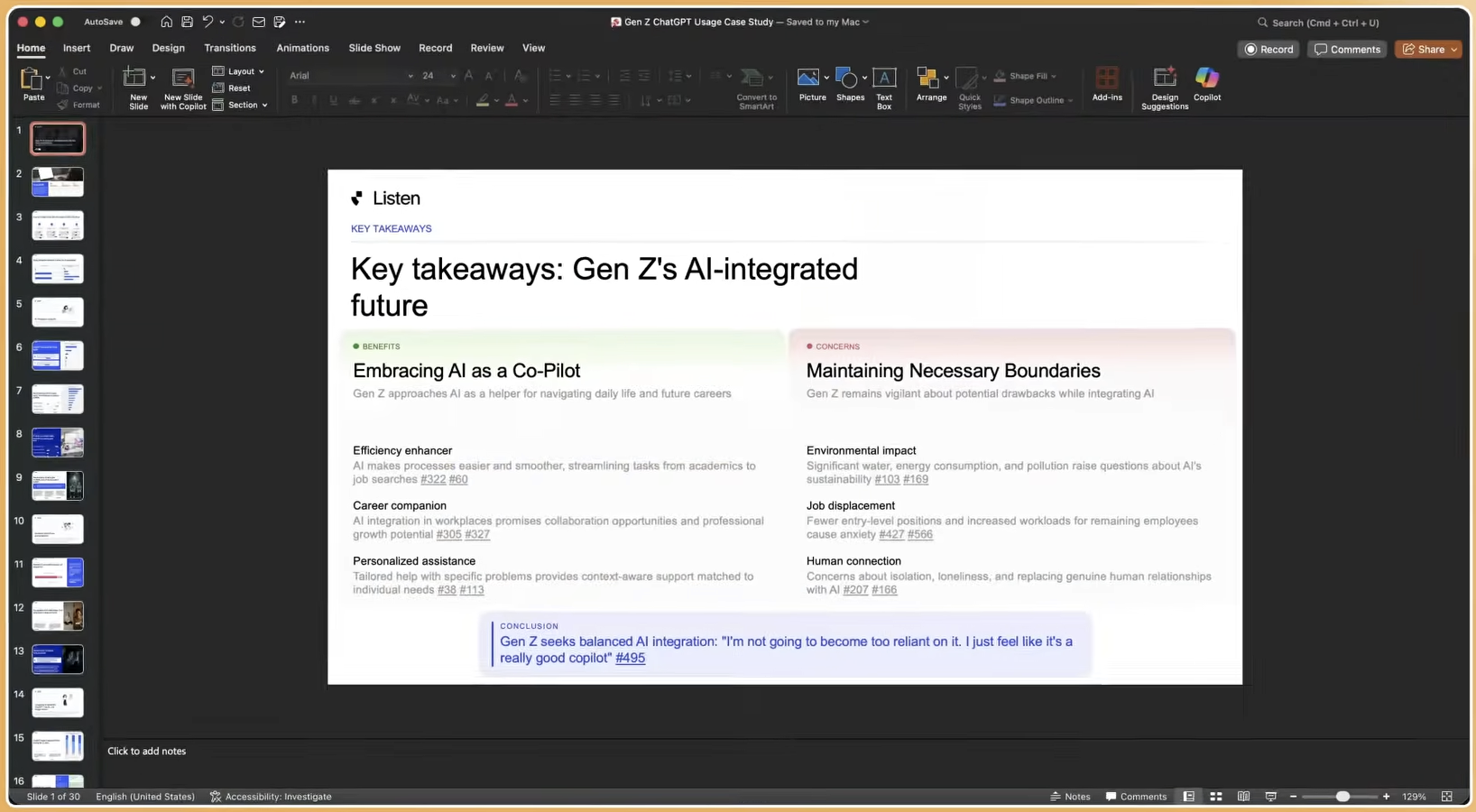
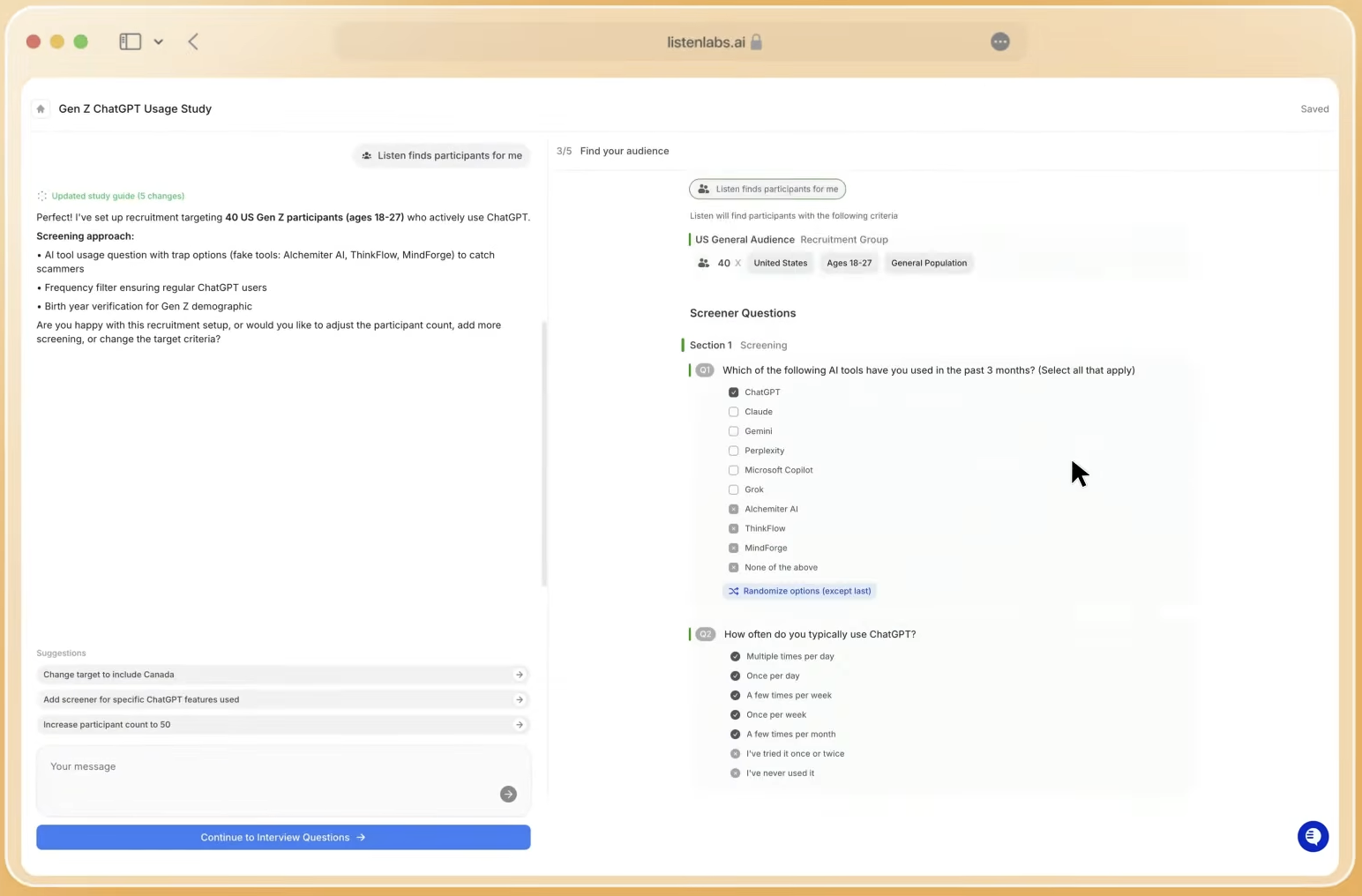
Quality controls represent a second major point of differentiation and connect directly to sample quality and fraud prevention in the evaluation criteria. Listen Atlas, the AI orchestration layer, matches participants across behavioral and intent data, not just self-reported demographics, drawing from a 30M-plus verified respondent network across 45-plus countries and 100-plus languages. Quality Guard monitors every interview in real time across video, voice, content, and device signals to detect fraud, low-effort responses, AI-generated scripts, and mismatched profiles. Participants are limited to three studies per month, which removes professional survey-takers and reduces panel fatigue. A dedicated recruitment operations team adds a human review layer for hard-to-reach segments including enterprise decision-makers, healthcare workers, and audiences below 1% incidence rate.
Enterprise Case Studies with Measurable Impact
Microsoft needed to collect global customer stories for its 50th anniversary celebration at speed and scale. Using Listen Labs, the team gathered user video stories within a single day. The Director of Data Science at Microsoft reported: "Our leadership team was very thrilled at both the speed and the scale that Listen Labs enabled. I can reach out to hundreds of users at one third of the cost."
Anthropic needed to understand why Claude users cancel their subscriptions. Listen Labs delivered 300-plus user interviews in 48 hours, surfacing churn drivers five times faster than traditional methods, identifying where former users migrate, and producing a prioritized list of ten must-fix items. The Director of Product Strategy at Anthropic stated: "Listen Labs lets us understand user churn with a level of clarity and speed we've never had before."
Procter & Gamble used Listen Labs to evaluate how men respond to new product claims before market launch. The platform delivered 250-plus interviews with quantified themes and verbatim proof in hours, directly shaping product and brand strategy. Skims validated campaign direction with thousands of high-income buyers overnight, enabling board-level buy-in before a global launch. Robinhood used qualitative interviews to reveal that users who view prediction markets as entertainment drive 2.4x higher weekly re-engagement, with insights delivered five times faster than traditional methods.
Best-Fit Use Cases for Modern Insights Teams
Different research scenarios align with different strengths across the evaluation criteria. Consumer insights leaders managing large backlogs benefit most from Listen Labs' ability to run multiple studies simultaneously, compressing a quarterly research calendar into weeks without adding headcount. UX research leads who need to test with 50–100-plus users instead of five to ten find that Listen Labs' screen-sharing and usability testing capabilities, combined with parallel interview execution, fit naturally into sprint cycles.
Product managers and marketing leaders without dedicated research teams can describe their goals in natural language and have the platform handle study design, recruitment, moderation, and analysis automatically. Agencies and consultancies operating under client deadlines use Listen Labs to reach niche audiences such as enterprise decision-makers, engineers, and healthcare workers within days rather than weeks, at a fraction of the cost of bespoke agency engagements.
Platforms like Listen Labs layer on auto-recruiting, transcription, sentiment tagging, and insight summarization so teams jump from question to findings in hours, not weeks. Supported study types span concept and prototype testing, usability testing with screen sharing, creative testing, brand perception studies, consumer journey mapping, multi-market segmentation, ad testing, pricing research, and survey open-end analysis.
Operational and Long-Term Platform Considerations
Adopting an AI-first research platform requires alignment across research, legal, IT, and procurement teams. Listen Labs holds SOC 2 Type II, GDPR, ISO 27001, ISO 27701, and ISO 42001 certifications. Customer data is never used for AI model training, and all data is protected with 256-bit encryption. Enterprise SSO is supported for seamless IT integration and governance.
Long-term value compounds through Mission Control, which serves as the organization's source of truth for everything ever learned from customers. Each study grows the institutional knowledge base, enabling cross-study queries and trend tracking in seconds. Teams that previously re-ran similar studies because findings were scattered across reports and slide decks can instead build on prior work systematically.
Change management remains straightforward for most enterprise teams. Listen Labs functions as a force multiplier for existing research teams, not a replacement. Researchers focus on strategic analysis and stakeholder communication while the platform handles logistics, moderation, and first-pass analysis.
Risks, Limitations, and Misconceptions About AI Research
Shallow data is the most common risk in media consumer insights, and it usually stems from rigid methodologies rather than AI moderation. Fixed-question surveys cannot probe unexpected responses. Qualitative data methods make up for limitations in speed and sample size tenfold in their ability to uncover nuance and complexity in human decision-making, and AI-moderated interviews preserve that probing depth at scale.
Fraud risk is real in commodity panel research and directly affects sample quality. Dominant cost drivers in conventional research include panel recruiting fees of $100–$300 per respondent, yet those panels frequently contain professional survey-takers and fraudulent profiles. Listen Labs' Quality Guard addresses this through real-time behavioral monitoring and participant frequency limits.
Overestimating automation is another common misconception. Sample quality remains the non-negotiable foundation because AI cannot compensate for poor respondent selection or non-reflective input. Listen Labs addresses this through Listen Atlas and Quality Guard rather than treating recruitment as a commodity step. The Research Agent generates deliverables automatically, and researchers retain full access to underlying data, verbatim quotes, and emotional timestamps to verify and extend findings.
Decision Framework and Vendor Checklist
Matching research options to specific goals, timelines, budgets, and internal capabilities simplifies vendor selection and keeps decisions aligned with the evaluation criteria.
- If the decision requires results in under 48 hours and qualitative depth with 50-plus participants, an AI-moderated platform is the only viable option.
- If the study involves executive interviews, ethnographic fieldwork, or court-defensible research, a traditional agency with human moderators remains appropriate.
- If the goal is quantitative validation at scale with no need for adaptive follow-up, a survey panel tool is cost-effective.
- If the team needs participant sourcing only and has internal moderation and analysis capacity, a standalone recruitment platform may suffice.
- If the organization runs more than three studies per quarter and needs institutional knowledge to accumulate across them, an end-to-end AI platform with a built-in knowledge repository is the highest-ROI investment.
For most Fortune 500 consumer insights teams managing growing backlogs, the combination of sub-24-hour turnaround, 30M-plus verified participants, adaptive AI moderation, emotional intelligence analysis, and automated deliverables makes Listen Labs the operationally superior choice across the majority of research use cases.
Frequently Asked Questions
How quickly can Listen Labs deliver results compared to a traditional research agency?
Listen Labs compresses the entire research cycle, including study design, recruitment, moderation, analysis, and deliverables, to under 24 hours. As noted earlier, traditional agencies operate on 6–12 week timelines for similar scopes because they rely on sequential workflows, with multi-market studies extending to 10–16 weeks. The speed difference is structural. Listen Labs runs hundreds of interviews in parallel, and automated analysis begins as conversations close instead of waiting for all fieldwork to finish.
How does Listen Labs ensure participant quality and prevent fraudulent responses?
Listen Labs applies three layers of quality control. First, it sources participants exclusively from high-quality, non-commodity panels, avoiding professional survey-takers. Second, Quality Guard monitors every interview in real time across video, voice, content, and device signals to detect fraud, low-effort responses, AI-generated scripts, and mismatched profiles. Third, a dedicated recruitment operations team adds human review for hard-to-reach segments, and participants are limited to three studies per month to prevent panel fatigue and repeat respondents.
Does Listen Labs support multilingual and multi-market research?
Yes. Listen Labs supports 100-plus languages for interview moderation, with automatic translation and transcription across all supported languages. The Emotional Intelligence layer is available across 50-plus languages. The platform covers 45-plus countries across the Americas, Europe, APAC, and MEA, and can execute multi-market studies simultaneously rather than sequentially, delivering results from five markets in the same 24-hour window as a single-market study.
What security and compliance certifications does Listen Labs hold?
Listen Labs maintains SOC 2 Type II, GDPR, ISO 27001, ISO 27701, and ISO 42001 certifications. All data is protected with 256-bit encryption. Customer data is never used for AI model training. Enterprise SSO is supported for IT integration. These certifications satisfy the compliance requirements of Fortune 500 procurement and legal teams across regulated industries including financial services, healthcare, and CPG.
Will adopting Listen Labs require replacing our existing research team?
No. Listen Labs functions as a force multiplier for existing research teams. The platform handles logistics, recruitment, moderation, and first-pass analysis so researchers can focus on strategic interpretation, stakeholder communication, and high-judgment decisions. Teams that previously ran four to six studies per quarter can run significantly more with the same headcount, clearing backlogs and responding to internal requests that previously went unfulfilled.
Conclusion: Setting a New Standard for Media Consumer Insights
The trade-off discussed throughout this guide, depth versus scale, is no longer a structural constraint. Listen Labs removes that constraint through a 30M-plus verified participant network, AI-moderated adaptive interviews, an Emotional Intelligence layer that captures what transcripts miss, a Research Agent that generates consultant-quality deliverables in under a minute, and Mission Control that builds institutional knowledge across every study. With qual-at-scale, the old trade-off between depth and scale is no longer a barrier.
For consumer insights leaders evaluating media consumer insights services in 2026, the core decision now centers on how quickly teams can redirect hours spent on logistics, transcription, and manual coding toward strategic work that drives business decisions. Enterprise clients including Microsoft, Anthropic, P&G, Skims, and Robinhood already operate on this new standard.