
Written by: Anish Rao, Head of Growth, Listen Labs
Key Takeaways for Retail Research Leaders
- Retail teams face mounting pressure from high cart abandonment and widening gaps between stated and actual shopper behavior across digital and physical channels.
- Traditional research tools force a trade-off between qualitative depth and quantitative scale, leaving critical gaps in omnichannel coverage and emotional insight.
- AI-moderated interview platforms are the fastest-growing category, enabling conversational depth at scale with verified retail shoppers and rapid analysis.
- Listen Labs stands out by combining a 30M+ verified shopper network, real-time fraud detection, multimodal emotional analysis, and consultant-quality deliverables in under 24 hours.
- Retail teams can replace fragmented tool stacks with a single end-to-end platform, and can book a demo with Listen Labs to see how omnichannel shopper insights are delivered at scale.
Evaluation Criteria for Retail User Research Tools
Selecting the right tool stack starts with clear criteria that match omnichannel retail realities. The eight criteria used throughout this article are:
- Research speed: Time from study brief to actionable findings, critical when seasonal windows and campaign timelines are fixed.
- Digital and in-store capture: Ability to gather data across websites, apps, and physical store environments in a unified workflow.
- Sample quality for retail audiences: Access to verified shoppers, high-income buyers, loyalty members, or niche segments without panel fraud.
- Omnichannel journey coverage: Capacity to synthesize insights across touchpoints rather than reporting on each channel in isolation.
- Analysis speed: Time required to move from raw data to structured themes, quotes, and recommendations.
- Deliverable quality: Whether outputs are stakeholder-ready or require significant manual processing.
- Scalability for seasonal needs: Ability to surge research capacity during peak retail periods without proportional cost increases.
- Total cost of ownership: Platform fees, panel costs, analyst time, and tool fragmentation overhead combined.
Behavioral Analytics and Conversion Tools for Digital Funnels
Behavioral analytics platforms, including FullStory, Hotjar, and Contentsquare, help retail ecommerce teams quantify what shoppers do on digital properties. These tools identify where users drop off in checkout flows, which product pages generate high dwell time, and where rage clicks signal friction. Increasing an ecommerce conversion rate from 2% to 3% translates to 50% more revenue, so funnel visibility directly affects revenue.
Contentsquare’s AI analysis layer can move analysts from data to action in minutes, according to practitioners using the platform. For digital channel performance, these tools deliver speed and scale.
Structural limits remain. Behavioral analytics tools capture clicks, scrolls, and session recordings, but they do not explain motivation. They have no coverage of physical store environments, where dwell time and path flow data require separate retail analytics infrastructure. They also cannot conduct follow-up conversations to understand why a shopper abandoned a cart or avoided a product category. Teams that need the “why” behind behavioral data must add a second tool category.
Usability and Prototype Testing Tools for UX Validation
Usability and prototype testing platforms extend this stack by explaining how shoppers interact with specific flows and interfaces. While behavioral analytics reveal what shoppers do, these tools focus on interaction quality and friction points. Platforms including Maze, UserTesting, and Sprig serve retail UX teams validating navigation flows, new feature concepts, and merchandise presentation before launch. Nielsen Norman Group research indicates that testing with just five users can uncover approximately 85% of a product’s usability problems, which shows why usability platforms have become standard infrastructure for retail UX teams.
Maze combines recruiting, unmoderated prototype testing, and AI synthesis in a single environment, with dynamic follow-up questions and bias detection built into its AI features. Sprig captures feedback and behavioral data directly within live products, combining in-product surveys, session replays, and heatmaps with AI that surfaces themes and sentiment in real time. UserTesting offers a panel spanning 60+ countries with enterprise compliance certifications including SOC 2, ISO 27001, GDPR, and HIPAA.
The category’s primary gap for retail teams is conversational depth at scale. Unmoderated tests capture task completion and surface-level reactions, but they do not probe the emotional reasoning behind a shopper’s hesitation on a product detail page or confusion with a loyalty rewards interface. Sample sizes in moderated sessions remain small, and physical store research sits outside the scope of these platforms.
Voice of Customer and Survey Platforms for Scaled Feedback
Voice of Customer and survey platforms, including Qualtrics, Typeform, and Alida, support post-purchase feedback, loyalty program research, and NPS tracking across retail organizations. These tools scale efficiently, since a post-purchase survey can reach thousands of shoppers within hours of transaction completion.
That scalability comes with a depth constraint. Pre-set survey questions cannot follow up on an unexpected response. A shopper who rates their in-store experience a 6 out of 10 cannot be asked in real time what specifically drove that rating. Qualitative data methods make up for limitations in speed and sample size tenfold in their ability to uncover nuance and complexity in human decision-making, which surveys structurally cannot match. For loyalty program research and campaign validation that require emotional context, survey platforms deliver volume without the insight quality retail leaders need for high-stakes decisions.
AI-Moderated Interview and Qual-at-Scale Platforms for Depth and Speed
AI-moderated interview platforms now give retail teams qualitative conversations at scale. The qualitative research software market is growing quickly, driven by AI. According to the Maze Future of User Research Report 2026, 88% of researchers identified AI-assisted analysis as the number one trend shaping the field, and 62% of researchers are using AI for research and/or publication-related tasks, up from 45% in 2024.
Emerging platforms in this category include Conveo, which captures verbal, tonal, and visual signals with a traceable evidence chain, and Outset, which supports shopalongs, in-home usage tests, and diary studies alongside AI-moderated interviews. Both address parts of the retail research problem. Listen Labs addresses the full stack.
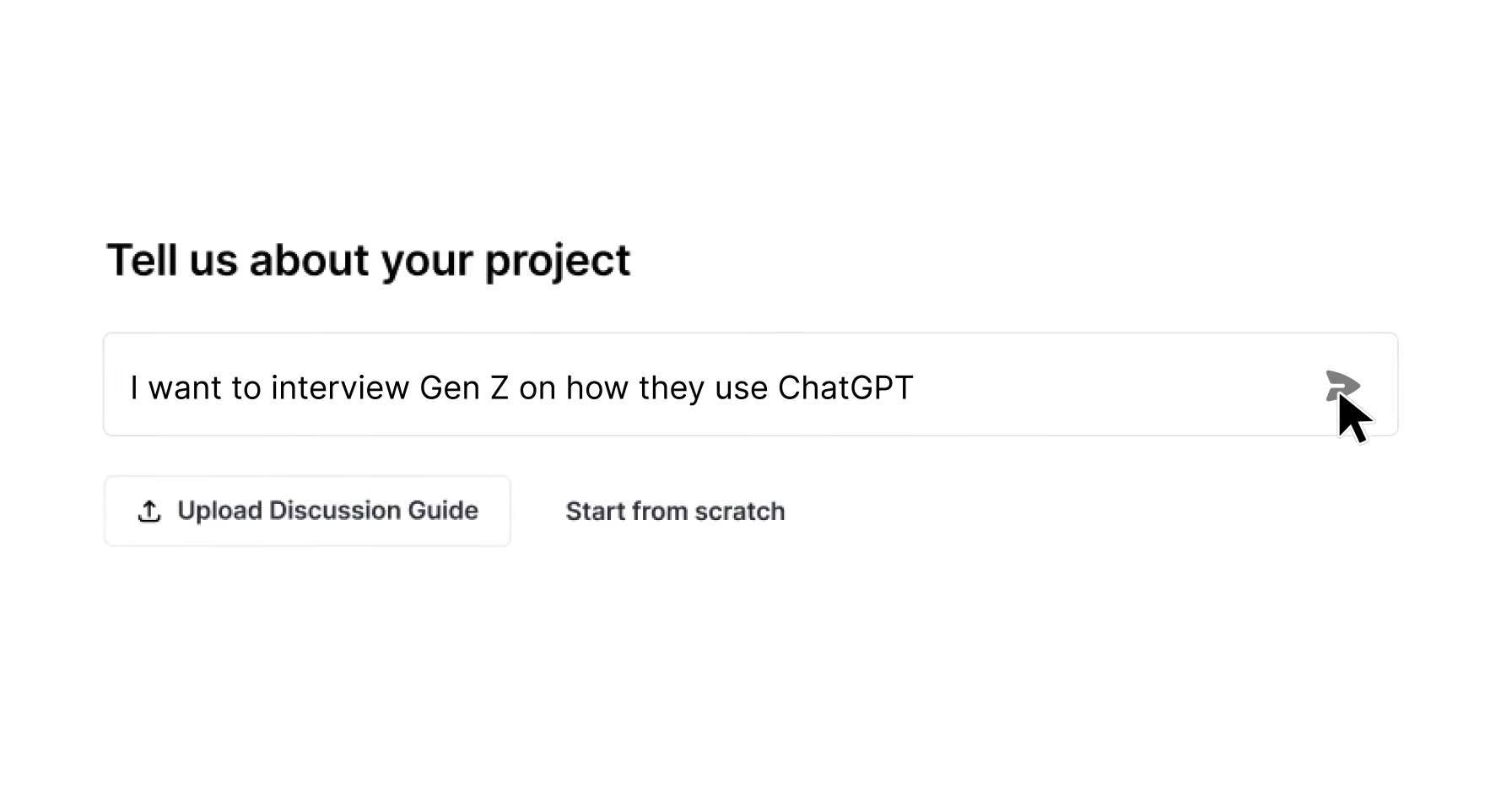
Listen Labs has run over 1 million AI-powered customer interviews for companies including Microsoft, Perplexity, and Sweetgreen, and raised $69 million in a Series B funding round led by Ribbit Capital at a valuation over $500 million as of January 2026. The platform’s retail-specific capabilities form an integrated research system that spans recruitment, moderation, analysis, and knowledge management.
Listen Atlas provides the foundation with a global panel of 30M verified respondents across 45+ countries and an AI orchestration layer that matches participants on behavioral and intent data, not just self-reported demographics. A dedicated recruitment operations team sources hard-to-reach segments, including high-income shoppers, loyalty program members, and audiences below 1% incidence rate.
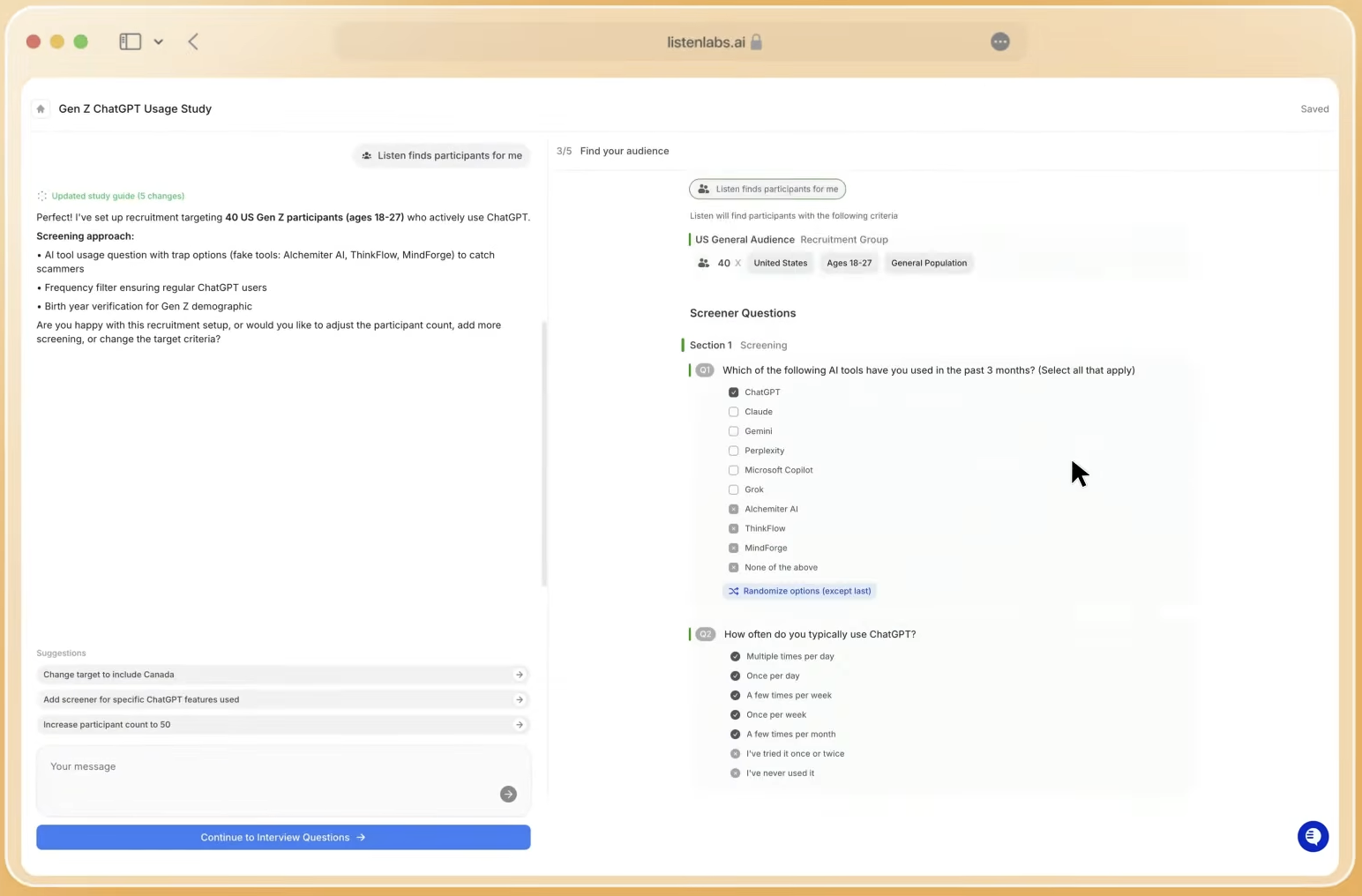
Quality Guard then protects sample integrity through real-time fraud detection across video, voice, content, and device signals, while capping participants at three studies per month to eliminate professional survey-takers. These verified participants engage through AI-Moderated Interviews that adapt in real time, conduct conversations in 100+ languages, ask dynamic follow-up questions, and capture screen recordings for usability testing with mixed methods such as Likert scales, NPS, and MaxDiff.
During these interviews, Emotional Intelligence analyzes tone of voice, word choice, and facial micro-expressions using Ekman’s universal emotions framework. Every emotion is quantified per question and linked to a timestamp, verbatim quote, and reasoning across 50+ languages. Research Agent then converts this rich data into stakeholder-ready outputs, generating slide decks, memos, video highlight reels, and statistical charts from interview data, while natural-language queries return segmented findings in under a minute.
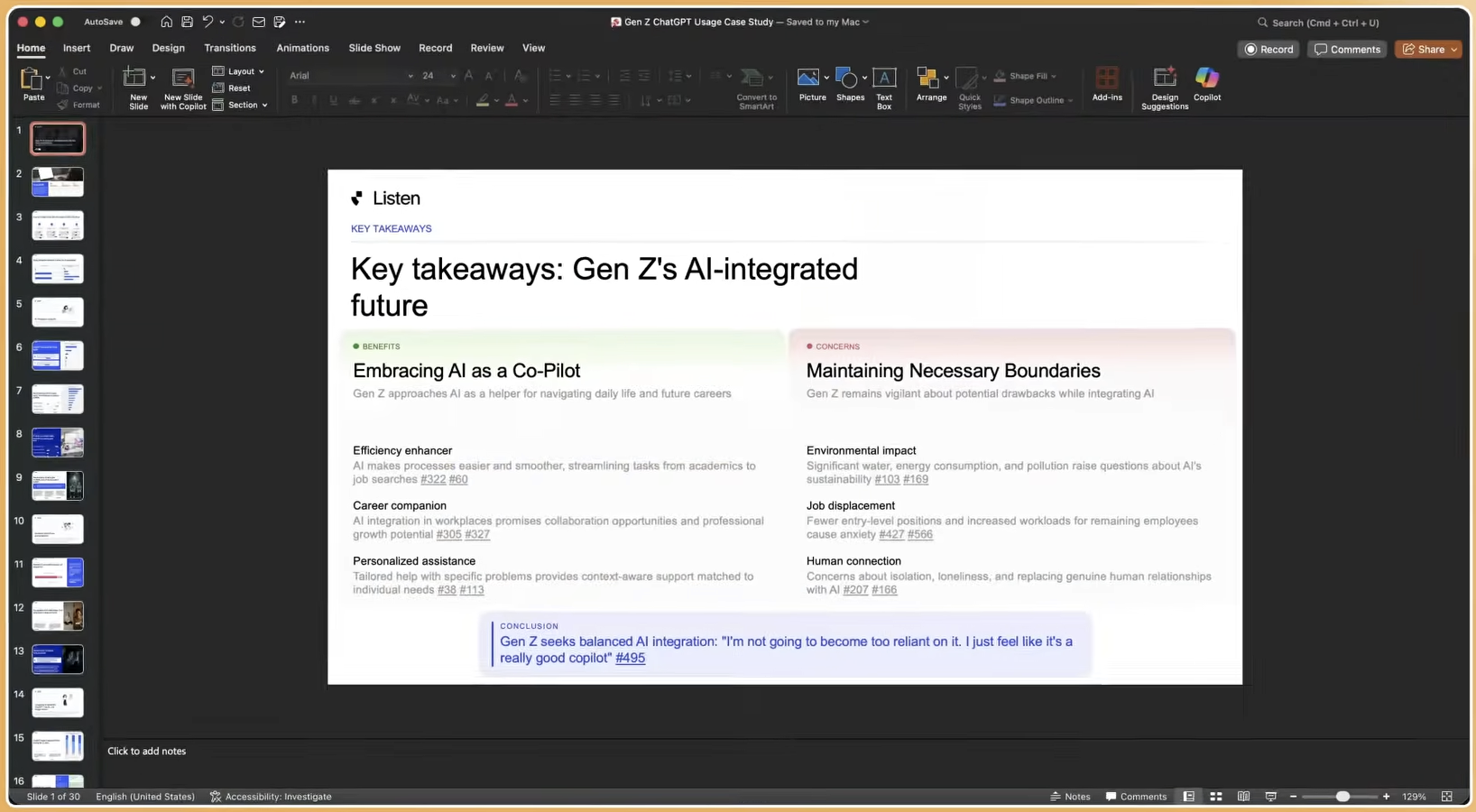
Mission Control preserves institutional knowledge by making every past interview queryable, so teams can track trends across loyalty, merchandising, and shopper journey research without re-running studies. Traditional focus groups take 3–5 weeks and $4,000–$12,000 per 90-minute session. Listen Labs compresses the full research cycle, from study design through recruitment, moderation, analysis, and deliverables, to under 24 hours. For Skims, the platform identified and qualified thousands of premium consumers overnight, enabling campaign validation before launch and securing board-level buy-in. For P&G, 250+ interviews with quantified themes shaped product and brand strategy in hours rather than weeks.
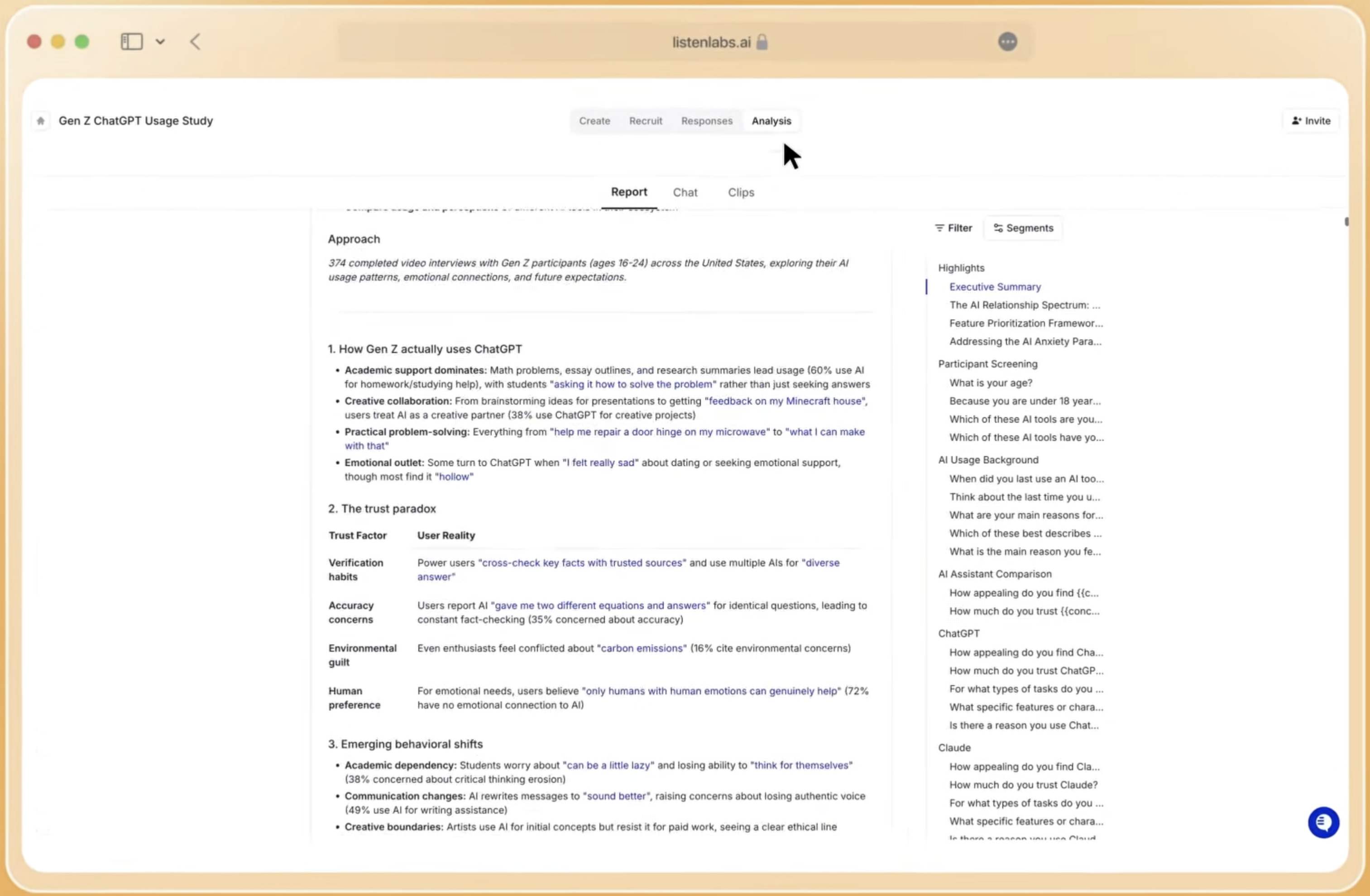
With qual-at-scale, the old trade-off between depth and scale is no longer a barrier, and Listen Labs leads this category with a deep data moat, proprietary recruitment infrastructure, and a full-stack platform that no point solution replicates.
Book a demo to see how Listen Labs runs omnichannel retail shopper research in under 24 hours.
Combining Tools for Omnichannel Retail Research
No single tool category covers the full omnichannel shopper journey. Effective retail research stacks usually combine behavioral analytics for digital funnel visibility, usability testing for prototype and navigation validation, and AI-moderated interviews for qualitative depth that explains behavioral patterns and validates concepts before launch.
A representative workflow for a cart abandonment investigation might follow this sequence:
- Behavioral analytics (FullStory or Contentsquare) identifies the specific checkout step where drop-off concentrates and segments by device type, highlighting mobile’s lower conversion rates.
- Listen Labs AI-moderated interviews recruit verified shoppers who abandoned carts in the relevant category, probe the emotional and rational drivers of abandonment, and deliver themed findings with video evidence within 24 hours.
- Mission Control stores findings alongside past loyalty and merchandising research, enabling cross-study queries that reveal whether abandonment drivers stay consistent across shopper segments or vary by market.
For physical store research, in-store observation methods, including shopalongs and path-flow studies, generate behavioral data that Listen Labs interviews can contextualize with shopper motivations. Integration with retail tech stacks such as POS systems, loyalty platforms, and CDP infrastructure enables participant targeting based on actual purchase behavior rather than self-reported demographics, which improves sample relevance and reduces recruitment time. Compliance requirements including GDPR, SOC 2, ISO 27001, ISO 27701, and ISO 42001 are met natively within the Listen Labs platform.
Scenario-Based Guidance by Retailer Size and Team Type
Tool selection depends on team size, research maturity, and the specific omnichannel challenges in play.
Enterprise insights teams (VP or Director of Consumer Insights leading 5–30 researchers) face a growing backlog of internal requests from product, brand, and marketing stakeholders. The primary risk is slow 4–6 week research cycles that deliver stale insights. Organizations where research is embedded into business decisions are more likely to improve brand perception and see greater user engagement. Listen Labs enables enterprise teams to multiply research output without proportional headcount increases, running studies that previously took weeks in under 24 hours.
Mid-market UX research groups need faster feedback loops to keep pace with sprint cycles. The primary risks are small sample sizes, often 5–10 users per study, and the logistical overhead of recruiting and scheduling. Listen Labs AI-moderated interviews reach 50–100+ verified participants simultaneously, with screen recording for usability testing and no scheduling coordination required.
Product and marketing teams without dedicated researchers face the dual challenge of limited methodology expertise and constrained budgets. AI-assisted study design in Listen Labs allows non-researchers to describe goals in natural language and receive structured study guides, recruitment, moderation, and analysis without research operations knowledge.
Operational risks to avoid across all team types include:
- Relying on shallow survey data for high-stakes merchandising or campaign decisions where emotional context determines outcome.
- Using manual moderation methods that cannot scale during peak retail seasons such as holidays, back-to-school, and major promotional events.
- Sourcing participants from commodity panels with high fraud rates, which undermines the validity of findings regardless of analysis quality.
- Stitching multiple point solutions, including separate recruitment, moderation, transcription, and analysis tools, which introduces delay, cost, and quality loss at every handoff.
Decision Framework and Practical Checklist
The following checklist maps common retail research goals to the tool categories best suited to address them. Treat it as a practical starting point rather than an exhaustive evaluation.
- Identifying where shoppers drop off in digital funnels: Behavioral analytics platforms (FullStory, Contentsquare, Hotjar) provide session-level visibility into click patterns and abandonment points.
- Validating a new app navigation flow or prototype before development: Usability testing platforms (Maze, Sprig) with unmoderated task completion studies and AI synthesis.
- Understanding why shoppers abandon carts or avoid a product category: AI-moderated interview platforms (Listen Labs) that probe motivation, emotion, and context with verified retail shoppers at scale.
- Collecting post-purchase NPS and satisfaction data at volume: VoC and survey platforms (Qualtrics, Typeform) for structured quantitative tracking.
- Validating a campaign or new product concept before launch with high-income or niche shoppers: Listen Labs, with dedicated recruitment operations sourcing hard-to-reach segments from a 30M+ verified network.
- Running multilingual research across global markets simultaneously: Listen Labs, supporting AI-moderated interviews in 100+ languages with automatic translation and transcription.
- Synthesizing findings across past loyalty, merchandising, and shopper journey studies: Listen Labs Mission Control, enabling cross-study queries without re-running research.
- Detecting emotional reactions to creative, packaging, or in-store displays: Listen Labs Emotional Intelligence, analyzing tone, word choice, and facial micro-expressions traceable to timestamps and verbatim quotes.
Frequently Asked Questions
How do retail teams conduct user research in physical stores?
Physical store research typically combines observational methods such as shopalongs, path-flow tracking, and in-home usage tests with follow-up qualitative interviews that explain what was observed. Behavioral data from in-store analytics, including foot traffic sensors, heatmaps, and dwell time monitoring, identifies where shoppers pause, backtrack, or disengage, but does not explain motivation. AI-moderated interview platforms like Listen Labs complement in-store observation by recruiting the same shopper segments and conducting adaptive conversations that surface the reasoning behind observed behavior. This combination of behavioral data from the physical environment and qualitative depth from AI-moderated interviews gives retail teams a complete picture of in-store experience without on-site moderation resources.
What are realistic turnaround times for campaign validation using modern tools?
Traditional qualitative research cycles often run 4–6 weeks from study design to final report, and in enterprise settings with internal prioritization queues, the timeline can extend to six months. Modern AI-moderated interview platforms have changed this dynamic. Listen Labs compresses the full research lifecycle, including study design, participant recruitment, AI-moderated interviews, analysis, and deliverable generation, to under 24 hours. For campaign validation, retail teams can test creative direction, messaging, and concept resonance with verified shoppers before a campaign launches rather than after, which removes the cost of post-launch corrections.
How can retail teams reach high-income or niche shoppers reliably?
Commodity survey panels are populated with professional survey-takers who optimize for incentive payouts, which systematically underrepresents high-income, time-constrained, or behaviorally specific shopper segments. Listen Labs addresses this through three mechanisms. First, Listen Atlas uses an AI orchestration layer that matches participants on behavioral and intent data rather than self-reported demographics, drawing from a 30M+ verified respondent network across 45+ countries. Second, Quality Guard monitors every interview in real time for fraud, low-effort responses, and repeat respondents, with participants capped at three studies per month. Third, a dedicated recruitment operations team sources audiences below 1% incidence rate, including high-income buyers, loyalty program members, and category-specific shoppers, through niche communities and specialized networks that commodity panels do not reach. Skims used this infrastructure to identify and qualify thousands of premium consumers overnight for a global campaign validation study.
What multilingual and data security capabilities matter for global retailers?
Global retail research requires both linguistic fidelity and enterprise-grade data governance. On the language side, AI-moderated interviews should support native-quality moderation in the markets being studied, not machine translation applied after the fact, to avoid introducing cultural or linguistic bias into the data. Listen Labs supports AI-moderated interviews in 100+ languages with automatic translation and transcription, and Emotional Intelligence analysis is available across 50+ languages. On the security side, global retailers operating across the EU, Americas, and APAC must verify that research platforms meet GDPR requirements for data residency and consent workflows, SOC 2 Type II for operational security controls, and ISO 27001 for information security management. Listen Labs holds SOC 2 Type II, GDPR, ISO 27001, ISO 27701, and ISO 42001 certifications, with 256-bit encryption and a policy that customer data is never used for AI model training.
Conclusion: Building the Right Stack for Retail Insights
Retail teams in 2026 operate across more channels, with more competitive pressure, and on tighter research timelines than at any previous point. Behavioral analytics tools answer what shoppers do digitally. Usability testing platforms validate prototypes before development. VoC and survey tools collect structured feedback at volume. Each category addresses a specific part of the omnichannel research problem, and each leaves significant gaps when used alone.
The depth-versus-scale trade-off that has historically constrained retail qualitative research no longer needs to hold teams back. As discussed earlier, AI-moderated platforms have removed the depth-versus-scale constraint that limited retail qualitative work, allowing teams to move from question to findings in hours rather than weeks. Platforms like Listen Labs layer on auto-recruiting, transcription, sentiment tagging, and insight summarization so teams jump from question to findings in hours, not weeks.
Retail insights and UX teams that need verified shopper samples, omnichannel journey coverage, emotional signal analysis, and stakeholder-ready deliverables within a single platform and a 24-hour window can use Listen Labs as an end-to-end solution that removes trade-offs fragmented tool stacks cannot resolve.